

Dosage of Stimulants for ADHD
Completely revised 09/2026
We consider the approach described below to be fundamentally sound. However, these are merely considerations from a scientific perspective and cannot serve as therapeutic recommendations for individual cases.
In any case, a personalized treatment plan must be developed by a doctor or psychotherapist.
This information is not intended to encourage self-medication, but rather to help people with ADHD and their families better understand medical recommendations and to enable them to discuss the options described with their treating physician and therapist.
Each specific treatment must follow the instructions of the attending physician for that particular case.
What This Page Is About
An ADHD medication can only be effective if the dose is right. The appropriate dose varies from person to person. It cannot be calculated based on body weight, age, or the severity of symptoms. You have to find it. This process is called dose titration. This page describes how it works and what to keep in mind during the process.
The basic idea: start small, build up gradually
You start with a very low dose and increase it gradually. Each increment is maintained for a few days so that you can assess its effect. We recommend smaller increments and more persistence than is customary in many places. The reason: For some people with ADHD, the range within which ADHD medications work optimally is very narrow. Those who increase the dose in large increments may inadvertently skip over this range without realizing it.
More isn’t better
The effects of stimulants do not follow a linear pattern. They increase up to a certain point and then begin to decline, while side effects increase at the same time. Experts refer to this as an inverted U-curve. Therefore, the best dose is not the highest one you can tolerate, but the lowest one that produces a truly beneficial effect.
A particularly important warning: The first noticeable improvement does not yet indicate the correct dose. Many people with ADHD—and even some healthcare providers—stop increasing the dose at this point, thereby forfeiting a significant portion of the potential benefit.
Two things must be right: the size of the single dose and the coverage for the day
The single dose determines how strong a medication’s effect is. The number of single doses determines how long it remains effective throughout the day. Both must be adjusted separately. A common mistake is trying to compensate for a short duration of action by taking a higher dose. This leads to an overdose in the morning and does nothing to change the fact that the effect wears off in the afternoon. The correct approach in this case is to take an additional dose, not a higher one.
The goal is to provide coverage for the entire day, typically 12 to 16 hours. ADHD does not end with the school or workday. Homework, family life, and leisure time are also affected, and the risk of accidents is higher during the parts of the day when medication is not taken.
The manufacturer’s claims regarding duration of action are often inaccurate
How long a single dose lasts depends on how quickly the body metabolizes the active ingredient. This varies from person to person. About 15 to 20% of people with ADHD metabolize stimulants so quickly that a single dose lasts only about half as long as indicated. According to our surveys, about half of those taking lisdexamfetamine (Vyvanse) report that the effects last significantly shorter than the stated 12 hours. Those who are unaware of this may interpret the waning of the effect in the afternoon as a failure of the medication or as a personal failure. Every person with ADHD should therefore know how long their medication typically lasts and that this duration may vary for them.
Observe and write down
During the titration phase, you should keep a brief daily journal: symptoms, dose, times of administration, meals, sleep, and stress levels. It is important never to assess the effect based on individual days, but always on the average over three to four days. Individual days vary too much.
It’s also helpful to get a second opinion from an outside source. People with ADHD don’t always reliably notice changes in themselves. Feedback from people who don’t know about the medication is particularly insightful, because they don’t have any preconceived expectations.
Avoid caffeine and alcohol
This is the most important practical tip on this page. Caffeine and stimulants amplify each other’s side effects. An amount of coffee that was previously tolerated without any problems can trigger heart palpitations, tremors, and restlessness during the titration phase, which are then mistakenly attributed to the medication. In our experience, this repeatedly leads to an effective medication being discontinued unnecessarily. Caffeine must therefore be strictly avoided during the titration phase, including cola, black tea, energy drinks, and dark chocolate. Anyone who has consumed a lot of caffeine should expect withdrawal symptoms.
Alcohol significantly increases blood levels of methylphenidate and should also be avoided.
However, you should not quit smoking during the titration phase. Simultaneous nicotine withdrawal distorts the results and can cause withdrawal symptoms.
If it doesn’t fit
Not every medication works for everyone. About 30% do not respond to methylphenidate, and for about 20%, amphetamine-based medications are ineffective (“nonresponders”). Only a small minority does not respond to either active ingredient. If a medication isn’t effective, it’s worth first trying a different formulation of the same active ingredient and then switching to a different active ingredient. The same applies to side effects: Which medication a person tolerates well varies remarkably from person to person and is unpredictable.
Side effects are usually manageable
Most side effects occur during the first few weeks and then go away. When the dose is tailored to the individual, very few people with ADHD experience lasting symptoms. This page describes specific remedies for the most common symptoms: Headaches are often caused by low blood sugar and improve after eating. Difficulty falling asleep can usually be resolved by taking the last dose earlier. A feeling of emotional numbness (“zombie mode”) is generally a sign of an overdose and only rarely an unavoidable side effect of a medication—in any case, it is not a condition that one should simply put up with.
In women, the effect can vary throughout the menstrual cycle because estrogen influences dopamine breakdown. In the days leading up to menstruation, the need is often greater.
What You Can Expect from This Page
This page is very detailed and contains study data and figures in many places. It is primarily intended for healthcare providers. For people with ADHD, a brief summary can be found at the beginning of each major section under the heading “ : What This Means for People with ADHD” ( Bedeutung für Personen mit ADHD) and “What This Means for People with ADHD” (). More technically detailed passages are moved to expandable sections that begin with “ ” (Scientific) and “ ” (Scientific). Those who simply want to know what matters in practical terms can skip these sections.
A purely standardized medication regimen is not possible for ADHD. How the dosage is adjusted also depends on which medication is used. Stimulants, atomoxetine, and guanfacine each follow their own guidelines.
Initial efforts to use artificial intelligence to assist with medication dosing for ADHD are currently being researched. (E 2b)1
1. Medication selection
For more information, see Choosing a Medication for ADHD or ADHD with Comorbidities
2. Dosage of Stimulants
Implications for People with ADHD
Stimulants (methylphenidate and amphetamine-based medications) are the most effective ADHD medications. The dosage must be determined individually for each person. Treatment begins at a low dose, which is gradually increased, with each increment monitored for several days (“Start low, go slow”). This chapter describes how this process works: how high to start, how large the increments should be, how long to stay at each increment, and how to tell when the appropriate dose has been reached.
2.1. Basics of stimulant dosage
Implications for People with ADHD
(E 1a): The most important rule is: start slowly and work your way up gradually. With ADHD, fixed standard doses consistently lead to poorer outcomes than up-dosing. This has been known for decades and has been confirmed by large-scale studies.
More isn’t necessarily better. Beyond a certain level, further increases offer barely any additional benefit, while side effects increase significantly. The best dose for each individual can only be determined through persistent trial and error.
(E 1a): In general, up-dosing that begins with low doses and increases them flexibly and individually offers a clear advantage over the administration of fixed doses.(E 4)2 This has been known since the 1970s (E 4)3 and is confirmed by a new, comprehensive meta-analysis (E 1a)4. Studies also use a gradual titration to avoid side effects. (E 1b)5
(E 1a): With both MPH and AMP, as the dose increases, both efficacy and the likelihood of discontinuation due to side effects increase. In fixed-dose studies in children and adolescents, the additional benefit in efficacy decreased above approximately 30 mg of MPH or approximately 20 mg of AMP per day (converted to immediate release MPH hydrochloride or mixed amphetamine salts).(E 1a)4 In adults, this threshold is slightly higher: with MPH, the gains become smaller above about 35 to 40 mg/day; with AMP, the curve flattens out to a plateau starting at about 30 to 35 mg/day. (E 1a)6
A recent dose-response network meta-analysis found that in children and adolescents, plateaus occur at approximately 45 mg/day of MPH and approximately 25 mg/day of AMP. (E 1a)7
More is not necessarily better. For each person with ADHD, the appropriate individual dose—one that provides optimal symptom relief with minimal side effects—must be determined through trial and error. (E 4)8
Scientific: Why Clinical Trials Use Fixed Doses
The fact that the fixed-dose approach—which is clearly less suitable in practice—is still occasionally used seems to stem in part from the FDA’s requirement for fixed-dose studies as a condition for drug approval. Dreher makes a similar point regarding receptor-targeted medications (E 4)9, even though this is not directly applicable to ADHD medications, which primarily act on transporters. The fact remains, however, that approval studies are not designed with individual clinical use in mind.
(E 1b): To determine the lower limit of the therapeutic range, study designs in which different patient groups each receive doses that result in a predefined blood concentration range of the drug are more appropriate.(E 4)10 The clozapine study by VanderZwaag et al. was cited as a positive example. (E 1b)11 Due to the logistical effort and the resulting costs, fixed-dose studies are preferred for determining the lower limit of the therapeutic reference range.
(ADxS experience): Based on our experience, we recommend a approach that proceeds even more slowly than what is outlined in the guidelines.
See also the summary of various international guidelines on MPH dosing, which consistently recommend starting with a low dose and, in most cases, weekly titration based on the individual’s response.
2.1.1. Guidelines
2.1.1.1. European Guideline
The European guidelines group notes that the response to ADHD medications varies greatly from person to person and that, to date, no characteristics have been identified that can reliably predict this variability. Selecting the appropriate medication therefore remains a process of trial and error—which makes careful, gradual dose adjustment the actual diagnostic tool.12
The EMA recommends careful dose titration at the start of treatment with MPH. Dose titration should begin with the lowest possible dose. (E 4)13
The guidelines in Germany and the United States do not specify fixed doses but instead call for up-dosing.
2.1.1.2. German S3 Guidelines
The 2018 German S3 guideline states:
“The goal is to use the lowest possible dose. This will also reduce or prevent the problem of adverse effects (…). Under these conditions, starting with a low initial dose, the dose can be gradually increased until no further clinically significant improvement in symptoms (e.g., in terms of core symptoms, but also in terms of a change in problem behavior) can be achieved, and the adverse effects remain tolerable.” (E 4)14
The 2009 guideline stated: “For stimulants: There is no strict correlation between body weight and the required dose! (E 2a). Always titrate individually. The mg/kg body weight values listed are averages and may be lower or higher depending on the individual.” (E 4)15
MPH:
While the guidelines for MPH recommend titrating the dose in 10-mg increments using half-day-release MPH, we, along with Kühle, consider titration increments half that size to be appropriate—even if this tests the persistence of some people with ADHD. For this purpose, immediate release MPH (2.5 mg per dose) or sustained release MPH (5 mg per dose, which—due to its twice-as-long duration of action—is equivalent to two consecutive doses of 2.5 mg of immediate release MPH) can be used.
AMP:
For lisdexamfetamine (Vyvanse), which is frequently prescribed to adults in Germany, the lowest dose for children is 20 mg and—until 2023—for adults is 30 mg; starting in 2023, the lowest dose for adults will also be 20 mg. Here, even more frequently than with MPH, we found that this lowest capsule dose was already too high for a significant proportion of people with ADHD. We are aware of a significant number of adults who require—in some cases significantly—less than 20 mg per dose. For some people with ADHD, doses of 2.5 mg were appropriate and higher doses were too much; one person with ADHD reported a suitable dose of 0.5 mg. A significant proportion of people with ADHD require doses that fall between the 10 mg increments of the capsules, meaning they are underdosed with the lower-dose capsule and overdosed with the higher-dose capsule. Contrary to the manufacturer’s instructions in the package insert, these patients rely on splitting the capsules to achieve the appropriate dosage. No adverse experiences regarding capsule splitting were reported. Splitting was reported to be done mechanically by eye, using a precision scale, or by dissolving the capsule in water (the active ingredient is water-soluble; only some additives are insoluble) and measuring the dose with a syringe. Divided doses were stored for several days. When dissolved in water, they were usually stored in the refrigerator. No adverse effects resulting from the storage of divided doses were reported.
The fact that, in 2023, the manufacturer supplemented the 30, 50, and 70 mg—previously available only for adults—with 20, 40, and 60 mg options in 2023 is consistent with our experience and has reduced the number of people with ADHD who must split capsules in a manner not approved by regulatory authorities in order to achieve their optimal dose.
Doctors may deviate from the manufacturers’ instructions when conducting individualized therapeutic trials.
For people with ADHD, the instructions for use prescribed by their physician are explicitly the most important.
The experiences described here are provided for informational purposes and for discussion with the prescribing physician.
2.1.1.3. U.S. Guidelines
The American “Clinical Practice Guideline for the Diagnosis, Evaluation, and Treatment of Attention-Deficit/Hyperactivity Disorder in Children and Adolescents” From the American Academy of Pediatrics from 2019 recommends that MPH treatment should be started at a low dose, especially in children, as they metabolize the medication more slowly and respond to it differently. The dose should then be gradually increased in 7-day increments (or in 3-day increments in urgent cases) to reach a target dose that provides optimal efficacy and minimal side effects. (E 4)16 This guideline does not specify dosage increments.
(E 3): As early as 2000 (E 4), the Texas Children’s Medication Algorithm Project recommended17 (E 3)18 (E 4)19
-
for MPH (immediate release)
-
to start with 5 mg of MPH per day
-
to increase the dose at weekly intervals during the first four weeks to up to 60 mg of MPH per day
-
-
for dextroamphetamine or mixed amphetamine salts (immediate release)
-
Start with 2.5 mg per day
-
to increase the dose at weekly intervals during the first four weeks to up to 30 mg per day.
-
-
Each dose increase is supported by a weekly assessment of symptoms by teachers and parents, who report their findings to the treating physician
-
After the fourth week, a doctor’s visit is recommended to review the symptom assessments and decide on further titration of the stimulant dose.
The revised algorithm from the Texas Children’s Medication Algorithm Project recommended an individualized titration regimen based on milligrams per day, adjusted to each patient’s individual response curve. (E 4)20
2.1.1.3.1. Amphetamine-based medications according to U.S. prescribing information
A review (Patel et al. 2025, StatPearls) summarizes the U.S. prescribing information for amphetamine medications as follows: (E 4)21
-
3 years old or younger: Dextroamphetamine is not recommended.
-
3 to 5 years:
-
immediate release AMP
-
Starting dose: 2.5 mg (immediate release) once daily in the morning after waking up
-
Additional doses may be given at intervals of 4 to 6 hours
-
Increase the dose by 2.5 mg each week until the optimal effect is achieved
-
Total daily dose between 2.5 and 40 mg, divided into 1 to 3 equal doses.
-
-
Ages 6 and up:
-
immediate release or extended-release amphetamine
-
Immediate release AMP:
-
The recommended starting dose is 5 mg once or twice daily
-
first dose after waking up
-
Additional doses may be given at intervals of 4 to 6 hours
-
Increase the daily dose by 5 mg each week until the optimal effect is achieved
-
Total daily dose of 5 to 40 mg, administered in 1 to 3 evenly spaced doses.
-
-
Extended-release capsules
-
Recommended starting dose: 5 to 10 mg once daily in the morning
-
Increase the daily dose by 5 to 10 mg each week until the optimal effect is achieved
-
Recommended maximum daily dose: 30 mg
-
-
-
Adolescents:
-
immediate release tablets or extended-release formulations
-
immediate release tablets
-
Recommended starting dose: 5 mg once or twice daily
-
Take the dose after waking up
-
The following doses may be given at intervals of 4 to 6 hours
-
Increase the daily dose by 5 mg each week until the optimal effect is achieved
-
Total daily dose between 5 and 40 mg, divided into 1 to 3 doses.
-
-
prolongs the effectiveness of medications
-
Recommended starting dose: 10 mg once daily in the morning
-
Increase to 20 mg daily after one week, if necessary
-
there is insufficient evidence that higher doses offer additional benefits (Note from ADxS.org: This is consistent neither with the existing research nor with empirical experience)
-
-
-
Adults
-
immediate release tablets or extended-release formulations
-
immediate release tablets:
-
The starting dose is 5 mg once or twice daily
-
Increase the daily dose by 5 mg each week until the optimal effect is achieved
-
Typical dosage range is between 5 and 40 mg per day, divided into 1 to 3 doses
-
Subsequent doses may be administered at intervals of 4 to 6 hours
-
-
prolongs the effectiveness of medications
-
Starting dose: 20 mg once daily in the morning
-
Higher doses (up to 60 mg/day) are not believed to offer any additional benefit (Note from ADxS: This is consistent neither with the studies we are aware of nor with empirical experience)
-
-
Amphetamine-Based Medications for Older Adults / Seniors
In older patients, amphetamine medications should be used with caution, starting with the lowest dose. (E 4)21
There is barely any controlled data available on dosing for individuals over 55 years of age. In an analysis of treatment records for n = 113 first-time patients between the ages of 55 and 79, 65% reported a positive response. 42% discontinued the medication due to side effects or lack of efficacy. Among the nearly 30% of participants with a pre-existing cardiovascular risk profile, no significant changes in weight, heart rate, or blood pressure were observed. The authors consider methylphenidate to be comparably effective in this age group as it is in younger adults, provided that somatic symptoms and, in particular, cardiovascular parameters are monitored before and during treatment.22 The authors recommend the following for people with ADHD:
- an ECG before starting treatment
- Monitoring of heart rate and blood pressure at the start and twice a year thereafter
- A thorough personal and family medical history regarding cardiovascular diseases.
Since a relatively large group discontinued treatment due to anxiety and depressive symptoms, cardiovascular complaints, and sleep problems, they also recommend assessing mood, anxiety, sleep, and cardiovascular symptoms, and to address these issues both before and during ADHD treatment.
In a population-based cohort study of n = 6,457 individuals aged 66 years and older who began treatment with stimulants, compared with 24,853 untreated individuals matched by propensity score, the risk of cardiovascular events was 40% higher in the first 30 days. A total of 932 cardiovascular events occurred in the first year: 820 in the untreated group (3.66 per 100 person-years) and 112 in the treated group (5.11 per 100 person-years). The risk after 30 days (HR 1.4; 95% CI 1.1 to 1.8) fell to 1.2 (0.9 to 1.6) after 180 days and to 1.0 (0.6 to 1.8) after 365 days. No increase in the incidence of heart attacks was observed at any time point (HR 1.0 in both cases). After 30 days, there was an increased risk of stroke and transient ischemic attack (HR 1.6; 1.1 to 2.1), as well as ventricular arrhythmias (HR 3.0; 1.1 to 8.7). The latter remained elevated even after 180 days (HR 3.0; 1.4 to 6.4).
The authors attribute the decline, in part, to the fact that people with cardiac symptoms likely discontinued treatment, and they believe that close cardiac monitoring is necessary during the titration period in the first four weeks.23
(ADxS assessment): Two points call for caution in interpreting the results. First: Overall mortality was significantly elevated after 30 days (HR 2.4), unremarkable after 180 days (1.0), and significantly reduced after 365 days (0.3). This pattern could suggest that stimulants—which have rarely been prescribed to older adults to date—may have been prescribed frequently in this study for patients already in critical medical conditions (such as exhaustion following a stroke, as a last resort) and do not necessarily indicate that they caused these conditions. Second: In two supplementary analyses with different designs, no significant association was found. Neither the comparison of patients with control subjects (odds ratio 0.9 for ongoing use and 1.1 for recent use) nor the comparison within the same individual between the risk and control periods (odds ratio 0.8) revealed an increase. The findings of the main analysis are therefore not particularly well-founded.
To put these figures into perspective, the same study23cites comparative data from a meta-analysis of ten randomized trials. In those trials, stimulants were associated with an increase in heart rate of 5.7 beats per minute and an increase in systolic blood pressure of 2.0 mmHg. For people with ADHD without pre-existing heart disease, these are minor changes. However, in older adults with existing cardiovascular disease, they can be significant. This supports the recommendation to closely monitor for cardiac arrhythmias and signs of stroke during the first few weeks.
(ADxS Assessment): In our opinion, a particularly low starting dose and gradual up-dosing should be considered here as well, to give the body a chance to adjust to the change.
2.1.1.3.2. Methylphenidate Recommendations for the U.S. Market
A publication on methylphenidate summarizes recommendations for the U.S. market: (E 4)24
Unless otherwise specified, the information is based on this publication.
-
Adults: (E 4)24
-
Adhansia XR Capsules:
-
Starting dose: 25 mg orally once daily in the morning
-
Increase: in increments of 10 to 15 mg at intervals of at least 5 days
-
Maximum dose: 100 mg/day (increased side effects at doses of 85 mg/day or higher)
-
-
Aptensio XR capsules:
-
Starting dose: 10 mg orally once daily in the morning
-
Increase: 10 mg increments at intervals of at least 7 days
-
Maximum dose: 60 mg/day
-
-
Concerta / Relexxii tablets:
-
Jornay PM Capsules:
-
Starting dose: 20 mg once daily in the evening, within 3 hours before bedtime
-
Increase: 20 mg increments at intervals of at least 7 days
-
Maximum dose: 100 mg/day
-
-
Metadate CD capsules, QuilliChew ER chewable tablets, and Quillivant XR oral suspension
-
Starting dose: 20 mg once daily in the morning
-
Increase: in increments of 10 to 20 mg at intervals of at least 7 days
-
Maximum dose: 60 mg/day
-
-
-
Children: (E 4)24
-
Immediate-release (short-acting) (chewable tablets, Ritalin tablets, and Methylin oral solution):
-
Starting dose: 5 mg by mouth twice daily, in the morning and at noon
-
Increase: in increments of 5 to 10 mg at intervals of at least 7 days
-
Maximum dose: 60 mg/day
-
-
Half-day-release formulations (AB-rated generics of Metadate ER or Methylin ER): ’
-
Starting dose: 10 mg by mouth twice daily, in the morning and at noon
-
Increase: 10 mg increments at intervals of at least 7 days
-
Maximum dose: 60 mg/day (two 30-mg doses)
-
-
All-day extended-release tablets
-
Adhansia XR capsules:
-
Starting dose: 25 mg orally in the morning
-
Increase: in increments of 10 mg to 15 mg at intervals of at least 5 days
-
Maximum dose: 100 mg/day (increased side effects at doses of 85 mg/day or higher)
-
-
Aptensio XR capsules:
-
Starting dose: 10 mg orally once daily in the morning
-
Increase: 10 mg increments at intervals of at least 7 days
-
Maximum dose: 60 mg/day
-
-
Concerta / Relexxii tablets:
-
Initial dose: 18 mg once daily in the morning (E 4)25 (E 2a)26
-
Increase: in increments of 9 to 18 mg at intervals of at least 7 days (E 4)25 (E 2a)26
-
Maximum dose: 72 mg/day
-
(E 2b): In the U.S., treatment is more often initiated at a higher daily dose and dose escalation is less common than in Japan, for example. In Japan, 91.9% of children and 77.9% of adolescents began treatment with OROS-MPH at the lowest dose of 18 mg/day, whereas starting doses in the U.S. were more widely distributed (18 to 54 mg/day) and daily doses were higher overall. In both countries, only a minority of patients—less than 40%—underwent dose titration at all. (E 2b)27 (ADxS strongly recommends slow dose titration)
-
-
Jornay PM Capsules:
-
Starting dose: 20 mg once daily in the evening, within 3 hours before bedtime
-
Increase: 20-mg increments at intervals of at least 7 days
-
Maximum dose: 100 mg/day
-
-
Metadate CD capsules, QuilliChew ER chewable tablets, and Quillivant XR oral suspension
-
Starting dose: 20 mg once daily in the morning
-
Increase: in increments of 10 to 20 mg at intervals of at least 7 days
-
Maximum dose: 60 mg per day
-
-
Transdermal (long-acting)
-
-
Starting dose: 10 mg patch once daily in the morning, 2 hours before the desired onset of action
-
Increase: The prescribing information specifies a fixed titration regimen.
- Week 1: a 12.5 cm² patch (10 mg every 9 hours, 1.1 mg/h)
- Week 2: 18.75 cm² (15 mg, 1.6 mg/h)
- Week 3: 25 cm² (20 mg, 2.2 mg/h)
- Week 4: 37.5 cm² (30 mg, 3.3 mg/h)
-
Maximum dose: 30 mg/day
- Up to 60 mg in individual cases
- According to the clinical trials, increasing the dose from 20 mg to 30 mg every 9 hours generally did not provide any additional benefit
-
The patches must not be cut; fine-tuning between the four increments is not possible
-
Remove the patch before 9 hours have elapsed if a shorter duration of action is desired, or leave it on for up to 16 hours if a longer duration of action is required. In addition to the dose, this also allows you to adjust the duration of use.
-
Absorption through the skin continues after the patch is removed; therefore, the effect does not end when the patch is removed and lasts for several more hours
-
The size of the patch and the duration of wear determine the amount released. The concentration per unit area is the same for all thicknesses.
-
With daily use, the area under the concentration-time curve increased by 13 to 14% after 7 days and by 64 to 76% after 28 days compared to the value expected from a single dose. The peak concentration increased by approximately 69% (children) and 100% (adolescents), respectively, within four weeks. Neither accumulation nor altered excretion explains this; skin absorption apparently increases with repeated use. A patch dose that is initially appropriate may therefore become too high after a few weeks. Over time, a reduction rather than an increase in the required patch amount should be considered. We do not know whether this applies only to application at the same site or also when the application site is changed.
-
Application errors can cause variations in effectiveness.
- Apply the patch to a clean, dry area of skin on the hip, avoiding the waistband, as clothing may cause it to come off; apply it to the opposite side the following day.
- Press down with the palm of your hand for about 30 seconds, especially along the edges.
- Contact with water while bathing, swimming, or showering reduces adhesion. Bandages, tape, or other adhesives are not permitted.
- If the liner comes off with adhesive residue, discard the patch. If the patch’s effectiveness appears to be inconsistent, check first to see if it adhered evenly across its entire surface for the full nine hours.
- When applied to inflamed skin, the rate and extent of absorption increase. Therefore, if you apply the patch to a reddened, irritated, or chafed area, you’ll absorb more of the active ingredient than intended. Since repeated application to the same spot can cause skin irritation, this can set off a self-perpetuating cycle.
-
Transdermal absorption largely bypasses the first-pass effect. A lower patch dose relative to body weight can therefore produce higher concentrations of the active d-methylphenidate than oral administration. With oral administration, barely any l-methylphenidate enters the bloodstream; after transdermal administration, it accumulates to levels nearly as high as those of the d-enantiomer. The half-life of d-methylphenidate after patch removal is 4 to 5 hours. In adolescents, peak concentrations and total exposure were approximately 50% lower than in children; therefore, they tend to require higher patch strengths.
-
The peak concentration and area under the curve for d-MPH increased proportionally with patch thickness in 34 children; the patch can therefore be dosed linearly
-
The dose titration, final dose, and duration of use should be determined individually based on the patient’s needs and response
-
A milligram-for-milligram conversion to oral formulations is not possible; when switching, treatment begins with 10 mg
-
The advantages of patches include, in particular,
- the ability to adjust the duration of effect based on how long it is worn
- visual monitoring of medication intake
- suitability for people with ADHD who cannot or will not swallow tablets (children or those with ASA-related comorbidities)
-
-
Xelstrym (U.S., since March 2022)30
- Dexamfetamine patch
- Approved for ages 6 and up, including adults
- Initial dose
- For children and adolescents: 4.5 mg every 9 hours
- 9 mg every 9 hours for adults
- Increase
- Weekly increments of 4.5 mg
- Maximum dose
- 18 mg/9 hours
- Following a single dose of 18 mg administered over 9 hours, the peak concentration in adults was 44.6 ng/ml, compared with 67.6 ng/ml after a 70 mg dose of lisdexamfetamine.
- max 1 bandage per day
- 18 mg/9 hours
- Apply two hours before the desired onset of action
- Removal within nine hours
- Installation
- on the hip, upper arm, chest, upper back, or side
- The position should be changed each time
-
-
-
In a survey conducted as early as 2004, most pediatricians (81.3%) and family physicians (81.7%) in the U.S. reported titrating stimulant medications for children with ADHD.(E 3)31 An analysis of U.S. claims data from 2000 to 2004 for children aged 6 to 12 found that, depending on the medication, 51.8% (sustained release mixed amphetamine salts) to 61.6% (immediate release MPH) of children received dose titration. For OROS-MPH, the figure was 52.7%, and for immediate release amphetamine salts, 59.5%. (E 3)18 The average initial daily dose was 23.8 mg/day for OROS-MPH, 14.8 mg/day for immediate release MPH, 12.7 mg/day for sustained release mixed amphetamine salts, and 11.2 mg/day for immediate release mixed amphetamine salts. The average maximum doses were 33.4 / 21.8 / 17.4 / 16.5 mg/day. Depending on the formulation, titration resulted in final doses that were 26 to 44% higher than (OROS-MPH: 39.1 versus 27.1 mg/day; immediate release MPH: 23.6 versus 18.8 mg/day). Lisdexamfetamine was not yet on the market at that time.
2.1.2. Dosage Forms: Immediate release or sustained release stimulants
Implications for People with ADHD
Immediate release medications have a short duration of action (about 2.5 to 3 hours) and can be dosed very precisely. Sustained release medications and prodrugs release the active ingredient gradually throughout the day and need to be taken less frequently.
Both options are available for dosing. Medications with immediate release have the advantage that you can feel their effects and the active ingredient more clearly, and you can adjust the dose in smaller increments. The disadvantage is that you have to take them more frequently. Your doctor will work with you to decide which option is best for you.
The dosage form affects how precisely the dose can be adjusted. Sustained-release MPH suspensions and sustained-release chewable tablets are available in the U.S. (but not in Germany) and allow for a level of dose precision that capsules do not: With the suspension, the amount is measured using a dosing syringe; with the chewable tablets, the 20- and 30-mg tablets can be split. This is particularly relevant for people with ADHD whose optimal dose falls between the available capsule strengths, as well as for anyone who cannot swallow capsules. When switching from another MPH medication, a milligram-for-milligram conversion is not recommended; instead, the dose is titrated anew.32
The choice of stimulant active ingredient is limited to methylphenidate or amphetamine. The number of dosage forms, on the other hand, is large, and each has its own advantages and limitations. Advances in delivery systems have led, among other things, to a faster onset of action, a longer duration of action, better tolerability due to reduced fluctuations in blood levels, greater flexibility in dose adjustment, non-oral alternatives, and less variability in response. If the active ingredient and dose are correct but the outcome is unsatisfactory, the delivery system is the next point of focus for fine-tuning the medication.33
The choice of preparation can be based on the desired characteristics:
- rapid onset of action
- Long-lasting and consistent effects
- minimal interactions with other medications and with food
- low potential for misuse
- a smooth concentration curve without a sharp peak or an abrupt end
The delivery technology influences both the timing of the active ingredient’s release and the blood levels achieved throughout the day, and thus the onset of action, duration of action, and tolerability. In addition to the ratio of immediate-release to sustained-release components, the type of release is also crucial. Discrete bursts or a continuous flow result in different concentration profiles and, consequently, different levels of symptom control throughout the day.
Release mechanisms that depend on specific conditions—such as a certain pH level—can be disrupted by external factors, such as other medications or diet. Anyone experiencing inconsistent effects from such a medication should first check for the use of proton pump inhibitors and review their dietary habits before adjusting the dose. 33
The prodrug principle is not limited to amphetamine. In the U.S., Azstarys—a combination drug consisting of serdex methylphenidate, a prodrug of dexmethylphenidate, and immediate release dexmethylphenidate in a fixed molar ratio of 70 to 30—is approved. The prodrug is primarily metabolized in the lower gastrointestinal tract. The half-life is 5.7 hours for the prodrug and 11.7 hours for the released active ingredient. The initial dose is 39.2/7.8 mg, with weekly adjustments upward to 52.3/10.4 mg or downward to 26.1/5.2 mg. As with all prodrugs and sustained release formulations, a milligram-for-milligram conversion to other methylphenidate formulations is not permitted. The prescribing information specifies a one-month trial period; if no improvement is observed within one month after appropriate dose adjustment, the medication should be discontinued.34
A single dose of MPH may be administered using either immediate release MPH or sustained release active ingredients.
(E 4): A single dose of immediate release MPH is common. A single dose of sustained release MPH is also recommended. (E 4)35 (E 4)36 The physician will have to weigh the disadvantage of more frequent dosing with immediate-release MPH—since only regular dosing ensures a consistent effect without rebound—against the advantage of more precise dosing when patients are sufficiently responsible. This issue generally does not arise in school-age children.
(ADxS assessment): Given the positive experiences of adults with ADHD, the decision to now also approve lisdexamfetamine in Europe for initial dosing in adults was the right one.
(No reference): In the U.S., once-daily dosing with long-acting amphetamine salts is common (Adderall XR).
2.2. Titration
The dosage of stimulants is not determined by age or weight. These factors may influence the starting dose, but the individual response is the decisive factor.
In a Danish observational study of 207 newly diagnosed children aged 7 to 12 years, MPH was titrated based on weekly assessments of symptoms and side effects. 90.8% reached a mean final dose of 1.0 mg/kg/day. In 81.2%, scores normalized on at least one subscale. 15.0% were nonresponders.37
Among 148 children from the same cohort who were followed up after three years, the long-term outcome was associated with early response, defined as at least a 20% reduction in symptoms after three weeks or at least a 40% reduction after twelve weeks.38The mean age at follow-up was 12.4 years; 77% were boys. The symptom score decreased from 41.9 to 27.5, and the impairment score from 41.6 to 35.6. The prediction applies only to symptoms, not to impairment in daily life. Neither week 3 nor week 12 reached the significance threshold in this regard; only the baseline value was significant. Data on adherence and treatment after week 12 are missing.
2.2.1. Initial Dose Amount
Implications for People with ADHD
Treatment begins with the lowest effective dose available.
(ADxS estimate): That is equivalent to 2.5 mg of immediate release methylphenidate, 5 mg of half-day-release methylphenidate, or 5 mg of lisdexamfetamine today.
Do not expect to feel any effects from the first, lowest dose. Its sole purpose is to allow the body to adjust to the active ingredient and to prevent side effects. The starting dose of 30 mg of lisdexamfetamine recommended by the manufacturer is too high for many people with ADHD.
It is important that, after starting with a low dose, you actually continue to increase it. A low starting dose is only beneficial if it is consistently increased to the target dose prescribed by your doctor.
In general, the appropriate dose must be determined individually for each person with ADHD.
2.2.1.1. Starting dose for MPH
For preschool children aged 3 to 5.5 years, the mean optimal daily dose of MPH was 14.2 ± 8.1 mg, corresponding to 0.7 ± 0.4 mg/kg/day. A dose of 1.25 mg three times daily did not yet have a significant effect, whereas 2.5 mg three times daily did. The effect sizes (0.4 to 0.8) were lower than in school-aged children, and the rate of side effects was higher. 11% discontinued treatment due to side effects. The younger the child, the lower the starting dose and the more frequent the monitoring.39 In a randomized, double-blind study with flexible titration, children aged 4 to under 6 years received sustained-release methylphenidate (Aptensio XR), starting at 10 mg once daily, with weekly adjustments up to a maximum of 40 mg daily. The mean optimized dose was 27.5 mg. With the exception of one case of severe insomnia, the side effect profile was mild to moderate.40
Therefore, studies that statistically determine the “optimal” dose of stimulants are of limited use for individual treatment.
In general, stimulants are prescribed at the lowest available doses. Currently, these are 2.5 mg of immediate release MPH by splitting higher-dose tablets, 5 mg for MPH half-day extended-release formulations, 18 mg for Concerta, 5 mg for Adderall XR capsules, etc. The dose is then increased in equal increments until the optimal benefit is achieved. At the dose that provides optimal symptom improvement, most adults with ADHD report only a few side effects other than a mild and temporary loss of appetite. (E 4)8
In 2002, the American Academy of Child and Adolescent Psychiatry (AACAP) recommended an initial dose of 5 mg for MPH and 2.5 mg for dextroamphetamine or mixed amphetamine salts, in each case in immediate release form, administered in 2 to 3 daily doses.(E 4)19
The EMA recommends starting treatment with MPH at the lowest possible dose. (E 4)13
-
(E 4): low starting dose (2.5 mg of immediate release MPH per single dose or the equivalent in other medications) (E 4)41 (E 4)42 or 5 mg of half-day-release MPH (E 4)43
-
at least 5 days per dose level
-
Dose adjustment increments: max. 2.5 mg of unret. MPH per single dose
-
(E 4): The optimal dose varies greatly from person to person (E 4)41 (E 4)42
-
Effect of slow dosing:
In Germany, a single dose of 5 mg of immediate-release MPH was recommended for school-age children in 2004. (E 4)44 At that time, this was the lowest available dose of MPH. It was not until two years later that the first 5-mg half-day sustained-release formulation (Medikinet retard 5 mg) was approved, which corresponds to two sequentially released doses of 2.5 mg of immediate-release MPH.
(E 4): The equivalent of 5 mg of immediate release MPH in Vyvanse is 10 mg. When titrating in 2.5 mg increments of immediate release MPH or 5 mg increments of sustained release MPH, the corresponding equivalent is 5 mg increments of Vyvanse.(E 4)45 (E 4)46 Another conversion table, particularly for U.S. formulations, can be found in Stutzman et al. (E 4)47
2.2.1.2. Starting dose for lisexamfetamine (LDX)
The manufacturer-recommended starting dose of 30 mg for lisdexamfetamine was not determined in clinical trials. The manufacturer has not conducted any studies with starting doses lower than 30 mg. The setting of the starting dose at 30 mg is therefore based solely on regulatory considerations. It is not supported by any pharmacological studies.
(ADxS experience): There are reports from people with ADHD of side effects associated with a single dose, even at low starting doses of lisdexamfetamine. The frequency of these side effects is unknown, as is whether they would not have occurred (or, indeed, would have occurred even more frequently) with a single dose at higher starting doses.
Side effects from taking the correct dose are generally less dangerous than the consequences of an overdose when it comes to stimulants, and they can improve with a controlled increase in dosage; however, we still consider a lower initial dose to be more sensible.
People with ADHD who generally tolerate medications well may also be able to tolerate higher starting doses (such as the 30 mg of lisdexamfetamine for adults or 10 mg of Medikinet Retard recommended in the prescribing information). However, you should bear in mind that even 30 mg of Vyvanse may already exceed the optimal target dose, and consider a lower dosage if appropriate signs are present.
In an open-label, manufacturer-sponsored 7-week study involving n = 316 children aged 6 to 12 years, virtually all participants began treatment with 20 mg/day of lisdexamfetamine. Those who did not respond adequately had their dose increased weekly in 10-mg increments up to a maximum of 70 mg/day. Among the target doses offered (20, 30, 40, 50, 60, and 70 mg of LDX), the optimal doses were: (E 2b)48
| Optimal dose of | in a group of n = 316 children (ages 6–12) |
|---|---|
| 20 mg | , 10.8% |
| 30 mg | 22.5% |
| 40 mg | 19.3% |
| 50 mg | 22.2% |
| 60 mg | 14.9% |
| 70 mg | 10.4% |
(ADxS experience): In the drug duration of action survey by ADxS (as of Dec. 19, 23), 13% of 223 Vyvanse users reported an optimal dose below 30 mg, and 11.7% reported an optimal dose of 20 mg or less. 1.8% reported a dose of 10 mg or less. The 11.7% taking 20 mg or less had an average weight of 71 kg and an average age of 40 years.
People with ADHD who have a known hypersensitivity to medications should start with low doses. However, it is important that they be aware that
-
A steady and consistent up-dosing every 5 to 7 days up to the target dose prescribed by the doctor is absolutely necessary in order to assess the benefits of stimulants (and discontinuing treatment prematurely often indicates not so much a drug intolerance as the person with ADHD’s impatience) and
-
any side effects associated with the initial dose may be reduced at higher dosage levels.
For people with ADHD who are particularly anxious about medication, it is worth considering whether it might be better to start directly at the target dose, because the renewed concerns about possible side effects that arise with each dose increase could raise the risk of placebo-related side effects.
Ultimately, it’s like the question of whether to go around a tree on the left or the right when walking through a forest. Both paths can lead to the destination, but you should be aware of the pitfalls of each path.
A collection of single-dose standards for various American ADHD medications by Lurie A, Lurie RH, Children’s Hospital of Chicago (2024) can be found in Romba et al. (E 4)49
Scientific: Dose levels in clinical trials for lisdexamfetamine
All of the clinical trials of lisdexamfetamine in adults began at a dose of 30 mg. In the four-week, double-blind, forced-titration registration study (n = 420, ages 18 to 55), all participants started at 30 mg/day. The higher-dose groups were titrated weekly in 20-mg increments to 50 mg or 70 mg, respectively. 57% (30 mg), 62% (50 mg), and 61% (70 mg) were considered improved or significantly improved, compared with 29% in the placebo group; thus, there was barely any difference among the three dose levels. Most side effects occurred during the first week of treatment—that is, at a time when all participants in the active treatment groups were uniformly receiving 30 mg, since the increase to 50 or 70 mg did not occur until afterward. Subsequently, the frequency of side effects decreased. The side effects in the first week are therefore attributable to the start of treatment and not to the dose level. This supports the recommendation to wait and see during the first few weeks rather than immediately reducing the dose or discontinuing treatment. The discontinuation rate did not increase with dose. Of 420 participants, 71 (17%) discontinued treatment prematurely. Discontinuation rates in the LDX groups ranged from 13% to 20%, which was within the range of the placebo group (16%). Due to side effects, 21 of 358 patients treated with LDX discontinued treatment (6%) compared with 1 of 62 in the placebo group (2%). The following reasons for discontinuation were cited multiple times: insomnia (8), increased blood pressure or hypertension (4), tachycardia (3), shortness of breath (3), and—each cited twice—irritability, headache, and anxiety. The efficacy increased across the dose levels (effect sizes 0.73 at 30 mg, 0.89 at 50 mg, and 0.99 at 70 mg), while the proportion of patients showing improvement remained nearly the same. The higher dose is therefore more potent in those who respond, but it results in a barely significant increase in the number of responders (Table 1 and Figures 4 and 5).
(ADxS assessment): Approval studies measure the effect at the endpoint, not tolerability at the initial dose. The fact that (the very expensive) clinical trials generally do not involve dose titration does not allow for the reverse conclusion that the starting dose should be equal to the target dose. The fact that most side effects occur in the first week is consistent with our experience.
Of the 327 adults who transitioned from the registration study to the one-year open-label extension, 44 were titrated to 30 mg/day, 112 to 50 mg/day, and 171 to 70 mg/day.Thus, only one-eighth were able to manage with the starting dose, while more than half required the maximum dose. 191 (54.7%) completed the 12-month period. Doses below 30 mg were not offered.50Symptom scores improved significantly as early as week 1 and remained improved throughout the entire study period. The mean improvement at the end was 24.8 points. The flexible dosing used here, which corresponds to routine clinical practice, likely contributed to achieving the optimal dose and may help explain the relatively low rates of side effects and discontinuations. The same doses of the active ingredient were better tolerated when titrated based on efficacy and tolerability rather than according to a fixed regimen. All participants had previously taken part in the four-week registration study and exhibited moderate to severe symptoms at the start of that study.
2.2.2. Dosing Increments: Small Increments Are Better Than Large Ones
Implications for People with ADHD
(ADxS recommendation): We recommend dose increments of 2.5 mg of immediate release methylphenidate or 5 mg of sustained release methylphenidate (which is equivalent to 2 x 2.5 mg of immediate release MPH). This is half the amount typically used.
For some people with ADHD, the range within which the medication works best is very narrow. Taking large dose adjustments can cause you to overshoot this range without even realizing it. Small adjustments don’t harm anyone, reduce side effects, and increase the chance of finding the dose that’s truly right for you.
Treatment for ADHD in children begins with a low dose, which is then gradually increased.
(ADxS Assessment): In our view, smaller increment up-dosing offers a clear advantage over the currently standard up-dosing in 10 mg/half-day sustained-release MPH increments, which is the basis for the following dosing recommendations. The typically recommended duration of each step—7 days—can thus be shortened to 4 to 5 days, so that the overall rate of up-dosing changes only slightly.
The following titration steps were listed for sustained-release formulations: (E 4)36
-
Concerta: Start with 18 mg, increase by 18 mg weekly
-
Medikinet Retard: Start at 10 mg, increase by 10 mg weekly
Mutschler also recommends starting with a low dose and increasing it gradually. (E 4)51
“Undesirable side effects are to be expected, especially at the start of treatment, which is why the dosage should be increased gradually.” (E 4)52
In the Italian ADHD registry, about three-quarters of the children and adolescents treated with MPH reported no side effects: 25.9% experienced at least one mild side effect, and 4.5% experienced at least one severe side effect.(E 2b)53 In the interest of the remaining quarter as well, side effects should be minimized through slow titration.
The reported incidence depends heavily on the survey method. In the Cochrane review on sustained-release methylphenidate in adults (k = 14 studies, N = 4,214 participants), the risk of experiencing any adverse event was 27% higher than with placebo (RR 1.27; 95% CI 1.19 to 1.37). Methylphenidate had no effect on serious adverse events. The authors rate the certainty of all results as very low.54
Scientific: A Detailed Look at Side Effect Rates in the Italian ADHD Registry
Of n = 1,350 children and adolescents (ages 6 to 18) treated with MPH, 369 (25.9%) experienced at least one mild adverse event and 64 (4.5%) experienced at least one severe adverse event. The rate of severe adverse events with MPH was higher than with atomoxetine (4.5% versus 3.1%), while MPH fared better in terms of mild adverse events. Overall, MPH had the more favorable safety profile based on incidence rates per 100 person-years. Since this is a spontaneous reporting system, underreporting is to be expected. (E 2b)53
Slow titration of ADHD medications in small dose increments serves several purposes.
2.2.2.1. Low doses have different effects and affect different regions of the brain
Low doses of stimulants have a different effect and act on different regions of the brain than higher doses. (E 4)55
In animal studies, MPH increased catecholamine release—particularly in the prefrontal cortex (PFC)—at low, cognition-enhancing doses. Outside the PFC, the effects were significantly weaker, for example with regard to dopamine in the nucleus accumbens (motor activation) or norepinephrine in the septum (arousal). Only higher doses increased norepinephrine and dopamine throughout the brain. Increasing the dose beyond the effective range did not result in improved cognitive effects but only led to increased subcortical side effects. This primary effect on the PFC was independent of the route of administration, as long as the dose was adjusted to achieve comparable plasma levels.56
The inverted U-shaped dose-response curve was also demonstrated at the level of individual neurons: Low-dose MPH increased the excitability of prefrontal neurons in an inverted U-shaped manner, whereas it did not do so in the somatosensory cortex. In behavioral testing, 0.5 mg/kg significantly improved spatial working memory, while 2.0 mg/kg significantly impaired it.57
-
Low-dose MPH
-
(approx. 0.75–3.0 mg/kg orally in rats) increased extracellular norepinephrine in the hippocampus, but not dopamine in the nucleus accumbens. Only a higher dose of MPH (5.0 mg/kg orally) also produced a dopaminergic effect in the nucleus accumbens. (E 2b)58
-
(0.25 mg i.p. / kg) selectively activate norepinephrine and dopamine neurotransmission in the PFC (working memory, executive functions, inhibition, emotion regulation), but barely affect other brain regions (E 2b)59
-
For more information, see How Methylphenidate Works in the article MPH Part 1: Active Ingredients, Effects, and Response.
-
-
Higher doses increase the efflux of dopamine and norepinephrine throughout the brain, thereby also affecting the striatum (drive, motivation). Attention problems in ADHD arise primarily from a lack of self-motivation (which is why attention works for intrinsically interesting things but not for intrinsically uninteresting ones). Since stimulants at higher doses also increase dopamine and norepinephrine in the striatum, they consequently boost drive and attention. Atomoxetine, which increases dopamine only in the PFC, has barely any such effect.
-
Low doses of D-amphetamine (ranging from 0.5 to 1 mg/kg in rats, which corresponds to approximately 0.08 to 0.16 mg/kg in humans, which amounts to 5.7 to 11.4 mg for a 70-kg individual) reduces (hyper)activity, while higher doses increase drive (E 4)60 Low doses increased baseline dopamine levels and thereby reduced the stimulus-related rise in dopamine. This resulted in flatter signal peaks without reducing the amount of dopamine released in response to stimuli.
-
Norepinephrine and dopamine play very closely related roles in improving ADHD symptoms. What works best for a person with ADHD must be determined on an individual basis.
-
(E 1b): Even in cases of severe symptoms, a very low dose may be appropriate on an individual basis. (E 4)61 Huberman reports a single case in which an optimal daily dose of 2.5 mg of Adderall was found (a woman weighing 150 kg).(E 4)62 In a classic study of 20 hyperkinetic children who received, in sequence, a placebo, 0.3 mg/kg, and 1.0 mg/kg of MPH, the optimal dose varied depending on the target symptom: Learning performance was best at 0.3 mg/kg and actually fell slightly below the placebo level at 1.0 mg/kg, while teachers’ assessment of social behavior was best at 1.0 mg/kg, and restlessness while seated decreased steadily as the dose increased. In the learning task, 10% of the children on placebo, 65% at 0.3 mg/kg, and 25% at 1.0 mg/kg reached their personal optimum—whereas in the teacher assessment, the figures were 0%, 28%, and 72%, respectively.(E 1b)63 We know of several people with ADHD for whom a single dose of 1.25 mg of immediate-release MPH is optimal.
2.2.2.2. Preventing Side Effects Through Careful Dosage
-
(E 4): Gradually acclimating the body to the active ingredient to avoid side effects that could lead to an avoidable discontinuation of ADHD medication. (E 4)64 (E 4)65
-
Predictable side effects such as loss of appetite and insomnia can be minimized by starting with a low dose and gradually increasing it66
-
A dosage that is too high leads to a recurrence of the ADHD symptoms that were prevented at the appropriate dosage (inverted-U curve). (E 2b)67
-
Adverse side effects increase significantly when the dose exceeds the optimal level. (E 4)68
-
In a dose-effect network meta-analysis, the risk of discontinuation due to side effects with MPH in adults rose to 7.3% at the maximum approved dose of 60 mg/day and to 10% at 90 mg/day, while efficacy increased only marginally in this range.69
-
In children, the risk of discontinuation while taking amphetamines decreased once the dose reached the efficacy plateau of 25 mg/day.69
-
For neither MPH nor amphetamine-based medications did exceeding the maximum approved dose improve the average efficacy in children or adults. These are population-level values, not thresholds for individual cases.69
-
In a network meta-analysis of k = 48 studies involving N = 4,964 children and adolescents, efficacy followed an inverted U-shaped curve, peaking at approximately 45 mg of MPH or 25 mg of amphetamine-based medications, while the probability of discontinuation due to side effects increased steadily with dose. Above the plateau, only the side effects continued to increase.70Studies using weight-based dosing achieved significantly larger effect sizes than those with fixed dose levels (coefficient 0.24; 95% credibility interval 0.06 to 0.41). Teacher assessments yielded larger treatment effects than assessments by clinicians (coefficient 0.26), and with each additional week of study duration, the SMD decreased by 0.05. Short studies therefore systematically overestimate the effect.
(ADxS experience): These reports refer to group values. We also have individual reports from people with ADHD in whom low doses caused severe side effects that disappeared at higher doses. However, we do not know whether the side effects resulted from the low dose or from the initial administration itself.
2.2.2.3. Particularly precise dosing using suspensions
For Dyanavel XR, the dosage is adjusted in finer increments than with most amphetamine preparations. Treatment begins with 2.5 or 5 mg once in the morning. The dose is increased by 2.5 to 10 mg every 4 to 7 days up to a maximum of 20 mg/day. This is made possible by the formulation as a suspension containing 2.5 mg of amphetamine base per milliliter, which is measured using a dosing syringe, allowing for precise dosing in 2.5-mg increments without splitting capsules. In the registration study involving 108 children aged 6 to 12 years, the mean optimized dose was 15.4 mg or 0.47 mg/kg, with individual optimized doses ranging from 10 to 20 mg/day. No child discontinued treatment due to side effects. The medication is not recommended for children under 6 years of age because, at the same dose, higher plasma levels and more side effects were observed in this age group.71
2.2.2.4. Special Case: Titration of Extended-Release MPH Taken in the Evening (DR/ER-MPH, Jornay PM)
With extended-release MPH (DR/ER-MPH, Jornay PM) taken in the evening, not only the dose but also the time of administration is titrated. In a Phase 3 study, an open-label optimization of dose (20, 40, 60, 80, or 100 mg/day) and time of administration (8:00 p.m. ± 1.5 hours) was conducted over six weeks. The mean optimized dose was 66.2 mg, and the most common time of administration was 8:00 p.m. Compared to placebo, functional performance improved in the early morning, throughout the school day, and in the late afternoon or evening.72
When switching to DR/ER-MPH, conversion to milligrams is not possible because the active ingredient is primarily absorbed in the large intestine. The dose must therefore be retitrated. 72After a six-week open-label dose-optimization study in children aged 6 to 12 years, the required dose was 1.8 to 4.3 times that of a sustained release formulation and 4.7 to 6.0 times that of an immediate release formulation, with these figures representing the upper limits for D-enantiomer formulations. The mean optimized dose was 68.6 mg daily. These ratios are well above what would be expected based on a bioavailability of 73.9% (approximately 1.3 for the racemic mixture, 2.7 for the D-enantiomer). The cause is a dose-dependent duration of action. As the dose increases, absorption in the large intestine is prolonged, while the peak concentration rises less sharply. The higher dose provides a longer duration of action, not greater potency. These ratios estimate the expected final dose, not the starting dose or titration profile. Only children aged 6 to 12 years without significant comorbidities and with at least a partial response to methylphenidate were included; extrapolation to other groups is not guaranteed. If participants were underdosed during pretreatment, the ratios are overestimated. Three of the five authors are employed by Highland Therapeutics and Ironshore.
A study examining the site of absorption modified the same formulation so that the active ingredient was released in the small intestine, the proximal colon, or the distal colon, and compared the results from 18 healthy adults using a crossover design. The concentration profile of the colon formulation shows a delay of 8 to 10 hours until absorption begins, followed by a gradual increase and a slow decline. The profiles for the small-intestine formulation and a sustained-release preparation taken in the morning—both of which are released in the upper gastrointestinal tract—were similar. The more distally the release occurred, the longer the delay until initial absorption, the lower and later the peak concentration was reached, and the lower the bioavailability. The composition of the delayed-release layer was identical in all three formulations. Reaching a specific pH value was therefore not the trigger for release. Rather, the temporal differences result from the interaction between the delaying and sustained-release layers.73
Methylphenidate, which is taken in the evening and has a delayed and prolonged release, is expected to be absorbed in the ascending colon. Its concentration profile is characterized by a delay of 8 to 10 hours until absorption begins, followed by a gradual increase and a slow decline. Three formulations of the same drug—which release the active ingredient in the small intestine, the ascending colon, or the descending colon—were compared in an open-label crossover study involving 18 healthy adults. Compared to the small intestine formulation, the ascending colon formulation exhibited a longer delay, a lower peak concentration, a later time to peak concentration, and lower bioavailability. These characteristics were even more pronounced with the descending colon formulation.73
Thus, intestinal transit helps determine when and at what concentration the active ingredient is absorbed. The study was conducted by the manufacturer, Ironshore Pharmaceuticals.
2.2.2.5. Gradual Dosage Escalation for Other Classes of Medications
Scientific: Gradual dose escalation with other classes of medications and the current state of research on ADHD
(E 1b): A gradual increase in dosage is helpful for many (other) classes of medications, (E 4)74 (E 2b)75 (E 4)76 (E 4)77 (E 2b)78 (E 2b)79 (E 2a)80 (E 4)81 (E 1b)82 (E 4)83 (E 4)84 (E 2b)85 (E 2b)86 (E 4)87 (E 4)88 (E 4)89 (E 4)90 (E 4)91 (E 4)92 (E 1b)93 (E 2b)94 (E 1b)95 (E 1b)96 while equivalence between faster and slower up-dosing (E 2b)97 (E 2b)98 (E 2b)99 or the disadvantages of slower up-dosing (E 1b)100 are reported much less frequently in studies, even beyond the point at which the full effect sets in.
(ADxS Assessment): It is striking that a gradual titration of dosage appears to be particularly important in geriatric medication. It is possible that clinical experience with stimulants is still shaped by a time when treatment was primarily directed at children. In any case, our experience with adults—who make up the majority of people with ADHD—shows that gradual up-dosing with stimulants is beneficial for them as well.
(E 4): Surprisingly, we were unable to find any studies on stimulants for ADHD that examined the effects of a more gradual dose escalation on side effects or the determination of the optimal dose, even though our experience—as well as that of others (E 4)64 (E 4)65 (E 4)61 is quite clear on this point.
A study on the use of MPH for depression in older adults reports benefits of gradual up-dosing. (E 1a)101
(E 1a): While there are studies on ADHD in which MPH was titrated, (E 1a)102 these appear to have focused more on maximum efficacy than on avoiding side effects. Furthermore, not all studies report on the dosing steps. (E 1a)103
Studies on the slow or rapid up-dosing of ADHD medications focused solely on atomoxetine, with slower up-dosing reducing side effects. (E 4)104
(ADxS assessment): It is possible that the impatience typical of ADHD is perceived as an obstacle to a gradual titration of the dosage.
Since there are no reported disadvantages to up-dosing ADHD medications, we believe that the primary concern should be to avoid the risk that a person with ADHD will be wrongly taken off an ADHD medication due to a supposed intolerance, as this would have a massive negative impact on the person’s life.
2.2.3. Duration of each dosing increment: 5 to 7 days per increment
Implications for People with ADHD
(ADxS recommendation): Each dose level should be tested for 5 to 7 days; for methylphenidate, at least 4 days. A shorter period is not advisable, because otherwise it is impossible to assess the effects of the new dose. Individual days show too much variation, so the rule is: observe daily, but always evaluate the average over three days.
Significantly longer increments—lasting several weeks—offer no benefit and merely prolong the period during which the patient is not yet well-controlled. For long-acting medications such as lisdexamfetamine, the increments should be set toward the upper end of the range, because it takes a few days for the active ingredient to reach a stable level.
From a purely pharmacological standpoint, the dose could be increased rapidly, since stimulants take effect immediately upon reaching the brain. From a clinical perspective, the dose could be increased daily, since all effects and side effects of an immediate release dose become apparent 1 hour after ingestion. Once the dose wears off, there is no further or cumulative benefit. (E 4)8
(ADxS assessment): In our view, however, there are several strong arguments against up-dosing:
-
It’s not just about the (desired) effect, but also about the body’s adaptation to the new phase (avoiding side effects)
-
The effects of sustained-release medications must be monitored throughout the day
-
It is not the doctor who assesses the effect, but the people with ADHD themselves
-
People with ADHD have no experience and therefore don’t know what to look out for
-
People with ADHD may experience placebo effects, which depend heavily on their subjective attitude toward the medication and can only be distinguished from the actual effect after several days
-
Individual daily factors can skew the results
- Rule of thumb: monitor daily, but evaluate only the 3-day average
-
For women, the current stage of the menstrual cycle must be taken into account
-
The longer a drug’s effect lasts (extended-release, prodrug), the longer the increments should be. Due to its long half-life, dextroamphetamine reaches a steady state. In a multiple-dose study of healthy adults, steady state was reached around the fifth day.(E 2b)105 In slow metabolizers, the period is significantly longer. The consequences are that, when titrating the dose of lisdexamfetamine, dose adjustments should not be made more frequently than once a week.
-
However, increasing the dose in increments of several weeks does not improve titration (especially not with methylphenidate) and merely prolongs the time it takes to reach the appropriate dose. More often than not, this simply places an unnecessary strain on the already limited persistence of people with ADHD.
Therefore, 1-day dose increments are not recommended for MPH either.
This applies even in the case of single-dose administration during hospitalization, although the duration of the increments can be reduced in that case as well.
For MPH, the duration should be at least 4 days, but it should not be unnecessarily extended.
We recommend that people with ADHD keep daily records of their medication intake, symptoms, and side effects (e.g., using the dosage guide from the ADHD forum at AdxS.org), but never to evaluate them on a daily basis—instead, always calculate a 3-day average. It follows that an increment of Level 3 to 4 (E 4)44 (we mean: more like 5 to 7) days are needed to allow for an assessment.
(ADxS Assessment): We consider the 1-month duration of each dose adjustment phase, as practiced by some physicians, to be of little value. It offers no benefits and may be necessary solely to compensate for dosing increments that are too large.
A German dosing regimen for schoolchildren using immediate-release MPH called for: (E 4)44 However, this recommendation dates back to 2004, when 5 mg of immediate release MPH was the lowest available dose and the extended-release formulations used today had not yet been developed. It was not until two years later that the first 5-mg half-day sustained-release formulation was approved (Medikinet retard 5 mg, 2006).)
| Duration | ; Mornings | ; Noon |
|---|---|---|
| 3 days | 5 mg | - |
| 4 days | 10 mg | - |
| Medical Consultation for Evaluation | ||
| 5–8 days | 10 mg | 5 mg |
| Further individual dose titration in 5- to 8-day increments |
(No evidence): Most children need 10–20 mg in the morning and 5 to 10 mg in the early afternoon.
If necessary, take 3 doses: in the morning, late morning, and afternoon.
2.2.4. Target dose
Implications for People with ADHD
(ADxS assessment): Two factors must be set separately: the size of the individual dose and the number of doses needed throughout the day. A duration of action that is too short cannot be corrected by increasing the dose; it can only be corrected by administering an additional dose.
The optimal dosage of an active ingredient and medication that is suitable for a person with ADHD must be determined individually based on two factors: (E 4)106
-
Single-dose amount
-
Number of daily doses
2.2.4.1. Target Factor 1: Single-Dose Amount
Implications for People with ADHD
(ADxS assessment): The correct dose is the lowest dose that produces a truly good effect, not the highest dose that can still be tolerated.
The first noticeable improvement is not yet the goal. If you stop here, you’ll be missing out on a large portion of the potential benefits. You should continue to increase the dosage in consultation with your doctor until a significant improvement is achieved and further increases no longer provide any benefit or cause side effects.
(E 2b): In our view, the “optimal dose” should be the lowest dose that produces an optimal therapeutic effect. Some guidelines instead recommend the dose at which no further improvement is observed. (E 4)68 In our view, the latter approach overlooks the fact that two doses can have equally good effects. Given that treatment adherence for ADHD is generally poor—in a meta-analysis, the average duration of treatment within a one-year observation period was only 136 days for children and adolescents and 230 days for adults, with medication available only 70% of the time, (meta-analysis, n = 127) (E 2b)107, with similarly high discontinuation rates in other studies (E 2b)108 (E 2b)109 — priority should be given to minimizing side effects as much as possible. Side effects were the most frequently cited reason for discontinuation in this review. (E 2b)107
Since there are marked individual differences in dose-response patterns, the optimal dose must be determined on an individual basis. In this regard, the art of treating patients with MPH (and stimulants in general) goes well beyond simply “fine-tuning the dosage.” (E 4)68
2.2.4.1.1. Dosage should not be determined on a blanket basis or based on body weight
The optimal target dose for ADHD varies greatly from person to person and cannot be determined on a blanket basis.
Fortunately, the misconception that stimulants should be dosed in relation to body weight is now less common.
(E 4): The amount of methylphenidate that is absorbed (and actually enters the bloodstream) varies considerably from person to person.
- The bioavailability of methylphenidate in children ranges from 11% to 53%, with an average of about 30%. This is due to pronounced first-pass metabolism by carboxylesterase 1. Despite the low and highly variable bioavailability, therapeutic levels can be achieved through titration; thus, up-dosing compensates for this variability, which cannot be calculated in advance.110
- An older study reported values ranging from 11% to 43% for the right-rotating MPH isomer, which is effective on its own. (E 4)8
- Differences of up to 30-fold in plasma concentration one hour after administration and up to 7-fold differences in peak concentration have been reported, even at the same dose. In our own study of 28 adults with ADHD and a substance use disorder, at daily doses ranging from 30 to 600 mg (median 160 mg), the ratio of d-MPH plasma concentration to dose varied by a factor of 25 among individuals. Dosage based on body weight was inappropriate; once a dose was determined through individual titration, it remained largely stable.111
- The resorption rate remained largely constant over time for the same individual, but varied significantly from person to person. For this reason alone, applying a flat rate based on body weight is not appropriate. (E 4)2111
There may be a statistical average that indicates which dosage is most likely to be appropriate for a given body weight. However, because individual variations are so great, determining the correct dosage is a matter that must be addressed on a case-by-case basis. Relying solely on a statistical average would constitute medical malpractice.
However, it has been reported that in cases of obesity, the maximum dose of 1 mg/kg is required more frequently. (E 4)112
Individualized dosing is also advisable in cases of intellectual disability (RCT involving 122 treatment-naive children aged 7 to 15 with hyperkinetic Disorder and an IQ between 30 and 69).11324 out of 60 showed improvement or marked improvement while taking MPH.
It is strongly advised not to mistake the first signs of improvement as an indication of an appropriate dose or to treat arbitrary doses as target doses.
Nevertheless, the response to the very first dose is not insignificant. In adults with ADHD, the clinical response to a single test dose of MPH predicted the response after two months. This addresses the question of whether the active ingredient is generally appropriate, not the question of what the correct dose is. A noticeable effect from the initial dose is a positive sign for the active ingredient, but it does not indicate that the target dose has already been reached.114
Attempts to predict response based on pre-treatment data have not yet proven practical. In a study of 83 young people with ADHD, parent questionnaires, sustained attention and Stroop tests, functional MRI scans, four genetic variants, as well as blood lead levels and urinary cotinine, and the response to an eight-week course of methylphenidate treatment was subsequently calculated. The accuracy rate rose from 64.1% when using only demographic data to 84.6% when genetic, environmental, and imaging data were included. The strongest predictors were age, weight, two variants of the alpha-2A-adrenoceptor gene, blood lead levels, Stroop performance, and oppositional symptoms.115 Given the costs of imaging and genetic testing, and in light of the comparatively low risk associated with methylphenidate treatment, the authors currently consider their method to be of no clinically significant use.
Scientific: Placebo-controlled single-dose study
A study that compared weekly placebo with 5, 10, 15, and 20 mg of methylphenidate twice daily in 45 children aged 5 to 13 found, on average across the groups, a positive linear dose-response curve in parent- and teacher-rated symptoms as well as in parent-reported side effects. Teachers observed an improvement over placebo at all dose levels, while parents reported an improvement only at doses above 5 mg per dose.
At the individual level, however, the picture was mixed.116
- 73 to 88 percent of the children showed a positively increasing dose-response curve.
- For the remaining 27 to 18 percent, increasing the dose did not result in any additional improvement or showed a negative dose-response curve (a higher dose worsened the outcome)
People with ADHD who responded positively to a dose increase had the following characteristics:
- more pronounced hyperactive-impulsive symptoms
- fewer internal complaints
- lower body weight
- younger age
- a more positive attitude toward diagnosis and medication.
There was considerable variation among the children, and higher doses did not lead to greater improvement in all of them. In practice, this means that the statement that a higher dose produces a better effect is valid only as a group average but is unsuitable as a rule for individual cases.116
Scientific: Largest Study on MPH Titration in Children
The largest controlled titration study of MPH in children involved daily blinded dose adjustments. In 289 children aged 7 to 9 years, clear dose-response effects were observed, with stronger effects as assessed by teachers than by parents (effect sizes of 0.8 to 1.3 SMD versus 0.4 to 0.6 SMD). The response rate was 77%, and the optimal individual doses ranged across the entire range from 10 to 50 mg/day. For children weighing less than 25 kg, a maximum daily dose of 35 mg was established. There was no standard dose.117 Among the children who completed the titration, the following individual optimal doses were found:
- 23% (n = 58) did not receive MPH (but rather a placebo or amphetamine)
- 22% (n = 57) taking up to 15 mg/day of MPH
- 25% (n = 65) 16 to 34 mg/day MPH
- 30% (n = 76) at 35 mg/day of MPH
The optimal doses were thus distributed almost evenly across the entire range.
The authors recommend that clinicians test the full range of methylphenidate doses at the start of treatment for children weighing 25 kg or more. The mean optimal dose was 30.4 mg and 1.04 mg/kg, respectively. For children weighing less than 25 kg, the dose was 22.1 mg; for heavier children, it was 35.4 mg. Of 289 participants, 256 (88.6%) successfully completed the titration.117
Scientific: Titration study in adolescents with OROS-MPH
All adolescents aged 13 to 18 years began treatment with 18 mg of OROS methylphenidate daily. If the response was inadequate, the dose was increased by 18 mg weekly up to a maximum of 72 mg. A response was defined as a decrease in the total ADHD score of at least 30% along with a good or very good overall clinical assessment. The majority of those who had not responded to a lower dose responded to the next higher increment at each increment. About two-thirds required 54 mg or more to meet the improvement criteria. Once the improvement criteria were met, the dose was not allowed to be increased further, even if additional improvement seemed possible.118Apart from the baseline severity of symptoms, which was moderately correlated with the minimum effective dose, barely any predictive factors were found. Age, height, and weight did not correlate with the absolute dose. However, the weight-adjusted dose proved to be somewhat more suitable than the absolute dose for describing side effects. Adolescents required, on average, a higher absolute dose but a lower weight-adjusted dose than previously reported for children.
The optimal doses found were distributed among 182 adolescents as follows: 118
- 7.1% (13): 18 mg
- 27.5% (50): 36 mg
- 27.5% (50): 54 mg
- 37.9% (69): 72 mg
Presumably, some of the young people would have needed even more, though the study did not test this.
2.2.4.1.2. The dosing regimen influences the optimal dose and response
For adults, there are two studies with contrasting titration regimens. A single-dose regimen that began with a low dose and was increased based on efficacy and tolerability resulted in lower optimal doses than a fixed weight-based dosing regimen, while yielding the same response rate. Since the goal is to find the lowest dose that achieves an optimal effect, this clearly argues against weight-based dosing.
- In a 24-week randomized, double-blind study involving 359 adults, treatment with sustained-release MPH was initiated at a dose of 10 mg/day and titrated up to 60 mg/day based on efficacy and tolerability. The mean optimal daily dose was 0.55 mg/kg. 61% (a reduction of more than 30% on the Wender-Reimherr Scale) and 55% (based on the physician’s overall assessment) of MPH recipients were responders. This demonstrates that low-dose, individually titrated up-dosing in adults over a period of half a year is effective and well tolerated.119
- An eight-week study by the same research group involving 162 adults used a weight-based dosage of up to 1 mg/kg/day, divided into two doses taken after breakfast and lunch, 6 to 8 hours apart. Fixed daily doses were assigned based on weight category: 40 mg for those weighing less than 55 kg, 60 mg for those weighing 55 to 69 kg, 80 mg for those weighing 70 to 104 kg, and 120 mg for those weighing 105 to 130 kg. The response rate was 50% (according to the Wender-Reimherr improvement scale as well as the physician’s overall assessment), compared with 18% in the placebo group.120
- Weight-based dosing results in significantly higher final doses but noticeably lower response rates.
2.2.4.1.3. The optimal single dose may be lower than the lowest standard dose or higher than the upper limit of the standard dose range.
Certain groups often require a lower target dose than usual. However, this does not rule out the possibility that some people with ADHD in these groups may require very high doses. The following are frequently mentioned in this context:
-
Adults
- often require lower doses than adolescents or children.
-
inattentive presentation type (ADHD-I)
- In a placebo-controlled crossover study with forced titration across three dose levels involving n = 47 children aged 5 to 16 years, 60% of those with ADHD-I showed improvement at doses of 36 mg or less; higher doses provided little additional benefit. For ADHD-C, two-thirds to three-quarters of patients achieved a clinically relevant reduction in symptoms only at 36 or 54 mg of OROS-MPH. 121 Side effects occurred at all dose levels and with placebo. Only insomnia and decreased appetite increased with dose.
-
concomitant ASA
- Start with a very low dose and increase it very gradually122123
- In patients with comorbid ASD, only 49% responded in the largest stimulant study to date on ASD (n = 72, ages 5 to 14, MPH in three dose levels). 19% discontinued treatment due to side effects. The effect sizes were lower than those observed in ADHD without ASD. Therefore, treatment for ASD should begin at a particularly low dose and be titrated upward very gradually.122
- In a pilot study involving 27 young children with ASD and ADHD, a long-acting liquid MPH formulation was administered according to various titration regimens. Low- to moderate-dose treatments effectively improved ADHD symptoms and were well tolerated. In the first stimulant study involving adults with high-functioning ASD and ADHD, a liquid formulation was deliberately chosen because it allows for a very gradual increase starting at 5 mg per day. Precise dosing is of particular importance for this group.123 Tolerability and adherence were better than expected based on earlier studies, presumably because the investigators were allowed to adjust the dose proactively at their own discretion, rather than having to increase it to the prescribed maximum dose for each group. At the low dose ranges used and with this cautious approach, there were no dose-dependent increases in insomnia or other side effects. No participants withdrew from the study due to intolerance. The liquid formulation also allows for precise dosing and is suitable for children who cannot swallow tablets. This was a pilot study without a placebo control.
In some cases, the optimal dose of MPH or AMP may be less than 5 mg/day. On the ADHD-Forum.adxs.org website, one person with ADHD reports that a single dose of 0.5 mg of Vyvanse provides the optimal effect. (ADxS experience)124
Huberman reports a single case in which an optimal daily dose of 2.5 mg of Adderall was observed in a woman weighing 150 kg, and daily doses of 180 and 210 mg of Adderall, respectively, were required for two sisters weighing 60 and 70 kg.(E 4)62 We, too, are aware of individual cases in which only extremely high doses of Vyvanse (several hundred mg/day and 50 mg as necessary sleep medication at night) produced an adequate effect and significant improvement. One of these cases later turned out to be chronic poisoning from nitrogen oxides in the air or a particular sensitivity to them. Such high doses may only be administered under the close supervision of a highly experienced physician. We strongly caution against self-experimentation.
(ADxS experience): In the drug duration-of-action survey conducted by ADxS (as of Dec. 19, 2023), out of 223 adult Vyvanse users, 13% reported an optimal dose below 30 mg, and 11.7% reported an optimal dose of 20 mg or less. 1.8% reported a dose of 10 mg or less. The 11.7% taking 20 mg or less had an average weight of 71 kg and an average age of 40 years.
The optimal dose may exceed the standard maximum dose (especially in rapid metabolizers). This applies to methylphenidate as well as to amphetamine-based medications. (E 4)106
For MPH, the standard maximum dose is 60 mg/day for children and adolescents and 80 mg/day for adults. However, these values are not uniform; they depend on the specific medication and the country (in Germany, for example, 54 mg/day for Concerta in children and 72 mg/day in adults). For details, see the tables below.
A maximum dose of 1 mg/kg of MPH is generally a good guideline for avoiding increased side effects. In some cases, however (when metabolism is correspondingly rapid), significantly higher doses are required and well tolerated.
European treatment guidelines specify an effective dose range for immediate release MPH in adults of typically 10 to 20 mg three to five times daily and explicitly note that higher or lower doses may be necessary in individual cases. The guidelines recommend a maximum single dose of 30 mg.(E 4)36
There are also groups for whom the optimal dose is often above the usual upper limit.
Higher doses are often required in cases of comorbid substance use disorder. In a 13-week randomized trial involving 126 adults with ADHD and cocaine use disorder, 75.0% (at 60 mg) and 58.1% (at 80 mg) achieved at least a 30% reduction in symptoms, compared with 39.5% in the placebo group. Only the difference in the 60-mg group was statistically significant (OR 5.23; 95% CI 1.98–13.85); the difference in the 80-mg group was not significant (OR 2.27; 95% CI 0.94–5.49). Conversely, cocaine abstinence increased with dose (30.2% versus 17.5% and 7.0% with placebo). 125While the higher dose did not provide any additional benefit for ADHD symptoms, it did lead to reduced substance use. The recommended maximum dose of sustained-release amphetamine salts (Adderall XR) for adults is 20 mg/day.
The same pattern is observed with methylphenidate. In a 24-week randomized, double-blind, placebo-controlled study of 54 incarcerated men with ADHD and amphetamine dependence (mean age 42 years), OROS-MPH was titrated up to 180 mg/day. The active-treatment group showed a greater reduction in ADHD symptoms, more amphetamine-negative urine samples, and better treatment retention.126
(E 4)127 The dose should be persistently increased until two consecutive doses result in a worsening of symptoms. It is not uncommon for a higher dose to be less effective than the next lower dose, while the dose one increment higher again produces a significant improvement.
2.2.4.1.4. Maximum dose
Implications for People with ADHD
Commonly cited upper limits are 1 mg per kilogram of body weight, 60 mg per day for children, and 80 mg per day for adults. These figures are less scientifically substantiated than they appear. They are derived primarily from regulatory filings in which higher doses were simply not studied.
For most people with ADHD, these guidelines are a useful reference. However, some individuals—especially those with a fast metabolism—need more. This is not an addiction or abuse, but rather a metabolic difference. In such cases, closer medical monitoring is recommended.
The following tables are primarily intended for healthcare providers and are therefore presented in expandable sections.
A maximum dose of 1 mg/kg of body weight, or 60 mg/day for children and 80 mg/day for adults, is often cited.
A dose-response network meta-analysis of 113 double-blind RCTs involving over 25,000 participants identified varying patterns depending on age group and drug class. In children and adolescents, the mean efficacy increased up to 45 mg/day of MPH (SMD −0.89; 95% CI −1.18 to −0.60), up to 25 mg/day of amphetamines, and up to 4 mg/day of guanfacine. Beyond these doses, no additional benefit was observed. In adults, amphetamines reached a plateau above approximately 50 mg/day, while the discontinuation rate due to side effects continued to rise. For MPH, no plateau was detectable in the high-dose range due to limited data. The doses were converted to a common scale: amphetamines as dextroamphetamine equivalents, and MPH as equivalents of immediate-release MPH hydrochloride. No benefit from increasing doses beyond the maximum approved doses was observed at the group level. Findings based on group means do not apply to individual cases.128
A systematic review of 11 randomized trials and 38 cohort studies concluded that, while the literature recommends a wide range of maximum doses (0.8 to 1.8 mg/kg/day), it provides no clear scientific rationale for any of these individual limits. The authors call for studies on purely clinically guided titration without a fixed upper limit. (Meta-analysis, k = 11 RCTs with n = 1,304, N = 2,191, and k = 38 cohort studies, N = 5,524) (E 1a)103 The standard values are derived primarily from manufacturers’ marketing authorization documents, in which the limitation of liability risks also plays a role.
(E 4): The professional literature recommends not exceeding MPH doses of more than 150 mg/day. (E 4)129 (E 4)130 European treatment guidelines consider doses of up to 2 mg/kg/day or up to 108 mg/day—whichever is lower—and are thus significantly higher than the maximum approved dose of 54 mg/day.(E 4)36
A placebo-controlled study of 103 adults with ADHD reported a titration up to 1.3 mg/kg/day for OROS-MPH, a mean daily dose of 72 mg, and a maximum dose of 108 mg/day. (E 1b)131
Scientific: Thresholds for Hospital Admission and Laboratory Values in Drug Monitoring
The Dutch Poison Control Center has raised its threshold—the level at which it recommends hospitalization for accidental or intentional MPH overdose—to 3 mg/kg, based on an analysis of 364 cases of poisoning in children and adults (previously 2 mg/kg). Regardless of the dose, hospitalization is still recommended if symptoms warrant it. (E 3)132
For therapeutic drug monitoring, the AGNP consensus guidelines for methylphenidate specify a laboratory warning level (at which the treating physician must be notified) of 50 ng/ml. The therapeutic reference range is 6 to 26 ng/ml for children and adolescents and 12 to 79 ng/ml for adults, measured 2 hours after a 20-mg immediate-release dose or 4 to 6 hours after a 40-mg sustained-release dose.(E 4)133
Therapeutic drug monitoring reveals the high interindividual variability in pharmacokinetics and thereby enables personalized pharmacotherapy. Groups that benefit particularly from this include children and adolescents, pregnant women, older adults, individuals with intellectual disabilities or substance-related disorders, and people with ADHD or other known or suspected pharmacokinetic peculiarities. For a substance with concentration differences of up to 25-fold at the same dose, determining drug levels is therefore not a luxury, but the only way to distinguish an unusual dosage requirement from an administration error. Unless otherwise noted, reference ranges and warning thresholds refer to trough levels.134
The following were cited as reference ranges:
- Methylphenidate, measured 2 hours after a 20-mg immediate release dose or 4 to 6 hours after a 40-mg sustained release dose
- 6 to 26 ng/mL in children and adolescents
- 12 to 79 ng/mL in adults
- Laboratory warning level: 50 ng/mL
- MPH is not stable at room temperature; the sample must be handled accordingly.
- Dexmethylphenidate
- 13 to 23 ng/mL (4 hours after 20 mg)
- Laboratory warning level: 44 ng/ml
- 5.2 to 5.5 ng/ml correspond to a 50 percent blockade of the DAT
- Atomoxetine, measured 60 to 90 minutes after a dose of 1.2 mg/kg,
- 200 to 1,000 ng/ml
- Laboratory warning level: 2,000 ng/mL
- Half-life
- 2 to 5 hours
- 21 hours for slow CYP2D6 metabolizers
The measurement is useful, but it is not routinely indicated.134
The reference range is based on the general population and does not necessarily apply to everyone; for some individuals, doses outside this range may be most effective. A high concentration alone does not justify a dose reduction. If the concentration is well tolerated and a reduction would worsen symptoms, the dose remains unchanged; the decision must be justified. For most active ingredients, the warning levels are not based on reports of poisoning but were arbitrarily set at twice the upper reference limit.
(ADxS Assessment): It is evident that some people with ADHD require daily doses significantly higher than 60 or 80 mg. It is true that, in these cases, more frequent monitoring is advisable. In any case, a blanket rejection of a dosage of up to 150 mg/day—which is necessary to achieve an adequate effect—is not justified.
Scientific: Meta-analysis of doses exceeding the maximum daily intake limits
A meta-analysis of k = 47 studies involving n = 7,714 adults found that dosages exceeding the maximum daily doses recommended by the FDA (E 1a)6
-
For MPH, there is evidence of minor further improvements in symptoms (SMD -0.23; 95% CI, -0.44 to -0.02; very low certainty of the results)
-
No additional reduction in symptoms with AMP (SMD -0.08; 95% CI, -0.24 to 0.08; very low certainty of the results)
-
With MPH, however, tolerability was significantly worse: Discontinuation due to side effects was twice as common at unapproved doses (OR 2.02; 95% CI, 1.19 to 3.43; moderate certainty of the results)
-
For AMP, however, the difference in discontinuation due to side effects between approved and unapproved doses was not significant (OR 1.19; 95% CI, 0.71 to 2.02). However, the dose-response curve showed a continuously increasing risk of discontinuation across the entire range examined.
The results are averages and cannot be generalized to every patient. The authors conclude: “Clinicians may try doses above the recommended maximum doses if necessary and if tolerated, but should keep in mind that there may be no significant gains in response to the medication with these further dose increases.”
When AMP is administered multiple times a day, the maximum single dose for children and adolescents is 25 mg. (E 4)19
Maximum Daily Doses for ADHD Medications by Age and Formulation, According to the FDA
-
Methylphenidate
-
Amphetamine-based medications
-
mixed amphetamine salts
-
Children ages 6 and up and teenagers
-
Adults
-
-
(E 1a): The FDA emphasizes that these maximum doses are based on limited clinical studies. Some clinical guidelines recommend higher doses than those approved by the FDA, particularly for adults, where guidelines sometimes recommend up to 100 mg/day of methylphenidate.(E 1a)6 The dosage should be titrated individually to achieve optimal therapeutic effects with minimal side effects. (E 1a)141 (E 1a)142
For more information, please contact the health authorities in the respective regions:
-
Europe: EMA: ema.europa.eu
- United Kingdom: MHRA/BNF: bnf.nice.org.uk
-
Australia: TGA: tga.gov.au
-
Canada: Health Canada: canada.ca/en/health-canada → Drug Product Database
-
Germany: Red List (Bertelsmann): fachinfo.de
-
Austria: ages.at
-
Switzerland: swissmedicinfo.ch
2.2.4.1.5. Maximum dose of methylphenidate
Scientific: Table of Maximum Doses of Methylphenidate in the U.S., the U.K., the EU, and Australia
| Formulation | Age group | , USA (FDA) | , Europe (no Europe-wide maximum limit) (E 4)143, | , Australia |
|---|---|---|---|---|
| IR (immediate release) | Children 3–6 years | Austria: 1.4 mg/kg/day or 30 mg/day (E 4)144 | ||
| IR (immediate release) | Children 6–12 years | 60 mg/day (E 4)145 | Licensed: 60 mg/day or 1.4 mg/kg/day; under specialist supervision: up to 2.1 mg/kg/day, max. 90 mg/day (E 4)146 Germany: 60 mg/day divided into 2–3 doses per day (E 4)147 Switzerland: 60 mg/day (E 4)148; Austria: 2 mg/kg/day or 60 mg/day (E 4)144 | titrated up to 1 mg/kg/day or 40 mg/day (ages 2–12) (E 4)149; 1 mg/kg/day or 60 mg/day (ages 4 and up) (E 4)150 |
| IR (immediate release) | Adolescents 13–17 years | 60 mg/day (E 4)145 | Licensed: 1.4 mg/kg/day or 60 mg/day; under specialist supervision: 2.1 mg/kg/day or 90 mg/day (E 4)146 Germany: 60 mg/day divided into 2–3 doses per day (E 4)147; Switzerland: 60 mg/day (E 4)148; Austria: 2 mg/kg/day or 60 mg/day (E 4)144 | titrated to 1 mg/kg/day or 60 mg/day (ages 13 and up) (E 4)151 |
| IR (immediate release) | Adults | 60 mg/day (E 4)145 | Individual titration (E 4)146 Germany: not approved (off-label). | Titrated up to 1 mg/kg/day or 60 mg/day (ages 13 and older) (E 4)151 |
| XR (extended-release, 2 release stages / Dose | , Children over 6 years of age / Adolescents | Germany: , 60 mg/day, for Medikinet retard (E 4)152 Switzerland: , 60 mg/day, for Ritalin LA (E 4)153, Medikinet MR (E 4)154 Austria: 60 mg/day (E 4)144 | Dose titration 0.5 to 2.0 mg/kg/day (over 6 years) (E 4)150 | |
| XR (extended-release, 2 release stages / dose | , adults 18–65 years | , Germany: , 1 mg/kg or 80 mg/day For Medikinet Adult (E 4)155, Medikinet Retard (E 4)156; Ritalin for adults (E 4)157; Switzerland: 1 mg/kg or 80 mg/day for Medikinet MR (E 4)154 | ** 80 mg/day** (E 4)149 | |
| OROS (Concerta, etc.) 3 release profiles / dose | Children 6–12 years | 54 mg/day (E 4)136 | Licensed: 54 mg/day; under specialist supervision: up to 2.1 mg/kg/day, max. 90 mg/day (E 4)146; Germany: 54 mg (E 4)158; Switzerland: 54 mg/day (E 4)159 Austria: 54 mg/day (E 4)144 | ** 54 mg/day** (E 4)149 Dose titration 0.5 to 2.0 mg/kg/day (over 6 years) (E 4)150 |
| OROS (Concerta, etc.) 3 release stages / dose | Adolescents 13–17 years | 72 mg/day, max. 2 mg/kg/day (E 4)136 | Under a specialist’s supervision: up to 2.1 mg/kg/day, max. 90 mg/day (E 4)146 Germany: 54 mg (E 4)158; Switzerland: 54 mg/day (E 4)159 Austria: 72 mg/day (E 4)144 | ** 72 mg/day** (OROS) (E 4)149 |
| OROS (Concerta, etc.) 3 release stages / dose | Adults 18–65 years | 72 mg/day (E 4)136 | Individual titration (E 4)146 Germany: 72 mg (E 4)158; Switzerland: 72 mg/day (E 4)159 | ** 72 mg/day** (E 4)149 |
| Transdermal (Daytrana) | Children/adolescents 6–17 years | 30 mg/9 hours (E 4)160 | Not available | Not available (E 4)161 |
The guidelines issued by the FDA for the United States and by regulatory authorities in Europe refer to specific approved medications (Ritalin, Concerta, etc.) rather than to methylphenidate in general. The limits were established based on a small number of randomized clinical trials. The evidence supporting these maximum doses is limited, as studies using higher doses are rare. (E 1a)103
A publication on methylphenidate summarizes recommendations for the U.S. market: (E 4)24
-
Children: (E 4)24
-
Immediate-release (short-acting):
- (Chewable tablets, Ritalin tablets, and Methylin oral solution): Maximum dose: 60 mg/day
-
Half-day delays
- AB-rated generic versions of Metadate ER or Methylin ER: Maximum dose: 60 mg/day (two doses of 30 mg each)
-
Full-day extended-release tablets:
-
Adhansia-XR capsules: Maximum dose: 100 mg/day (increased side effects at doses of 85 mg/day or higher)
-
Aptensio-XR capsules: Maximum dose: 60 mg/day
-
Concerta / Relexxii tablets: Maximum dose: 72 mg/day
-
Jornay-PM capsules: Maximum dose: 100 mg/day
-
-
- Metadate CD capsules, QuilliChew-ER chewable tablets, and Quillivant-XR oral suspension: Maximum dose: 60 mg/day

- Transdermal (long-acting, Daytrana): Maximum dose: 30 mg/day (up to 60 mg in individual cases)
-
Adults: (E 4)24
-
Adhansia XR Capsules: Maximum dose: 100 mg/day (increased side effects at doses of 85 mg/day or higher)
-
Aptensio XR capsules: Maximum dose: 60 mg/day
-
Concerta / Relexxii tablets: Maximum dose: 72 mg/day
-
Jornay-PM capsules: Maximum dose: 100 mg/day
-
Metadate CD capsules, QuilliChew-ER chewable tablets, and Quillivant-XR oral suspension: Maximum dose: 60 mg/day
-
2.2.4.1.6. Maximum dose of amphetamine medications
Scientific: Table of Maximum Doses for Amphetamine Medications in the U.S., the U.K., the EU, and Australia
| Active ingredient / Formulation | Age group | , USA (FDA) | , UK / Europe (NICE 2018) | , Australia |
|---|---|---|---|---|
| Lisdexamfetamine | Children ≥ 6 years / Adolescents / Adults | 70 mg/day (E 4)162 | Germany: 70 mg/day (E 4)163; Switzerland: 70 mg/day (E 4)164; Austria: 70 mg/day (E 4)165 | ** 70 mg/day** |
| Lisdexamfetamine | Severe renal insufficiency (GFR 15–30) | 50 mg/day (E 4)162 | Similar to FDA | Similar to FDA |
| Lisdexamfetamine | Renal failure (GFR below 15) | 30 mg/day (E 4)162 | FDA-approved | FDA-approved |
| Dextroamphetamine IR (immediate release) | Children 3–5 years | Starting dose: 2.5 mg/day; individualized titration (E 4)166 | Germany: Not approved for children under 6 years of age (E 4)167 | Available |
| **** | Children 6 years and older / adolescents | 40 mg/day (E 4)166 | Germany: 20 mg/day, older children 40 mg/day (E 4)167; Switzerland: 20 mg/day, older children 40 mg/day (E 4)168; Austria: 20 mg/day, older children 40 mg/day (E 4)169 | ** 40 mg/day** (E 1a)139 |
| Dextroamphetamine IR (immediate-release) | Adults | 40 mg/day (E 4)166 | Germany: Not approved for adults (E 4)167 | ** 40 mg/day** (E 1a)139 |
| Mixed amphetamine salts IR (immediate release, Adderall, etc.) | Children 3–5 years | Start at 2.5 mg/day; individual titration (E 4)137 | Not approved in the EU and UK (E 4)170 | Not available |
| Mixed amphetamine salts IR (immediate release, Adderall, etc.) | Children ≥ 6 years / Adolescents / Adults | 40 mg/day (“exceed only in rare cases”) (E 4)137 | Not approved in the UK and EU (E 4)170 | Not available (E 4)170 |
| Mixed amphetamine salts ER (extended-release, Adderall XR, etc.) | Children ages 6–12 | Recommended max. 30 mg/day (E 4)137 | Not approved in the UK and EU (E 4)170 | Not available |
| Mixed amphetamine salts with sustained release (Adderall XR, etc.) | Adolescents aged 13–17 | Start at 10 mg/day, increase to 20 mg/day (E 4)137 | Not approved in the UK and EU (E 4)170 | Not available (E 4)170 |
| Mixed amphetamine salts ER (extended-release, Adderall XR, etc.) | Adults | 20 mg/day (recommended) (E 4)137 | Not approved (E 4)170 | Not available |
| Amphetamine ER ODT (sustained release, Adzenys) | Children 6–12 years | 18.8 mg/day (≙ 30 mg Adderall XR) (E 4)171 | Not available | Not available |
| Amphetamine ER ODT (sustained release, Adzenys) | Adolescents aged 13–17 | 12.5 mg/day (≙ 20 mg Adderall XR) (E 4)171 | Not available | Not available |
| Amphetamine ER ODT (sustained release, Adzenys) | Adults | 12.5 mg/day (≙ 20 mg Adderall XR) (E 4)171 | Not available | Not available |
2.2.4.1.7. Maximum dose of atomoxetine
Scientific: Table of Maximum Doses of Atomoxetine in the U.S., the U.K., the EU, Australia, and Canada
| Patient Group | Maximum Daily Dose in the U.S. (FDA) | UK / Europe | Australia | Canada |
|---|---|---|---|---|
| Children/adolescents weighing less than 70 kg | 1.4 mg/kg/day or 100 mg/day (whichever is lower) (E 4)172 | ** 1.2 mg/kg/day**, no additional benefit above 1.2 mg/kg, safety above 1.8 mg/kg not tested | 1.2 mg/kg/day or 100 mg/day (whichever is lower) (TGA, analogous to FDA) | Max. 1.4 mg/kg/day or 100 mg (whichever is lower) (E 4)173 |
| Children/adolescents ≥ 70 kg | 100 mg/day (E 4)172 | ** 100 mg/day** (EMA-SmPC) | 100 mg/day (TGA, analogous to FDA) | 100 mg/day (E 4)173 |
| Adults | 100 mg/day (E 4)172 | ** 100 mg/day** The safety of single doses exceeding 120 mg and total daily doses exceeding 150 mg has not been systematically studied.(E 4)174 | ** 100 mg/day** (TGA, analogous to the FDA) | 100 mg/day (E 4)173 |
| CYP2D6 Poor Metabolizer / Concomitant Use of Potent CYP2D6 Inhibitors | The maximum dosage when used concomitantly with a potent CYP2D6 inhibitor or in patients with CYP2D6 metabolic insufficiency has not been established.(E 4)172 | As per FDA (EMA SmPC) | As per FDA | |
| Liver failure, Child-Pugh Class B | 50% of the normal dose (E 4)172 | As per FDA (EMA-SmPC) | As per FDA | |
| Liver failure, Child-Pugh C | 25% of the normal dose (E 4)172 | As per FDA (EMA-SmPC) | As per FDA |
2.2.4.1.8. Maximum dose of guanfacine
Scientific: Table of Maximum Doses of Guanfacine in the U.S., the U.K., the EU, Australia, and Canada
| Patient group | Maximum daily dose: U.S. (FDA) | UK / Europe (EMA) | Australia (TGA) | Canada |
|---|---|---|---|---|
| Children 6–12 years (monotherapy) | 4 mg/day (higher doses not evaluated) (E 4)175 | ** 4 mg/day** (EMA approval: Intuniv is approved for children and adolescents aged 6–17 years when stimulants are not suitable or are not tolerated. NICE 2018: Guanfacine as an option following stimulants and atomoxetine) (E 4)176 (E 4)170 | ** 4 mg/day** (TGA: Intuniv approved for children and adolescents aged 6–17) | 4 mg/day (Health Canada: Intuniv XR approved for ages 6–17) |
| Adolescents aged 13–17 years (monotherapy) | 7 mg/day (higher doses not evaluated) (E 4)175 | ** 7 mg/day** (EMA approval; weight-based 0.05–0.12 mg/kg/day) (E 4)176 (E 4)170 | ** 7 mg/day** (TGA, similar to FDA) | 7 mg/day (Health Canada, similar to FDA) |
| Children/Adolescents (used in combination with stimulants) | 4 mg/day (higher doses not studied) (E 4)175 | ** 4 mg/day** (EMA SmPC, analogous to FDA) | 4 mg/day (TGA, analogous to FDA) | 4 mg/day (Health Canada, analogous to FDA) |
| **** | ****175 | **** | **** | **** |
| Co-administration of CYP3A4 inhibitors (e.g., ketoconazole) | Half of the recommended dose (E 4)175 | As per FDA (EMA-SmPC) | As per FDA | As per FDA |
| Co-administration with CYP3A4 inducers (e.g., carbamazepine) | Up to Double of the recommended dose (E 4)175 | Similar to FDA (EMA-SmPC) | Similar to FDA | Similar to FDA |
2.2.4.1.9. Maximum dose of clonidine
Scientific: Table of maximum doses of clonidine in the U.S., the U.K., the EU, Australia, and Canada
| Formulation / Usage | Patient Group | Max. Daily Dose USA (FDA) | UK / Europe | Australia | Canada |
|---|---|---|---|---|---|
| Clonidine ER 2 times daily (Kapvay, ADHD monotherapy) | Children/adolescents 6–17 years | 0.4 mg/day (0.2 mg in the morning + 0.2 mg in the evening); Higher doses not evaluated (E 4)177 | ** Not approved** for ADHD (no EMA-approved clonidine ER formulation for ADHD) (E 4)178 (E 4)179 | No direct regulatory source available. Consult TGA directly | No direct regulatory source available. Consult Health Canada directly |
| **177 | Clonidine ER 2 times daily (Kapvay, adjunctive medication for ADHD) | Children/adolescents 6–17 years | 0.4 mg/day (0.2 mg in the morning + 0.2 mg in the evening) Not approved** for ADHD (E 4)178 (E 4)179 | No direct regulatory source available | No direct regulatory source available |
| Clonidine ER 1 time daily (Onyda XR, ADHD monotherapy) | Children/adolescents ≥ 6 years | 0.4 mg/day (1 time in the evening); Higher doses not evaluated (E 4)170 | ** Not approved** for ADHD | No direct regulatory source available | No direct regulatory source available |
| Clonidine ER 1 time daily (Onyda XR, adjunctive medication for ADHD) | Children/adolescents ≥ 6 years | 0.4 mg/day (1× in the evening) (E 4)170 | ** Not approved** for ADHD | No direct source from regulatory authorities available | No direct source from regulatory authorities available |
| Clonidine IR (Immediate-Release, ADHD) | All age groups | Not approved for ADHD (approved only for hypertension) (E 4)177 | ** Not approved** for ADHD (off-label use for comorbid sleep disorders/tics) (E 4)178 | Off-label | Off-label |
2.2.4.1.10. Maximum dose of bupropion
Scientific: Table of Maximum Doses of Bupropion in the U.S., the U.K., the EU, Australia, and Canada
| Formulation / Indication | Patient Group | Maximum Daily Dose in the U.S. (FDA) | UK / Europe | Australia / Canada |
|---|---|---|---|---|
| Bupropion IR (Immediate-Release, MDD) | Adults | 450 mg/day (max. 150 mg/single dose, 3–4 times daily) (E 4)180 | No direct regulatory source available. Consult the EMA/MHRA SmPC directly | No direct regulatory source available. Consult the TGA/Health Canada directly |
| Bupropion SR (Sustained-Release, MDD) | Adults | 400 mg/day (200 mg twice daily) (E 4)181 | No direct regulatory source available | No direct regulatory source available |
| Bupropion XR (Extended-Release, MDD) | Adults | 450 mg/day (E 4)182 | No direct regulatory source available | No direct regulatory source available |
| All formulations (ADHD) | Children/adolescents | Not approved (Safety and efficacy not established) (E 4)180 | Not approved for children/adolescents | Not approved for children/adolescents |
| All formulations (ADHD) | All age groups | Not approved (Off-label: Studies used 150–450 mg/day) (E 1a)183 | Not approved for ADHD | Not approved for ADHD |
2.2.4.2. Target Factor 2: Full-Day Coverage / Number of Individual Doses
Implications for People with ADHD
The goal is for the medication to last throughout the entire waking day, typically 12 to 16 hours. ADHD doesn’t end when school is out or after work.
If one dose is not enough, a second or third dose is added; if necessary, an immediate release formulation may also be given in addition to a sustained release one. The mistake of increasing the single dose instead leads to an overdose in the morning and still does not solve the problem in the afternoon.
The last dose must be taken early enough so that its effects wear off at least one hour before bedtime.
2.2.4.2.1. Full-Day Care as a Goal
(E 4): The goal should be full-day coverage (E 4)170 (E 4)184 (E 4)185 (E 4)186 (E 4)187, that is, coverage from 12 to 16 hours. (E 4)188 (E 4)187
In a cross-sectional survey of 616 adults with ADHD receiving medication and 200 control subjects, those receiving treatment reported significant impairments throughout the day—particularly in the afternoon and evening—despite their medication. Symptoms emerged as the medication’s effects wore off, negatively impacting homework, work tasks, household chores, emotional regulation, mood, and relationships. The most frequently cited unmet need concerned the duration of action. Participants on long-acting medication, in particular, reported significantly more often that the evening was problematic; thus, a longer duration of action alone does not solve the problem.189The survey was conducted online in December 2016. Participants were divided into those taking long-acting once-daily medication (n = 201), short-acting medication up to twice daily (n = 166), and those who increased their dosage (n = 249; long-acting more than once, short-acting more than twice, or a combination of both). The fact that 40% used supplemental doses is a finding in itself. For many, the basic regimen is not sufficient. The authors conclude that healthcare providers should specifically ask about functional levels at certain times of day and for specific activities in order to adjust coverage throughout the day and into the evening. The study was funded by Shire, with the funder’s involvement in planning, analysis, and manuscript approval. Two authors are former Shire employees and Takeda shareholders. Diagnoses were not verified; the online survey relied on self-selection.
Optimizing treatment for adults with ADHD requires taking into account individual coverage needs at different times of the day and adjusting the dose accordingly. Differences among medications in terms of onset of action and duration of effect must be taken into account to ensure coverage for activities that extend over significant portions of the day, particularly into the afternoon and evening.190
The Need for Full-Day Coverage: The Example of Driving
When driving, the evening dosage has safety implications. A systematic review of 15 randomized trials found that stimulants improve driving performance in people with ADHD, most notably among adolescents and young adults. Therapeutic doses of stimulants or atomoxetine did not impair driving performance. Immediate release methylphenidate was just as effective during the day as OROS methylphenidate, but its effect wore off in the evening. Sustained-release mixed amphetamine salts improved driving performance during the day but worsened it in the evening; a rebound effect has been described that may increase the risk of driving problems. OROS methylphenidate maintained its effect even late in the evening. Evening coverage is therefore not just a matter of comfort. For people with ADHD who drive in the evening, the choice of medication can play a role in traffic safety.191(Auswertung von k = 15 randomisierte Studien, überwiegend im Crossover-Verfahren, mit unretardiertem und OROS-Methylphenidat, dem Methylphenidat-Pflaster, retardierten gemischten Amfetaminsalzen, Atomoxetin und Lisdexamfetamin. Verfahren umfassten Fahrsimulatoren bis echte Fahrzeuge. Die Untersuchung zur Abenddeckung verglich 72 mg OROS-Methylphenidat, 30 mg retardierte Amfetaminsalze und Placebo bei 35 Jugendlichen, gefahren im Simulator um 17, 20 und 23 Uhr nach Einnahme um 8 Uhr. OROS-Methylphenidat war dem Placebo deutlich überlegen (Effektstärke 0,82), the amphetamine salts had only a weak effect (0.28). Immediate release methylphenidate was similarly effective during the day as OROS, but its effect wore off in the evening.
In a U.S. cohort of 2,319,450 adults with ADHD, the risk of accidents was higher compared to matched controls (OR 1.49 for men, 1.44 for women). When comparing data within the same individual, the risk of accidents decreased significantly with medication—by 38% for men and 42% for women. The authors estimate that up to 22.1% of the accidents could have been prevented if the people with ADHD had received treatment. A limitation of the study is that the database only includes emergency room visits, not fatal or minor accidents, and a filled prescription does not prove actual medication use.192 Insurance data from 2005 to 2014 were analyzed; the median age was 32.5 years, and 51.7% of participants were female. Months with and without medication were compared within the same individual, thereby controlling for personality, severity, and driving experience as potential confounders. In a simple comparison across individuals, the effect was significantly smaller (OR 0.88 for men, 0.86 for women). The results were consistent across all age groups and in several sensitivity analyses.
A separate study on the rebound effect associated with sustained-release amphetamine salts was conducted on 19 male adolescents aged 17 to 19, using a simulator and an additional 25-minute real-world drive covering 16 miles. The simulator drives took place at 5:00 p.m., 8:00 p.m., 11:00 p.m., and 1:00 a.m., and the road drive at midnight. Rebound was measured 16 to 17 hours after ingestion at 8:00 a.m.In the simulator at 1 a.m., performance under the effects of amphetamine salts did not decline significantly compared to placebo; on the road, however, more inattentional errors occurred than under placebo (p < 0.04; Effect size 0.42) and compared to OROS methylphenidate (p < 0.008; effect size 0.90). The measured values under the amphetamine salts showed greater variability. Limitations include the small sample size and the absence of hyperactive symptoms. Funded by McNeil Pediatrics, the manufacturer of Concerta.193
The duration of medication coverage required throughout the day is influenced by various factors. (E 4)8
(No evidence): A distinction must be made here:
-
Symptoms related to attention and organization (medication as needed is acceptable, provided the person with ADHD prefers it)
-
Length of the school or work day
-
Demanding situations outside of work (events, social gatherings)
-
-
Impulsivity and emotional dysregulation (requires round-the-clock coverage; may be combined with ATX or guanfacine as needed)
- The need for medication to make social life manageable
In any case, ADHD doesn’t end when school is over.
-
Treatment should not be aimed solely at ensuring school readiness
-
ADHD has a significant negative impact on homework, social life, and family life
-
Untreated ADHD is associated with a significantly increased risk of accidents, and a significantly reduced life expectancy has been reported for ADHD overall (for more on this, see: Life expectancy reduced by 8 to 11 years in the chapter “ : Consequences of ADHD”). Medication measurably reduces these risks. With stimulants, overall mortality decreased by about 20%, mortality from unnatural causes by about 22%, and the risk of suicide attempts by 12% to 72%, depending on the study (with the reduction increasing with the duration of use). For more on this, see: Reduced premature mortality, fewer suicides in the chapter “ Consequences of ADHD”). Against this backdrop, it is difficult to objectively justify treating existing ADHD not at all or only for part of the day.
An accident during the part of the day when medication is not administered carries the risk of a liability claim.
2.2.4.2.2. Number of single doses required for full-day coverage
(E 4): The number of individual doses of a suitable active ingredient and formulation required to provide 24-hour coverage must be determined on an individual basis.(E 4)106 With MPH, the single-dose amount does not affect the duration of action of the single dose, whereas with lisdexamfetamine, a higher single dose also prolongs the duration of action of the single dose. (E 4)194
If the daily intake is not achieved with a single dose of a medication:
-
Multiple doses throughout the day (up to 3 doses of a half-day-release formulation)
-
Sustained-release formulations can also be supplemented with immediate-release formulations
-
Full-day coverage may require a combination of sustained-release and immediate-release stimulants. (E 4)195
-
Dyanavel XR, an amphetamine preparation with a particularly long duration of action (not approved in Germany), is associated with a reduced need for additional doses of stimulants in immediate release (E 2b)196
(E 1b): According to Dodson, concerns that stimulant medications might impair sleep are often unfounded. (E 4)8 As a rule, stimulants improve sleep quality in people with ADHD. A placebo-controlled crossover study of adults with ADHD found that methylphenidate was associated with shorter sleep duration but improved sleep quality.(E 1b)5
Scientific: Meta-analysis of objectively measured sleep parameters in children
In children and adolescents, a meta-analysis of objectively measured sleep parameters found that stimulants were associated, on average, with a longer time to fall asleep, poorer sleep efficiency, and shorter sleep duration. (Effect size for sleep duration: -0.59). (Meta-analysis, k = 9, n = 246) (E 1a)197
Therefore, it is especially important to ensure that you stop taking the medication in a timely manner in the late afternoon. For more information, see Treatment of Sleep Problems in ADHD
The longer the half-life of the active ingredient relative to the duration of action of a single dose, the more frequently the number of daily doses needs to be adjusted. For ADHD medications, this applies in particular to lisdexamfetamine. Immediate-release MPH has a duration of action of 2.5 to 3.5 hours. Immediate-release amphetamine has a duration of action of up to 4.5 hours. Half-day-release MPH formulations are effective for 4.5 to 6 hours; full-day-release MPH formulations for up to 10 or 12 hours; and dAMP derived from LDX has a half-life of 12 hours. According to the manufacturer, the duration of action for a single dose is 12 hours; in reality, however, for more than half of the people with ADHD, it is only 7 hours or less—see Empirical data on the duration of action of a single dose of lisdexamfetamine).
This is a clear indication of a narrow therapeutic range. As we understand it, administering a higher single dose in this case to achieve a longer-lasting effect would be highly illogical—at least as long as patient compliance does not preclude it. It is consistent with pharmacological principles that, for active ingredients with a significant steady state (such as LDX), increasing the single dose beyond what is necessary to achieve sufficient efficacy carries the risk of temporary overdose.
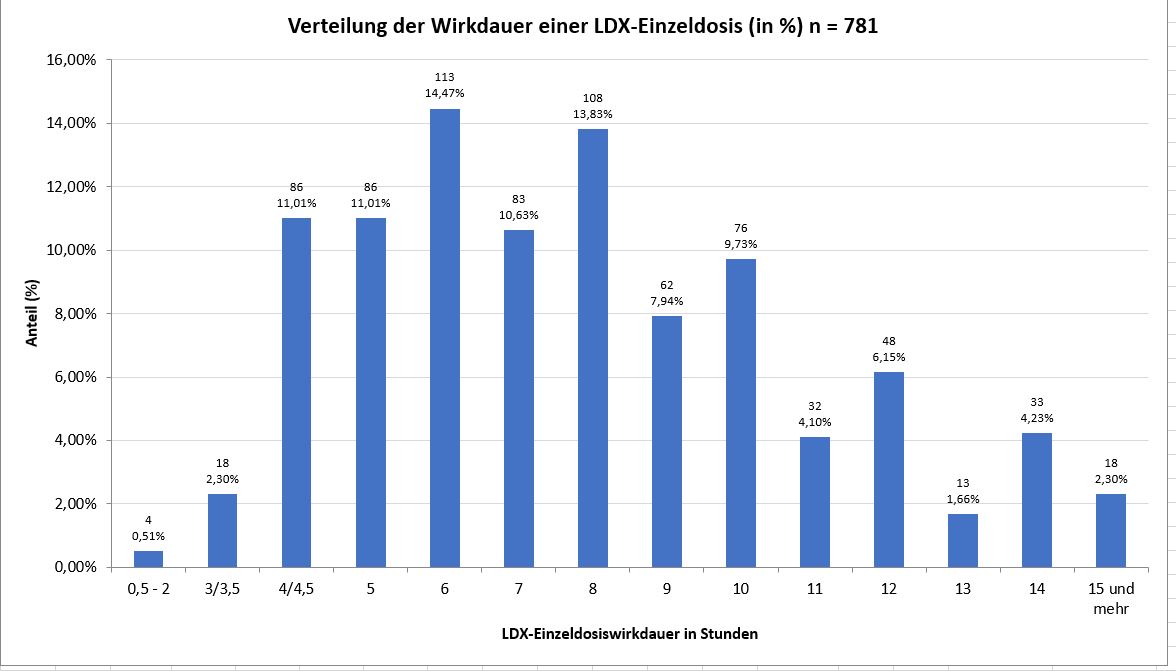 Online survey by ADxS.org on the self-reported duration of action of a single dose of lisdexamfetamine, as of May 3, 2026, 781 participants.
*“The administration of intermittent bolus doses of a drug with a narrow therapeutic range exposes patients to toxic and ineffective levels during the peak and trough phases, respectively.”
Increasing the frequency of intermittent administration while simultaneously reducing the dose may help reduce fluctuations and make administration more similar to an infusion; however, this is likely to be associated with poorer patient compliance with taking the medication.“* (E 4)198
Especially with stimulants, unnecessarily high doses should be avoided whenever possible.
Empirical evidence shows that a significant proportion of people with ADHD cope much better with multiple, lower individual doses of LDX (often in a descending sequence, e.g., 20-10-0 or 25-10-5) than with a single, higher dose. It is very regrettable that this form of treatment is off-label for LDX, as we believe this leads to unnecessary spikes in dosage.
2.2.4.2.3. The duration of action of a single dose may be significantly shorter or longer
Implications for People with ADHD
The manufacturers’ information regarding duration of action applies to people with an average metabolism. Many people with ADHD fall outside this range.
Typically, about 15 to 20% of people with ADHD metabolize the active ingredient so quickly that a single dose lasts only about half as long as indicated. According to our surveys, about half of the people with ADHD report that the drug’s effects last significantly less than 12 hours.
The opposite scenario—where the effect lasts longer than indicated and accumulates over the course of several days, resulting in symptoms similar to those of an overdose—is much less common.
Neither of these is a sign that the medication isn’t working. It just means that the number of daily doses needs to be adjusted.
2.2.4.2.4. Manufacturer’s Specifications
(E 4): Manufacturer’s specifications regarding duration of action (rarely achieved in practice) (E 4)41 (E 4)42
-
Immediate-release MPH is effective for 2.5–3.5 hours per single dose
-
4 to 5 single doses are required for daily coverage
-
barely feasible in the long run, especially for children
-
For dosing, immediate-release MPH is still preferable because it allows for the most precise control
-
-
Half-day-release MPH is effective for an average of 4.5 to 6 hours per single dose
-
2 doses + immediate-release MPH, if necessary, to cover the remainder (E 4)187
-
The second dose is usually 50% to 75% of the first dose
-
-
Sustained-release MPH taken once daily is effective for an average of 10 to 12 hours
-
Attentin (immediate release AMP) is effective for an average of 4.5 hours per single dose. (E 4)49
-
2 doses and, if necessary, immediate-release MPH to cover the remainder
-
The second dose is usually 50% to 75% of the first dose
-
-
Lisdexamfetamine (Vyvanse) lasts for up to about 10–12 hours (Note: In practice, the duration is much shorter in more than 50% of people with ADHD!)
-
Amphetamine medications take 3 to 5 days to reach steady state
-
1 dose and, if necessary, immediate-release MPH to cover the remainder
-
For people with a fast metabolism (more than 50%—a second dose may be necessary)
-
For people with a very fast metabolism, a third or fourth dose should also be considered
-
-
Guanfacine
- Mirror medication, once a day
-
Atomoxetine
- Mirror medication, once a day
2.2.4.2.5. Prolonged effect (rather rare)
(ADxS experience): It is quite rare for us to encounter people with ADHD who experience a significantly longer duration of effect from a single dose of an ADHD medication than indicated by the manufacturer.
This is sometimes evident in the adequate effect of a given dose on the first day and, in some cases, even on the second day of administration. On subsequent days, symptoms of overdose occur even with the same dosage. When amphetamine-based medications are involved, the steady state should also be taken into account in this context due to their relatively long half-life.
2.2.4.2.6. Shortened duration of effect (quite common)
(ADxS experience): In contrast, it is more common for people with ADHD to experience a single dose that lasts significantly shorter than the manufacturer specifies.
In our experience, about 15 to 20 percent of the people with ADHD are pronounced fast metabolizers, for whom a single dose lasts only about half as long as indicated by the manufacturer. A moderately shortened duration of action is significantly more common.
-
People with fast metabolisms often need several doses a day instead of higher single doses
-
According to our survey data, about half of the people with ADHD report that the duration of action—particularly for lisdexamfetamine—is significantly shorter than the manufacturer’s stated duration
-
typically ultra-rapid metabolizers (e.g., acidic pH or a rapid-metabolizing CYP or CES1 gene variant)
-
Multiple doses per day, including of extended-release formulations intended for once-daily use
-
Combination therapy for fine-tuning / in difficult cases
- For more information, see Combination Therapy for ADHD
-
in particular:
-
50% ATX for full-day treatment of emotional dysregulation
-
50% MPH or AMP, as they generally have a better effect on motivation and concentration
-
-
Rebound treatment
-
Rebound is particularly common with MPH
-
Solution:
-
Take the second dose in time so that its effects begin before the first dose wears off during the rebound phase
-
immediate release MPH shortly before the end of the last dose
-
1/4 to 1/3 of what would be equivalent to a single daily treatment dose
-
Example: 20 mg of semi-daily-release MPH is equivalent to 2 x 10 mg of immediate release MPH. In this case, take 2.5 to 3.5 mg of immediate release MPH 30 minutes before the last sustained-release dose wears off.
-
-
The phenomenon of a shortened duration of action per single dose is significantly more common with Vyvanse than with MPH:
-
Unlike with MPH, a significantly higher number of people with ADHD taking Vyvanse reported a significantly shorter duration of action than the 12 to 14 hours specified by the manufacturer. Many of them were able to achieve optimal daily coverage by taking several single doses. For more on this, see Amphetamine-Based Medications for ADHD: Effect Profile (Over Time) / Duration of Action
-
Some people with ADHD report that intense sports can shorten the duration of action of stimulants by up to 40%. (ADxS experience)199
- For more information, see Physical Activity / Sports in the article “ : Efficacy and Duration of Action of ADHD Medications”
-
In an individual, higher doses of amphetamine have a longer-lasting effect (E 4)8
-
Since amphetamine is primarily excreted by the kidneys, the duration of action is influenced not only by the total dose but also by kidney function and, above all, by the pH of the urine
-
Another consequence of this is that blood levels of amphetamine change more slowly and are less prone to rebound than with methylphenidate
-
2.2.4.2.7. Information on the duration of action of the prescribed doses
When administering a single dose, people with ADHD must be explicitly informed of the typical duration of action of a single dose of the respective medication. This is not only ethically required, but also medically and therapeutically necessary.
We repeatedly receive reports from people with ADHD who were led to believe that a single dose of immediate release or half-day extended-release MPH (e.g., Ritalin Adult) would last all day, rather than informing them of the usual duration of action of 2.5 to 3 hours (immediate release) or 5 to 6 hours (half-day extended-release). This naturally leads to inaccurate feedback to the doctor when patients report that their symptoms remain unchanged, because—unaware of the limited duration of action—they mistakenly describe periods in the afternoon or evening when the medication is no longer effective.
2.2.5. Dosage Adjustments
Implications for People with ADHD
If an effect that was initially very positive seems to wear off after a few weeks, it’s usually not because of the medication. You get used to feeling better and no longer perceive it as an improvement. Checking your dosing log can help in this situation.
The goal of treatment is not to eliminate all symptoms. Even people without ADHD exhibit some of these symptoms.
A study conducted over 14 months examined how well the initial dose predicts the subsequent maintenance dose. The study began with a placebo-controlled, double-blind titration involving daily dose adjustments. The results were compared with the subsequent maintenance therapy. The dose determined during the titration did not remain constant; adjustments were necessary over time. Once an optimal dose has been found, it is therefore not a permanent value but must be reviewed regularly.200Of 230 children for whom an optimal dose was determined, only 39 (17%) remained on the same treatment and dose throughout the maintenance phase, which lasted an average of 11.8 months. For 186 (81%), at least one change occurred; 20 of these returned to the original regimen by the end, so that ultimately 59 children (25%) were back on the titration dose. On average, 2.8 adjustments per child were necessary, with the first occurring after 4.7 months. The correlation between the titration dose and the final dose ranged from 0.52 to 0.68. Children receiving additional behavioral therapy required only 31.1 mg, compared to 38.1 mg for those on medication alone. Under the titration protocol used, a change of up to 10 mg from the current dose was permitted. Each change was typically tested for one month. Further increases required the approval of an expert committee. A dose reduction was permitted only in cases of moderate to severe side effects; a scheduled reduction for evaluation purposes was not provided for.
A comparison of the MTA treatment arms showed that the quality of treatment is influenced by the dose level. The mean daily dose of MPH was significantly lower among children in standard care (18.7 mg/day) than among those treated by study physicians (32.8 mg/day). The latter group had better outcomes. A systematic review concluded that the apparent ineffectiveness of stimulants may be due to overly cautious titration or simply to underdosing. This underdosing can occur at the start of treatment or months to years later, when a previously effective regimen loses its efficacy, e.g., because the child has grown. Within the first six months of treatment, mild tolerance may develop, requiring a one-time dose increase of 20 to 30%. Predictable side effects such as loss of appetite and insomnia can be minimized by starting with a low dose and increasing it gradually. Unusual side effects that cannot be attributed to the properties of the active ingredient generally necessitate discontinuation of treatment. The authors include tics and mood changes among these.66
The goal is for the symptoms to no longer cause significant impairment.
The perception that a very positive effect subsides a few days or weeks after the initial adjustment is often not due to a change in the drug’s effect, but rather to a change in the perception of the people with ADHD. During the so-called “honeymoon phase” immediately after reaching an effective dose, the contrast with the previous state of deficiency is perceived as a particularly positive experience. Such a feeling of significant improvement is, by its very nature, fleeting—just as the euphoria a soccer fan feels after winning a championship returns to normal within days, even though they’ve been on the edge of their seat all season. In such cases, it’s important to carefully assess whether a higher dose is truly necessary. External assessments can be helpful in this regard.
-
It is possible that a one-time readjustment may be necessary after a few months. This is not a “habituation effect” that recurs regularly.
-
A trial withdrawal should be conducted once a year to determine whether ADHD symptoms persist without medication.
-
People with ADHD frequently exhibit 75% of the possible ADHD symptoms, while persons without ADHD exhibit 12 to 25%. The goal of optimal dosing is therefore not complete freedom from symptoms, but rather a reduction of symptoms to a healthy level. Attempting to increase the dosage until all symptoms are completely eliminated would inevitably result in an overdose.
2.2.6. No admissions in the afternoons, on weekends, and during school breaks
Implications for People with ADHD
Since ADHD is not purely a school-related issue—even though it becomes particularly evident in that setting due to extrinsic demands and learning difficulties caused by a lack of neurotrophic factors—continuous medication is strongly recommended. Whether medication should be taken only in the mornings during school hours depends on whether the people with ADHD are still able, while on this medication, to concentrate on their homework and manage their social interactions without emotional dysregulation until early evening without experiencing symptoms.
You should avoid stopping medication on weekends or during school breaks. For one thing, symptoms don’t strictly follow the school schedule, and for another, a longer break in treatment may require gradually reintroducing the medication to avoid side effects.
Due to the 5-day steady state, amphetamine medications should not be skipped on individual days or over the weekend. Doing so would result in the effect being weaker on the first day of resuming the medication than on the last day before the break, even though the dose remains the same. It takes as many days of continuous use to return to the maximum steady-state level as there were days of the break. Whether this can be compensated for by taking a slightly higher dose on the first day of treatment should be discussed with the doctor.
In a 28-day double-blind study, 40 boys with ADHD received either MPH seven days a week or MPH on weekdays and a placebo on weekends. Both groups showed significant improvement in symptoms as the dose was increased. Compared with the seven-day regimen, the five-day regimen with a weekend break resulted in significantly less insomnia (p = 0.05) and, at trend level, a slight reduction in appetite loss (p = 0.08). Parents’ assessment of efficacy over the weekend did not deteriorate significantly, and teachers’ assessment of ADHD symptoms on the Monday following the weekend was not elevated. The authors explicitly note that this contradicts the widespread assumption that even a single placebo day leads to a return of symptoms. (Results and Discussion)201
A review of 22 studies from 1972 to 2013 notes that medication breaks occur in 25 to 70 percent of families, predominantly during school vacations. A beneficial effect of longer breaks on growth was observed. Shorter breaks were found to reduce sleep disturbances and improve appetite. In practice, these breaks served three purposes: to assess whether the medication was still necessary, to reduce side effects, and to counteract tolerance. Ibrahim K, Donyai P (2015): Drug Holidays From ADHD Medication: International Experience Over the Past Four Decades. J Atten Disord. 2015;19(7):551-568. doi: 10.1177/1087054714548035202
(ADxS Assessment): Since ADHD is not a disorder that is limited to the morning school hours, we would be more inclined to consider slightly reducing the dosage during periods of lower demands (to 2/3 or 3/4). This depends heavily on the individual needs of the people with ADHD. All dosage changes must be coordinated with the doctor. However, an experienced doctor will grant a trusted patient considerable leeway.
2.2.7. Intake Based on Need
Implications for People with ADHD
During the dosing period, it is important to follow the prescribed regimen exactly. Making changes to the dose or timing on your own renders the monitoring useless, and the dosing process must start over from the beginning.
Only once a person is properly stabilized can a needs-based regimen be appropriate for adults. For children, a fixed schedule is generally the safer option.
The greater a person with ADHD’s ability to self-regulate, the more likely they are to take stimulants as needed. While a rigid dosing schedule is generally the safer approach for children, adults—once the initial titration is complete—are more likely to decide on a day-to-day basis whether and at what dose to take their prescribed stimulants (within the dosing range agreed upon with their doctor). Some people with ADHD are able to manage this well when specific tasks (e.g., evening events) require an additional evening dose or a single dose on an otherwise medication-free (because it is a low-demand) weekend day (such as shopping on Saturday afternoon or while on vacation). The guiding principle is: “I manage my ADHD; my ADHD does not manage me.” (E 4)112
(ADxS experience): During the titration phase, adults must not deviate from the prescribed regimen. We repeatedly observe that the impulsivity and impatience of people with ADHD lead them to change the dose or the timing of administration within 2 or 3 days. However, this is primarily a symptom of the disorder. Stimulants require several days at a consistent dose to enable a stable sense of self.
For women, the days leading up to menstruation are often associated with an increased need for stimulants. For more information, see the section below at Cycle-Related Symptom Fluctuations in Women.
2.2.8. Metabolism of Drugs and Active Ingredients
Implications for People with ADHD
(ADxS Assessment): If a medication isn’t effective or is poorly tolerated, that’s no reason to give up. Surprisingly many people with ADHD tolerate another medication containing the same active ingredient much better. It’s impossible to predict in advance which one that will be.
That is why the order of priority is: try a different medication first, then switch the active ingredient.
About 30% do not respond to methylphenidate, and about 20% do not respond to amphetamine-based medications. Only a small minority is affected by both, so the vast majority of people with ADHD respond to one of the two active ingredients.
Switching between methylphenidate and amphetamine-based medications does not require a break from medication.
(ADxS assessment): A suboptimal response to medication may require a change in medication
For example:
-
Non-responding / Partially responding
-
Switch between medications within the same class of active ingredients
-
Change the active ingredient group
-
Combining medications ⇒ Medication Combinations for ADHD
-
-
Side effects that prevent the patient from taking the required dose
-
Most side effects occur (only) during the initial dosing phase (the first few weeks)
-
The slower the dose escalation, the fewer side effects are expected
-
Change the active ingredient
-
-
Combine medications if necessary ⇒ Medication Combinations for ADHD
* E.g., in cases of reduced emotionality (a sign of hypersensitivity or an overdose of MPH/AMP—in which case a 50/50 mix of ATX and MPH or AMP is often better).
-
Comorbidities
A change in medication or active ingredient may be necessary or helpful due to adverse side effects or lack of response (no effect).
If a medication does not produce the desired effect (non-response), the first step—especially with MPH—should be to switch to a different MPH formulation. Surprisingly often, people with ADHD react negatively to one MPH medication or experience severe side effects from it, yet respond positively to another MPH medication, while others may experience the exact opposite. A nationwide Korean study of 132,017 people with ADHD who were receiving medication found that 85% switched between different MPH formulations during the course of treatment. (E 3)203
If an active ingredient shows no effect overall (regardless of the formulation) (non-responsive), another active ingredient should be tried first.
(E 1a): About 40% of all people with ADHD do not respond to MPH, and about 30% do not respond to AMP (nonresponders). 87% of people with ADHD responded to one of the two types of active ingredients. (E 4)204 A meta-analysis of 32 studies reached the same conclusion (significantly better response rates to amphetamine medications than to MPH). (E 1a)205
Switching between classes of active ingredients is also worthwhile if the first active ingredient was effective but not sufficiently so. In two randomized, double-blind, placebo-controlled comparative studies in adolescents, lisdexamfetamine and sustained-release methylphenidate were directly compared. Both were superior to placebo but differed in response rates and side effect profiles.206
However, nonresponse rarely involves both active ingredients at the same time, so that approximately 85% to 90% of people with ADHD respond to either MPH or AMP. Approximately 40% of people with ADHD who do not respond to MPH respond to atomoxetine. (E 4)36
Response rates vary widely among the different classes of active ingredients. In a six-week, placebo-controlled comparative study involving children and adolescents, OROS methylphenidate achieved a response rate of 56%, atomoxetine 45%, and placebo 24%. In the subsequent blinded crossover phase, one-third of the people with ADHD responded to only one of the two medications. A lack of response to one active ingredient therefore says little about the other, making the switch a viable treatment option in its own right rather than a stopgap measure.207
In the six most informative crossover studies, involving a total of 174 people with ADHD, 48 responded better to amphetamine, 27 to methylphenidate, and at least 72 to both—resulting in an overall response rate of at least 87% when both active ingredients are tested. The authors conclude that people with ADHD for whom one stimulant fails should try the other. Pharmacologically, this is because methylphenidate is a pure reuptake inhibitor, whereas amphetamine additionally releases catecholamines.208 Excluding the two studies from a full-day behavioral therapy summer program, which normalized the baseline values, the rate was 92%. Due to the evaluation methods used in some studies, double responders went undetected; the 87% figure is therefore a lower bound. No crossover study showed consistency in response at the individual level. In every study, there were participants who responded to one treatment but not the other, in both directions.
In a study of 49 previously untreated adults, 41% had to switch from the initially prescribed class of medication to another within 90 days due to poor tolerability. Methylphenidate was the initial prescription for 67% of the participants, while 33% were initially prescribed an amphetamine-based medication. The switch rate was significantly higher among those initially prescribed methylphenidate. Among those on amphetamine, however, changes in formulation or additional medication were more frequently necessary. More patients on amphetamine remained within the same class of medication but required a different dosage form or additional anxiolytic or antidepressant treatment. No characteristics were identified that could predict who would need to switch.209
When switching between methylphenidate and amphetamine-based medications, no medication-free interval is required due to their short half-lives. Similarly, no adverse effects have been reported when switching promptly to ADHD medications such as guanfacine or atomoxetine. When switching from MAO inhibitors to stimulants or atomoxetine, or from stimulants or atomoxetine to an MAO inhibitor, a 14-day waiting period must be observed—and, of course, concurrent use is not permitted.
It has been reported that the optimal dose of stimulants—which is often highly individualized—may vary between MPH and AMP. A person with ADHD may require a relatively high dose of MPH or a relatively low dose of AMP to achieve an adequate effect. Therefore, when switching active ingredients, a new individual titration is necessary. (E 4)112 Consequently, the standard conversion tables should be viewed with caution when switching active ingredients.
2.2.8.1. Non-responders: Drug Metabolism
-
MPH: 30% non-responders
-
If MPH is ineffective:
-
Check stomach acid levels
-
Change the active ingredient
-
-
-
AMP: 20% non-responders
-
If AMP is ineffective:
- Check the pH level of the urine at the time of ingestion
-
For more than 40% of people with ADHD who do not respond to treatment, switching medications within the first 3 months is helpful. (E 2b)210
(E 4): When MPH and AMP are substituted due to non-response, only about 10% (E 4)49 to 15% remain who are non-responders to both types of stimulants.(E 4)41 (E 4)42 This is, after all, 1.6 to 2.5 times the rate of purely random double non-responsiveness (30% × 20% = 6%), which suggests that there are indeed common factors influencing responsiveness, even if they are few in number.
REVIEW of Treatment Options for Treatment-Resistant ADHD: Cortese et al. (E 4)211
-
Optimize stimulants
-
Try alternative monotherapies
-
Try non-stimulants
-
combination drug therapy
- A combination of stimulants and non-stimulants is superior to monotherapy with only one class of active ingredients
-
Use off-label medications that have been shown to help with ADHD
-
Treat comorbid conditions
2.2.8.2. Side Effects: Drug-Drug or Drug-Active Ingredient Interactions
To avoid side effects, see the section below titled “Avoiding Side Effects.”
-
MPH
-
in the event of severe side effects:
-
Check: Have the recommendations under “Avoiding Side Effects” been followed, particularly regarding the complete elimination of caffeine?
-
Overdose?
-
Do you need a very low dosage?
-
when MPH generally responds:
-
Change the product first
-
surprisingly varied side effects
- Person A cannot tolerate medication A but tolerates B just fine; Person B is exactly the opposite: it’s unpredictable
-
Alternative products, e.g.:
-
immediate release
-
Medikinet Retard / Adult
-
Ritalin LA / Adult
-
Concerta
-
Kinecteen
-
-
-
then switch to a different active ingredient
- For recommended order of use, see above under “Medication Selection”
-
-
-
-
AMP
-
in case of severe side effects:
-
Check: Have the recommendations under “Avoiding Side Effects” been followed, especially regarding the complete elimination of caffeine?
-
Overdose?
-
Do you need a very low dosage?
-
when AMP responds in general:
-
Change the product first
-
surprisingly varied side effects
- Person A cannot tolerate medication A but tolerates B just fine; Person B is exactly the opposite: it’s unpredictable
-
Alternative products, e.g.:
-
Lisdexamfetamine (Vyvanse)
-
immediate release (Attentin)
-
Amphetamine solution (to be prepared by a pharmacy)
-
United States: a large number of additional approved drugs
-
-
-
then switch to a different active ingredient
- For recommended order of use, see above under “Medication Selection”
-
-
-
2.2.8.3. Conversion Tables for Switching Between Stimulants
In addition to medication changes due to non-response, supply issues are another reason to consider dosage conversions. Since October 2022, mixed amphetamine salts have been on the FDA’s shortage list in the U.S., and since July 2023, lisdexamfetamine and methylphenidate have also been added to the list. In the United Kingdom, a shortage of sustained-release methylphenidate, lisdexamfetamine, and sustained-release guanfacine was reported in September 2023.
A conversion table from dexamfetamine to Vyvanse can be found on ADHSpedia. (E 4)212
When switching medications or active ingredients due to side effects, the conversion table by Kühle is very helpful (in German). It provides a guide to which dose of a different type of stimulant corresponds to the dose of the previously taken medication. The UpToDate conversion table (in English) is also helpful.(E 4)213
A comprehensive conversion table for American stimulant preparations, including recommendations for the transition process, can be found in Stutzman et al. (E 4)47
According to the prescribing information, a fixed ratio of 2 to 1 applies when switching between racemic methylphenidate and dexmethylphenidate. The daily dose of dexmethylphenidate is half the previous daily dose of methylphenidate, because only the d-enantiomer is active. A 1-to-1 conversion will result in underdosing. For immediate release dexmethylphenidate, treatment begins with 2.5 mg once or twice daily and is increased by 2.5 to 5 mg weekly. The maximum daily dose is 20 mg. In contrast, a 1:1 switch is expressly prohibited for Onyda XR, DR/ER-MPH, and sustained-release clonidine; these formulations must be retitrated.214
A 2026 review article presents a systematic framework, including a dose equivalence table and conversion formulas. The principles outlined in the article are as follows:215
- Start by switching within the same class of active ingredients
- Switching between methylphenidate formulations helps maintain symptom control
- The isomer composition must be taken into account, as dexmethylphenidate is approximately twice as potent as racemic methylphenidate and requires a 50 percent reduction in dose when switching.
- Release mechanisms must be taken into account, as OROS technology and bead-based systems differ significantly.
- Only after alternatives within the same class have been exhausted should switching between amphetamine and methylphenidate be considered.
An analysis of posts from an online forum between August 2021 and February 2024 found that supply shortages can impose significant cognitive, emotional, and functional impairments on people with ADHD, difficulties accessing care due to confusing healthcare systems, financial strain, and a lack of information about the causes. Among the coping strategies mentioned were:216
- Changing the dose or medication on your own
- Skipping doses
- Storing medications
- Turning to caffeine and nicotine
This is significant for dosing in that supply shortages can lead to uncontrolled changes in dosage, which may subsequently be misinterpreted as fluctuations in efficacy or tolerance.
2.2.9. Development of Tolerance to Stimulants / Habituation Effects
For more details, see ⇒ Medications: Development of Tolerance
2.2.10. Withdrawal from Stimulants
Implications for People with ADHD
Stimulants can generally be discontinued at any time. A tapering-off period is usually not necessary, as they take effect immediately and are metabolized quickly.
In some cases, people with ADHD report feeling tired or listless for a few days after stopping amphetamine-based medications. The situation is different with guanfacine and antidepressants: These must be tapered off gradually.
(ADxS experience): Stimulants such as methylphenidate or amphetamine-based medications have an immediate effect that is dose-dependent. As a general rule, they can be discontinued immediately and without side effects. Compared to the—sometimes very severe—side effects that people with ADHD repeatedly report from discontinuing antidepressants—especially when done too quickly (for context: Dreher (2026) (E 4)9), it can generally be said that stimulants do not pose any withdrawal issues. However, people with ADHD then suffer from the recurrence of ADHD symptoms, which can subjectively be misinterpreted as a withdrawal side effect.
(ADxS experience): However, there are reports from affected individuals of withdrawal symptoms associated with amphetamine medications; in isolated cases, these have even lasted up to 14 days. For a minority of people with ADHD, these symptoms appear to go beyond the unpleasant experience of the recurrence of ADHD symptoms. It is not known whether this is related to a previous overdose. It is noteworthy that these reports originate primarily from the United States. In one individual case known to us, withdrawal symptoms were reported upon discontinuation of a 10-fold overdose of Vyvanse (50 mg, while the patient required only 5 mg).
If necessary, withdrawal symptoms upon discontinuation should be managed by gradually reducing the dose.
A systematic review of 35 studies on the planned discontinuation of stimulants in children and adolescents found no significant problems with discontinuation. Two specific findings emerged: 217
- There was a distinct group of people with ADHD who, upon discontinuation, experienced neither a relapse nor a worsening of their condition, which justified regular attempts to discontinue treatment to assess whether treatment was still necessary.
- Caution is advised when administering antipsychotics (risperidone, aripiprazole) concomitantly. In several case reports, dystonia occurred within 33 hours to 10 days after abrupt discontinuation of the stimulant. In this scenario, a gradual tapering-off under close observation for movement disorders is recommended.
- Four studies describe seven children with acute dystonia following discontinuation of a stimulant (MPH, such as AMP, in combination with risperidone or aripiprazole). In five cases, it occurred within 33 hours; in two cases, within ten days.
- With the stimulant, the increased dopamine levels that counteract dopamine blockade are no longer present, which enhances the antipsychotic’s binding in the striatum.
- The disorders resolved while the patient was taking anticholinergic medications or after the medication was resumed.
- Conversely, withdrawal dyskinesias may occur when the antipsychotic is discontinued while stimulant treatment is ongoing; this has been described in three case reports following both sudden and gradual discontinuation. In some cases, they persist for several weeks after the stimulant has been discontinued. It is recommended to taper off the antipsychotic over a period of weeks and to discontinue the stimulant immediately as soon as involuntary movements occur.
- Another case report involves a 13-year-old girl who experienced painful calf cramps after discontinuing immediate release methylphenidate for the summer break.
2.2.11. Medication Adherence
Implications for People with ADHD
(ADxS assessment): A large proportion of people with ADHD stop taking their medications sooner than is medically advisable. The most common reason is side effects.
If you are dissatisfied with your medication, you should discuss this with your doctor first before stopping it. Very often, the problem can be resolved by changing the dose, switching to a different medication, adjusting the time of day you take it, or modifying your eating habits around the time you take it.
Although ADHD medications do not cure the condition, most people with ADHD do not take medication for the rest of their lives or take breaks from medication lasting more than 12 months.
This may indicate fluctuating ADHD. For more information, see Fluctuating ADHD in the article “ : ADHD in Adults”.
In the largest study on medication adherence, which included 1,229,972 new patients from 9 countries between 2010 and 2020, 65% of children, 47% of adolescents, 39% of young adults, and 48% of adults were still taking their medication one year after treatment began. After five years, the figures were 24% of children, 9% of adolescents, 10% of young adults, and 15% of adults. Including cases where treatment was resumed after interruptions, 30 to 60% remained in treatment for five years. Treatment continuity among adolescents and young adults was lower than would have been expected given the known persistence of symptoms in these age groups.218
Among n = 43,825 children and adolescents aged 6 to 18, only 43% took the medication consistently. The strongest influencing factor was age at the start of treatment. Those who started between the ages of 6 and 12 were more than four times as likely to continue taking it as those who started between the ages of 17 and 18 (OR 4.29; 95% CI 3.93–4.69). The longer the interval between diagnosis and the start of medication, the lower the adherence (OR 0.80 per year). As a first-line medication, lisdexamfetamine was associated with the highest adherence (OR 2.2; 95% CI 1.86–2.59) and was the only active ingredient to show consistent adherence rates across all age groups. However, the sample size was small (n = 654). Male gender (OR 1.47) and lower socioeconomic status were also associated with higher medication adherence.219 The study measured continued prescription filling, not treatment success.
A systematic review of k = 91 original studies showed that part of the apparent lower adherence to immediate release stimulants compared with sustained release stimulants is attributable to the titration process itself. Immediate release formulations are often used for the initial titration and are subsequently switched to sustained release formulations as scheduled. For studies that rely on medication databases, this routine switch in formulations appears to be a discontinuation.220
The reported continuation rates ranged from 0.1% to 89.9%, depending on the permitted gap between prescriptions and the observation period. Most studies found adherence rates below 80%, which is generally considered low for ADHD treatment. Long-acting medications consistently had a higher continuation rate than short-acting stimulants. Adherence rates for ADHD are comparable to those for schizophrenia, bipolar disorder, dyslipidemia, diabetes, and hypertension; thus, the problem is not specific to ADHD. Side effects were consistently the most common reason for discontinuation, regardless of the drug class. Careful monitoring of dosage titration—including consideration of tolerability—therefore helps prevent the most common reason for discontinuation (“start low, go slow” avoids unnecessary side effects). Children and adolescents demonstrated higher adherence to non-stimulant medications than to stimulants. Among adults, adherence tended to be higher with amphetamine-based medications than with methylphenidate.
Scientific: Studies on Treatment Duration and Medication Adherence
Of n = 198 children and adolescents between the ages of 6 and 18 (mean age 10.4 years), 66.1% to 75.4% were classified as fully adherent, depending on the time of assessment. Thus, one-quarter to one-third did not take their medication as prescribed. Older age and a lower IQ were correlated with nonadherence. Neither monotherapy nor polypharmacy, nor the distinction between stimulants and non-stimulants, predicted (partial) discontinuation of medication or interrupted use. (E 2b)221
Among Finnish children and adolescents with ADHD, the median duration of medication use (until discontinuation for at least 12 months) was 3.2 years. Boys had a longer duration of treatment than girls, and the younger the participants were, the longer the duration of use. Boys aged 6 to 8 had the longest duration of treatment, with a median of 6.3 years. (E 2b)222
Of n = 7,661 people with ADHD, with an average age of 21.8 years, only 55.4% were prescribed medication. Of the n = 4,011 people with ADHD for whom information on medication adherence was available, the average adherence rate was 56%. 27.5% took their medication on at least 80% of the days over a 2-year period. (E 3)223
2.3. Single dose of immediate release MPH
Implications for People with ADHD
This section describes the process step by step: Start with 2.5 mg, then gradually increase the number of single doses throughout the day, followed by gradually higher single doses—each adjustment made every 4 to 7 days, and always only one change at a time.
Two experiences are particularly valuable. First: After reaching what seems to be the optimal dose, you should increase it by two more increments in consultation with your doctor. This is the only way to recognize what an excessively high dose feels like, ensuring that you have reached the optimal level. Second: Side effects that occur at a low or moderate increment sometimes disappear again at a higher increment.
Immediate-release MPH, on the one hand, allows for better monitoring of symptom improvement; on the other hand, it requires more reliable patient compliance due to the higher number of doses per day. Therefore, a single daily dose of sustained-release medication may be recommended for children, and especially for younger children.
According to the 2018 German S3 guideline, immediate-release MPH may be considered, for example, for the following reasons: (E 4)224
• More precise dose adjustment during the initial titration phase of the medication
• the need for greater flexibility in dosing regimens
Based on our experience, we recommend the following:
-
Start with a single, very low dose (2.5 mg of immediate release MPH) and, for the time being, make a conscious effort not to expect any effects at all.
- Since half-day-release MPH is available in doses starting at 5 mg, a 5-mg dose of sustained-release MPH can be taken instead of two doses of immediate-release MPH (typical duration of action: approx. 5–6 hours)
-
After 4 to 7 days, 2.5 mg of immediate release medication taken twice daily
-
Continue to increase the number of single doses every 4 to 7 days until the entire day is covered.
Immediate-release MPH lasts only 2.5 to 3 hours, 3 to 5 single doses are required for full-day coverage. With only two doses, almost the entire day would go without medication. This could completely distort the assessment by people with ADHD or by third parties, especially if they have not been informed about the limited duration of action (and the expected rebound effect). Above all, however, it would not sufficiently alleviate the symptoms and thus the burden on the person with ADHD.
-
Increase single doses to 5 mg (sustained release to 10 mg per single dose)
- When doing so, increase only a single dose at a time for each dose adjustment, starting with the first dose (e.g., 2.5 / 2.5 / 2.5 to 5 / 2.5 / 2.5 to 5 / 5 / 2.5, etc.)
-
After that, increase the dose by a maximum of 2.5 mg per single dose of immediate release MPH every 4 to 7 days.
We consider dose increments of 5 mg of immediate release MPH per single dose (or 10 mg per single dose of half-day extended-release MPH, as recommended, for example, in the Medikinet prescribing information) to be detrimental.
-
Purpose: Gradually increasing the dose prevents the optimal dose from being skipped.
- In our experience, while not many, a significant proportion of people with ADHD have a very narrow window for optimal dosing—well below 5 mg—such that 2.5 mg less per single dose is insufficient, and 2.5 mg more can already trigger the first signs of an overdose. Similarly: Dreher. (E 4)64 It is likely that cases of intolerance have frequently been assumed in the past when, in reality, they were due to inappropriate dosages.
- (E 1a): Since such small dosing increments do not harm other people with ADHD (but, on the contrary, help prevent dose-related side effects), (E 4)225 dosage adjustments in 2.5-mg increments (based on a single immediate-release dose of MPH) should be the gold standard. Kühle concurs. (E 4)226 A large meta-analysis points in the same direction. (E 1a)102
- Other sources recommend starting with 1–2 single doses of 5 mg and increasing the single dose weekly in 5-mg increments. (E 4)227 For the reasons mentioned, we consider these dose increments to be too large.
- For people with ADHD, for whom even extremely small differences in dosage are critical, a pharmacy in Switzerland offers MPH drops. One drop contains 0.35 mg of MPH. It is manufactured in batches and preserved with E216 and E218.(E 4)228 One person with ADHD reports that dissolving immediate release MPH in alcohol in such precise quantities that they could be measured drop by drop yielded a comparable result. The typical amount of alcohol—20 drops = 1 ml of 50% alcohol—corresponds to 1/40 of 0.2 l of wine or 0.5 l of beer.
-
-
Inform people with ADHD and (informed) third-party observers about
-
the typical duration of action of the respective medication
-
the option of a shorter or longer duration of action, depending on individual needs
-
about the expected rebound
- Knowing the typical duration of action—and that it can vary from person to person—is just as important for monitoring the effect and its end as it is for ensuring that the last dose is taken well in advance of bedtime so that the effect has worn off at least one hour beforehand. For some people with ADHD (we suspect this is more common in ADHD-I than in ADHD-HI), a reduced dose (1/5 to 1/2 of an optimized single dose) in an immediate release form may help with falling asleep. The same principle applies here: Test very low doses (1/10 of the single daily dose) when using the medication as a sleep aid. When doing so, convert sustained-release daily doses to the duration of action of the immediate release form. (Example: 20 mg of a sustained-release formulation with a 5–6-hour duration of action corresponds to 10 mg of an immediate release formulation with a 2.5–3-hour duration of action.)
-
-
Increase the dosage until a very satisfactory effect is achieved.
- At the group level, symptoms decrease linearly as the dose increases—however, this does not apply equally to every child, and the side effects reported by parents also increase linearly with the dose. (E 1b)229
-
When the daily dose of MPH is 20, 40, or 60 mg, a follow-up consultation with the treating physician should take place in each case.
-
It is also recommended that you keep a diary (see below). Some doctors expect you to submit your diary weekly, for example, by email. This can help identify any adverse developments early on.
-
After reaching the supposedly optimal dose, increase it two more times to determine whether any adverse symptoms now appear.
Purpose:
This ensures that not only are symptoms improved, but the optimal dose is also determined. Furthermore, the person with ADHD learns what it feels like when the dosage is slightly too high. This is important so that the person with ADHD can develop a sense of what the optimal dosage is and, if necessary, suggest further dose reductions.
-
It is possible that side effects may occur at certain dosage levels below the optimal dose, which then disappear again at higher dosage levels. In particular, internal tremors (like having one too many cups of coffee) may subside within 2 to 3 days after a dose increase. This may be due to the noradrenergic system adjusting. Several people with ADHD have reported to us that this internal trembling no longer occurred at the next or subsequent dosage level. If it becomes more pronounced or persists, it is a sign of overdose.
-
“Zombie” symptoms often indicate either an overdose or depression that has come to the surface.
- A meta-analysis of studies on mood- and emotion-related side effects in children and adolescents showed that, compared to placebo, MPH increased the risk of irritability, anxiety, and euphoria, but increased the risk of apathy and reduced speech. Amphetamines increased the risk of emotional lability. Relevant factors influencing the risk included dose and dosage form. Particularly high doses of immediate-release MPH in younger children and girls were associated with an increased risk of affective flattening (“zombie mode”), which supports the interpretation of apathy and emotional flattening as dose-dependent phenomena rather than an unavoidable property of the drug.230
-
Stimulants block sensory filters: This is likely one of the reasons why students may “try out” stimulants during stressful exam periods (which we strongly advise against), but then stop taking them on their own initiative afterward. In fact, students who misuse stimulants during exam periods exhibit an above-average number of ADHD symptoms. (E 3)231
-
People (other than people with ADHD) who do not have a stimulus filter that is too open experience a reduced quality of life as a result. We are aware of barely any reports of students who voluntarily take MPH outside of highly stressful exam periods (unless they have severe ADHD symptoms (E 2b)232 )
-
Stimulants inhibit the limbic system. An overdose can therefore diminish emotional sensitivity. (E 4)233
-
The manufacturer’s information regarding the typical duration of action applies only to individuals with standard variants of the metabolism-related genes. However, many people with ADHD have variations in the relevant metabolism gene (MPH: CES1 gene; AMP / atomoxetine / bupropion: CYP2D6 gene; guanfacine: CYP3A4 gene). In addition to CYP 450 enzymes, there are genetic variants of the POR gene that, in turn, influence the efficacy of the CYP enzymes; therefore, the CYP genetic variant alone is not sufficient to draw conclusions. For more information, see CYP2D6 Metabolizing Enzyme, CYP3A4 Metabolizing Enzyme, CES1 Metabolizing Enzyme. In addition, there are other pharmacological factors that influence the duration of action. For more information, see Effects and Duration of Action of ADHD Medications
-
Variations are so common that the typical duration of action cannot be assumed. It must be assessed individually for each person with ADHD.
-
According to our survey, a single dose of Vyvanse lasts for only 5 to 7 hours at most in two-thirds of people with ADHD. The typical duration of 12 hours specified by the manufacturer is therefore far from being achieved by the majority of people with ADHD.
-
In fast metabolizers (approximately 15 to 20 percent of people with ADHD), immediate-release MPH lasts only about 1 to 1.25 hours instead of the usual 2.5 to 3 hours, Medikinet or Ritalin for adults lasts only about 3 hours instead of the usual 5 to 6 hours, and Vyvanse lasts 5 to 7 hours instead of the usual 10 to 12 hours. The rapid metabolizers known to us reported that they tolerated the correspondingly more frequent dosing and higher daily doses well, without any side effects. Nevertheless, given the required increase in the number of doses per day and the resulting potential for exceeding the general maximum dosage recommendations, closer monitoring is certainly necessary.
-
(E 4): Amphetamines are only partially metabolized in the liver (via CYP2D6, among other enzymes). A significant proportion is excreted unchanged via the kidneys. This excretion depends heavily on the pH of the urine: acidic urine (low pH) significantly accelerates excretion, thereby shortening the potency and duration of action, while alkaline urine slows it down. If the effect of amphetamine medications is too weak or too short-lived, measuring the urine pH at the time of administration and, if necessary, adjusting the urine pH through diet (keyword: PRAL value) may be helpful. Conversely, deliberately alkalizing the urine increases the risk of an overdose. It should therefore only be done after consulting a physician. (E 4)234 (E 4)235
-
-
Excessively rapid metabolism may, in some cases, be countered by cross-inhibition with inhibitors of the relevant metabolic enzyme. For example, several people with ADHD for whom LDX (whose active ingredient, dAMP, is also metabolized to a lesser extent via CYP2D6) had a much too short duration of action or no effect at all reported a satisfactory effect and duration of action after combining it with bupropion (which inhibits CYP2D6). Since both substances can lower the seizure threshold, such a combination should only be considered after a physician has weighed the benefits against the risks.
2.4. Transition to sustained-release MPH / AMP
Implications for People with ADHD
Once the appropriate total dose of immediate release methylphenidate has been determined, the patient is usually switched to a sustained-release formulation so that the medication needs to be taken less frequently.
Whether the immediate release or sustained release formulation is more suitable varies from person with ADHD to person with ADHD. In a one-year study, about half of the people with ADHD preferred one formulation, while the other half preferred the other. Important to know: (Only) Medikinet Adult and Medikinet Retard must be taken with a meal; otherwise, the entire dose will be released at once.
(E 3): Once treatment with immediate release MPH has been initiated, the number of daily doses should be reduced by using extended-release formulations, since administering the 4 to 6 daily doses of immediate release MPH that would otherwise be required (E 4)236 is barely possible for children and adolescents to maintain. Medication adherence decreases in proportion to the required frequency of administration. (E 3)237 Since people with ADHD are notoriously disorganized and forgetful, each additional dose presents another opportunity to forget to take the medication. Furthermore, the embarrassment and teasing that adolescents experience when they have to pick up their medication from the school nurse are among the most common reasons for discontinuing medication treatment. (E 4)8 A single daily dose improves compliance. (E 4)238
Immediate release MPH is not approved for adults in Germany and can only be prescribed off-label.
Whether immediate release or sustained-release MPH works better varies from person to person. In a 1-year study, about half of the people with ADHD preferred immediate release MPH, while the other half preferred OROS MPH. (E 2b)239 As a rule, people with ADHD are better able to assess which type of medication they cope with better than the doctor. Therefore, the person with ADHD’s experience should be taken into account.
With sustained-release MPH, pharmacological methods are used to release several doses in succession.
Due to significant individual differences in the duration of action, it is possible (albeit rare) that the first dose is metabolized so quickly that a gap in efficacy occurs before the second dose takes effect. This can be avoided by taking several (possibly reduced) doses at staggered intervals. For example, if 20 mg of sustained-release MPH has an action profile of 2 hours of effect + a 30-minute gap in effect + 2 hours of effect, one option would be to administer two 10-mg sustained-release doses 30 minutes apart.
For people who have difficulty eating in the morning, Medikinet Adult and Medikinet Retard are not suitable, as these medications only provide their sustained release effect when taken with food. In such cases, Ritalin Adult, Ritalin LA, or an OROS formulation such as Concerta should be considered.
2.5. AMP Dosage
Implications for People with ADHD
(ADxS recommendation): The same basic principle applies to amphetamine medications as to methylphenidate: start small and increase the dose gradually.
One drug that stands out is lisdexamfetamine (Vyvanse). It is converted into the active ingredient only after it enters the body, and it takes up to five days for steady-state levels to be established. Therefore, the increments should be on the longer side. The starting dose of 30 mg recommended by the manufacturer is too high for many people with ADHD.
In addition to the general information provided above regarding the dosing of stimulants and determining the appropriate starting dose, the following applies:
2.5.2. Lisdexamfetamine (Vyvanse, Tyvanse)
The manufacturer-recommended starting dose of 30 mg for lisdexamfetamine was not determined in clinical trials. The manufacturer has not conducted any studies using starting doses lower than 30 mg. The establishment of the 30-mg starting dose is therefore based solely on regulatory considerations. It is not supported by any pharmacological studies.
-
Since amphetamine-based medications are the first choice of medication for adults (offering the greatest effect size and fewest side effects among all ADHD medications), it would make sense to start treatment directly with these medications.
-
Vyvanse/Tyvanse/Tyvanse contains lisdexamfetamine dimesylate. Lisdexamfetamine dimesylate is dextroamphetamine base bound to lysine. The lysine bond results in a slower and more steady release of dextroamphetamine into the bloodstream, thereby providing a longer-lasting effect compared to dextroamphetamine sulfate medications.
The following are available in the U.S.:
Capsules: 10, 20, 30, 40, 50, 60, 70 mg
Chewable tablets: 10, 20, 30, 40, 50, 60 mg
-
In our experience, the 30 mg dose recommended as the standard initial dose carries a significant risk of overdose and increases the risk of side effects associated with the initial dose.
-
We know of quite a few adults with ADHD for whom the optimal dosage range for Vyvanse falls below a margin of 5 mg per single dose. 5 mg less is too little; 5 mg more is an overdose. We also know of individual people with ADHD for whom 3 mg of Vyvanse per day is the optimal dose. Therefore—contrary to the majority opinion—we would consider dosing increments of 5 mg of LDX dimethylate to be more appropriate than the officially recommended 10 mg increments. See also the section above on titration of immediate release MPH.
-
There are also people with ADHD who experience LDX side effects at lower doses, which disappear at higher doses. It is unknown whether these are general side effects associated with the dose—which would have occurred for a limited time even at higher doses—or side effects specific to low doses.
-
Starting with lower doses therefore has both advantages and disadvantages.
-
It requires more persistence when dispensing
-
It reduces the risk of side effects from an overdose
-
It increases the risk of side effects associated with underdosing
-
With sufficient perseverance and persistence, it increases the likelihood of finding the right dose for each individual
-
For people with anxiety, it is often difficult to muster this kind of perseverance and persistence. In such cases, it is recommended to start with the standard initial dose of 30 mg.
-
In any case, the treating physician’s decision is final
-
-
In 2002, the American Academy of Child and Adolescent Psychiatry (AACAP) recommended a starting dose of 2.5 mg of dextroamphetamine or mixed amphetamine salts—in each case, immediate release—administered in 2 to 3 daily doses. (E 4)19
-
-
The maximum daily dose of dextroamphetamine sulfate from lisdexamfetamine recommended by the FDA (28 mg of dextroamphetamine sulfate, derived from 70 mg of lisdexamfetamine) is lower than the maximum recommended daily dose of dextroamphetamine sulfate from immediate release dextroamphetamine preparations (40 mg).
| Lisdexamfetamine dimesylate (capsule, e.g., Vyvanse) | Dextroamphetamine sulfate (tablet, e.g., Attentin) | Dextroamphetamine base (pharmacologically active) | Lisdexamfetamine base (irrelevant) |
|---|---|---|---|
| 10 mg | 2.95 mg | 5.78 mg | |
| 5 mg | 3.67 mg | ||
| 20 mg | 8.04 mg | 5.90 mg | 11.56 mg |
| 10 mg | 7.39 mg | ||
| 30 mg | 12.06 mg | 8.85 mg | 17.34 mg |
| 40 mg | 16.08 mg | 11.80 mg | 23.12 mg |
| 20 mg | 14.68 mg | ||
| 50 mg | 20.10 mg | 14.75 mg | 28.90 mg |
| 60 mg | 24.12 mg | 17.70 mg | 34.68 mg |
| 70 mg | 28.14 mg | 20.65 mg | 40.46 mg |
| 30 mg | 22.01 mg | ||
| 40 mg | 29.35 mg |
Scientific: Conversion between lisdexamfetamine, dextroamphetamine sulfate, and dextroamphetamine base
The conversion ratio of lisdexamfetamine dimexilate (LDX capsules) to pharmacologically active dextroamphetamine base is 0.2948. (E 4)240
The conversion factor for dextroamphetamine sulfate (Attentin tablets) to dextroamphetamine base can be set at 0.7338. (E 4)241
Lisdexamfetamine base is listed for informational purposes only.
-
In a study of 4- to 5-year-old children with ADHD, in which treatment began with a dose of 5 mg of LDX and was increased by 5 mg of LDX each week, 19 out of 24 children reached an optimal dose: (E 2b)242
-
10 mg at 10.5% (2/19)
-
15 mg in 31.6% (6/19)
-
20 mg at 10.5% (2/19)
-
30 mg in 47.4% (9/19)
-
5 out of 24 discontinued treatment
-
The mean daily dose of LDX in Week 8 was 22.9 mg/day (SD 7.25 mg).
-
-
In a subsequent Phase III study involving N = 199 preschool children treated with fixed doses of lisdexamfetamine dimesilate ranging from 5 to 30 mg, there was also no evidence of disadvantages associated with a low dose or advantages associated with a higher dose. Rather, the dose-response relationship was highly individualized. (E 1b)243
-
Although the Vyvanse package insert does not permit dividing the capsule contents, based on many years of experience among a large number of people with ADHD, this is a practical approach for both administering the medication and determining the optimal dose. We are not aware of any reports of fluctuations in efficacy due to uneven distribution of the active ingredient. Precise dosing can be achieved—to within a milligram—by dissolving the capsule contents in water and dividing the solution using a syringe. This is also noted by Kühle in the equivalence table (E 4):45 A somewhat less precise method involves dividing the capsules into equally sized piles using a razor blade on a glass surface.
-
Vyvanse dissolved in water will keep in the refrigerator for a few days. Small mounds of Vyvanse spread out on a dry glass plate will keep at room temperature for several days. You can further extend the shelf life by covering them airtight with food-grade plastic wrap. However, this is generally not necessary. Always keep the product out of the reach of children.
-
Due to its long half-life, Vyvanse can take up to 5 days to reach steady state. (E 2b)105 After a break in taking the medication, unpleasant side effects may occur during the first few days, but these subside quickly.
This video explains how to split Vyvanse capsules into smaller doses (German).
2.5.3. Adderall (immediate release and sustained release)
(E 4): The FDA recommends the following single dose of immediate release amphetamine salts (Adderall) for ADHD: (E 4)244 (E 4)245
-
Children under 3 years of age: Amphetamine is not recommended
-
Children ages 3 to 5:
-
immediate release AMP
-
Starting dose of 2.5 mg once daily in the morning after waking up
-
Subsequent doses at 4- to 6-hour intervals
-
weekly increase in 2.5 mg increments until the optimal response is achieved
-
Dosage range between 2.5 and 40 mg per day, divided into 1 to 3 doses
-
Children ages 6 and older
-
immediate release AMP
-
Initial dose of 5 mg once or twice daily at 4- to 6-hour intervals
-
Weekly increases in 5-mg increments until the optimal response is achieved
-
Dosage range of 5 to 40 mg per day, divided into 1 to 3 doses
-
sustained release AMP
-
Starting dose of 5 to 10 mg once daily in the morning
-
Weekly increases in increments of 5 to 10 mg until the optimal response is achieved
-
Maximum daily dose: 30 mg per day
-
Teens
-
immediate release AMP
-
Initial dose of 5 mg once or twice daily at 4- to 6-hour intervals
-
weekly increase in 5-mg increments until the optimal response is achieved
-
Dosage range between 5 and 40 mg per day, divided into 1 to 3 doses
-
sustained release AMP
-
Starting dose of 10 mg once daily in the morning
-
weekly increase in 10-mg increments until the optimal response is achieved
-
Insufficient evidence of better results at doses higher than 20 mg per day
- Note: This does not correspond to the experiences with Vyvanse in Europe
-
Adults
-
immediate release AMP
-
Initial dose of 5 mg once or twice daily at 4- to 6-hour intervals
-
Weekly increase in 5-mg increments until the optimal response is achieved
-
Dosage range of 5 to 40 mg per day, divided into 1 to 3 doses
-
sustained release AMP
-
Initial dose of 20 mg once daily in the morning
-
Insufficient evidence of better results at doses higher than 20 mg per day
Baykova E, Raya Ò, Lombardía C, Gonzalvo B, Andreu I, Losada D, Falkenhain T, Cunill R, Serrano D, Rigau D, Ramírez-Saco D, López B, Castells X (2025): Assessing TDApp: An AI-based clinical decision support system for ADHD treatment recommendations. Front Psychiatry. 2025 Aug 22;16:1582746. doi: 10.3389/fpsyt.2025.1582746. PMID: 40917247; PMCID: PMC12411474. ↥
Kimko HC, Cross JT, Abernethy DR (1999): Pharmacokinetics and clinical effectiveness of methylphenidate. Clin Pharmacokinet. 1999 Dec;37(6):457-70. doi: 10.2165/00003088-199937060-00002. PMID: 10628897. REVIEW ↥ ↥
Oettinger L Jr, Majovski LV. Methylphenidate: a review. South Med J. 1976 Feb;69(2):161-3. doi: 10.1097/00007611-197602000-00010. PMID: 1251235. REVIEW ↥
Farhat LC, Flores JM, Behling E, Avila-Quintero VJ, Lombroso A, Cortese S, Polanczyk GV, Bloch MH (2022): The effects of stimulant dose and dosing strategy on treatment outcomes in attention-deficit/hyperactivity disorder in children and adolescents: a meta-analysis. Mol Psychiatry. 2022 Mar;27(3):1562-1572. doi: 10.1038/s41380-021-01391-9. PMID: 35027679. METASTUDY ↥ ↥
Boonstra AM, Kooij JJ, Oosterlaan J, Sergeant JA, Buitelaar JK, Van Someren EJ (2007): Hyperactive night and day? Actigraphy studies in adult ADHD: a baseline comparison and the effect of methylphenidate. Sleep. 2007 Apr;30(4):433-42. doi: 10.1093/sleep/30.4.433. PMID: 17520787. ↥ ↥
Farhat LC, Flores JM, Avila-Quintero VJ, Polanczyk GV, Cipriani A, Furukawa TA, Bloch MH, Cortese S (2024): Treatment Outcomes With Licensed and Unlicensed Stimulant Doses for Adults With Attention-Deficit/Hyperactivity Disorder: A Systematic Review and Meta-Analysis. JAMA Psychiatry. 2024 Feb 1;81(2):157-166. doi: 10.1001/jamapsychiatry.2023.3985. PMID: 37878348; PMCID: PMC10600727. ↥ ↥ ↥
Chang Y, Ju PC, Hsieh MH, Liu YC, Chang CC (2026): Dose-response, net clinical benefit and optimal dose ranges of stimulants in children and adolescents with ADHD: a network meta-analysis. Eur Child Adolesc Psychiatry. 2026 Apr 10. doi: 10.1007/s00787-026-03025-3. PMID: 41961095. ↥
Dodson WW (2005): Pharmacotherapy of adult ADHD. J Clin Psychol. 2005 May;61(5):589-606. doi: 10.1002/jclp.20122. PMID: 15723384. REVIEW ↥ ↥ ↥ ↥ ↥ ↥ ↥ ↥
Unterecker S, Hefner G, Baumann P, Gründer G, Bergemann N, Clement HW, Conca A, Deckert J, Domschke K, Eckermann G, Egberts K, Gerlach M, Greiner C, Haen E, Havemann-Reinecke U, Helmer R, Janssen G, Jaquenoud E, Laux G, Messer T, Mössner R, Müller MJ, Paulzen M, Pfuhlmann B, Riederer P, Saria A, Schoppek B, Schoretsanitis G, Schwarz M, Gracia MS, Stegmann B, Steimer W, Stingl JC, Uhr M, Ulrich S, Waschgler R, Zernig G, Zurek G, Hiemke C (2019): Therapeutisches Drug-Monitoring in der Neuropsychopharmakologie : Zusammenfassung der Konsensusleitlinien 2017 der TDM-Arbeitsgruppe der AGNP [Therapeutic drug monitoring in neuropsychopharmacology : Summary of the consensus guidelines 2017 of the TDM task force of the AGNP]. Nervenarzt. 2019 May;90(5):463-471. German. doi: 10.1007/s00115-018-0643-9. Erratum in: Nervenarzt. 2019 Jul 15;: PMID: 30446893. REVIEW ↥
VanderZwaag C, McGee M, McEvoy JP, Freudenreich O, Wilson WH, Cooper TB (1996): Response of patients with treatment-refractory schizophrenia to clozapine within three serum level ranges. Am J Psychiatry. 1996 Dec;153(12):1579-84. doi: 10.1176/ajp.153.12.1579. PMID: 8942454. ↥
Coghill D, Banaschewski T, Cortese S, Asherson P, Brandeis D, Buitelaar J, Daley D, Danckaerts M, Dittmann RW, Doepfner M, Ferrin M, Hollis C, Holtmann M, Paramala S, Sonuga-Barke E, Soutullo C, Steinhausen HC, Van der Oord S, Wong ICK, Zuddas A, Simonoff E (2023): The management of ADHD in children and adolescents: bringing evidence to the clinic: perspective from the European ADHD Guidelines Group (EAGG). Eur Child Adolesc Psychiatry. 2023 Aug;32(8):1337-1361. doi: 10.1007/s00787-021-01871-x. PMID: 34677682; PMCID: PMC8532460. REVIEW ↥
Langfassung der interdisziplinären evidenz- und konsensbasierten (S3) Leitlinie„Aufmerksamkeitsdefizit- / Hyperaktivitätsstörung (ADHS) im Kindes-, Jugend und Erwachsenenalter“, AWMF-Registernummer 028-045 S. 75 ↥
Leitlinie der Arbeitsgemeinschaft ADHS der Kinder- und Jugendärzte e.V., Stand 2009, ADHS bei Kindern und Jugendlichen, Seite 10 ↥
Wolraich ML, Hagan JF Jr, Allan C, Chan E, Davison D, Earls M, Evans SW, Flinn SK, Froehlich T, Frost J, Holbrook JR, Lehmann CU, Lessin HR, Okechukwu K, Pierce KL, Winner JD, Zurhellen W (2019): SUBCOMMITTEE ON CHILDREN AND ADOLESCENTS WITH ATTENTION-DEFICIT/HYPERACTIVE DISORDER. Clinical Practice Guideline for the Diagnosis, Evaluation, and Treatment of Attention-Deficit/Hyperactivity Disorder in Children and Adolescents. Pediatrics. 2019 Oct;144(4):e20192528. doi: 10.1542/peds.2019-2528. Erratum in: Pediatrics. 2020 Mar;145(3): PMID: 31570648; PMCID: PMC7067282. ↥
Pliszka, Greenhill, Crismon, Sedillo, Carlson, Conners, McCracken, Swanson J, Hughes, Llana, Lopez, Toprac (2000): The Texas Children’s Medication Algorithm Projct: Report of the Texas Consensus Conference Panel on Medication Treatment of Childhood Attention-Deficit/Hyperactivity Disorder. Part II: Tactics. Attention-Deficit/Hyperactivity Disorder. J Am Acad Child Adolesc Psychiatry. 2000 Jul;39(7):920-7. doi: 10.1097/00004583-200007000-00022. PMID: 10892235. REVIEW ↥
Olfson M, Marcus S, Wan G (2009): Stimulant dosing for children with ADHD: a medical claims analysis. J Am Acad Child Adolesc Psychiatry. 2009 Jan;48(1):51-9. doi: 10.1097/CHI.0b013e31818b1c8f. PMID: 19218896. ↥ ↥
Greenhill LL, Pliszka S, Dulcan MK, Bernet W, Arnold V, Beitchman J, Benson RS, Bukstein O, Kinlan J, McClellan J, Rue D, Shaw JA, Stock S; American Academy of Child and Adolescent Psychiatry (2002): Practice parameter for the use of stimulant medications in the treatment of children, adolescents, and adults. J Am Acad Child Adolesc Psychiatry. 2002 Feb;41(2 Suppl):26S-49S. doi: 10.1097/00004583-200202001-00003. PMID: 11833633. REVIEW ↥ ↥ ↥ ↥
Pliszka, Crismon, Hughes, Corners, Emslie, Jensen, McCRACKEN, Swanson, Lopez (2006):TEXAS CONSENSUS CONFERENCE PANEL ON PHARMACOTHERAPY OF CHILDHOOD ATTENTION DEFICIT HYPERACTIVITY DISORDER. The Texas Children’s Medication Algorithm Project: revision of the algorithm for pharmacotherapy of attention-deficit/hyperactivity disorder. J Am Acad Child Adolesc Psychiatry. 2006 Jun;45(6):642-657. doi: 10.1097/01.chi.0000215326.51175.eb. PMID: 16721314. ↥
Patel P, Marwaha R, Molla M (2025): Dextroamphetamine-Amphetamine. 2025 Apr 6. In: StatPearls [Internet]. Treasure Island (FL): StatPearls Publishing; 2025 Jan–. PMID: 29939585. ↥ ↥
Michielsen M, Kleef D, Bijlenga D, Zwennes C, Dijkhuizen K, Smulders J, Hazewinkel A, Beekman ATF, Kooij JJS (2021): Response and Side Effects Using Stimulant Medication in Older Adults With ADHD: An Observational Archive Study. J Atten Disord. 2021 Oct;25(12):1712-1719. doi: 10.1177/1087054720925884. PMID: 32508213. ↥
Tadrous M, Shakeri A, Chu C, Watt J, Mamdani MM, Juurlink DN, Gomes T (2021): Assessment of Stimulant Use and Cardiovascular Event Risks Among Older Adults. JAMA Netw Open. 2021 Oct 1;4(10):e2130795. doi: 10.1001/jamanetworkopen.2021.30795. Erratum in: JAMA Netw Open. 2021 Nov 1;4(11):e2138512. doi: 10.1001/jamanetworkopen.2021.38512. PMID: 34694389; PMCID: PMC8546494. ↥ ↥
Verghese C, Patel P, Abdijadid S (2024): Methylphenidate. 2024 Oct 29. In: StatPearls [Internet]. Treasure Island (FL): StatPearls Publishing; 2025 Jan–. PMID: 29494058. ↥ ↥ ↥ ↥ ↥ ↥
Brinkman WB, Epstein JN (2011): Promoting productive interactions between parents and physicians in the treatment of children with attention-deficit/hyperactivity disorder. Expert Rev Neurother. 2011 Apr;11(4):579-88. doi: 10.1586/ern.10.151. PMID: 21469930; PMCID: PMC3146016. ↥ ↥ ↥
Epstein JN, Rabiner D, Johnson DE, Fitzgerald DP, Chrisman A, Erkanli A, Sullivan KK, March JS, Margolis P, Norton EC, Conners CK (2007): Improving attention-deficit/hyperactivity disorder treatment outcomes through use of a collaborative consultation treatment service by community-based pediatricians: a cluster randomized trial. Arch Pediatr Adolesc Med. 2007 Sep;161(9):835-40. doi: 10.1001/archpedi.161.9.835. PMID: 17768282. ↥ ↥ ↥
Xu Y, Chung H, Shu M, Liu Y, Zhang Y, Qiu H (2023): Dose titration of osmotic release oral system methylphenidate in children and adolescents with attention-deficit hyperactivity disorder: a retrospective cohort study. BMC Pediatr. 2023 Jan 23;23(1):38. doi: 10.1186/s12887-023-03850-4. PMID: 36683085; PMCID: PMC9869580. ↥
DAYTRANA (methylphenidate transdermal system). FDA Drug Label, DailyMed sowie FDA Prescribing Information 2017, Abschnitte 2.1 Dosierung und 12.3 Pharmakokinetik. ↥
Cutler AJ, Hanaie J (2025): Understanding the delivery technology used in ADHD stimulant medications can help to individualize treatment. CNS Spectr. 2025 Feb 13;30(1):e30. doi: 10.1017/S1092852925000070 ↥
XELSTRYM (dextroamphetamine transdermal system). FDA Drug Label, DailyMed. ↥
Rushton JL, Fant KE, Clark SJ (2004): Use of practice guidelines in the primary care of children with attention-deficit/hyperactivity disorder. Pediatrics. 2004 Jul;114(1):e23-8. doi: 10.1542/peds.114.1.e23. PMID: 15231969. ↥
QuilliChew ER (methylphenidate hydrochloride) extended-release chewable tablets. Prescribing Information. ↥
Cutler AJ, Hanaie J (2025): Understanding the delivery technology used in ADHD stimulant medications can help to individualize treatment. CNS Spectr. 2025 Feb 13;30(1):e30. doi: 10.1017/S1092852925000070. ↥ ↥
AZSTARYS (serdexmethylphenidate and dexmethylphenidate) capsules. FDA Drug Label, DailyMed. ↥
Schneider, Folmert (2023): Pharmakotherapie und Psychotherapie der ADHS im Erwachsenenalter. Schweizer Zeitschrift für Psychiatrie & Neurologie 01/2023,, deutsch ↥
Banaschewski T, Coghill D, Santosh P, Zuddas A, Asherson P, Buitelaar J, Danckaerts M, Döpfner M, Faraone SV, Rothenberger A, Sergeant J, Steinhausen HC, Sonuga-Barke EJ, Taylor E (2008): Langwirksame Medikamente zur Behandlung der hyperkinetischen Störungen1. Eine systematische Übersicht und europäische Behandlungsleitlinien, Teil 1: Übersicht und Empfehlungen [Long-acting medications for the treatment of hyperkinetic disorders - a systematic review and European treatment guideline. Part 1: overview and recommendations]. Z Kinder Jugendpsychiatr Psychother. 2008 Mar;36(2):81-94; quiz 94-5. German. doi: 10.1024/1422-4917.36.2.81. PMID: 18622938. REVIEW ↥ ↥ ↥ ↥ ↥
Kaalund-Brok K, Houmann TB, Hebsgaard MB, Lauritsen MG, Lundstrøm LH, Grønning H, Darling L, Reinert-Petersen S, Petersen MA, Jepsen JRM, Pagsberg AK, Plessen KJ, Rasmussen HB, Jeppesen P (2021): Outcomes of a 12-week ecologically valid observational study of first treatment with methylphenidate in a representative clinical sample of drug naïve children with ADHD. PLoS One. 2021 Oct 21;16(10):e0253727. doi: 10.1371/journal.pone.0253727. PMCID: PMC8530346. ↥
Houmann TB, Kaalund-Brok K, Clemmensen L, Petersen MA, Plessen KJ, Bilenberg N, Verhulst F, Jeppesen P; INDICES Consortium (2024): Early treatment response as predictor of long-term outcome in a clinical cohort of children with ADHD. Eur Child Adolesc Psychiatry. 2024 Feb;33(2):357-367. doi: 10.1007/s00787-023-02158-z. PMID: 36795232. ↥
Greenhill L, Kollins S, Abikoff H, McCracken J, Riddle M, Swanson J, McGough J, Wigal S, Wigal T, Vitiello B, Skrobala A, Posner K, Ghuman J, Cunningham C, Davies M, Chuang S, Cooper T (2006): Efficacy and safety of immediate-release methylphenidate treatment for preschoolers with ADHD. J Am Acad Child Adolesc Psychiatry. 2006 Nov;45(11):1284-1293. doi: 10.1097/01.chi.0000235077.32661.61. PMID: 17023867. ↥
Childress AC, Kollins SH, Foehl HC, Newcorn JH, Mattingly G, Kupper RJ, Adjei AL (2020): Randomized, Double-Blind, Placebo-Controlled, Flexible-Dose Titration Study of Methylphenidate Hydrochloride Extended-Release Capsules (Aptensio XR) in Preschool Children with Attention-Deficit/Hyperactivity Disorder. J Child Adolesc Psychopharmacol. 2020 Mar;30(2):58-68. doi: 10.1089/cap.2019.0085. PMCID: PMC7047252. ↥
Ryffel (2008): Vortrag beim Rheinfelder Herbstsymposium 6. November 2008 ↥ ↥ ↥ ↥ ↥
Ryffel (2003): Langzeiterfahrungen mit Stimulanzien bei ADHS: Empfehlungen für die Praxis. Forum der Kinder- und Jugendpsychiatrie und Psychotherapie, 13. J. Heft 1, S. 27 - 47, 2003 ↥ ↥ ↥ ↥ ↥
Endrass (2019): Leitfaden zur Diagnostik und Therapie der ADHS im Erwachsenenalter in der neuropsychiatrischen Praxis, 3. Auflage ↥
Warnke, Walitza (2004): Methylphenidat in der Behandlung der Aufmerksamkeits-/Hyperaktivitätsstörung (ADHS), S. 14, 22, in: Schulte-Markwort, Warnke (2004): Methylphenidat. ↥ ↥ ↥
Stutzman DL, Dopheide JA (2024): Practice Pearls for Stimulant Treatment of Attention-Deficit/Hyperactivity Disorder in Youth. J Pediatr Pharmacol Ther. 2024 Jun;29(3):215-231. doi: 10.5863/1551-6776-29.3.215. PMID: 38863854; PMCID: PMC11163912. ↥ ↥
Findling RL, Ginsberg LD, Jain R, Gao J (2009): Effectiveness, safety, and tolerability of lisdexamfetamine dimesylate in children with attention-deficit/hyperactivity disorder: an open-label, dose-optimization study. J Child Adolesc Psychopharmacol. 2009 Dec;19(6):649-62. doi: 10.1089/cap.2008.0165. PMID: 20035583. ↥
Romba C, Singh J (2025): Stimulant Management of Attention-Deficit/Hyperactivity Disorder for the Pediatric Prescriber: A Review of Stimulant-Dosing Strategies and An Overview of New Stimulants. Pediatr Ann. 2025 Jan;54(1):e22-e26. doi: 10.3928/19382359-20241007-06. PMID: 39760345. REVIEW ↥ ↥ ↥
Weisler R, Young J, Mattingly G, Gao J, Squires L, Adler L; 304 Study Group (2009): Long-term safety and effectiveness of lisdexamfetamine dimesylate in adults with attention-deficit/hyperactivity disorder. CNS Spectr. 2009 Oct;14(10):573-585. doi: 10.1017/S1092852900024056. ↥
Geisslinger G, Menzel S, Gudermann T, Hinz B, Ruth P: Mutschler Arzneimittelwirkungen. Pharmakologie – Klinische Pharmakologie – Toxikologie. Begründet von Ernst Mutschler, 11. Auflage. Wissenschaftliche Verlagsgesellschaft, Stuttgart 2020, ISBN 978-3-8047-3663-4. S. 246. ↥
Rösler, Retz (2020): Medikamentöse Therapie der ADHS bei Erwachsenen; Psychiatrie up2date 2020; 14: 59–75 ↥
Cortese S, Panei P, Arcieri R, Germinario EA, Capuano A, Margari L, Chiarotti F, Curatolo P (2015): Safety of Methylphenidate and Atomoxetine in Children with Attention-Deficit/Hyperactivity Disorder (ADHD): Data from the Italian National ADHD Registry. CNS Drugs. 2015;29(10):865-77. doi: 10.1007/s40263-015-0266-7. PMID: 26293742. ↥ ↥
Boesen K, Paludan-Müller AS, Gøtzsche PC, Jørgensen KJ (2022): Extended-release methylphenidate for attention deficit hyperactivity disorder (ADHD) in adults. Cochrane Database Syst Rev. 2022 Feb 24;2(2):CD012857. doi: 10.1002/14651858.CD012857.pub2. PMID: 35201607. COCHRANE METASTUDY, k = 14 ↥
Brennan, Arnsten (2008): Neuronal mechanisms underlying attention deficit hyperactivity disorder: the influence of arousal on prefrontal cortical function. Ann N Y Acad Sci. 2008;1129:236-45. doi: 10.1196/annals.1417.007. REVIEW ↥
Berridge CW, Devilbiss DM, Andrzejewski ME, Arnsten AFT, Kelley AE, Schmeichel B, Hamilton C, Spencer RC (2006): Methylphenidate preferentially increases catecholamine neurotransmission within the prefrontal cortex at low doses that enhance cognitive function. Biol Psychiatry. 2006 Nov 15;60(10):1111-1120. doi: 10.1016/j.biopsych.2006.04.022. ↥
Devilbiss DM, Berridge CW (2008): Cognition-enhancing doses of methylphenidate preferentially increase prefrontal cortex neuronal responsiveness. Biol Psychiatry. 2008 Oct 1;64(7):626-635. doi: 10.1016/j.biopsych.2008.04.037. PMID: 18585681. ↥
Kuczenski R, Segal DS (2002): Exposure of adolescent rats to oral methylphenidate: preferential effects on extracellular norepinephrine and absence of sensitization and cross-sensitization to methamphetamine. J Neurosci. 2002 Aug 15;22(16):7264-71. doi: 10.1523/JNEUROSCI.22-16-07264.2002. PMID: 12177221; PMCID: PMC6757883. ↥
Berridge CW, Devilbiss DM, Andrzejewski ME, Arnsten AF, Kelley AE, Schmeichel B, Hamilton C, Spencer RC (2006): Methylphenidate preferentially increases catecholamine neurotransmission within the prefrontal cortex at low doses that enhance cognitive function. Biol Psychiatry. 2006 Nov 15;60(10):1111-20. doi: 10.1016/j.biopsych.2006.04.022. PMID: 16806100. ↥
Seeman P, Madras BK (1998): Anti-hyperactivity medication: methylphenidate and amphetamine. Mol Psychiatry. 1998 Sep;3(5):386-96. doi: 10.1038/sj.mp.4000421. PMID: 9774771. REVIEW ↥
Krause, Krause (2014): ADHS im Erwachsenenalter: Symptome – Differenzialdiagnose – Therapie, Seite 254, mwN ↥ ↥
Huberman (2023): Adderall, Stimulants & Modafinil for ADHD: Short- & Long-Term Effects | Huberman Lab Podcast, english ↥ ↥
Sprague RL, Sleator EK (1977): Methylphenidate in hyperkinetic children: differences in dose effects on learning and social behavior. Science. 1977 Dec 23;198(4323):1274-6. doi: 10.1126/science.337493. PMID: 337493. n = 20 ↥
Dreher (2019): ADHS im Erwachsenenalter. Anleitung zur Diagnostik und erste Therapieschritte, Seite 31. Download 06.01.2020 ↥ ↥ ↥
http://www.ads-hyperaktivitaet.de/FAQ/Infos/Medis/medis.html#1 ↥ ↥
Stevens JR, Wilens TE, Stern TA (2013): Using Stimulants for Attention-Deficit/Hyperactivity Disorder: Clinical Approaches and Challenges. Prim Care Companion CNS Disord. 2013;15(2):PCC.12f01472. doi: 10.4088/PCC.12f01472. PMID: 23930227. ↥ ↥
Arnsten AF, Dudley AG (2005). Methylphenidate improves prefrontal cortical cognitive function through alpha2 adrenoceptor and dopamine D1 receptor actions: Relevance to therapeutic effects in Attention Deficit Hyperactivity Disorder. Behav Brain Funct. 2005 Apr 22;1(1):2. doi: 10.1186/1744-9081-1-2. PMID: 15916700; PMCID: PMC1143775. ↥
Huss M, Duhan P, Gandhi P, Chen CW, Spannhuth C, Kumar V (2017): Methylphenidate dose optimization for ADHD treatment: review of safety, efficacy, and clinical necessity. Neuropsychiatr Dis Treat. 2017 Jul 4;13:1741-1751. doi: 10.2147/NDT.S130444. PMID: 28740389; PMCID: PMC5505611. REVIEW ↥ ↥ ↥
Chang Y, Ju PC, Hsieh MH, Liu YC, Chang CC (2026): Dose-response, net clinical benefit and optimal dose ranges of stimulants in children and adolescents with ADHD: a network meta-analysis. Eur Child Adolesc Psychiatry. doi: 10.1007/s00787-026-03025-3. METASTUDY; k = 48, N = 4.964 ↥
DYANAVEL XR (amphetamine) extended-release oral suspension and extended-release tablets. FDA Drug Label, DailyMed. ↥
Childress AC, Cutler AJ, Marraffino A, McDonnell MA, Turnbow JM, Brams M, DeSousa NJ, Incledon B, Sallee FR, Wigal SB (2020): A Randomized, Double-Blind, Placebo-Controlled Study of HLD200, a Delayed-Release and Extended-Release Methylphenidate, in Children with Attention-Deficit/Hyperactivity Disorder: An Evaluation of Safety and Efficacy Throughout the Day and Across Settings. J Child Adolesc Psychopharmacol. 2020 Feb;30(1):2-14. doi: 10.1089/cap.2019.0070. PMID: 31464511. ↥ ↥
Incledon B, Incledon C, Gomeni R, Uchida CL, Morris A, Perry K, Kapuscinski J (2022): Effect of Colonic Absorption on the Pharmacokinetic Properties of Delayed-Release and Extended-Release Methylphenidate: In Vivo, In Vitro, and Modeling Evaluations. Clin Pharmacol Drug Dev. 2022;11(8):966-975. doi: 10.1002/cpdd.1089. PMCID: PMC9541386. ↥ ↥
Torta RG (2012): Antidepressant up-titration: pharmacological and psychological considerations. Expert Opin Drug Saf. 2012 Sep;11(5):685-8. doi: 10.1517/14740338.2012.712683. PMID: 22862155. ↥
Nakamura T, Tomita M, Hirota S, Matsunaga T, Uchimura N (2022): Impact of Selected Initial Titration Schedules on Safety and Long-Term Effectiveness of Lamotrigine for the Treatment of Mood Disorders. J Clin Psychopharmacol. 2022 Jul-Aug 01;42(4):350-356. doi: 10.1097/JCP.0000000000001557. PMID: 35506599; PMCID: PMC9257060. ↥
Seiden LG, Connor GS (2022): The importance of drug titration in the management of patients with epilepsy. Epilepsy Behav. 2022 Mar;128:108517. doi: 10.1016/j.yebeh.2021.108517. PMID: 35066388. ↥
Trinka E, Steinhoff BJ, Nikanorova M, Brodie MJ (2016): Perampanel for focal epilepsy: insights from early clinical experience. Acta Neurol Scand. 2016 Mar;133(3):160-72. doi: 10.1111/ane.12529. PMID: 26506904; PMCID: PMC4738453. ↥
Basheikh M, Sadler RM (2021): Retention Rate and Efficacy of Perampanel with a Slow Titration Schedule in Adults. Can J Neurol Sci. 2021 Jan;48(1):105-111. doi: 10.1017/cjn.2020.174. PMID: 32799941. ↥
D’Onofrio G, Kuchenbuch M, Hachon-Le Camus C, Desnous B, Staath V, Napuri S, Ville D, Pedespan JM, Lépine A, Cances C, de Saint-Martin A, Teng T, Chemaly N, Milh M, Villeneuve N, Nabbout R (2020): Slow Titration of Cannabidiol Add-On in Drug-Resistant Epilepsies Can Improve Safety With Maintained Efficacy in an Open-Label Study. Front Neurol. 2020 Aug 12;11:829. doi: 10.3389/fneur.2020.00829. PMID: 32903409; PMCID: PMC7434926. ↥
Ielmini M, Poloni N, Caselli I, Bianchi L, Diurni M, Vender S, Callegari C (2018): Efficacy and Tolerability of Two Different Kinds of Titration of Paroxetine Hydrocloride Solution: an Observational Study. Psychopharmacol Bull. 2018 Mar 13;48(3):33-41. PMID: 29713104; PMCID: PMC5875366. ↥
Basile JN (2003): Titration of beta-blockers in heart failure. How to maximize benefit while minimizing adverse events. Postgrad Med. 2003 Mar;113(3):63-70; quiz 3. doi: 10.3810/pgm.2003.03.1389. PMID: 12647475. ↥
Biton V, Gil-Nagel A, Brodie MJ, Derossett SE, Nohria V (2013): Safety and tolerability of different titration rates of retigabine (ezogabine) in patients with partial-onset seizures. Epilepsy Res. 2013 Nov;107(1-2):138-45. doi: 10.1016/j.eplepsyres.2013.08.021. PMID: 24094693. ↥
Lochhead JD, Nelson MA, Schneider AL (2016): Risks and Benefits of Rapid Clozapine Titration. Ment Illn. 2016 May 18;8(1):6457. doi: 10.4081/mi.2016.6457. PMID: 27403276; PMCID: PMC4926035. ↥
Vigevano F (2005): Levetiracetam in pediatrics. J Child Neurol. 2005 Feb;20(2):87-93. doi: 10.1177/08830738050200020101. PMID: 15794171. ↥
Korian Topiramate Study Group (2002): Low dose and slow titration of topiramate as adjunctive therapy in refractory partial epilepsies: a multicentre open clinical trial. Seizure. 2002 Jun;11(4):255-60. doi: 10.1053/seiz.2001.0605. PMID: 12027573. ↥
Wroe SJ (2005): Effects of dose titration on tolerability and efficacy of interferon beta-1b in people with multiple sclerosis. J Int Med Res. 2005 May-Jun;33(3):309-18. doi: 10.1177/147323000503300306. PMID: 15938592. ↥
McIntyre RS (2002): Psychotropic drugs and adverse events in the treatment of bipolar disorders revisited. J Clin Psychiatry. 2002;63 Suppl 3:15-20. PMID: 11908917. ↥
Haanpää ML, Gourlay GK, Kent JL, Miaskowski C, Raja SN, Schmader KE, Wells CD (2010): Treatment considerations for patients with neuropathic pain and other medical comorbidities. Mayo Clin Proc. 2010 Mar;85(3 Suppl):S15-25. doi: 10.4065/mcp.2009.0645. PMID: 20194144; PMCID: PMC2844009. ↥
Libianto R, Davis TM, Ekinci EI (2020): Advances in type 2 diabetes therapy: a focus on cardiovascular and renal outcomes. Med J Aust. 2020 Feb;212(3):133-139. doi: 10.5694/mja2.50472. PMID: 31910303. ↥
Costa AC, Joaquim HPG, Pedrazzi JFC, Pain AO, Duque G, Aprahamian I (2022): Cannabinoids in Late Life Parkinson’s Disease and Dementia: Biological Pathways and Clinical Challenges. Brain Sci. 2022 Nov 22;12(12):1596. doi: 10.3390/brainsci12121596. PMID: 36552056; PMCID: PMC9775654. ↥
Baghdady NT, Banik S, Swartz SA, McIntyre RS (2009): Psychotropic drugs and renal failure: translating the evidence for clinical practice. Adv Ther. 2009 Apr;26(4):404-24. doi: 10.1007/s12325-009-0021-x. PMID: 19444657. ↥
Rizzoli PB (2012): Acute and preventive treatment of migraine. Continuum (Minneap Minn). 2012 Aug;18(4):764-82. doi: 10.1212/01.CON.0000418641.45522.3b. PMID: 22868540. ↥
Ruoff GE (1999): Slowing the initial titration rate of tramadol improves tolerability. Pharmacotherapy. 1999 Jan;19(1):88-93. doi: 10.1592/phco.19.1.88.30515. PMID: 9917081. ↥
Robert S, Hamner MB, Durkalski VL, Brown MW, Ulmer HG (2009): An open-label assessment of aripiprazole in the treatment of PTSD. Psychopharmacol Bull. 2009;42(1):69-80. PMID: 19204652. ↥
Reid AM, McNamara JP, Murphy TK, Guzick AG, Storch EA, Goodman WK, Geffken GR, Bussing R (2015): Side-effects of SSRIs disrupt multimodal treatment for pediatric OCD in a randomized-controlled trial. J Psychiatr Res. 2015 Dec;71:140-7. doi: 10.1016/j.jpsychires.2015.10.006. Erratum in: J Psychiatr Res. 2016 Mar;74:94. Goodman, Wayne K [added]. PMID: 26495770; PMCID: PMC4653063. ↥
Rauck RL, Wallace MS, Leong MS, Minehart M, Webster LR, Charapata SG, Abraham JE, Buffington DE, Ellis D, Kartzinel R (2006): Ziconotide 301 Study Group. A randomized, double-blind, placebo-controlled study of intrathecal ziconotide in adults with severe chronic pain. J Pain Symptom Manage. 2006 May;31(5):393-406. doi: 10.1016/j.jpainsymman.2005.10.003. PMID: 16716870. ↥
Bogetto F, Albert U, Maina G (2002): Sertraline treatment of obsessive-compulsive disorder: efficacy and tolerability of a rapid titration regimen. Eur Neuropsychopharmacol. 2002 Jun;12(3):181-6. doi: 10.1016/s0924-977x(02)00012-3. PMID: 12007668. ↥
Youn SE, Kim SH, Ko A, Lee SH, Lee YM, Kang HC, Lee JS, Kim HD (2018): Adverse Events During Perampanel Adjunctive Therapy in Intractable Epilepsy. J Clin Neurol. 2018 Jul;14(3):296-302. doi: 10.3988/jcn.2018.14.3.296. PMID: 29971974; PMCID: PMC6031997. ↥
Babic T, Boothmann B, Polivka J, Rektor I, Boroojerdi B, Häck HJ, Randerath O (2006): Rotigotine transdermal patch enables rapid titration to effective doses in advanced-stage idiopathic Parkinson disease: subanalysis of a parallel group, open-label, dose-escalation study. Clin Neuropharmacol. 2006 Jul-Aug;29(4):238-42. doi: 10.1097/01.WNF.0000228179.83335.65. PMID: 16855426. ↥
Goetz CG, Blasucci L, Stebbins GT (1999): Switching dopamine agonists in advanced Parkinson’s disease: is rapid titration preferable to slow? Neurology. 1999 Apr 12;52(6):1227-9. doi: 10.1212/wnl.52.6.1227. PMID: 10214748. ↥
Smith KR, Kahlon CH, Brown JN, Britt RB (2021): Methylphenidate use in geriatric depression: A systematic review. Int J Geriatr Psychiatry. 2021 Sep;36(9):1304-1312. doi: 10.1002/gps.5536. PMID: 33829530. ↥
Farhat LC, Flores JM, Behling E, Avila-Quintero VJ, Lombroso A, Cortese S, Polanczyk GV, Bloch MH (2022): The effects of stimulant dose and dosing strategy on treatment outcomes in attention-deficit/hyperactivity disorder in children and adolescents: a meta-analysis. Mol Psychiatry. 2022 Mar;27(3):1562-1572. doi: 10.1038/s41380-021-01391-9. PMID: 35027679. METASTUDIE ↥ ↥
Ching C, Eslick GD, Poulton AS (2019): Evaluation of Methylphenidate Safety and Maximum-Dose Titration Rationale in Attention-Deficit/Hyperactivity Disorder: A Meta-analysis. JAMA Pediatr. 2019 Jul 1;173(7):630-639. doi: 10.1001/jamapediatrics.2019.0905. PMID: 31135892; PMCID: PMC6547117. ↥ ↥ ↥
Prasad S, Steer C (2008): Switching from neurostimulant therapy to atomoxetine in children and adolescents with attention-deficit hyperactivity disorder : clinical approaches and review of current available evidence. Paediatr Drugs. 2008;10(1):39-47. doi: 10.2165/00148581-200810010-00005. PMID: 18162007. REVIEW ↥
Krishnan SM, Stark JG (2008): Multiple daily-dose pharmacokinetics of lisdexamfetamine dimesylate in healthy adult volunteers. Curr Med Res Opin. 2008 Jan;24(1):33-40. doi: 10.1185/030079908x242737. PMID: 18021493. ↥ ↥
Weiss MD, Surman CBH, Elbe D (2018): Stimulant ‘rapid metabolizers’: wrong label, real phenomena. Atten Defic Hyperact Disord. 2018 Jun;10(2):113-118. doi: 10.1007/s12402-017-0242-9. PMID: 29103196. REVIEW ↥ ↥ ↥
Gajria K, Lu M, Sikirica V, Greven P, Zhong Y, Qin P, Xie J (2014): Adherence, persistence, and medication discontinuation in patients with attention-deficit/hyperactivity disorder - a systematic literature review. Neuropsychiatr Dis Treat. 2014 Aug 22;10:1543-69. doi: 10.2147/NDT.S65721. PMID: 25187718; PMCID: PMC4149449. METASTUDY, k = 127 ↥ ↥
Zetterqvist J, Asherson P, Halldner L, Långström N, Larsson H (2013): Stimulant and non-stimulant attention deficit/hyperactivity disorder drug use: total population study of trends and discontinuation patterns 2006-2009. Acta Psychiatr Scand. 2013 Jul;128(1):70-7. doi: 10.1111/acps.12004. PMID: 22943458. n = 41.700 ↥
Garbe E, Mikolajczyk RT, Banaschewski T, Petermann U, Petermann F, Kraut AA, Langner I (2012): Drug treatment patterns of attention-deficit/hyperactivity disorder in children and adolescents in Germany: results from a large population-based cohort study. J Child Adolesc Psychopharmacol. 2012 Dec;22(6):452-8. doi: 10.1089/cap.2012.0022. PMID: 23234588; PMCID: PMC3523251. n = 6.210 ↥
Cutler AJ, Mattingly GW, Jain R, O’Neal W (2019): An update on the pharmacokinetic considerations in the treatment of ADHD with long-acting methylphenidate and amphetamine formulations. Expert Opin Drug Metab Toxicol. 2019;15(11):917-929. doi: 10.1080/17425255.2019.1675636. ↥
- Arvidsson M, Franck J, Ackehed G, Pettersson Bergstrand M, Ekström L, Rosenborg S, Dahl ML (2022): Plasma concentrations of methylphenidate enantiomers in adults with ADHD and substance use disorder, with focus on high doses and relationship to carboxylesterase activity. Basic Clin Pharmacol Toxicol. 2022 Apr;130(4):492-500. doi: 10.1111/bcpt.13707. PMID: 35040257; PMCID: PMC9303366. ↥ ↥
Endrass, G (2024): ADHS aktuell – Mythen und Bedenken versus Fakten; NeuroTransmitter 2024; 35 (1-2) ↥ ↥ ↥
Simonoff E, Taylor E, Baird G, Bernard S, Chadwick O, Liang H, Whitwell S, Riemer K, Sharma K, Sharma SP, Wood N, Kelly J, Golaszewski A, Kennedy J, Rodney L, West N, Walwyn R, Jichi F (2013): Randomized controlled double-blind trial of optimal dose methylphenidate in children and adolescents with severe attention deficit hyperactivity disorder and intellectual disability. J Child Psychol Psychiatry. 2013 May;54(5):527-535. doi: 10.1111/j.1469-7610.2012.02569.x. PMID: 22676856. ↥
Parlatini V, Radua J, Thomas H, Garcia-Argibay M, Bellato A, Cortese S, Murphy D (2025): Clinical response to a single-dose methylphenidate challenge is indicative of treatment response at two months in adults with ADHD. Transl Psychiatry. 2025;15:368. doi: 10.1038/s41398-025-03557-3. ↥
Kim JW, Sharma V, Ryan ND (2015): Predicting Methylphenidate Response in ADHD Using Machine Learning Approaches. Int J Neuropsychopharmacol. 2015;18(11):pyv052. doi: 10.1093/ijnp/pyv052. ↥
Vertessen K, Luman M, Swanson JM, Bottelier M, Stoffelsen R, Bet P, Wisse A, Twisk JWR, Oosterlaan J (2024): Methylphenidate dose-response in children with ADHD: evidence from a double-blind, randomized placebo-controlled titration trial. Eur Child Adolesc Psychiatry. 2024 Feb;33(2):495-504. doi: 10.1007/s00787-023-02176-x. PMID: 36862163. ↥ ↥
Greenhill LL, Swanson JM, Vitiello B, Davies M, Clevenger W, Wu M, Arnold LE, Abikoff HB, Bukstein OG, Conners CK, Elliott GR, Hechtman L, Hinshaw SP, Hoza B, Jensen PS, Kraemer HC, March JS, Newcorn JH, Severe JB, Wells K, Wigal T (2001): Impairment and deportment responses to different methylphenidate doses in children with ADHD: the MTA titration trial. J Am Acad Child Adolesc Psychiatry. 2001 Feb;40(2):180-187. doi: 10.1097/00004583-200102000-00012. PMID: 11211366. ↥ ↥
Newcorn JH, Stein MA, Cooper KM (2010): Dose-response characteristics in adolescents with attention-deficit/hyperactivity disorder treated with OROS methylphenidate in a 4-week, open-label, dose-titration study. J Child Adolesc Psychopharmacol. 2010;20(3):187-196, Methoden und Ergebnisteil. ↥ ↥
- Rösler M, Fischer R, Ammer R, Ose C, Retz W (2009): A randomised, placebo-controlled, 24-week, study of low-dose extended-release methylphenidate in adults with attention-deficit/hyperactivity disorder. Eur Arch Psychiatry Clin Neurosci. 2009 Mar;259(2):120-129. doi: 10.1007/s00406-008-0845-4. PMID: 19165529. ↥
Retz W, Rösler M, Ose C, Scherag A, Alm B, Philipsen A, Fischer R, Ammer R (2012): Multiscale assessment of treatment efficacy in adults with ADHD: a randomized placebo-controlled, multi-centre study with extended-release methylphenidate. World J Biol Psychiatry. 2012 Jan;13(1):48-59. doi: 10.3109/15622975.2010.540257. PMID: 21247257. ↥
Stein MA, Sarampote CS, Waldman ID, Robb AS, Conlon C, Pearl PL, Black DO, Seymour KE, Newcorn JH (2003): A dose-response study of OROS methylphenidate in children with attention-deficit/hyperactivity disorder. Pediatrics. 2003 Nov;112(5):e404. doi: 10.1542/peds.112.5.e404. PMID: 14595084. ↥
Research Units on Pediatric Psychopharmacology (RUPP) Autism Network (2005): Randomized, controlled, crossover trial of methylphenidate in pervasive developmental disorders with hyperactivity. Arch Gen Psychiatry. 2005 Nov;62(11):1266-1274. doi: 10.1001/archpsyc.62.11.1266. PMID: 16275814. ↥ ↥
Kim SJ, Shonka S, French WP, Strickland J, Miller L, Stein MA (2017): Dose-Response Effects of Long-Acting Liquid Methylphenidate in Children with Attention Deficit/Hyperactivity Disorder (ADHD) and Autism Spectrum Disorder (ASD): A Pilot Study. J Autism Dev Disord. 2017;47(8):2307-2313. doi: 10.1007/s10803-017-3125-1. ↥ ↥
https://adhs-forum.adxs.org/t/wechselwirkungen-elvanse-amphetamin-elvanse-mehrmals-am-tag/23627/40 ↥
Levin FR, Mariani JJ, Specker S, Mooney M, Mahony A, Brooks DJ, Babb D, Bai Y, Eberly LE, Nunes EV, Grabowski J (2015): Extended-Release Mixed Amphetamine Salts vs Placebo for Comorbid Adult Attention-Deficit/Hyperactivity Disorder and Cocaine Use Disorder: A Randomized Clinical Trial. JAMA Psychiatry. 2015 Jun;72(6):593-602. doi: 10.1001/jamapsychiatry.2015.41. PMID: 25887096; PMCID: PMC4456227. ↥
Konstenius M, Jayaram-Lindström N, Guterstam J, Beck O, Philips B, Franck J (2014): Methylphenidate for attention deficit hyperactivity disorder and drug relapse in criminal offenders with substance dependence: a 24-week randomized placebo-controlled trial. Addiction. 2014 Mar;109(3):440-449. doi: 10.1111/add.12369. PMID: 24118269; PMCID: PMC4226329. ↥
Waltereit, Müller (2018): Weiterbildungs-Curriculum Psychopharmakologie/Pharmakotherapie, Teil 4: Psychopharmakologie und klinische Psychopharmakotherapie der Stimulanzien, Psychopharmakotherapie 2018;25: 199–207. german ↥
Nourredine M, Jurek L, Hamza T, Cipriani A, Subtil F, Parlatini V, Farhat LC, Veronesi GF, Efthimiou O, Salanti G, Cortese S (2026): Pharmacological interventions for ADHD: a systematic review and dose-effect network meta-analysis. Lancet Psychiatry. 2026 Jun;13(6):485-495. doi: 10.1016/S2215-0366(26)00091-X. PMID: 42134365. ↥
Kooij (2013): Adult ADHD: Diagnostic Assessment and Treatment, 3rd edn. Springer ↥
Jaeschke RR, Sujkowska E, Sowa-Kućma M (2021): Methylphenidate for attention-deficit/hyperactivity disorder in adults: a narrative review. Psychopharmacology (Berl). 2021 Oct;238(10):2667-2691. doi: 10.1007/s00213-021-05946-0. PMID: 34436651; PMCID: PMC8455398. REVIEW ↥
Biederman J, Mick E, Surman C, Doyle R, Hammerness P, Harpold T, Dunkel S, Dougherty M, Aleardi M, Spencer T (2006): A randomized, placebo-controlled trial of OROS methylphenidate in adults with attention-deficit/hyperactivity disorder. Biol Psychiatry. 2006 May 1;59(9):829-35. doi: 10.1016/j.biopsych.2005.09.011. PMID: 16373066. ↥
Hondebrink L, Rietjens SJ, Hunault CC, Pereira RR, Kelleci N, Yasar G, Ghebreslasie A, Lo-A-Foe C, De Vries I, Meulenbelt J (2015): Methylphenidate intoxications in children and adults: exposure circumstances and evidence-based dose threshold for pre-hospital triage. Clin Toxicol (Phila). 2015 Mar;53(3):168-77. doi: 10.3109/15563650.2015.1004579. PMID: 25650984. ↥
Hiemke C, Bergemann N, Clement HW, Conca A, Deckert J, Domschke K, Eckermann G, Egberts K, Gerlach M, Greiner C, Gründer G, Haen E, Havemann-Reinecke U, Hefner G, Helmer R, Janssen G, Jaquenoud E, Laux G, Messer T, Mössner R, Müller MJ, Paulzen M, Pfuhlmann B, Riederer P, Saria A, Schoppek B, Schoretsanitis G, Schwarz M, Gracia MS, Stegmann B, Steimer W, Stingl JC, Uhr M, Ulrich S, Unterecker S, Waschgler R, Zernig G, Zurek G, Baumann P (2018): Consensus Guidelines for Therapeutic Drug Monitoring in Neuropsychopharmacology: Update 2017. Pharmacopsychiatry. 2018 Jan;51(1-02):9-62. doi: 10.1055/s-0043-116492. PMID: 28910830. REVIEW ↥
Hiemke C, Bergemann N, Clement HW, Conca A, Deckert J, Domschke K, Eckermann G, Egberts K, Gerlach M, Greiner C, Gründer G, Haen E, Havemann-Reinecke U, Hefner G, Helmer R, Janssen G, Jaquenoud E, Laux G, Messer T, Mössner R, Müller MJ, Paulzen M, Pfuhlmann B, Riederer P, Saria A, Schoppek B, Schoretsanitis G, Schwarz M, Gracia MS, Stegmann B, Steimer W, Stingl JC, Uhr M, Ulrich S, Unterecker S, Waschgler R, Zernig G, Zurek G, Baumann P (2018): Consensus Guidelines for Therapeutic Drug Monitoring in Neuropsychopharmacology: Update 2017. Pharmacopsychiatry. 2018 Jan;51(1-02):9-62. doi: 10.1055/s-0043-116492 ↥ ↥
Food and Drug Administration (2025): Methylphenidate. FDA Drug Label. Updated date: 2025-09-23. ↥
Food and Drug Administration (2025): Methylphenidate Hydrochloride. FDA Drug Label. Updated date: 2025-01-20. ↥ ↥ ↥ ↥ ↥ ↥
Food and Drug Administration (2024): Dextroamphetamine Saccharate, Amphetamine Aspartate Monohydrate, Dextroamphetamine Sulfate, and Amphetamine Sulfate. Food and Drug Administration. Updated date: 2024-05-17. ↥ ↥ ↥ ↥ ↥ ↥ ↥ ↥ ↥
Food and Drug Administration (2025): Amphetamine Sulfate. Food and Drug Administration. Updated date: 2025-09-30. ↥ ↥
Castells X, Blanco-Silvente L, Cunill R (2018): Amphetamines for attention deficit hyperactivity disorder (ADHD) in adults. Cochrane Database Syst Rev. 2018 Aug 9;8(8):CD007813. doi: 10.1002/14651858.CD007813.pub3. PMID: 30091808; PMCID: PMC6513464. METASTUDY, k = 19 ↥ ↥ ↥
Food and Drug Administration (2024): MYDAYIS. FDA Drug Label. Updated date: 2025-03-10. ↥
Storebø OJ, Storm MRO, Pereira Ribeiro J, Skoog M, Groth C, Callesen HE, Schaug JP, Darling P, Huus CL, Zwi M, Kirubakaran R, Simonsen E, Gluud C (2025): Methylphenidate for children and adolescents with attention deficit hyperactivity disorder (ADHD). Cochrane Database Syst Rev. 2025 Dec 4;12(12):CD009885. doi: 10.1002/14651858.CD009885.pub4. PMID: 41342306; PMCID: PMC12676995. METASTUDY ↥
Cândido RCF, Menezes de Padua CA, Golder S, Junqueira DR (2021): Immediate-release methylphenidate for attention deficit hyperactivity disorder (ADHD) in adults. Cochrane Database Syst Rev. 2021 Jan 18;1(1):CD013011. doi: 10.1002/14651858.CD013011.pub2. PMID: 33460048; PMCID: PMC8092481. METASTUDY ↥
EMA Article-31-Referral-Annex (2009): ema.europa.eu – Methylphenidate Referral Annex I–IV ↥
Dailymed (2025): RITALIN- methylphenidate hydrochloride tablet ↥ ↥ ↥
Methylphenidate for patients within adult and children/adolescent services“ (National shared care protocol) ↥ ↥ ↥ ↥ ↥ ↥
Australian Medicines Handbook, zitiert nach Ching C, Eslick GD, Poulton AS (2019): Evaluation of Methylphenidate Safety and Maximum-Dose Titration Rationale in Attention-Deficit/Hyperactivity Disorder: A Meta-analysis. JAMA Pediatr. 2019 Jul 1;173(7):630-639. doi: 10.1001/jamapediatrics.2019.0905. PMID: 31135892; PMCID: PMC6547117. ↥ ↥ ↥ ↥ ↥
Australian Therapeutic Guidelines, zitiert nach Ching C, Eslick GD, Poulton AS (2019): Evaluation of Methylphenidate Safety and Maximum-Dose Titration Rationale in Attention-Deficit/Hyperactivity Disorder: A Meta-analysis. JAMA Pediatr. 2019 Jul 1;173(7):630-639. doi: 10.1001/jamapediatrics.2019.0905. PMID: 31135892; PMCID: PMC6547117. ↥ ↥ ↥
Australians Medicine Handbook, zitiert nach Ching C, Eslick GD, Poulton AS (2019): Evaluation of Methylphenidate Safety and Maximum-Dose Titration Rationale in Attention-Deficit/Hyperactivity Disorder: A Meta-analysis. JAMA Pediatr. 2019 Jul 1;173(7):630-639. doi: 10.1001/jamapediatrics.2019.0905. PMID: 31135892; PMCID: PMC6547117. ↥ ↥
Submission to the Inquiry into the assessment and treatment of ADHD and support services in Tasmania (2024) ↥
Food and Drug Administration (2025): Vyvanse. Food and Drug Administration. Updated date: 2025-10-01. ↥ ↥ ↥
Food and Drug Administration (2025): Dextroamphetamine Sulfate. Food and Drug Administration. Updated date: 2025-06-13. ↥ ↥ ↥
Cortese S (2020): Pharmacologic Treatment of Attention Deficit-Hyperactivity Disorder. N Engl J Med. 2020 Sep 10;383(11):1050-1056. doi: 10.1056/NEJMra1917069. PMID: 32905677. REVIEW ↥ ↥ ↥ ↥ ↥ ↥ ↥ ↥ ↥ ↥ ↥ ↥
Food and Drug Administration (2025): Amphetamine Extended-Release. Food and Drug Administration. Updated date: 2025-09-24. ↥ ↥ ↥
Food and Drug Administration (2026): Atomoxetine hydrochloride. Food and Drug Administration. Updated date: 2026-04-03. ↥ ↥ ↥ ↥ ↥ ↥
ELI LILLY CANADA INC. (2020): STRATTERA® Product Monograph. Revisison July 17, 2020 ↥ ↥ ↥
Electronic medicinescompendium, Atomoxetine 40 mg Hard Capsules; Date of revision: 27/12/2024 ↥
Food and Drug Administration (2025): Intuniv. FDA Drug Label.Food and Drug Administration. Updated date: 2025-06-23. ↥ ↥ ↥ ↥ ↥ ↥
EMA EPAR / SmPC (Intuniv, deutsch): ema.europa.eu – Intuniv Product Information (PDF) ↥ ↥
Food and Drug Administration (2020): Clonidine Hydrochloride. FDA Drug Label. Updated date: 2020-10-27. ↥ ↥ ↥
Food and Drug Administration (2025): ONYDA XR. FDA Drug Label. Updated date: 2025-04-11. ↥ ↥ ↥
Posner J, Polanczyk GV, Sonuga-Barke E (2020): Attention-deficit hyperactivity disorder. Lancet. 2020 Feb 8;395(10222):450-462. doi: 10.1016/S0140-6736(19)33004-1. PMID: 31982036; PMCID: PMC7880081. REVIEW ↥ ↥
Food and Drug Administration (2026): BUPROPION HYDROCHLORIDE. FDA Drug Label. Updated date: 2026-04-22. ↥ ↥
Food and Drug Administration (2025): WELLBUTRIN SR. FDA Drug Label. Food and Drug Administration. Updated date: 2025-11-05. ↥
Food and Drug Administration (2024): Bupropion Hydrochloride. FDA Drug Label.Updated date: 2024-02-23. ↥
Verbeeck W, Bekkering GE, Van den Noortgate W, Kramers C (2017): Bupropion for attention deficit hyperactivity disorder (ADHD) in adults. Cochrane Database Syst Rev. 2017 Oct 2;10(10):CD009504. doi: 10.1002/14651858.CD009504.pub2. PMID: 28965364; PMCID: PMC6485546. METASTUDY ↥
Faraone SV, Asherson P, Banaschewski T, Biederman J, Buitelaar JK, Ramos-Quiroga JA, Rohde LA, Sonuga-Barke EJ, Tannock R, Franke B (2015): Attention-deficit/hyperactivity disorder. Nat Rev Dis Primers. 2015 Aug 6;1:15020. doi: 10.1038/nrdp.2015.20. PMID: 27189265. REVIEW ↥
Kooij (2022): Adult ADHD; Diagnostic Assessment and Treatment. Springer ↥
Mattingly GW, Wilson J, Ugarte L, Glaser P (2021): Individualization of attention-deficit/hyperactivity disorder treatment: pharmacotherapy considerations by age and co-occurring conditions. CNS Spectr. 2021 Jun;26(3):202-221. doi: 10.1017/S1092852919001822. PMID: 32054558. REVIEW ↥
Jaeschke, Sujkowska, Sowa-Kućma (2021): Methylphenidate for attention-deficit/hyperactivity disorder in adults: a narrative review. Psychopharmacology (Berl). 2021 Oct;238(10):2667-2691. doi: 10.1007/s00213-021-05946-0. PMID: 34436651; PMCID: PMC8455398. REVIEW ↥ ↥ ↥
Kooij SJ, Bejerot S, Blackwell A, Caci H, Casas-Brugué M, Carpentier PJ, Edvinsson D, Fayyad J, Foeken K, Fitzgerald M, Gaillac V, Ginsberg Y, Henry C, Krause J, Lensing MB, Manor I, Niederhofer H, Nunes-Filipe C, Ohlmeier MD, Oswald P, Pallanti S, Pehlivanidis A, Ramos-Quiroga JA, Rastam M, Ryffel-Rawak D, Stes S, Asherson P (2010): European consensus statement on diagnosis and treatment of adult ADHD: The European Network Adult ADHD. BMC Psychiatry. 2010 Sep 3;10:67. doi: 10.1186/1471-244X-10-67. PMID: 20815868; PMCID: PMC2942810. REVIEW ↥
Brown TE, Romero B, Sarocco P, Atkins N, Schwartz EJ, Rhoten S (2019): The Patient Perspective: Unmet Treatment Needs in Adults With Attention-Deficit/Hyperactivity Disorder. Prim Care Companion CNS Disord. 2019;21(3):18m02397. ↥
Brown TE, Flood E, Sarocco P, Atkins N, Khachatryan A (2017): Unmet Medication Coverage Needs among Adults with Attention Deficit/Hyperactivity Disorder (ADHD). Psychopharmacol Bull. 2017 Sep 15;47(4):18-28. PMID: 28936005; PMCID: PMC5601085. ↥
Gobbo MA, Louzã MR (2014): Influence of stimulant and non-stimulant drug treatment on driving performance in patients with attention deficit hyperactivity disorder: A systematic review. Eur Neuropsychopharmacol. 2014;24(9):1425-1443. doi: 10.1016/j.euroneuro.2014.06.006. ↥
Chang Z, Quinn PD, Hur K, Gibbons RD, Sjölander A, Larsson H, D’Onofrio BM (2017): Association Between Medication Use for Attention-Deficit/Hyperactivity Disorder and Risk of Motor Vehicle Crashes. JAMA Psychiatry. 2017 Jun 1;74(6):597-603. doi: 10.1001/jamapsychiatry.2017.0659. ↥
Cox DJ, Moore M, Burket R, Merkel RL, Mikami AY, Kovatchev B (2008): Rebound effects with long-acting amphetamine or methylphenidate stimulant medication preparations among adolescent male drivers with attention-deficit/hyperactivity disorder. J Child Adolesc Psychopharmacol. 2008 Feb;18(1):1-10. doi: 10.1089/cap.2006.0141. PMID: 18294083. ↥
Auskunft Takeda, April 2024 ↥
Banaschewski T, Coghill D, Santosh P, Zuddas A, Asherson P, Buitelaar J, Danckaerts M, Döpfner M, Faraone SV, Rothenberger A, Sergeant J, Steinhausen HC, Sonuga-Barke EJ, Taylor E (2006): Long-acting medications for the hyperkinetic disorders. A systematic review and European treatment guideline. Eur Child Adolesc Psychiatry. 2006 Dec;15(8):476-95. doi: 10.1007/s00787-006-0549-0. PMID: 16680409. REVIEW ↥
Young JL, Powell RN, Powell A, Welling LLM, Granata L, Saal J, Nash M (2025): Extended-release amphetamine (Dyanavel XR) is associated with reduced immediate-release supplementation in adults with ADHD, regardless of baseline patient variables: a retrospective cohort analysis of medical treatment records. BMC Psychiatry. 2025 Jan 3;25(1):12. doi: 10.1186/s12888-024-06446-z. Erratum in: BMC Psychiatry. 2025 Jun 5;25(1):583. doi: 10.1186/s12888-025-06903-3. PMID: 39754122; PMCID: PMC11697907. ↥
Kidwell KM, Van Dyk TR, Lundahl A, Nelson TD (2015): Stimulant Medications and Sleep for Youth With ADHD: A Meta-analysis. Pediatrics. 2015 Dec;136(6):1144-53. doi: 10.1542/peds.2015-1708. PMID: 26598454. REVIEW ↥
https://adhs-forum.adxs.org/t/medi-wirkdauer-bei-sport/11700 ↥
Vitiello B, Severe JB, Greenhill LL, Arnold LE, Abikoff HB, Bukstein OG, Elliott GR, Hechtman L, Jensen PS, Hinshaw SP, March JS, Newcorn JH, Swanson JM, Cantwell DP (2001): Methylphenidate dosage for children with ADHD over time under controlled conditions: lessons from the MTA. J Am Acad Child Adolesc Psychiatry. 2001 Feb;40(2):188-196. doi: 10.1097/00004583-200102000-00013. PMID: 11211367. ↥
Martins S, Tramontina S, Polanczyk G, Eizirik M, Swanson JM, Rohde LA (2004): Weekend holidays during methylphenidate use in ADHD children: a randomized clinical trial. J Child Adolesc Psychopharmacol. 2004;14(2):195-206. doi: 10.1089/1044546041649066. Sowie: Ibrahim K, Donyai P (2015): Drug Holidays From ADHD Medication: International Experience Over the Past Four Decades. J Atten Disord. 2015;19(7):551-568. doi: 10.1177/1087054714548035. ↥
Ibrahim K, Donyai P (2014): Drug Holidays From ADHD Medication: International Experience Over the Past Four Decades. J Atten Disord. 2015 Jul;19(7):551-68. doi: 10.1177/1087054714548035. PMID: 25253684. ↥
Cho Y, Kim AY, Lee S, Lee H (2024): Recent updates on treatment patterns in patients with treated attention-deficit/hyperactivity disorders from a nationwide real-world database in South Korea. Int Clin Psychopharmacol. 2024 Mar 11. doi: 10.1097/YIC.0000000000000549. PMID: 38477521. ↥
Arnold: Journal of Attention Disorders Vol. 3(4):200-211 (2000) Methylphenidate vs. amphetamine: Comparative review, n = 174 REVIEW ↥
Roskell, Setyawan, Zimovetz, Hodgkins (2014): Systematic evidence synthesis of treatments for ADHD in children and adolescents: indirect treatment comparisons of lisdexamfetamine with methylphenidate and atomoxetine. Curr Med Res Opin. 2014 Aug;30(8):1673-85. doi: 10.1185/03007995.2014.904772. ↥
Newcorn JH, Nagy P, Childress AC, Frick G, Yan B, Pliszka S (2017): Randomized, Double-Blind, Placebo-Controlled Acute Comparator Trials of Lisdexamfetamine and Extended-Release Methylphenidate in Adolescents With Attention-Deficit/Hyperactivity Disorder. CNS Drugs. 2017 Nov;31(11):999-1014. doi: 10.1007/s40263-017-0468-2. PMID: 28980198; PMCID: PMC5680387. ↥
Newcorn JH, Kratochvil CJ, Allen AJ, Casat CD, Ruff DD, Moore RJ, Michelson D; Atomoxetine/Methylphenidate Comparative Study Group (2008): Atomoxetine and osmotically released methylphenidate for the treatment of attention deficit hyperactivity disorder: acute comparison and differential response. Am J Psychiatry. 2008 Jun;165(6):721-730. doi: 10.1176/appi.ajp.2007.05091676. PMID: 18281409. ↥
Arnold LE (2000): Methylphenidate vs. Amphetamine: comparative review. J Atten Disord. 2000;3(4):200-211. doi: 10.1177/108705470000300403. ↥
Biederman J, DiSalvo M, Green A, Woodworth KY, Law C, Gabrieli JDE, Faraone SV (2021): How Frequent Is Switching From an Initial Stimulant Family to the Alternative One in the Clinical Setting? A Pilot Study of 49 Consecutively Referred Medication-Naive Adults With ADHD. J Clin Psychopharmacol. 2021 May-Jun;41(3):310-314. doi: 10.1097/JCP.0000000000001374. PMID: 33657069. ↥
Biederman J, DiSalvo M, Green A, Woodworth KY, Law C, Gabrieli JDE, Faraone SV (2021): How Frequent Is Switching From an Initial Stimulant Family to the Alternative One in the Clinical Setting?: A Pilot Study of 49 Consecutively Referred Medication-Naive Adults With Attention-Deficit/Hyperactivity Disorder. J Clin Psychopharmacol. 2021 May-Jun 01;41(3):310-314. doi: 10.1097/JCP.0000000000001374. PMID: 33657069. ↥
Cortese S, Newcorn JH, Coghill D (2021): A Practical, Evidence-informed Approach to Managing Stimulant-Refractory Attention Deficit Hyperactivity Disorder (ADHD). CNS Drugs. 2021 Oct;35(10):1035-1051. doi: 10.1007/s40263-021-00848-3. PMID: 34403134. ↥
https://www.adhspedia.de/wiki/Umrechnungstabelle_Medikamente ↥
UpToDate: Dosing guidelines when switching from one stimulant to another in the treatment of attention deficit hyperactivity disorder in children and adolescents ↥
FOCALIN (dexmethylphenidate hydrochloride) tablets. FDA Drug Label. ↥
Hwang G, Yi H, Pinkhasov A (2026): Strategies for Substituting ADHD Medications During Stimulant Shortages. J Pharm Pract. 2026 May 16. doi: 10.1177/08971900261450836. PMID: 42141870. ↥
Shrestha S, Varghese S, Mehta S, Dev S (2025): Attention-deficit hyperactivity disorder medication shortage in the United States: a qualitative assessment of Reddit posts. Front Pharmacol. 2025 Jul 7;16:1529115. doi: 10.3389/fphar.2025.1529115. PMID: 40693269. ↥
Lohr WD, Wanta JW, Baker M, Grudnikoff E, Morgan W, Chhabra D, Lee T (2021): Intentional Discontinuation of Psychostimulants Used to Treat ADHD in Youth: A Review and Analysis. Front Psychiatry. 2021 Apr 20;12:642798. doi: 10.3389/fpsyt.2021.642798. PMID: 33959050; PMCID: PMC8093505. ↥
Brikell I, Yao H, Li L, Astrup A, Gao L, Gillies MB, Xie T, Zhang-James Y, Dalsgaard S, Engeland A, Faraone SV, Haavik J, Hartman C, Ip P, Jakobsdóttir Smári U, Larsson H, Man KKC, de Oliveira Costa J, Pearson SA, Hostrup Nielsen NP, Snieder H, Wimberley T, Wong ICK, Zhang L, Zoega H, Klungsøyr K, Chang Z (2024): ADHD medication discontinuation and persistence across the lifespan: a retrospective observational study using population-based databases. Lancet Psychiatry. 2024 Jan;11(1):16-26. doi: 10.1016/S2215-0366(23)00332-2. ↥
Fisher Yosef T, Landau T, Levy R, Shalev Z, Chodick G, Patalon T, Eisenkraft A (2026): Factors associated with stimulant persistence among children with ADHD: a retrospective cohort study. Front Pharmacol. 2026 Jul 10;17:1847068. doi: 10.3389/fphar.2026.1847068. ↥
Gajria K, Lu M, Sikirica V, Greven P, Zhong Y, Qin P, Xie J (2014): Adherence, persistence, and medication discontinuation in patients with attention-deficit/hyperactivity disorder - a systematic literature review. Neuropsychiatr Dis Treat. 2014 Aug 22;10:1543-1569. doi: 10.2147/NDT.S65721. PMID: 25187718. ↥
Mechler K, Banaschewski T, Hellenschmidt T, Correll CU, Theisen FM, Kaess M, Kölch M, Libal G, Renner TJ, Fegert JM, Karwautz A, Plener PL, Heuschmann P, Fekete S, Romanos M, Egberts K, Häge A (2025): Medication Nonadherence in Children and Adolescents with ADHD. Z Kinder Jugendpsychiatr Psychother. 2025 Sep;53(5):249-261. doi: 10.1024/1422-4917/a001034. PMID: 40548886. ↥
Kolari TA, Vuori M, Rättö H, Varimo EA, Aronen ET, Auranen K, Saastamoinen LK, Ruokoniemi PT (2025): Duration of ADHD medication treatment among Finnish children and adolescents ‒ a nationwide register study. Eur Child Adolesc Psychiatry. 2025 May 7. doi: 10.1007/s00787-025-02735-4. PMID: 40332610. ↥
Nguyen L, Le YL, Reygaerts H, Johnson TR, Soutullo CA (2025): Factors Associated With Medication Adherence Among Patients With Attention-Deficit/Hyperactivity Disorder (ADHD). J Atten Disord. 2025 Oct;29(12):1039-1053. doi: 10.1177/10870547251336852. PMID: 40357727; PMCID: PMC12368301. ↥
Langfassung der interdisziplinären evidenz- und konsensbasierten (S3) Leitlinie„Aufmerksamkeitsdefizit- / Hyperaktivitätsstörung (ADHS) im Kindes-, Jugend und Erwachsenenalter“AWMF-Registernummer 028-045 S. 75 ↥
Tan, King (2022): Finding the “Sweet Spot”: Sharing the decision-making in ADHD treatment selection. Ann Gen Psychiatry. 2022 May 27;21(1):14. doi: 10.1186/s12991-022-00394-2. PMID: 35624455; PMCID: PMC9145110. ↥
praxis-suchtmedizin.ch: Dosierungs- und Aequivalenz-Tabelle Methylphenidat Präparate – Schweiz – ↥
Dorfplatzapotheke, CH-3110 Münsingen. Eine Flasche mit 50 Gramm kostet SFR 50,50. ↥
Vertessen K, Luman M, Swanson JM, Bottelier M, Stoffelsen R, Bet P, Wisse A, Twisk JWR, Oosterlaan J )2023): Methylphenidate dose-response in children with ADHD: evidence from a double-blind, randomized placebo-controlled titration trial. Eur Child Adolesc Psychiatry. 2023 Mar 2. doi: 10.1007/s00787-023-02176-x. PMID: 36862163. n = 45 ↥
Pozzi M, Carnovale C, Peeters GGAM, Gentili M, Antoniazzi S, Radice S, Clementi E, Nobile M (2018): Adverse drug events related to mood and emotion in paediatric patients treated for ADHD: A meta-analysis. J Affect Disord. 2018 Oct 1;238:161-178. doi: 10.1016/j.jad.2018.05.021. PMID: 29883938. ↥
Caron C, Dondaine T, Bastien A, Chérot N, Deheul S, Gautier S, Cottencin O, Moreau-Crépeaux S, Bordet R, Carton L (2023): Could psychostimulant drug use among university students be related to ADHD symptoms? A preliminary study. Psychiatry Res. 2023 Nov 25;331:115630. doi: 10.1016/j.psychres.2023.115630. PMID: 38043409. n = 4.431 ↥
Jean FAM, Moulin F, Schwartz AN, Castel L, Montagni I, Macalli M, Notredame CE, Côté SM, Galéra C (2023): Association between ADHD symptoms and illicit stimulants use following 1 year among French university students of the i-Share cohort. Soc Psychiatry Psychiatr Epidemiol. 2023 Jun 2. doi: 10.1007/s00127-023-02499-9. PMID: 37268785. ↥
Barkley (2014): The Importance of Emotion in ADHD; https://drive.google.com/file/d/0B885LHMHOu5BWmR1YlNoOElCLTg/view?resourcekey=0-lBjUELS_pba99fW5nP5vng ↥
Glennon RA (2013): “Phenylisopropylamine stimulants: amphetamine-related agents”, Chapter 19 Hallucinogens, Stimulants, and Related Drugs of Abuse and Their Therapeutic Potential“. In Lemke TL, Williams DA, Roche VF, Zito W (eds.). Foye’s principles of medicinal chemistry (7th ed.). Philadelphia, US: Wolters Kluwer Health/Lippincott Williams & Wilkins. pp. 646–648. ISBN 9781609133450 ↥
Heal DJ, Smith SL, Gosden J, Nutt DJ (2013): Amphetamine, past and present–a pharmacological and clinical perspective. J Psychopharmacol. 2013 Jun;27(6):479-96. doi: 10.1177/0269881113482532. PMID: 23539642; PMCID: PMC3666194. REVIEW ↥
Krause, Krause (2014): ADHS im Erwachsenenalter: Symptome – Differenzialdiagnose – Therapie, Seite 244 ↥
Gau SS, Shen HY, Chou MC, Tang CS, Chiu YN, Gau CS (2006): Determinants of adherence to methylphenidate and the impact of poor adherence on maternal and family measures. J Child Adolesc Psychopharmacol. 2006 Jun;16(3):286-97. doi: 10.1089/cap.2006.16.286. PMID: 16768636. ↥
Soutullo CA, Are F, Schield-Grant S (2023):Factores asociados a la adherencia al tratamiento farmacológico del trastorno por déficit de atención e hiperactividad (TDAH): revisión preliminar [Factors associated with adherence to pharmacological treatment of attention deficit hyperactivity disorder (ADHD): preliminary review]. Medicina (B Aires). 2023 Mar;83 Suppl 2:27-31. Spanish. PMID: 36820479. REVIEW ↥
Fredriksen M, Dahl AA, Martinsen EW, Klungsøyr O, Haavik J, Peleikis DE (2014): Effectiveness of one-year pharmacological treatment of adult attention-deficit/hyperactivity disorder (ADHD): an open-label prospective study of time in treatment, dose, side-effects and comorbidity. Eur Neuropsychopharmacol. 2014 Dec;24(12):1873-84. doi: 10.1016/j.euroneuro.2014.09.013. PMID: 25453480. ↥
Mohammadi M, Akhondzadeh S (2011): Advances and considerations in attention-deficit/hyperactivity disorder pharmacotherapy. Acta Med Iran. 2011;49(8):487-98. PMID: 22009816. REVIEW ↥
Kämmerer W (2024): Comparative pharmacology and abuse potential of oral dexamphetamine and lisdexamfetamine-A literature review. Hum Psychopharmacol. 2024 Jul 18:e2910. doi: 10.1002/hup.2910. PMID: 39024047. REVIEW ↥
Childress AC, Findling RL, Wu J, Kollins SH, Wang Y, Martin P, Robertson B (2020): Lisdexamfetamine Dimesylate for Preschool Children with Attention-Deficit/Hyperactivity Disorder. J Child Adolesc Psychopharmacol. 2020 Apr;30(3):128-136. doi: 10.1089/cap.2019.0117. PMID: 32233956; PMCID: PMC7153646. ↥
Childress AC, Lloyd E, Jacobsen L, Gunawardhana L, Johnson SA Jr, Findling RL (2022): Efficacy and Safety of Lisdexamfetamine in Preschool Children With Attention-Deficit/Hyperactivity Disorder. J Am Acad Child Adolesc Psychiatry. 2022 Dec;61(12):1423-1434. doi: 10.1016/j.jaac.2022.03.034. PMID: 35577034. ↥
Sharbaf Shoar N, Marwaha R, Molla M (2023): Dextroamphetamine-Amphetamine. 2023 May 23. In: StatPearls [Internet]. Treasure Island (FL): StatPearls Publishing; 2023 Jan–. PMID: 29939585. ↥