

Efficacy and Duration of Action of ADHD Medications
Completely revised 09/2026
Only in theory is the drug concentration proportional to the administered dose. In general pharmacological practice, there are significant interindividual differences ranging from a factor of 8 to 30. (E 4)1
Data from clinical trials are of little help in determining the appropriate dose of a medication for an individual. These trials examine only the dose-response relationship, but not the drug concentration. Dosages for a medication listed in prescribing information, package inserts, and textbooks are based on the average across the entire population of people with ADHD. While this information is certainly helpful as a guideline, it should not be regarded as the definitive standard for individuals with ADHD, who differ in many ways:(E 4)1
- Gender
- Size
- Weight
- Age
- Compliance
- Liver and kidney diseases
- Comorbidities
- Interactions
- pharmacokinetic ((other) drugs)
- xenobiotic (dietary)
- Drugs (nicotine, alcohol, caffeine, recreational drugs)
- Genetics
- Metabolism gene variants
Pharmacology encompasses the fields of pharmacodynamics (what an active ingredient does to the body) and pharmacokinetics (what the body does to the active ingredient).
The most important processes in pharmacokinetics are: (E 4)2(E 4)3
- Absorption
- Bioavailability
- Distribution
- Breakdown (metabolism)
- Elimination (excretion)
In addition, the release (liberation) of the active pharmaceutical ingredient is also relevant.
There is very little universally applicable data regarding ADHD medications, their use, and their effects. While the manufacturers’ claims regarding the duration of action of methylphenidate are reasonably realistic—and any variations tend to be individual in nature—the stated duration of action for Vyvanse is achieved by only a small group of people with ADHD.
However, in cases of ADHD, medications must always be tested and adjusted on an individual basis.
This article examines the factors that individually influence the response to and duration of action of a single dose of ADHD medication.
Although blood levels are an important factor in determining drug dosage, they cannot measure factors such as blood-brain barrier permeability or receptor activity, among others; therefore, this value alone cannot serve as an objective criterion for a drug’s efficacy.
1. Duration of Action of Active Ingredients and Medications for ADHD
Implications for People with ADHD
The manufacturers’ claims regarding the duration of action of ADHD medications are average values and are by no means achieved by all people with ADHD. For methylphenidate (MPH), these figures are fairly close to what is reported in everyday life. For lisdexamfetamine (LDX), only a portion of people with ADHD achieve the stated duration.
The duration of action was measured primarily in so-called laboratory school studies, in which children spend an entire day under observation. In these studies, the duration during which a medication was more effective than a placebo ranged from about 8 hours for sustained-release methylphenidate to 14 hours for lisdexamfetamine. Most medications were effective for about 12 hours after a single morning dose. In most studies, observation ended after 12 hours, so longer durations of action could not be recorded at all.
The duration of action differs not only in length but also in the pattern of its progression. Formulations with a high proportion of immediate-release ingredients take effect quickly and strongly but wear off sooner. Formulations with sustained-release properties provide a more gradual and longer-lasting effect. Which form is more suitable varies from person to person and also depends on the time of day when the effect is most urgently needed.
Within a single person, the duration of effect is usually quite stable. However, it varies considerably from person to person. Anyone who observes a significantly shorter duration of effect than indicated should not dismiss this as a measurement error but should discuss it with their healthcare provider.
1.1. Manufacturer’s information on duration of effect
The information on medications available in the U.S. is sourced from Rodden. (E 4)4 Unless otherwise noted, the figures in the table represent average values.
The actual duration of action varies from person to person and depends heavily on the individual’s metabolism. The typical duration of action for immediate release methylphenidate is 3 to 4 hours, but it can also be as short as 1 hour. This is due to variations in the activity of the esterases that break down the drug from person to person with ADHD.(E 4)5 With the half-day sustained-release formulation, the duration can therefore range from 5 to 6 hours down to 1.5 to 2 hours. Similarly, although apparently less frequently, there are people with ADHD for whom a formulation has a significantly longer duration of action.
The prescribing information for a biphasic-release MPH extended-release formulation indicates a wide range of variability among individuals. After a dose of 0.30 mg/kg, the first peak concentration is reached on average after 1 to 2 hours and is approximately 40 nmol/L, or 11 ng/mL. After 1.5 hours, the measured levels ranged from 3.2 to 13.3 ng/ml, with a mean of 7.7 ng/ml; and after the second release surge, with a second peak at 4.5 hours, levels ranged from 4.9 to 15.5 ng/ml, with a mean of 8.2 ng/ml. At the same weight-based dose, levels thus vary by more than a factor of four between individuals. The prescribing information also notes that taking a sustained-release formulation with breakfast, compared to two immediate release doses, flattens the trough level before lunch and the peak afterward; however, levels may be lower after school ends, and that the different pharmacokinetic profiles lead to a different daily pattern of symptom control in some people with ADHD. (Prescribing Information, Pharmacokinetics section, E 4)6 Addepta XL / Biphentin is a hard capsule containing 30% immediate release and 70% sustained release active ingredient with a duration of action of approximately eight hours, to be taken in the morning before breakfast. This release profile corresponds to that of Equasym XL and Metadate CD, respectively
The differences concern not only the duration but also the profile of the drug’s action. In a laboratory-school study, two long-acting MPH formulations with the same daily dose were tested against a placebo and evaluated every 1.5 hours. The comparison was between Metadate CD—approved in Europe as Equasym XL, with a 30% immediate-release component—and Concerta XL, with a 22% immediate-release component. According to this study, while the duration of action is stable within an individual, it differs between individuals not only in length but also in the shape of the dose-response curve. Differences in the shape of the dose-response curve depended on the immediate release component of the formulation. A post hoc analysis divided the children receiving placebo into three groups based on symptom severity, comprising 23, 75, and 71 children, respectively. The more severe the symptoms were under placebo, the better the response. The two formulations produced different dose-response curves. Metadate CD showed a marked reduction in symptoms immediately after administration in the two more severely affected groups, while Concerta XL exhibited a virtually flat curve across all three groups. In the group with moderate symptoms, the ratio reversed over the course of the day: Metadate CD was superior from 1.5 to 4.5 hours, while Concerta XL was superior after 12 hours. The authors attributed the difference to the immediate release component. When the daily dose was adjusted, Metadate CD contained 50% more active ingredient in the initial release (6 versus 4 mg at a low daily dose, 12 versus 8 mg at a moderate daily dose, and 18 versus 12 mg at a high daily dose), with the same sustained release component. When the immediate release portions were adjusted, the difference disappeared. (Post hoc analysis of a placebo-controlled crossover study in a special education school, N = 184, E 2b):7
| Time | : severe (n = 23) Metadate | : severe Concerta | : moderate (n = 75) Metadate | : moderate Concerta | : mild (n = 71) Metadate | : mild Concerta |
|---|---|---|---|---|---|---|
| 0 h | - | - | 0.83 | 0.86 | 0.59 | 0.57 |
| 1.5 h | 2.61 | 1.62 | 1.48 | 0.60 | 0.66 | 0.46 |
| 3.0 h | 1.80 | 1.18 | 1.86 | 1.07 | 0.65 | 0.34 |
| 4.5 h | 1.35 | 0.75 | 1.77 | 1.04 | 0.64 | 0.36 |
| 6.0 h | 1.67 | 1.57 | 1.62 | 1.32 | 0.44 | 0.67 |
| 7.5 h | 0.76 | 0.79 | 1.11 | 1.10 | 0.65 | 0.50 |
| 12 h | - | - | - | 0.48 | - | - |
The effect sizes relative to placebo are shown. A line indicates that the difference from placebo was not significant; the source reports only significant values.
In a direct comparison of the two medications, the source showed a significant difference at only four time points: at 1.5 hours, 0.59 (severe) and 0.58 (moderate); at 3.0 hours: 0.77 (severe) and 0.60 (moderate); at 4.5 hours: 0.54 (moderate), in each case in favor of Metadate CD; and at 12 hours: 0.37 in favor of Concerta XL (moderate). In the mildly affected group, there was no significant difference between the medications at any time point.
(The effect sizes at 0 hours reflect differences in baseline levels between treatment days.)7
The duration of MPH’s effects is stable and predictable for each individual and remains unchanged throughout their entire lifespan. (E 4)5
A study of 28 adults with ADHD and substance use disorder demonstrates significant interindividual variability and high intraindividual stability at daily doses ranging from 30 to 600 mg (median 160 mg, well above typical ADHD doses). For 21 participants, the samples were analyzable; here, the ratio of d-methylphenidate plasma levels to dose varied by a factor of 25 between individuals (0.1 to 2.5 ng/mL per mg), but remained largely consistent within the same individual across multiple visits. The Ritalin acid/d-MPH metabolic ratio, which is considered a measure of CES1A activity, varied by a factor of about 80 among participants. Only in 12 of the 21 subjects was the inactive l-isomer detectable at all, accounting for 2 to 48% of the total MPH level (median 17%). Non-enantioselective laboratory assays overestimate the amount of the active d-isomer in these individuals. (Cross-sectional study with follow-up samples, 28 participants included, 21 in the level analysis, of whom 12 had follow-up samples, E 3)8Interestingly, all 28 participants were homozygous for the G allele at rs71647871. The fluctuations were therefore not due to CES1 gene variants. The study has consequences for laboratory MPH level measurements, which should use an enantioselective method.
For information on the metabolism of methylphenidate and amphetamine-based medications, see below. There you will also find more detailed information on pharmacokinetics, such as the onset of action and the shape of the dose-response curve.
Particularly with two-increment sustained-release formulations (“half-day sustained-release”), a second dose of medication—which is typically lower in strength—is generally required at noon to ensure full daily coverage.
A half-day treatment session is not effective. ADHD is not a “morning disorder.”
The manufacturers’ reported durations of action are closer to one another than the wide variety of formulations would suggest. In 15 laboratory school and laboratory workstation studies, the duration of superiority over placebo—as measured by computing performance on the PERMP—ranged from 8 hours for sustained-release methylphenidate to 14 hours for lisdexamfetamine. Most formulations were effective for 12 hours (better than placebo) following a single morning dose. The observation period ended after 12 hours in most studies, so longer durations of action could not be methodologically assessed. (Systematic review of randomized, single- or double-blind, placebo-controlled studies, n = 15, manufacturer-funded, E 1a)9
The 13-hour figure for lisdexamfetamine comes from a pilot study. After a four-week open-label (= individually titrated) titration to 30, 50, or 70 mg daily, followed by a blinded switch to placebo, lisdexamfetamine was superior to placebo at every measurement time point ranging from 1.5 to 13.0 hours after administration (p < 0.005 for SKAMP behavior, SKAMP attention, and PERMP). However, a post-hoc analysis of the same study shows that the values under lisdexamfetamine were no longer better than before administration at 12 and 13 hours. The superiority over placebo at these late time points was partly due to a deterioration in the placebo group over the course of the day: For SKAMP behavior, the late superiority over placebo is largely due to the deterioration in the placebo group, as the LDX scores at 12/13 h were no longer above baseline levels. For PERMP, however, the difference in effect persisted until 13 h and even increased. (Randomized, placebo-controlled crossover study following open-label dosing, 129 enrolled, 117 randomized, 113 included in the efficacy analysis, 111 completed, manufacturer-funded, E 1b)10The 13-hour mark was the last measurement point, not the proven duration of action. The effect of LDX on behavior was therefore shorter than that on (mathematical) performance.
| Methylphenidate preparations | Active ingredient | Typical duration of action in hours (according to the manufacturer) | Empirical data from the ADxS survey | sustained release | Country |
|---|---|---|---|---|---|
| Ritalin, Methylphenidate HEXAL, Methylpheni TAD (immediate release), Medikinet (immediate release), generic methylphenidate | Methylphenidate | 2.5–3.5; 3–4 (E 4)5 | 3.06 hours (2.5 to 3.875 / 1st quartile to 3rd quartile) (ADxS experience)11 | immediate release | EU, USA |
| Methylin Liquid | Methylphenidate | 3–4 | immediate release | USA | |
| Ritalin SR | Methylphenidate | Duration of action: 5 to 8 hours (theoretical), 3 to 5 hours (practical) (E 4)12, 8 (E 4)4 | sustained-release (E 4)12 | EU | |
| Focalin | Dexmethylphenidate | 4–6 | immediate release | USA | |
| Equasym Retard/XL | Methylphenidate | 6–8 (E 4)13 /8 (E 4)14 | Two-phase sustained-release | EU | |
| Medikinet Adult (adults), Medikinet Retard (children) (same extended-release formulation, different marketing authorization) (E 4)15 | Methylphenidate | 6–8 (E 4)13 | 4.65 hours (4.0 to 5.0 / 1st quartile to 3rd quartile) (ADxS experience)16 | Two-phase sustained-release | EU |
| Ritalin LA, Ritalin Adult (same extended-release formulation, different approval) | Methylphenidate | 6 - 8 (E 4)12 / 8 (E 4)13 | 4.6 hours (3.38 to 6.0 / 1st quartile to 3rd quartile) (ADxS experience)17 | EU; USA: Ritalin LA only | |
| Methysym | Methylphenidate | up to 8 | sustained release | available in Germany since June 1, 2021 | |
| Metadate CD | Methylphenidate | 8–10 | Sustained release | USA | |
| Daytrana | Methylphenidate | 10 (for a 9-hour wear time) | Patch | USA | |
| Concerta, Methylphenidate Hydrochloride-neuraxpharm (bioequivalent), Methylphenidate AL Retard (bioequivalent) | Methylphenidate | 8–12 (E 4)13, 10–12 (E 4)12, 12 (E 4)18 | 10.2 hours (7.5 to 11.5 / 1st quartile to 3rd quartile) (ADxS experience)19 | sustained release | Germany, Switzerland, USA |
| Focalin XR | Dexmethylphenidate | 8–12 | sustained release | CH, USA | |
| Methylphenidate Hydrochloride Ratiopharm (E 4)20 | Methylphenidate | 12 | sustained release | EU | |
| Methylphenidate Hydrochloride Hexal (E 4)21 | Methylphenidate | 12 | sustained release | EU | |
| Kinecteen | Methylphenidate | 12 | sustained release | EU | |
| Aptensio XR | Methylphenidate | 12 | sustained release | USA | |
| Cotempla XR-ODT | Methylphenidate | 12–13 | sustained release | USA | |
| Quillichew ER | Methylphenidate | 12–13 | sustained release | USA | |
| Quillivant XR | Methylphenidate | 12–13 | sustained release | USA | |
| Jornay PM | Methylphenidate | 12–14 | sustained release | USA |
| Amphetamine preparations | Active ingredient | Duration of action in hours (according to the manufacturer) | Empirical data from the ADxS survey | sustained release | Country |
|---|---|---|---|---|---|
| Dexedrine | Dextroamphetamine | 3–4 | immediate release | USA | |
| ProCentra | Dextroamphetamine | 3–6 | immediate release | USA | |
| Zenzedi | Dextroamphetamine | 3–6 | immediate release | USA | |
| Desoxyn | Methamphetamine | 4–6 | immediate release | USA | |
| Adderall | Amphetamine mixed salts | 4–6 | immediate release | USA | |
| Amphetamine sulfate 4–6 immediate release USA | |||||
| Attentin | Dextroamphetamine | 5–6 | immediate release | Germany, since late 2011 | |
| Dexamin | Dextroamphetamine | 5–6 | immediate release | Switzerland, as a compounded prescription | |
| Dexedrine ER | Dextroamphetamine | 5–10 | sustained release | USA | |
| Adderall XR | Amphetamine mixed salts | 10–12 | sustained release | USA | |
| Adzenys ER | Amphetamine | 10–12 | sustained release | USA | |
| Adzenys XR-ODT | Amphetamine | 10–12 | sustained release | USA | |
| Elvanse, Vyvanse, Tyvanse, generic versions | Lisdexamfetamine | 13 (children); 14 (adults) | 7 hours or less in 57% of people with ADHD; up to 5 hours in about one-third (see below) | Prodrug | EU, USA |
| Dyanavel XR | Amphetamine | 13 | sustained release | USA | |
| Mydayis | Amphetamine mixed salts | 14–16 | sustained release | USA |
| Active ingredient Duration of effect in hours (according to the manufacturer) sustained release Country | |||||
|---|---|---|---|---|---|
| Strattera, Agakalin | Atomoxetine | once daily;22 | immediate release | EU (D), USA | |
| Intuniv | Guanfacine | Once daily; peak concentration after approximately 5 hours; elimination half-life approximately 18 hours | sustained release | EU (Germany), USA |
The course of the response curves varies considerably depending on the drug. (E 4)23
1.2. Empirical Data on Duration of Effect
1.2.1. Empirical data on the duration of action of a single dose of lisdexamfetamine
Three online surveys of n = 1,327 people with ADHD ADxS Drug Duration of Action Survey (781 participants for LDX, as of May 3, 2026), in an English-language subreddit about Vyvanse (466 participants, through 2022), and on the German-language adhs-forum.adxs.org (80 participants, through 2022), asking how long a single dose of lisdexamfetamine (LDX, e.g., Vyvanse) lasted for them, yielded the following combined results:
| Duration of Action of a Single Dose of LDX | : Participants (n = 1,327) |
|---|---|
| 5 hours or less | , 31.5% |
| 6 to 7 hours | , 25.8% |
| 8 to 9 hours | , 19.1% |
| 10 to 11 hours | , 12.7% |
| 12 hours or more | , 11.0% |
The perceived duration of effect is thus significantly shorter than the 13 hours (children) and 14 hours (adults) reported in the Shire-funded review conducted by former Shire employees. (E 4)24
For about one in three people, a single dose subjectively lasts only up to 5 hours; for more than half (57.3%), it lasts 7 hours or less. Less than a quarter of those affected (23.7%) experience a duration of effect of 10 hours or longer. This is consistent with the numerous reports from lisdexamfetamine users on the forum who need more than one single dose per day. Some users require 3 doses (though subsequent doses are generally lower than the preceding ones).
The three surveys are self-reported data from self-selected samples (forum, subreddit, ADxS form). People who are dissatisfied with the duration of the treatment are more likely to participate in such surveys than those who are satisfied. The results therefore cannot be generalized to all patients who received the treatment.
Among the participants in the ADxS Drug Duration of Action Survey , the average single dose among the n = 391 users with a duration of action of up to 7 hours (43.6 mg) was slightly higher than the single dose among the n = 390 users with a duration of action of 8 hours or more (42.8 mg). The values showed barely any variation by age among adults. Even among users aged 60 and older, the average dose was 38.9 mg.
There is evidence that lisdexamfetamine has a delayed, but not prolonged, effect compared to dextroamphetamine. In a randomized, double-blind, placebo-controlled crossover study involving 24 healthy subjects (100 mg lisdexamfetamine versus an equimolar dose of 40 mg dextroamphetamine), the rise in plasma amphetamine levels following lisdexamfetamine began 0.6 ± 0.6 hours later and reached its peak 1.1 ± 1.5 hours later. Cmax, AUC, and the elimination constant did not differ. The concentration curves differed only in terms of timing; otherwise, they were virtually identical.(E 1b)25(E 4)26 (Dolder used 100 mg of lisdexamfetamine (above the maximum approved dose of 70 mg) in healthy subjects, not in people with ADHD. The applicability to the therapeutic setting is therefore limited.)
Nevertheless, this strongly calls into question the manufacturer’s claim of 13 to 14 hours per single dose and is consistent with the empirical data on the duration of action of a single dose of lisdexamfetamine experiences of people with ADHD.
In a crossover study comparing the daily profiles of once-daily lisdexamfetamine versus twice-daily dexamfetamine in adults with ADHD, the treatment effects were comparable, despite exceeding the bioequivalence limits. The effect of LDX was perceived as more consistent. Patient satisfaction was higher with dexamfetamine 2 hours after the first dose than with LDX, while with LDX it remained higher than with dexamfetamine for the remainder of the day. The desire for more of the active ingredient was significantly lower with LDX throughout the day, which was attributed to the slower decline in dAMP levels. Sleep quality did not differ. (E 2b)27 The greater flexibility of dexamfetamine in adapting the dose and dosing schedule to individual daily routines and needs could be advantageous for some patients.
The time to reach the maximum dAMP level was determined using:
- after oral administration of LDX
- 3 hours (healthy adults in steady state) (E 2b)28
- 3.5 hours (children) (E 1b)29
- 4 hours (E 4)30
- 4.2 hours (2 to 6 hours. Open-label titration study, 24 preschoolers in the safety analysis set, 8 in the pharmacokinetic analysis set, 19 completed, manufacturer-funded, Phase 2b)31
- 4.4 hours (adults with ADHD undergoing treatment for less than five weeks) (E 2b)32
- LDX prodrug: total exposure 45.9, peak concentration 25.0, half-life 0.5 hours
- Dexamfetamine: Total exposure 641.6, peak concentration 67.9, half-life 17.0 hours
- After intravenous administration
- 2.51 hours (50 mg LDX IV, N = 12 adult stimulant users, n = 9, E 1b)33
- 0.82 hours on 20 mg of dexamfetamine IV
- The onset of lisdexamfetamine—including when administered intravenously—is delayed by about 1.7 hours because its conversion in the blood determines the rate of absorption = the key to its abuse-deterrent properties
- Peak concentrations:
- according to LDX, 38.9 ± 8.1 ng/ml
- for dexamfetamine: 105 ± 91.4 ng/ml
- 2.51 hours (50 mg LDX IV, N = 12 adult stimulant users, n = 9, E 1b)33
Adler et al. (2017) (E 2b)32 studied 21 adults with ADHD who received five weeks of treatment with up to 70 mg of lisdexamfetamine daily. Plasma levels of d-amphetamine and symptom severity were measured simultaneously using the Time-Sensitive ADHD Symptom Scale, both before the morning dose and then at 0.5, 1, 2, 4, 6, 8, 10, and 12 hours afterward. Results: Tmax 4.4 hours, AUC 641.6, Cmax 67.9, half-life 17.0 hours. The study states explicitly that no statistically significant correlations were found between d-amphetamine levels and symptom scores.
Exposure to dexamfetamine released from lisdexamfetamine may be prolonged by the intake of alkalizing agents. (E 4)26
Impaired renal function did not alter the absorption of the prodrug lisdexamfetamine in cases of mild to severe impairment. Only in patients with end-stage renal disease requiring dialysis were the Cmax and AUC of the prodrug elevated. For the active ingredient d-amphetamine, total exposure (AUC) increased with increasing renal impairment, while the peak concentration (Cmax) decreased. In patients with end-stage renal disease, the weight-adjusted clearance of d-amphetamine was approximately 50% lower than that in patients with normal renal function. Neither lisdexamfetamine nor d-amphetamine is dialysable. (Open-label single-dose study, N = 40 out of 68 screened, all completed, manufacturer-funded, Phase 2b)34 (This study was conducted by Shire. Ermer is a former Shire employee and holds shares or options.) Maximum doses are derived from these findings: for severe renal impairment (GFR 15 to less than 30 mL/min/1.73 m²), 50 mg of lisdexamfetamine daily; for end-stage renal disease (GFR below 15), 30 mg daily. The consequences of the altered kinetics for a longer clinical duration of action were not measured. Before use in clinical practice, the authors’ cautionary notes should be reviewed.
The dose also did not differ significantly by weight (up to 50 kg: 42.5 mg; 51 to 70 kg: 41.9 mg; 71 to 90 kg: 43.0 mg; over 90 kg: 47.1 mg).
Interestingly, there were also several people with ADHD for whom not only Elvanse/Vyvanse but also methylphenidate had a much shorter duration of action. Since dextroamphetamine and MPH are metabolized in different ways and by different enzymes, this suggests mechanisms other than overactive enzyme gene variants, as is also explained in this article.
The duration of action of lisdexamfetamine depends on erythrocyte activity. For more information, see Red Blood Cell Function and Lisdexamfetamine. The duration of action of dextroamphetamine—whether derived from lisdexamfetamine or taken directly—depends on the body’s pH level and possibly (following food intake) on the activity of the genes for CYP2D6 and POR in people with ADHD. For more information, see Metabolism of Amphetamine as well as under CYP2D6 Metabolizing Enzyme
1.2.2. Empirical data on the duration of action of a single dose of immediate release MPH
Among the participants in the ADxS Drug Duration of Action Survey (as of December 19, 23), the duration of action of a single dose of immediate release MPH was, on average, 2.95 hours (n = 20) for single doses of up to 12.5 mg (mean: 9 mg), and for single doses of 15 to 20 mg (average: 18.75 mg), it was 3.43 hours (n = 8). The overall average was 3.18 hours and 14.8 mg.
1.2.3. Empirical data on the duration of action of a single dose of MPH half-day sustained-release
Among the participants in the ADxS Drug Duration of Action Survey , the duration of action of a single dose of half-day-release MPH (Medikinet Retard, Medikinet Adult, Ritalin Adult, Ritalin LA) was 4.61 hours (n = 163). The average single dose was 21.7 mg.
| Duration of Action of a Single Dose of MPH Half-Day Sustained-Release | Participants (n = 163) |
|---|---|
| Up to 1 hour | , 0.6% |
| > 1 to 2 hours | , 5.5% |
| > 2 to 3 hours | , 7.4% |
| > 3 to 4 hours | 23.9% |
| > 4 to 5 hours | 43.6% |
| > 5 to 7 hours | , 14.1% |
| 8 hours or more | 4.9% |
Thus, 67.5% of people with ADHD report that a single dose remains effective for > 3 to 5 hours, and 81.6% report that it remains effective for > 3 to 7 hours. The results are therefore significantly more consistent and closer to the manufacturer’s specifications than those for lisdexamfetamine.
Medikinet Retard and Medikinet Adult (which have the same drug release profile) had an average duration of action of 4.58 hours (n = 132) at an average dose of 20.64 mg, Ritalin Adult and Ritalin LA (which are also the same extended-release formulation) had an average duration of action of 4.74 hours (n = 31) with an average dose of 26.3 mg.
1.3. Fast Metabolizers / Slow Metabolizers
A review article considers the term “ultra-rapid metabolizer” to be misleading. It distinguishes between two pharmacokinetic patterns: high-dose responders and short-duration responders, as well as two pharmacodynamic patterns: acute and chronic tolerance development. Only the second pharmacokinetic pattern actually corresponds to accelerated metabolism. The others require different dosing strategies. (Narrative review, E 4)35
A study describes a case of a previously unreported slow MPH metabolism in which the inactive l-isomer exceeded the level of the active d-isomer. In the remaining 19 subjects, the l-isomer accounted for only 1 to 3% of the d-isomer.36
2. Potency
Methylphenidate is most effective during the rise in blood levels, not when levels peak. Both plasma concentration and behavioral effects reach their peak between one and three hours after administration. The immediate release form remains effective for about four hours thereafter. Because the behavioral response varies greatly from person to person, measuring blood levels is not clinically helpful, and body weight is also not a useful factor in determining the dose. Dosage is therefore initiated at a low dose and gradually increased to the maximum effective dose, typically starting at 10 to 15 mg daily in increments of 10 to 15 mg at weekly intervals up to 60 mg daily, regardless of the dosage form. (Review based on k = 4 meta-analyses, E 4)37
With amphetamine medications as well, the effect is greatest as blood levels rise. Sixteen adults with ADHD received bioequivalent doses of dexamfetamine twice daily or lisdexamfetamine once daily in an open-label crossover design. Over a 12-hour period, dexamfetamine plasma levels, ADHD symptoms, subjective effects, and vital signs were measured. The time courses of plasma levels differed significantly (treatment × time: F(5,165) = 12.21. P < 0.001), as did the craving for more of the active ingredient (F(4,135) = 2.47, P = 0.047) and satisfaction (F(4,135) = 2.50, P = 0.045). The subjective effect did not depend on the level of the concentration curve but rather on its slope. Under dexamfetamine, the subjective effects fluctuated more, which can increase the craving for another dose and make dosing more difficult. (Open-label crossover study, n = 16)(E 2b)27The finding that the slope of the plasma concentration curve—rather than the peak plasma concentration—determines the subjective effect is consistent with the acute tolerance discussed below. Contrary to the study’s initial hypothesis, the study found no advantage of the two-part dosing regimen in terms of onset of action or duration of effect.
3. Single-dose amount
Implications for People with ADHD
A higher dose does not necessarily produce a stronger effect. Based on the average of many studies, efficacy in children and adolescents increased up to daily doses of about 45 mg of methylphenidate and about 25 mg of amphetamine, after which it plateaued, while side effects continued to increase. In adults, this plateau was observed only for amphetamine at doses above about 50 mg per day; the effect of methylphenidate continued to increase, although data in the higher dose range were limited.
These are average values across study groups and do not represent an upper limit for individual patients. They indicate that, on average, increasing the dose beyond this point yields little additional benefit—not that it has no effect on anyone. In adults, doses above the approved limit did indeed further reduce symptoms, but they doubled the number of discontinuations due to side effects. Whether a higher dose is appropriate is therefore determined on a case-by-case basis based on the balance between efficacy and tolerability.
The amounts listed are daily doses. If a supplement is taken multiple times a day, the individual doses should be reduced accordingly.
Body weight is not a helpful factor in determining the dose. Neither age, height, nor weight can reliably predict the required dose. Symptoms in heavier individuals can sometimes be controlled with low doses, while lighter individuals may require high doses. The dose must therefore always be determined on an individual basis by testing it in small increments.
The time of day also plays a role. In one experiment, the effect was suppressed during the nighttime trough, even though blood levels were the same.
Some people with ADHD report that higher single doses of amphetamine (especially lisdexamfetamine) have a longer-lasting effect on them.
Pharmacological tests of various doses of lisdexamfetamine show, however, that Tmax remains approximately the same. In children with ADHD (ages 6 to 12), Tmax for d-amphetamine was less than 30, 50, and 70 mg of LDX was approximately 3.5 hours in each case, while the peak concentration increased in a dose-proportional manner from 53.2 to 93.3 to 134.0 ng/mL.(E 1b)29 Ermer et al. (E 2b)38 arrive at a comparable result in adults.
Tests using doses above the therapeutic range showed that lysine cleavage is not saturated or slowed by higher doses. dAMP exposure increased linearly with dose over the range of 50 to 250 mg. (E 2b)38
Ermer et al. (E 2b)38 report low inter-person variability, whereas the findings—including those from the ADxS surveys (Section 19)—show high inter-individual variability.
This discrepancy could be explained by the fact that manufacturer studies measure plasma levels in a small number of healthy volunteers under standardized conditions. The ADxS surveys capture the perceived duration of effect among people with ADHD in their daily lives. A consistent blood level does not automatically mean a consistent effect, and variations in everyday life also include diet, urine pH, concomitant medications, and daily rhythms.
We were able to find only one older study on the differing effects depending on the circadian rhythm. Ten male volunteers received 30 mg of dexmethamfetamine per 70 kg orally, once at 8:40 a.m. and, one week later, once at 8:40 p.m. There was no difference in pharmacokinetics between daytime and nighttime administration, but the effects differed. After the morning dose, mental performance and perceived fatigue improved compared to the state before administration. During the nighttime low point, approximately eight hours after the evening dose—that is, around 4:30 a.m.—this effect did not occur. There was no correlation between serum levels and the measured behavioral parameters. (Very small crossover study in healthy subjects, n = 10, E 2b)39 The circadian rhythm did not alter the rate of elimination but rather the sensitivity to the same serum level.
With lisdexamfetamine, food affects only the onset of action, not the potency. In healthy adults, following a single dose of 70 mg, the total amount of dexamfetamine absorbed (AUC) and the peak concentration (Cmax) were independent of whether the dose was taken on an empty stomach or after a meal.(E 1b)40 Only the time to peak concentration shifted—from 3.8 hours on an empty stomach to 4.2 hours after a soft food such as yogurt, and to 4.7 hours after a high-fat meal. Stirring the capsule into yogurt delays the onset of action by about 25 minutes; after a high-fat breakfast, it delays it by just under an hour.
Dissolving the capsule contents in orange juice—which is expressly permitted in the prescribing information—does not alter the amount of active ingredient absorbed. (E 4)41
Dopamine transporter occupancy was determined using positron emission tomography 120 minutes after oral administration of methylphenidate: 12% (SD 4) at 5 mg, 40% (SD 12) at 10 mg, 54% (SD 5) at 20 mg, 72% (SD 3) at 40 mg, and 74% (SD 2) at 60 mg. The dose required to block half of all dopamine transporters was 0.25 mg/kg. The standard therapeutic doses of 0.3 to 0.6 mg/kg therefore occupy more than half of the receptors. The peak concentration in the brain was not reached until 60 minutes after administration, which corresponds to the reported time course to maximum effect. (Imaging study in healthy subjects, n = 7, E 2b)42 This is the only direct measurement of the dose-transporter occupancy relationship in humans that we were able to find. It explains why the potency barely increases above about 40 mg (saturation of transporter occupancy, which is consistent with other studies4344 45 .
The duration of action of a single dose of methylphenidate preparations is said to be independent of the dose. (E 4)46
Unlike the duration of action, the potency increases with dose, but only up to a saturation point. A dose-effect network meta-analysis found an increase in mean efficacy in children and adolescents up to 45 mg of MPH daily, up to 25 mg of AMP daily, and up to 4 mg of guanfacine daily. Above these daily doses, no additional benefit was observed on a group average. In adults, amphetamine medications reached a plateau above approximately 50 mg daily, while the efficacy of MPH continued to increase (which could be attributed to the limited data available in the higher dose range). The probability of discontinuation due to side effects increased in a dose-dependent manner for amphetamine medications above 25 mg in children and 50 mg in adults, as well as for methylphenidate above 50 mg in adults. In children, no clear dose-response relationship was observed for methylphenidate. No dose-response pattern was found for atomoxetine in fixed-dose studies or for modafinil. Amphetamine doses were converted to dextroamphetamine equivalents, and methylphenidate doses to immediate-release methylphenidate hydrochloride. (Meta-analysis, k = 113 RCTs, including 68 in children and adolescents with N = 14,138 and 45 in adults with N = 11,016, E 1a)43
A 2026 meta-analysis that assessed the net clinical benefit of stimulants in children and adolescents reached identical conclusions. For both groups of active ingredients, efficacy increased on average until it plateaued at approximately 45 mg of MPH and 25 mg of AMP daily, while discontinuations due to side effects increased steadily with dose. When the benefit-risk balance was neutral, the net benefit for methylphenidate was highest between about 18 and 46 mg daily, peaking at 30 to 39 mg, for amphetamine medications, between 12 and 26 mg, with a maximum at 18 to 20 mg. Across all the assessments considered, amphetamine medications consistently achieved a higher maximum net benefit than MPH. (Bayesian dose-effect network meta-analysis, k = 48 RCTs, N = 4,964, E 1a)44
In adults, increasing the dose beyond the maximum approved dose provides, on average, only a small additional benefit. Although unapproved doses reduced symptoms more effectively than approved doses (SMD −0.23; 95% confidence interval −0.44 to −0.02; certainty of evidence very low), but they doubled the risk of discontinuation due to side effects (odds ratio 2.02; 1.19 to 3.43; moderate certainty of evidence). For amphetamine medications, the dose-response curve reached a plateau beyond which higher doses no longer improved symptoms at all, while the risk of discontinuation continued to rise. (Meta-analysis, k = 47, N = 7,714, mean age 35 years, E 1a)45
For amphetamine-based medications, Dodson reported a longer duration of action with higher single doses. (E 4)5
In a modeling analysis of guanfacine extended-release in children and adolescents, the effect increased uniformly with the dose across ten studies. For each 0.1 mg/kg increase, the symptom score decreased by 37.1% compared with placebo (32.2% to 42.0%). The full effect was not observed until some time later. There was barely any difference between children and adolescents or between the ADHD subtypes. (Population modeling of exposure-effect and discontinuation data from k = 10 randomized, double-blind, parallel-group studies, n = 1,108 treated patients + 831 placebo recipients, E 2a)47 Unlike with methylphenidate and amphetamine (see above), no saturation point was observed here, but rather a linear relationship across the range studied. The maximum dose for guanfacine was therefore determined by tolerability, not by a plateau in efficacy. Co-author Ermer was employed by Shire, the manufacturer of guanfacine extended-release. The modeling is based on manufacturer studies.
3.1. Weight Does Not Predict the Required Dose
Weight or body mass are not suitable for predicting the appropriate single dose.
76 children with ADHD received, in a balanced order of priority, placebo as well as 5, 10, 15, and 20 mg of methylphenidate under double-blind conditions. The dose-response curves did not vary continuously with body mass nor between groups with different mean body masses. Body weight also did not predict the optimal dose and did not distinguish responders from nonresponders. (Double-blind, placebo-controlled crossover study, n = 76, E 2b)48
During titration with OROS methylphenidate (18, 36, 54, or 72 mg), the age, height, and weight of adolescents did not correlate with the absolute final dose and accounted for only a small portion of the variation in the weight-based dose. About two-thirds required 54 mg or more. The minimum effective dose depended only moderately on baseline severity. On average, adolescents required a higher absolute dose but a lower weight-based dose than previously reported in children. (Open-label titration study over 4 weeks, N = 220; author(s) employed by the manufacturer)49
4. Dosage Forms
Implications for People with ADHD
Products containing the same active ingredient can vary significantly throughout the day. The key factor is the method used to release the active ingredient.
There are several different types of formulations. In one method, release is triggered by the acidity level in the digestive tract; in another, by a time-release coating; and in a third, by an exchange of charged particles that is independent of acidity. Lisdexamfetamine follows a different path: the active ingredient is released only once it enters the bloodstream.
This is important in everyday life because acid-dependent formulations are more sensitive to diet and concomitant medications. Switching to a different formulation containing the same active ingredient can therefore noticeably alter the effect throughout the day, even if the amount of the active ingredient remains the same.
This also applies to switching between the brand-name drug and a generic version. According to a Canadian study, significantly more reports of diminished efficacy were recorded following the introduction of a generic version, primarily in the afternoon. Two medications may be equivalent on average but still differ for an individual. Anyone who notices a change after switching medications should bring it up.
4.1. Salts Affect the Properties of Active Ingredients
Scientific: Salt Forms of Active Ingredients and Their Physicochemical Properties
The binding of ionizable active ingredients to salts has a pharmacological effect (E 4)50
-
physical and chemical properties
- Improving the water solubility of weakly acidic and basic active ingredients
- The delivery technology plays a role in determining how susceptible a formulation is to failure. A 2025 review (E 4)51classified common techniques based on the factors that influence drug release. In most microsphere technologies, release depends on the pH level in the digestive tract and transit time, both of which can be altered by diet and concomitant medications—a factor cited as their greatest limitation.
- In the case of sustained-release amphetamine salts, the immediate release pellets are released in the stomach at a pH of 1.5 to 3.5, while the sustained release pellets are released in the small intestine at a pH of 5.5.
- In contrast, the ion-exchange technology used in some newer formulations is pH-independent: the body’s own positively charged ions displace the active ingredient molecules from a coating of varying thickness, resulting in a series of release events rather than a single surge.
- This study classifies drug release not by salt form, but by the mechanism triggering the release (pH-dependent, time-dependent, ion-exchange-based, prodrug, transdermal).
-
Characteristics of the dosage form
-
biopharmaceutical characteristics
- e.g., safety and tolerability
-
therapeutic efficacy
Scientific: Common Gegenions and Their Solubility
The most commonly used counterions are (E 4)50
- for basic active ingredient molecules
- hydrochloride
- mesylate
- high water solubility; in a comparative study of thirteen salt forms of a basic active ingredient, the dimesylate was the most soluble at 59.1 mg/mL (E 4)
- This explains why lisdexamfetamine is formulated as a dimesylate rather than as a hydrochloride.
- high water solubility; in a comparative study of thirteen salt forms of a basic active ingredient, the dimesylate was the most soluble at 59.1 mg/mL (E 4)
- hydrobromide
- Acetate
- Fumarate
- Sulfonate (E 4)52
- Methanesulfonate
- Kampfersulfonate
- for weakly acidic active ingredients
- Sodium
- Calcium
- Potassium
4.2. Dosage Forms of ADHD Medications
The dosage form helps determine the extent to which absorption of the active ingredient varies. A review study compared the degree of variation in the parameters of active ingredient absorption (coefficients of variation) for long-acting stimulants, distinguishing between inter-individual variability at the same dose and intra-individual variability across multiple doses: (Review study, authors employed by the manufacturer, E 4)53The data were collected by the manufacturer of the product that performed best.
- Formulations using pH-dependent microsphere technology may vary depending on food intake and concomitant medications that alter stomach pH (see also (E 1b)54)
- With the MPH patch, gastrointestinal effects are eliminated; however, there remains considerable interindividual variability.
- Exposure to lisdexamfetamine was found to be largely independent of these factors because its metabolism in the blood occurs in red blood cells.
- Low variability within an individual does not eliminate the need for individual dosing, but it does reduce the likelihood of falling below the threshold for therapeutic effect or exceeding the threshold for side effects without noticing it.
- For OROS methylphenidate, the inter-individual coefficient of variation for total exposure was approximately 35%, for peak concentration it ranged from 26.7% to 46.5%, and for Tmax it ranged from 13.3% to 34.8%.
- For the methylphenidate patch, the inter-individual variability in total exposure ranged from 45.7% to 76.5%, depending on the patch size, and that in peak concentration ranged from 37.2% to 58.7%.
- For lisdexamfetamine, the intra-individual variability across all tested doses was 19.5% for total exposure and 21.5% for peak concentration; across the three lowest doses, it was 10.4% and 9.2% (n = 20).
Historically, the disadvantage of flat release profiles became apparent early on. Nine boys with ADHD received a single morning dose of 20 mg of sustained-release methylphenidate, while a second group of eight boys received a higher single dose of immediate-release methylphenidate. After dose adjustment, the sustained-release formulation reached a later Tmax but did not achieve the peak concentration of the immediate-release formulation. (Pharmacokinetic single-day study, n = 9 and n = 8, Phase 2b)55 This study was the earliest concrete measurement we could find of the difference between sustained-release and immediate-release formulations. It already points to the importance of the rate of rise of the curve (rather than cMax) for the effect. The mean half-life of the sustained-release formulation was 3.36 ± 1.08 hours, while that of the immediate release formulation was 3.33 ± 0.65 hours. The mean Tmax was 4.12 ± 1.52 hours, compared to significantly shorter values for the immediate release formulation, and the mean peak concentration was 7.22 ± 3.82 ng/ml. Thus, the half-life differed barely between the two formulations. The difference lay solely in release and absorption.
5. Bioequivalence
Bioequivalence means that two drugs are metabolically equivalent. The generic drug must contain the same active ingredient, which must reach the bloodstream in the same amount and at the same rate as the original drug. This is measured by
- \(C_{max}\): The highest concentration of the active ingredient in the blood.
- AUC (Area Under the Curve): The total amount of the active ingredient that accumulates in the body over time
5.1. Bioequivalence Confidence Intervals
The 90% confidence intervals for these values must fall within 80 to 125% of the original value (particularly for ADHD medications). The actual difference in the mean values across the studies is usually well below 5%. The range from 80% to 125% is merely a mathematical buffer for statistical uncertainty.
Drugs for which even the slightest differences could be dangerous (those with a “narrow therapeutic range,” such as strong heart medications or anti-epileptic drugs) are subject to significantly stricter rules. In these cases, the confidence interval must usually fall within a narrower range of 90% to 111%.
5.2. Mean Bioequivalence and Individual Bioequivalence
While the approval process evaluates average bioequivalence values, individual patients may experience different effects.
For methylphenidate, part of this variation has now been elucidated. Based on blood levels from 122 healthy individuals, researchers calculated the factors influencing this variation. Several CES1 gene variants increased dMPH levels: rs71647871 GA by 143%, two copies of CES1A2 by 70%, rs115629050 TG by 68%, and one copy of CES1A2 by 22%. Unlike other studies, this one also found an effect of body weight: 50 kg increased exposure by 29%, while 100 kg decreased it by 24%, without significantly altering the effect of the CES1 variants. When several of these characteristics occurred together, the amount of active ingredient in the blood increased two- to sevenfold. In a simulated population of 100,000 individuals, 4.1% had two- to threefold increased exposure and 1.3% had more than threefold increased exposure. (Population pharmacokinetic study in healthy subjects, N = 122, Phase 2b)56
An OROS methylphenidate generic drug approved as bioequivalent showed a reported rate of treatment failure in Canada of 411.5 percases per 100,000 patient-years, compared with 37.5 for the brand-name drug (reporting rate ratio 10.99; 95% confidence interval 5.93 to 22.21). Of 230 individual case reports on the generic drug that were reviewed in detail, 60 (26%) were classified as likely and 170 (74%) as possibly attributable to the drug. In 98 cases (42.6%), premature loss of efficacy—that is, a shortened duration of action—was described, predominantly in the afternoon. In 31 cases (13.5%), symptoms resembling an overdose occurred, predominantly in the morning. In 51 cases (22.2%), work, school, or social behavior was impaired. In 2014, the U.S. Food and Drug Administration (FDA) had declared two U.S. generic drugs to be non-bioequivalent and non-interchangeable with OROS methylphenidate in similar cases. (Analysis of spontaneous reporting databases, n = 230 reviewed individual case reports, author(s) employed by the manufacturer, E 3)57 The first author and co-author were employed by the manufacturer of the original drug (Janssen). The study compares the company’s own product with a competitor’s product. Adverse event reporting data generally do not allow for a comparison of incidence rates because reporting behavior depends on awareness and reporting practices.
In another documented case, this occurred during the loading phase due to above-average individual variability. Twenty healthy men between the ages of 20 and 33 each received two 20-mg doses of immediate-release MPH as the reference and bioequivalent test drug, respectively. The test formulation dissolved more rapidly in vitro and was absorbed more rapidly in vivo. Peak concentration and total exposure differed by an average of 11% and 9%, respectively, indicating bioequivalence. However, based on the criterion of individual bioequivalence, the test formulation failed the test for peak concentration because its variability within the same individual was greater and the person-drug interaction was borderline high. (Replicated crossover study, N = 20, E 2b)58 Accordingly, different individuals may react differently to a change in formulation, so that a formulation that is bioequivalent on average may have a different effect in individual patients.
Average bioequivalence compares group means, whereas individual bioequivalence additionally considers intra-individual variability and person-drug interactions. Only the second criterion determines whether a change in medication has no consequences for an individual. The individual criterion was never made mandatory by the FDA. The current solution to this problem is the use of partial area criteria. The FDA’s response was the introduction of partial area criteria (pAUC metrics, partial area under the curve bioavailability metrics).59
On the comparability of racemic and non-racemic immediate-release methylphenidate: Twenty-four healthy subjects received either immediate release racemic methylphenidate (0.3 mg/kg) or half that amount of dexmethylphenidate (0.15 mg/kg); the peak concentration and total exposure of the d-isomer were bioequivalent (90% confidence intervals ranging from 0.8 to 1.25). However, the area under the curve over the first three hours for the racemate was only 0.76 times that of dexmethylphenidate (p < 0.001; 90% CI 0.67 to 0.87), i.e., significantly lower. A double dose of the racemate thus results in the same total exposure but a slower onset of action. (Randomized crossover study in healthy subjects, N = 24, including 12 men and 12 women, E 1b)60 During the first hour, the racemate reached only 56% of the d-methylphenidate concentration of the pure isomer. The peak concentration was also significantly lower for the racemate (p < 0.05), while total exposure, with a ratio of 0.89, did not differ significantly (p = 0.21). According to the authors’ assessment, this difference applies to the three hours following both the morning and midday doses—that is, the period during which the effect is needed.
The prescribing information for the pure isomer61recommends halving the milligram dose when switching from immediate release racemic MPH; however, it does not describe the kinetics of the two formulations as comparable (bioequivalent) at half the milligram dose of the pure isomer.
The range for methylphenidate is very wide, as evidenced by its bioavailability. In children, it ranges from 11 to 53 percent. The time to peak plasma concentration also varies considerably and ranges from one to three hours for immediate release methylphenidate. There are no reliable biomarkers that predict an individual’s response to long-acting stimulants. The choice of formulation must therefore be based on the release characteristics and the desired duration of action. (Review article, E 4)62
Below, we explain the factors that can individually influence the duration of a medication’s effects (particularly in the case of ADHD medications).
6. Mechanical Effects of Food Intake
Implications for People with ADHD
Eating delays the onset of the effect but usually does not change the total amount absorbed. After a meal, the effect typically sets in later, and the peak level is slightly lower.
However, there are important exceptions. With Medikinet, a sustained-release formulation, a meal is actually necessary for the second release to occur. If taken on an empty stomach, the afternoon portion of the effect is missing. For medications whose release is controlled by the acidity level in the stomach, a high-fat breakfast can, on the other hand, significantly reduce the early release of the active ingredient.
Caution is advised with sustained-release guanfacine. A high-fat meal increases the peak concentration by about 75 percent and the total amount by about 40 percent. The prescribing information therefore expressly advises against taking the medication with high-fat meals, as side effects such as a drop in blood pressure, slow heart rate, and fatigue depend on the amount of the active ingredient.
The medication should be taken at the same time each day whenever possible—either consistently with meals or consistently on an empty stomach. Alternating between the two results in varying daily patterns.
6.1. Food Intake as a Prerequisite for the Extended-Release Effect of Medikinet
For Medikinet Adult and Medikinet Retard, prior or simultaneous food intake is required for sustained release of the drug. The prescribing information specifies that the medication should be taken with or immediately after breakfast. When taken on an empty stomach, MPH is released more rapidly. Peak plasma concentrations increase, and the duration of action is correspondingly shortened.
Other sustained-release formulations use different mechanisms for sustained release that do not depend on simultaneous food intake, such as
- Ritalin for adults
- Ritalin LA
- Methysym
- Equasym Retard/XL
- Methylphenidate Hydrochloride - Neuraxpharm
- Kinecteen
- Methylphenidate Hydrochloride Ratiopharm
- Methylphenidate Hydrochloride Hexal
6.2. Food intake affects duration of action and tMax
Regardless of the need for a sustained-release effect in some MPH formulations and regardless of the impact on urine pH (with regard to amphetamine medications) or gastric pH (with regard to MPH), certain patterns of food intake affect the effect and duration of action of stimulants in a more mechanical way.
Food affects the rate of absorption and peak levels, not the total amount absorbed. The only known exception is pH-controlled sustained-release amphetamine salts.
With high-fat meals, lisdexamfetamine (Vyvanse) reaches its maximum blood level one hour later (4.7 hours instead of 3.8 hours after administration) (E 1b)40 (E 4)63 (E 4)64. After soft foods such as yogurt, Tmax is 4.2 hours. Taking the medication mixed into yogurt therefore delays the onset of action by about 25 minutes, whereas taking it after a high-fat breakfast delays it by just under an hour. Other parameters, such as the duration of action, the total amount absorbed, or the peak concentration of the active ingredient, are not affected by food. (E 4)64 (E 1b)40
Orange juice for oral administration: Dissolving the capsule contents in orange juice—which is expressly permitted in the prescribing information—does not affect the AUC or Cmax and therefore leaves the amount of active ingredient absorbed unchanged. In contrast, the effect of orange juice on urine pH (+0.68), as mentioned in Section 5.4, affects excretion over several hours, not absorption.
After taking 20 mg of sustained-release amphetamine salts, amphetamine levels over the first 8 hours following a high-fat breakfast were significantly lower than when fasting (p < 0.0001), whereas MPH levels remained unchanged over the same period after 36 mg of OROS-MPH. In 32 of the 36 participants, early amphetamine exposure decreased by 20 to 80% after breakfast.(Open-label randomized crossover study in healthy subjects, four treatment arms, manufacturer-funded, E 1b)65The study was conducted by the manufacturer of Concerta and compares its own product with a competitor’s product.
The validity of this study is limited because: (Letter to the Editor, E 4)66
- Area under the curve values (AUCp4h, AUCp6h, AUCp8h) were evaluated instead of the standard bioequivalence criteria Cmax and AUC to infinity. Area under the curve values are not criteria recognized by the regulatory authority.
- For sustained-release amphetamine salts taken after a high-fat breakfast, reference is made to studies in which the confidence intervals for Cmax and AUC extended to infinity and remained within the bioequivalence limits
- For stimulants, there is no evidence of a close relationship between plasma levels and objectively measured effects
For non-stimulants, the effect of food varies. With sustained-release guanfacine, a high-fat meal in adults increased the peak concentration by about 75% and total exposure by about 40% compared to administration on an empty stomach; for this reason, the prescribing information prohibits taking the medication with high-fat meals. In children and adolescents aged 6 to 17 years, peak plasma levels are reached approximately 5 hours after administration. Approximately 70% of guanfacine is bound to plasma proteins, regardless of the drug concentration. Displacement effects due to concomitant medications are therefore unlikely.67 Since significant side effects of guanfacine (hypotension, bradycardia, fatigue, QT prolongation) occur in a dose- or exposure-dependent manner, this effect is clinically significant.
The AUC of lisdexamfetamine was similar whether it was taken without food or in solution. However, C(max) was lower when lisdexamfetamine was administered with a high-fat meal. The t(max) of d-amphetamine and intact lisdexamfetamine was similar when taken in solution or on an empty stomach, but was prolonged by approximately 1 hour when taken with food. (Open-label, randomized, two-period crossover study, N = 48, single dose of 60 mg, manufacturer-funded, E 1b)40
With Cotempla XR-ODT, an orally disintegrating extended-release MPH tablet (melting tablet), food slowed absorption without altering the total amount absorbed. After a single 60-mg dose, the lower limit of the 90% confidence interval for the peak concentration ratio of the fed-to-fasted state was less than 80%, while the confidence intervals for total exposure remained within the bioequivalence limits of 80 to 125%. (Open-label, randomized, two-period crossover study in healthy subjects, N = 48, E 1b)68 When taken with food, the amount of active ingredient was 27% lower during the first three hours and 22% lower between the third and seventh hours compared to when taken on an empty stomach. Between the seventh and twelfth hours, however, it was approximately 10% higher (not statistically significant). The peak concentration decreased by about 23%. Food thus slowed absorption without altering the total amount absorbed. Taking the medication with breakfast therefore reduced the morning effect by a good quarter, without any significant gains in the late afternoon.
With OROS methylphenidate, a high-fat meal slightly increased Cmax and AUC and delayed Tmax. The 90% confidence interval for the fed-to-fast ratio was 120.6 to 140.0% for Cmax (18 mg) and 105.4 to 119.3% (36 mg); for AUC to infinity, it ranged from 114.6 to 125.7% (18 mg) and from 115.1 to 124.6% (36 mg). The elimination half-life remained unchanged; no dose dumping occurred. The peak concentration occurred about one hour later after a meal (18 mg: 6.1 vs. 7.2 hours; 36 mg: 6.5 versus 7.4 hours), the peak concentration rose from 3.3 to 4.4 ng/mL and from 6.20 to 6.87 ng/mL, respectively, and total exposure from 37.6 to 45.3 and from 67.6 to 79.0 ng·h/mL, respectively. (Two randomized crossover studies in healthy subjects, n = 24 for 18 mg and n = 31 for 36 mg, manufacturer-funded, E 1b)69
A person with ADHD shares their story:
“I’ve been taking Medikinet Adult consistently for three months now, and it took me a long time to find the right regimen for me. In addition to the dosage (20-10-0 for me), other factors related to food intake have also been important for me. Eating too much while taking it is problematic for me, as is eating too little. And I get better results when I eat something high in carbohydrates along with the medication.”
For sustained-release viloxazine, exposure was not affected by food intake. Following a single 200-mg dose, the ratio of Cmax with food to without food was 90.86% (90% CI 84.05 to 98.21), 89.68% (85.26 to 94.33) for the AUC to the last measurement point, and 92.35% (86.96 to 98.07) for the AUC to infinity. Even stirring the capsule contents into applesauce did not alter absorption (90.10%, 83.35 to 97.40 for Cmax). All confidence intervals fell within the bioequivalence limits of 80 to 125%. (Randomized, open-label, three-arm crossover study in healthy subjects, N = 27, of whom 25 were included in the pharmacokinetic analysis; manufacturer-funded; E 1b)70 Viloxazine is not yet approved in Germany.
6.3. Absorption of the Active Ingredient
Some foods have the ability to absorb active ingredients, thereby delaying the onset and duration of their effects.
Example:
- Psyllium (E 4)71(E 4)72, which is why it is recommended to wait half an hour to one hour before taking other medications (E 4)73
7. Physical Activity / Sports
Implications for People with ADHD
There are no studies available on whether sports affect blood levels of ADHD medications. Some people with ADHD report that the duration of the medication’s effect is significantly shorter after intense sports.
Intense physical exertion causes acidosis, which also makes urine more acidic. With amphetamine-based medications, this can shorten the duration of the effect. Heavy physical labor in hot conditions measurably lowers the pH of urine.
A study on trained athletes has examined the effects under exercise conditions. At an ambient temperature of 18 degrees, methylphenidate did not affect performance; however, at 30 degrees, a time trial was completed 16 percent faster. During the trial, core body temperature rose above 40 degrees without an increase in the perception of exertion or heat.
When using stimulants during physical activity in hot weather, the body’s natural warning system against overheating may be diminished. Therefore, special care should be taken to ensure adequate rest breaks and fluid intake.
Some people with ADHD report that intense sports can significantly shorten the duration of action of stimulants (one person estimated a 40% reduction). (ADxS experience)74
To study the effects of methylphenidate during exercise, eight trained cyclists were randomly assigned in a double-blind trial to receive either 20 mg of methylphenidate or a placebo one hour before exercise and rode for 60 minutes at 55% of their maximum power, followed by a time trial, at 18 °C and 30 °C, respectively. At 18 °C, methylphenidate had no effect on time trial performance (p = 0.397); at 30 °C, the time trial was completed 16% faster (38.1 versus 45.4 minutes; p = 0.049). At 30 °C, core body temperature was higher under MPH even at rest and throughout the entire time trial (p < 0.018) and exceeded 40 °C; heart rate was also higher (p < 0.05). In contrast, perceived exertion and perceived heat stress did not differ. The effect of MPH on physical performance is therefore dependent on ambient temperature, and the body’s response to overheating is attenuated. (Randomized, double-blind crossover study in healthy subjects, n = 8, E 1b) 75With only eight participants, the finding (p = 0.049) is just at the threshold of statistical significance. The applicability to everyday ADHD treatment is limited.
Heavy physical labor in hot conditions measurably lowers urine pH. (E 3)76 Intense physical exertion causes lactic acidosis, which acidifies the urine, potentially shortening the duration of action of amphetamine medications.
A review article on drug interactions during high levels of physical activity notes that clinical trials are typically conducted under resting conditions and that physical exertion alters the absorption, distribution, metabolism, and excretion of numerous medications, particularly during prolonged exertion. Underlying changes cited include, among others, redistribution of blood flow, an increase in skin temperature, fluid loss from the plasma, and changes in plasma pH and glomerular filtration rate. For amphetamine, a specific mechanism is also involved. Its excretion depends heavily on urine pH and urine flow rate. The half-life increases by about 7 hours for every unit increase in urine pH. Intense sports lower urine pH through lactate production, which can accelerate excretion and shorten the duration of action. Although the conversion of lisdexamfetamine to dextramfetamine is not pH-dependent, the excretion of dextroamphetamine—the active ingredient derived from LDX—is. (E 4)77This effect is particularly significant during prolonged physical exertion.
No specific studies are available for ADHD medications in this regard. However, absorption from methylphenidate and dexamfetamine patches depends on blood flow and skin temperature, both of which increase significantly during physical exertion. Similarly, the excretion of amphetamine medications is pH-dependent. The half-life of amphetamine increases by approximately 7 hours for every unit increase in urine pH. At normal urine pH, 30 to 40% is excreted unchanged; the overall recovery rate ranges from 1% to 75%. Between 60% and 80% of methylphenidate is excreted as Ritalin acid within 48 hours, with less than 1% excreted unchanged. Urine pH and fluid balance therefore have a significant effect on the duration of action only in the case of amphetamine preparations.
When heat was applied to methylphenidate patches, absorption was significantly accelerated and enhanced. The median time to first absorption occurred one hour earlier, the median time to peak concentration occurred half an hour earlier, the median peak concentration was twice as high, and total exposure was two and a half times higher. On inflamed skin, the peak concentration and total exposure increased to approximately three times the normal levels. Application sites other than the hip exhibited different absorption characteristics and were not investigated. (Prescribing Information, E 4)78 The label does not specify the number of study participants.
Sports, saunas, hot baths, electric blankets, and sunburn can therefore lead to a significant overdose when using the patch. Conversely, this explains why the patch’s effect varies so greatly from person to person.
8. Nicotine / Smoking
Implications for People with ADHD
Smoking accelerates the breakdown of certain medications because the substances in tobacco smoke stimulate a liver enzyme that breaks them down. The enzyme CYP1A2 is particularly affected.
This is of little significance for MPH and amphetamine-based medications because they are metabolized through other pathways. However, it is important for viloxazine, which is metabolized via CYP1A2, as well as for melatonin and caffeine.
When a person quits smoking, enzyme activity returns to normal within a few days. The levels of the affected medications may then rise, which may require a dose adjustment. This should be discussed with the treating healthcare provider when quitting smoking.
There are no studies available on whether smoking affects the blood levels or duration of action of MPH and amphetamine medications.
Several people with ADHD reported that smoking altered the effects of stimulants.
The following were reported (in each individual case as a specific occurrence associated with stimulant use):
- A person with ADHD shares:
- Increased nicotine cravings 4 hours after taking Vyvanse
- After the first cigarette of the day, I feel a bit sluggish and start to get tired
- A day without cigarettes and just taking Vyvanse is going okay, aside from the restlessness caused by nicotine withdrawal, but I’m still feeling motivated and the effects last into the afternoon and evening
- Switching to nicotine “gum” instead of smoking or vaping resulted in significantly greater feelings of calm and an end to midday fatigue
- One person with ADHD described an effect similar to drug dependence:
- Vyvanse + nicotine: reduced effectiveness, negative feelings
- MPH + nicotine: enhanced effect, “kick” (but also a greater drop/rebound)
- An occasional smoker:
- Even just one or two cigarettes can cause Vyvanse and MPH to stop working properly
- It takes a few days for them to start working properly again
- “I usually sleep well with Vyvanse these days. When I’ve smoked, I sleep worse.”
- “The difference in how Vyvanse works when I haven’t smoked for a while is enormous.”
- A person with ADHD:
- “When I push myself too hard, I feel the urge to smoke—as a way to cope or to keep pushing myself.”
- “It works at first, but after a few days, things take a turn for the worse. I start to feel less energetic, and my mood gets worse.”
- “In the long run, it’s not good for me, and it doesn’t mix well with my medication. The medication becomes less effective, and in the end, I feel worse,”
- A female steamship passenger:
- After taking MPH, vaping makes her feel tired and gives her headaches
- Nicotine enhances the effects of MPH
9. Alcohol
Implications for People with ADHD
Alcohol alters the absorption of methylphenidate. In studies, the amount of the active isomer increased by 44 to 99 percent during the absorption phase when alcohol was consumed at the same time.
With sustained-release capsules, alcohol can also interfere with the release of the drug. The second release of the active ingredient was then approximately 27 to 35 percent higher than without alcohol.
Taking alcohol and MPH at the same time leads to higher and less predictable blood levels. Therefore, this combination should be avoided. This applies in particular to extended-release formulations.
An increase in dexamfetamine levels has been reported with alcohol. However, the underlying measurement data show no clinically significant effect with d-amphetamine and even an opposite trend (single dose of 0.09 mg/kg): AUC over four hours of 46.3 with ethanol (850 mg/kg) vs. 49.4 without.) (E 4)79
The situation is different with methylphenidate: When taken with alcohol, the metabolite ethylphenidate is formed, and exposure to d-methylphenidate increases significantly. (E 1b)36
Alcohol enhances the effects of MPH not only pharmacodynamically but also pharmacokinetically. This effect is more pronounced with racemic MPH than with dexmethylphenidate.
- 10 men and 10 women received 0.3 mg/kg of racemic methylphenidate: once 30 minutes before and once 30 minutes after 0.6 g/kg of ethanol, and once without ethanol. Ethanol increased the peak d-MPH concentration by approximately +40% (from a geometric mean of 15.3 (± 3.37) to 21.5 (± 6.81) or 21.4 (± 4.86) ng/ml) and total exposure by approximately 25% (from 82.9 (± 21.7) to 105.2 (± 23.5) and 102.9 (± 19.2) ng·h/ml) (p < 0.0001). The order of priority in which the doses were administered was not significant. The metabolite l-ethylphenidate frequently exceeded 1 ng/ml in plasma, while d-ethylphenidate remained only in the lower picogram range. (E 1b)36
Total d-MPH exposure was significantly higher in men (93.4 [± 25.3] ng·h/ml) than in women (p = 0.042). Nevertheless, women reported a stronger stimulant effect than men (p < 0.05). The authors concluded that there was a gender-specific difference in the risk of abuse. Furthermore, among the 20 participants, one individual was found to have a previously undescribed slow MPH metabolism, in which the inactive l-isomer exceeded the level of the active d-isomer. In all other participants, the l-isomer accounted for only 1 to 3% of the d-isomer.36 - Twenty-four healthy subjects received racemic methylphenidate (0.3 mg/kg) or dexmethylphenidate (0.15 mg/kg), each with or without ethanol (0.6 g/kg). During the absorption phase of racemic MPH, ethanol increased d-MPH concentrations by 44 to 99% (p < 0.005) and total exposure (AUC to infinity) by 21% (p < 0.001). With dexmethylphenidate, the increase in total exposure was only 14% (p = 0.001). This is because the inactive l-isomer of racemic methylphenidate binds to carboxylesterase 1, thereby inhibiting the breakdown of the active d-isomer. This competition does not occur with the pure d-isomer. (Randomized crossover study with four periods in healthy subjects, N = 24, E 2b)80
In extended-release formulations with two release peaks, alcohol affects the second release, even if consumed hours after ingestion. 14 healthy subjects received 40 mg of racemic MPH or 20 mg of dexmethylphenidate as a pulsatile extended-release capsule, followed by ethanol (0.6 g/kg) four hours later. Ethanol increased the peak concentration of the second pulse for racemic MPH by 35% (p = 0.001) and the area under the curve from hours 4 to 8 by 25% (p < 0.001), and for dexmethylphenidate by 27% (p < 0.001) and 20% (p < 0.05), respectively. Because the second release already occurs in the lower gastrointestinal tract at this point, the effect is not due to accelerated dissolution in the stomach, but rather to the inhibition of degradation following absorption. (Randomized crossover study with four periods in healthy subjects, N = 14, E 1b)81
10. Cycle
Implications for People with ADHD
Many women report that ADHD medications are less effective during the second half of their menstrual cycle. There is very little research on this topic.
A review article identified only eight studies on the topic. Four of them reported a worsening of ADHD symptoms during the luteal phase (the days leading up to menstruation). Two studies described treatment tailored to the menstrual cycle.
In a small study involving nine women, the dose was increased during the second half of the cycle, which was described as helpful. However, this is not yet a generally accepted practice.
In practice, it is recommended to track the cycle in the treatment log. This allows you to document any recurring patterns and discuss them with your doctor. It is a well-known gap in research that women are significantly less studied in this area than men.
The female menstrual cycle affects dopamine levels. Estrogen influences COMT, which breaks down dopamine in the prefrontal cortex (PFC). It is not the phase of the cycle alone, but its interaction with an individual’s dopamine levels that determines the effect. Whether a woman needs more or less of the active ingredient in the second half of her cycle also depends on her baseline dopamine level, which is, among other things, genetically determined. This explains the varying anecdotal reports and the inconsistencies in the research literature. The direction of estrogen’s effect depends on the baseline dopamine level. Dopamine acts in the prefrontal cortex according to an inverted U-shaped curve. Both too little and too much dopamine worsen ADHD symptoms. Estradiol shifts the point on this curve. In women with the Val/Val genotype, who have low dopamine levels in the prefrontal cortex due to high COMT activity, high estradiol levels improved working memory. In women with the Met/Met genotype, who already had high dopamine levels, high estradiol levels worsened working memory. The authors conclude that estrogen, when considered in isolation, has unpredictable effects on cognitive performance and can only be understood in the context of dopamine homeostasis. A study of 24 healthy young women—13 with the Val/Val genotype and 8 with the Met/Met genotype—was conducted on two separate occasions when estradiol levels were low and high, respectively, without the administration of medication. (Controlled experimental study with functional imaging and genotype-based analysis, N = 24, E 2b)82
The extrapolation to the effects of stimulants is an inference, not a measurement.
People with certain COMT gene variants are particularly susceptible. (E 4)83(E 2b)84 According to the authors, estrogen presumably enhances the perceived effect of a stimulant, but this effect is masked in the presence of progesterone. It is not estrogen alone, but the ratio of the two hormones that determines the effect. This explains why many women do not experience the worsening consistently throughout the second half of their cycle, but rather in the latter half, when progesterone levels are at their highest.
For us, this is consistent with clinical evidence showing that the required dose of stimulants can vary depending on the phase of the menstrual cycle.
A narrative review identified two studies on the effect of psychostimulants on female sex hormones in women with ADHD, four additional studies reporting a worsening of symptoms during the luteal phase, and two studies involving treatment tailored to the menstrual cycle. (Narrative review, n = 10, E 4)85
A case series from a specialized ADHD outpatient clinic describes cycle-dependent dose adjustment. In nine women with ADHD and comorbidities, the individually tailored stimulant dose was increased during the premenstrual week, and their progress was monitored for 6 to 24 months. All nine reported improved ADHD and mood symptoms with minimal side effects. Premenstrual inattention, irritability, and motivation levels aligned with those of the other weeks of the cycle. All nine continued with the increased premenstrual dose. (Unblinded case series, n = 9, E 4)86
When adjusting the dosage of stimulants, women should keep a tracking chart to monitor both cycle fluctuations and the medication’s effects. This is the only way to determine whether the medication dosage needs to be adjusted during certain phases of the cycle. The dosage adjustment chart, available in the download section of adhd-forum.adxs.org , makes it easier to track medication intake, symptom progression, and the menstrual cycle.
11. Red Blood Cell Function with Lisdexamfetamine
Implications for People with ADHD
Lisdexamfetamine is not a finished active ingredient, but rather a precursor. It is only once it enters the bloodstream—specifically, the red blood cells—that the active ingredient, dexamfetamine, is released from it.
Nothing that happens in the stomach or intestines has much effect on its action. Neither food nor the acidity of the stomach nor acid-suppressing medications significantly alter the amount absorbed. With this medication, variations between doses are smaller than with other long-acting stimulants.
However, this protection does not apply to everything. Once the dexamphetamine is released, it is subject to the same strong influence of urine pH as any other amphetamine medication.
The metabolism of the drug within red blood cells determines the rate at which the active ingredient is released. This has consequences for the delayed onset of action that is characteristic of this medication. According to laboratory studies, the conversion rate does not slow down until the red blood cell count drops to one-tenth of the normal level. Concerns about anemia are therefore barely justified. Even in patients with sickle cell disease, the conversion process proceeded unchanged.
The current body of research shows that the rate at which LDX is converted to dAMP by erythrocytes in humans can vary by at least 56%. This range is based on data from only six individuals, in whom erythrocyte hydrolysis was measured individually (not pooled, not diluted). Four of these cases are reported in Pennick (2013), and two in Pennick (2010). A larger range is expected when analyzing a larger number of subjects. Other studies suggest an even wider possible range.
Lisdexamfetamine (LDX) is absorbed as an intact prodrug via the peptide transporter PEPT1, which is abundant in the small intestine but barely present in the large intestine. Following perfusion of the rat small intestine, LDX and d-amphetamine were detectable in the blood; following perfusion of the large intestine, they were not.(E 4)87
This explains why absorption may be impaired when intestinal transit is accelerated, and is consistent with the observation regarding gastrointestinal influences.
| Level | t½-span | k (h⁻¹) | bandwidth | basis |
|---|---|---|---|---|
| In vivo, individual | 0.39 to 0.55 h | 1.26 to 1.77 | 40% | 6 people, kₑ reported in the original 88 |
| In vivo, all group means (dose + diet) | 0.41 to 0.9 h | 0.77 to 1.69* | 120% | 4 studies8840 53 89 |
| In vitro, individual (undiluted) | 0.87 to 1.36 h | 0.51 to 0.80* | 56% | 6 people90 |
| Total human | 0.39 to 1.6 h | 0.43 to 1.78* | 310% | see above |
* Kₑ values calculated using k = ln2/t½
A range of 310% means that the person who converted the slowest took 4.1 times as long as the fastest.
The in vivo t½ therefore appears to reflect not the rate of hydrolysis, but rather the sum of hydrolysis, distribution, and renal excretion, and must therefore be distinguished from the in vitro t½.
LDX dissolves very well in water at any acidity level found in the body. As a result, it cannot pass through the intestinal wall on its own, but only via a transporter. This transporter (PEPT1) is located in the small intestine and has a high capacity, ensuring reliable absorption even when the intestinal mucosa is compromised. (Animal and in vitro studies, E 4)91
The conversion of LDX to dextroamphetamine occurs almost exclusively in the blood. In human tissue, the half-life of degradation was 1.6 hours in whole blood, 2.3 hours in kidney homogenate, and 9.7 hours in liver homogenate. LDX remained stable in plasma, the small and large intestines, the pancreas, liver microsomes, and freshly isolated liver cells, as well as in artificial gastric and intestinal juices and in solutions containing trypsin, dipeptidylpeptidase IV, cathepsin G, and elastase. The authors attribute the metabolism in liver and kidney homogenates to residual blood in these highly perfused tissues. Of the blood cells, only red blood cells metabolize LDX; neither white blood cells nor platelets do so. (Animal and in vitro study, E 4)91
The metabolic capacity is so high that depletion is not expected at therapeutic doses. This is considered a major reason for the minimal fluctuations in dexamfetamine levels when taking lisdexamfetamine. (Animal and in vitro study, E 4)91 Metabolism in the blood largely compensates for differences in absorption. In six healthy subjects receiving 70 mg, the peak concentration of the prodrug ranged from 23.5 to 73.0 µg/L, whereas that of the resulting dexamfetamine ranged only from 57.8 to 68.1 µg/L. The amount of lisdexamfetamine that entered the bloodstream varied by more than a factor of three among the subjects, whereas the amount of active dexamfetamine varied by only one-sixth. (Open-label single-dose study in healthy subjects, n = 6, E 2b)88
A short t½ corresponds to a rapid transformation. The minimum value of the velocity therefore corresponds to the maximum value of the half-life.
The cleaving enzyme is a metal-dependent aminopeptidase located inside red blood cells; it is not a carboxylesterase or amidease. Exactly which enzyme it is remains unclear. The carboxylesterase and amidase inhibitor BNPP had no effect on the conversion, whereas bestatin, AEBSF, and the chelating agent EDTA inhibited it. The serine, cysteine, and thiol protease inhibitors aprotinin, E-64, and leupeptin were also ineffective. Aminopeptidase B, as an obvious candidate, was tested and ruled out because the recombinant human enzyme LDX did not catalyze the reaction. No measurable conversion was detected in the cell membrane, but it was found in the cytosol. (In vitro study, pooled blood from 3 donors, E 4)92
Aminopeptidase inhibitors are being studied as anti-inflammatory, immunomodulatory, analgesic, and anticancer agents, and bestatin is used as an anticancer drug in some countries. It is therefore conceivable that such substances could inhibit the activation of lisdexamfetamine. Conversely, lisdexamfetamine does not inhibit any of the seven major cytochrome P450 enzymes, making interactions via this pathway unlikely. (In vitro study, pooled blood from 3 donors, E 4)92
Metabolism remains robust in the presence of anemia and impaired red blood cell function. Even when the hematocrit was reduced to 10% or 25% of the normal value, a significant degree of conversion was maintained, and the concentration profiles of lisdexamfetamine and dexamfetamine in donors with sickle cell disease were virtually identical to those in healthy donors. (In vitro study, pooled blood from 3 donors, E 4)92
Once dexamfetamine is released from lisdexamfetamine, it is subject to the same influence of urinary pH as immediate release dexamfetamine. Alkalinizing agents therefore also prolong the effect of lisdexamfetamine. Neither dexamfetamine nor lisdexamfetamine are substrates or inhibitors of human P-glycoprotein. The intact prodrug is absorbed via the PEPT1 peptide transporter in the small intestine. Up to 250 mg, the pharmacokinetics of lisdexamfetamine were linear and dose-proportional. In healthy subjects, the pharmacokinetic profile of 100 mg of lisdexamfetamine corresponded to that of 40 mg of dexamfetamine taken one hour later. (Review article, E 4)26
11.1. In vitro
Scientific: Measurements of the metabolism of lisdexamfetamine in vitro
LDX 1 µg/mL, 37 °C, incubation for up to 4 hours, LC-MS/MS
| Matrix / Condition | Design | t½ reported | t½ min | t½ max | Range | d-amphetamine after 4 h | Source |
|---|---|---|---|---|---|---|---|
| Human whole blood | in vitro | 1.6 h | — | — | — | — | Pennick (2010)(E 4)87 |
| Human whole blood (pooled, n = 3 donors) | in vitro | 1.6 h (SD 0.5); 82% (SD 8) loss after 4 h | 1.1 h * | 2.1 h * | 91% * | 446 ng/mL (SD 20) | Sharman & Pennick (2014)(E 4)93 |
| Human whole blood, 2 healthy donors | in vitro | 1.15 / 1.13 h; Residual 13.1% / 10.5% | 1.13 h | 1.15 h | 1.8% ‡ | 297.0 / 324.3 ng/mL | Pennick (2013)(E 4)90 |
| Human whole blood, 2 donors with sickle cell disease | in vitro | 1.30 / 1.36 h; Residual 14.1% / 15.3% | 1.30 h | 1.36 h | 4.6% ‡ | 304.5 / 286.6 ng/mL | Pennick (2013)(E 4)90 |
| Isolated erythrocytes, 2 donors | in vitro | Ø 1.0 h | 0.87 h | 1.10 h | 26.4% ‡ | — | Pennick (2010)(E 4)87 |
| Red blood cells, varying hematocrit (10 to 90%) | in vitro | published as a figure only | n. b. | n. b. | n. b. | — | Pennick (2010)(E 4)87Fig. 8; Pennick (2013)(E 4)90 |
| Erythrocyte lysate (diluted 1:5) | in vitro | no t½ calculated; 24% loss / 4 h | — | — | — | 102 ng/mL | Sharman & Pennick (2014)(E 4)93 |
| Erythrocyte cytosol extract (diluted 1:3) | in vitro | 4.1 h (SD 0.99); approx. 50% loss / 4 h | 3.1 h * | 5.1 h * | 65% * | 223 ng/mL (SD 53) | Sharman & Pennick (2014) (E 4)93 |
| Erythrocyte membrane fraction | in vitro | no measurable degradation | — | — | — | 29 ng/mL | Sharman & Pennick (2014) (E 4)93 |
| Human plasma | in vitro | completely stable over 4 h | — | — | — | < LOD (10 ng/mL) | Sharman & Pennick (2014)(E 4)93 |
| PBMC, PMN, platelets | in vitro | stable | — | — | — | negligible | Pennick (2010)(E 4)87 |
| Human kidney homogenate | in vitro | 2.3 h | — | — | — | — | Pennick (2010)(E 4)87 |
| Human liver homogenate | in vitro | 9.7 h | — | — | — | — | Pennick (2010)(E 4)87 |
| Comparison: Rat whole blood | in vitro | 1.0 h | — | — | — | — | Pennick (2010)(E 4)87 |
| Comparison: Rat liver | in vitro | 2.5 h | — | — | — | — | Pennick (2010)(E 4)87 |
| Across studies: all individuals, undiluted matrix | in vitro | — | 0.87 h | 1.36 h | 56.3% | — | Pennick (2010)(E 4)87Pennick (2013)(E 4)90 |
* Derived from the mean ± 1 SD; not published. SD calculated from repeat experiments using pooled blood (assay variability); no interindividual variability.
‡ Calculated from only two data points — describes the distance between these two people; not a reliable estimate of the spread.
11.2. In vivo
Scientific: Measurements of the Metabolism of Lisdexamfetamine in the Body
Healthy adults, single oral dose
| Parameter | Design | Reported value | min | max | Bandwidth | Type of span | Source |
|---|---|---|---|---|---|---|---|
| LDX Plasma-t½, 70 mg (n = 6) | in vivo | 0.45 ± 0.06 h | 0.39 h | 0.55 h | 41.0% | individual | Comiran et al. (2021)(E 2b)88, Table 1 |
| LDX Plasma-t½, 70 mg on an empty stomach (n = 13) | in vivo | 0.41 ± 0.07 h | — | — | — | Group mean | Krishnan & Zhang (2008)(E 1b)40, Table III |
| LDX Plasma-t½, 70 mg as a solution (n = 17) | in vivo | 0.44 ± 0.10 h | — | — | — | Group mean | Krishnan & Zhang (2008)(E 1b)40 |
| LDX Plasma t½, 70 mg with a high-fat meal (n = 16) | in vivo | 0.63 ± 0.20 h | — | — | (53.7%) † | Group mean, dietary effect | Krishnan & Zhang (2008)(E 1b)40 |
| LDX plasma t½, 50 to 250 mg (n = 9 to 20 per dose) | in vivo | 0.6 / 0.7 / 0.7 / 0.9 / 0.9 h | — | — | (50.0%) † | Dose trend | Ermer et al. (2010) (E 2b)38, Table II |
| LDX kₑ Plasma, 70 mg | in vivo | 1.57 ± 0.19 h⁻¹ | 1.26 | 1.77 | 40.5% | individual | Comiran et al. (2021)(E 2b)88 |
| LDX tmax, 70 mg | in vivo | 1.2 ± 0.3 h | 0.8 h | 1.5 h | 87.5% | individual | Comiran et al. (2021)(E 2b)88 |
| LDX tmax, fasting / solution / with food | in vivo | 1.15 / 0.97 / 2.08 h | — | — | (114.4%) † | Group mean, food effect | Krishnan & Zhang (2008) (E 1b)40 |
| LDX tmax, 50 to 250 mg | in vivo | 1.0 to 1.5 h (median) | 1.0 h | 1.5 h | 50.0% | dose groups | Ermer et al. (2010)(E 2b)38 |
| d-amphetamine plasma t½, 70 mg | in vivo | 10.70 ± 2.09 h | 7.77 h | 13.95 h | 79.5% | individual | Comiran et al. (2021)(E 2b)88, Table 2 |
| d-amphetamine plasma half-life (t½), fasting / fed / solution | ; in vivo | ; 9.69 / 9.59 / 9.37 h | ; — | ; — | (3.4%) † | ; group mean | ; Krishnan & Zhang (2008)(E 1b)40, Table I |
| d-amphetamine plasma half-life (t½), 50 to 250 mg | in vivo | 10.9 to 12.4 h (mean) | — | — | (13.8%) † | dose groups | Ermer et al. (2010)(E 2b)38, Table I |
| d-amphetamine plasma t½, 50 mg (n = 35) | in vivo | 11.43 ± 1.94 h | group mean | Faison et al. (2021)(E 1b)89, Table 1. | |||
| d-amphetamine kₑ plasma, 70 mg | in vivo | 0.07 ± 0.01 h⁻¹ | 0.05 | 0.09 | 80.0% | individual | Comiran et al. (2021)(E 2b)88 |
| d-amphetamine tmax, 70 mg | in vivo | 3.8 ± 0.8 h | 3.0 h | 5.0 h | 66.7% | individual | Comiran et al. (2021)(E 2b)88 |
| d-amphetamine tmax, fasted / fed / solution | in vivo | 3.78 / 4.72 / 3.33 h | — | — | (41.7%) † | group mean | Krishnan & Zhang (2008)(E 1b)40 |
| d-amphetamine tmax, 50 to 250 mg | in vivo | 4 to 6 h (median) | 4 h | 6 h | 50.0% | dose groups | Ermer et al. (2010)(E 2b)38 |
| d-amphetamine tmax, 50 mg (n = 35) | in vivo | 3.00 h (median) | 2.0 h | 5.03 h | 151.5% | individual | Faison et al. (2021)(E 1b)89, Table 1. |
| Across studies: LDX plasma t½, all conditions | in vivo | — | 0.39 h | 0.90 h | 130.8% | mixed | Comiran et al. (2021)(E 2b)88 Krishnan & Zhang (2008)(E 1b)40; Ermer et al. (2010)(E 2b)38 |
† Value in parentheses: calculated from group means where the min/max cells are empty. This reflects a dietary or dose effect, not interindividual variability. Do not compare this with the values without parentheses in a given statement.
12. Gastric transit speed
Implications for People with ADHD
Before a medication can take effect, it must leave the stomach and enter the small intestine. For medications with immediate release, how quickly this happens largely determines when the medication begins to take effect.
Anything that slows gastric emptying also delays the onset of action. This includes high-fat meals, certain medications for nausea or cramps, and active ingredients with anticholinergic effects. Conversely, some medications speed up gastric emptying.
Acid-suppressing medications such as omeprazole alter the acidity level in the stomach. For medications whose release is controlled by stomach acidity, this can significantly accelerate the onset of action. This effect is not expected with lisdexamfetamine because the active ingredient is converted only after it enters the bloodstream.
Amphetamine itself appears to slow gastric emptying. A second daily dose taken while the effects of the first dose are still present could therefore be absorbed more slowly than a dose taken on an empty stomach. So far, this has only been demonstrated in animal studies.
In addition to the rate of small intestine transit, gastric function plays a role. Gastric motility and the rate of gastric emptying influence how quickly a substance reaches the small intestine. For example, with acetaminophen, gastric emptying is the rate-limiting step for the substance’s appearance in the blood plasma. Delayed or accelerated gastric emptying can therefore fundamentally influence the kinetics of orally administered drugs, such that, for example, the necessary therapeutic concentrations are not reached or are reached only after a delay. (E 4)94
In a modeling study, immediate release MPH dissolved predominantly in the stomach and was subsequently absorbed mainly in the jejunum, because this section has the longest transit time. Only a very small proportion reached the cecum and ascending colon. For sustained-release formulations (not OROS), this applied to the immediate release portion, while the sustained-release portion was predominantly released and absorbed in the cecum and ascending colon. According to the model, only 65 to 75% of the total active ingredient in a sustained-release formulation was absorbed. 25 to 35% reached the descending colon and were excreted, of which 19 to 27% were unreleased solids and 6 to 9% were dissolved. After a meal, the absorption of the immediate release fraction shifted to the ileum because the lower pH in the duodenum and jejunum caused the basic substance to ionize more strongly, thereby reducing its ability to pass through the intestinal wall. A sensitivity analysis revealed that the pH values of the individual small intestine segments significantly influenced the predicted plasma levels. (Physiology-based modeling versus measurement data from adults)(E 4)95The model closely matched the measured data for a multilayer formulation (Aptensio XR / Biphentin) and Metadate CD, but deviated for Ritalin LA and Medikinet retard, and is unsuitable for OROS (Concerta). It is interesting to note that food not only influenced transit time but also shifted the site of absorption via the pH-dependent degree of ionization in the small intestine. This supports the observation that food altered the rate of absorption but not the total amount absorbed. This study was conducted by FDA staff, meaning it was independent of any manufacturer’s interests.
The same model provided another possible explanation for the food effect, one that is independent of the release mechanism. When the patient is fasting, the fraction with immediate release is absorbed primarily in the jejunum; when the patient is in a fed state, however, it is absorbed only in the ileum. This is due to the decrease in pH in the duodenum and jejunum that occurs upon food intake. Methylphenidate is a base; at lower pH levels, it becomes more negatively charged and thus passes through the intestinal wall less easily. In the sensitivity analysis, the pH values of the individual sections of the small intestine were among the factors with the strongest influence on the calculated blood levels. The proportions of the immediate release active ingredient differed considerably between the formulations and determined the shape of the diurnal profile. These proportions were 40% for the multi-layer sustained-release formulation, 50% for Ritalin LA, 30% for Metadate CD, and 50% for Medikinet retard. For Metadate CD, therefore, 70% was attributable to the sustained release fraction, whose peak concentration was thus higher than that of the immediate release fraction. With Medikinet retard, taking the medication at or after breakfast is a prerequisite for the development of the biphasic profile. Ritalin LA reaches a higher initial peak concentration than the multilayer sustained-release formulation Aptensio XR / Biphentin. When switching from Ritalin LA to Aptensio XR / Biphentin, it may therefore be advisable to start with a relatively higher dose. Anything that accelerates intestinal transit—such as diarrhea, laxatives, or a diet very high in fiber—can lead to a weaker effect because the active ingredient has less time to be absorbed. (Physiology-based modeling versus measured data in adults) (E 4)95 Since the model was developed for formulations consisting of many pellets, it does not account for OROS methylphenidate (Concerta), which passes through the gastrointestinal tract as a whole. For Ritalin LA, the model underestimated the second peak concentration by a factor of two to 2.6; for Medikinet retard, it underestimated excretion after approximately eight hours. Furthermore, the mechanism of nonspecific loss in the intestine remains unclear, as the authors note that it is controversial whether CES1 is even present in the intestine.
With age, the surface area of the small intestine and the rate of gastric emptying decrease. At the same time, the pH of the stomach increases. Nevertheless, these changes usually have no effect on drug absorption. (E 4)96(E 4)97
Lisdexamfetamine is absorbed as an intact prodrug via the peptide transporter PEPT1, which is highly expressed in the small intestine but barely expressed in the large intestine.(E 4)87 Consistent with this, a study involving targeted release at various sites in the gastrointestinal tract found that d-amphetamine exposure was equivalent to that of oral administration when released in the small intestine, but was reduced when released in the ascending colon. (18 healthy men, ages 18 to 48). (E 1b)98
In practice, anything that shortens the transit time through the small intestine can reduce the amount absorbed—for example, diarrhea, laxatives, or a shortened intestine following surgery.
In male rats, amphetamine inhibited gastric emptying following both a single dose and chronic administration. Transit through the rest of the digestive tract was slowed only following a single dose. Blood levels of cholecystokinin increased in a dose-dependent manner, and the cholecystokinin-A receptor antagonist lorglumide reversed the inhibition of gastric emptying in a dose-dependent manner. The effect was thus mediated by increased cholecystokinin release. Gastric emptying decreased after a single dose to 24.5 ± 5.2% and 49.3 ± 4.8%, respectively, compared with 66.1 ± 4.8% in the control animals (p < 0.01), and after continuous administration to 26.4 ± 4.0% and 20.2 ± 4.0%, respectively, compared with 67.2 ± 2.8%. (Animal study in rats, 7 to 10 animals per group, E 4)99 The applicability to humans is unclear. If gastric emptying were the rate-limiting step and were slowed by amphetamine, a second daily dose taken while the first dose is still active would be absorbed more slowly than when taken on an empty stomach. We have no knowledge of findings in humans regarding this.
Anticholinergic drugs can slow the passage of medications from the stomach into the small intestine. (E 4)96(E 4)97
Acid blockers may also affect gastric motility, depending on the formulation. With omeprazole (40 mg daily for 14 days), the median Tmax of total amphetamine shifted from 5 to 2.75 hours when administered with 20 mg of sustained-release amphetamine salts, and in 57.1 to 61.9% of subjects, Tmax occurred at least one hour earlier. Total exposure and peak concentration remained unchanged. With 50 mg of lisdexamfetamine, the median Tmax remained at 3 hours with and without omeprazole. Only 25% showed a Tmax that occurred at least one hour earlier. This is due to the pH-dependent release of the second bead fraction of the sustained-release amphetamine salts, which occurs unpredictably earlier when gastric acidity is reduced, whereas lisdexamfetamine is hydrolyzed only after entering the bloodstream. Even with lisdexamfetamine, 25% of participants taking omeprazole experienced a peak time that was at least one hour earlier. The difference compared to the sustained-release amphetamine salts (57.1% to 61.9%) was significant, but it shows that lisdexamfetamine is not entirely unaffected by acid blockers. For lisdexamfetamine, the mean time to peak remained at three hours with and without omeprazole. (Open-label, randomized crossover study with four periods in healthy subjects aged 18 to 45 years, N = 24, of whom 21 completed the study; manufacturer-funded)(E 1b)54 The findings pertain to the pH-controlled dual-pulse release of sustained-release amphetamine salts (Adderall XR), which are not approved in Germany; however, they are applicable to all sustained-release formulations with pH-dependent release. We do not have our own data for the MPH sustained-release formulations available in Germany.
Following gastric reduction surgery or a gastric bypass, total exposure to dexamfetamine increased when lisdexamfetamine was taken (n = 4); in two individuals, the increase was approximately 50 to 100 percent, and in the other two, approximately 30 percent. The peak concentration increased in all participants. However, there was no clear shortening of the time to peak concentration, although reliable data were available for only three of the five participants. In the one participant who took dexamfetamine immediately, total exposure did not increase. With atomoxetine (n = 2), total exposure (AUC₀–₂₄) remained unchanged, the peak concentration was higher, and Tmax was shorter. For methylphenidate, the AUC0 to 24 of ritalin acid remained unchanged (n = 1). (E 4)100
Malabsorptive bariatric procedures (e.g., small intestine bypass) result in measurably more acidic urine. The 24-hour urine pH was significantly lower (24-hour pH of 5.9 compared to 6.3) compared to restrictive procedures (e.g., sleeve gastrectomy, gastric banding). The 24-hour pH was significantly lower (24-hour pH of 5.9 versus 6.3 after restrictive procedures (p < 0.001), odds ratio 3.76 for a pH of 5.8 or lower; 95% confidence interval 1.33 to 10.64), as were hypocitraturia and hypomagnesuria. (E 3)101
After gastric bypass surgery, not only does the absorption of the active ingredient change, but so does its excretion due to more acidic urine; moreover, acidic urine shortens the duration of the amphetamine’s effects (see section 5.1. on this page). The opposing effects of these two mechanisms could explain the inconsistent findings reported by Krabseth et al. (E 4)100. In particular, patients taking lisdexamfetamine should be closely monitored following bariatric surgery (gastric sleeve, gastric bypass), and the dose should be adjusted based on their response. A case study reports methylphenidate and lisdexamfetamine intoxication in a patient with ADHD following gastric bypass surgery (E 4).102
The proportion of an amphetamine dose excreted unchanged in the urine ranged from about 1% in alkaline urine to about 70% in acidic urine. (E 4)100 3 of the 8 subjects had undergone gastric bypass surgery, and 5 had undergone sleeve gastrectomy. The two individuals with the greatest increase in exposure lost the most weight (35.2% versus 25.2% relative weight loss after twelve months). For the other active ingredients, no discernible correlation was found between changes in body composition and pharmacokinetics.
In our view, when it comes to amphetamine-based medications, the type of surgical procedure is likely to influence the direction of the change in the drug’s effects. Following a gastric bypass, a shorter duration of action is more likely, whereas following a sleeve gastrectomy, a longer duration of action is more likely.
13. Small intestine
Implications for People with ADHD
The small intestine is where the active ingredient is primarily absorbed. How long the food remains there helps determine how much of the active ingredient is actually absorbed.
With immediate release formulations, absorption occurs almost entirely in the upper small intestine. With extended-release formulations, part of the active ingredient is released further down the digestive tract, and some of it as early as the large intestine. Absorption is significantly poorer there. According to a model calculation, only about 65 to 75 percent of the active ingredient in sustained-release formulations enters the body. The rest leaves the body unused, a significant portion of it even in a form that has not yet been released.
13.1. Small Intestine Length
In children, the small intestine is shorter, resulting in reduced absorption by the small intestine. (E 4)103(E 4)104
13.2. Small Intestine Transit Time
“For oral medications, the transit time through the stomach and small intestine sets a natural upper limit on the release of the active ingredient: Once the tablet has left the small intestine, nothing more can be absorbed, so the release is limited to a period of about 8–10 hours.”(E 4)105
This duration may vary from person to person, just as the rate of intestinal transit varies. This is likely the reason why there are a few individuals with a very fast metabolism who report that Medikinet lasts 1 to 2 hours and Vyvanse lasts 3 hours. They also report that they need to eat much more frequently throughout the day than others.
To achieve a duration of action that is longer (not just on average) than intestinal transit time, mechanisms are therefore required that go beyond absorption from the small intestine.
Onset of action, peak concentration, and bioavailability are influenced not only by transit time but also by the site of release. Three MPH formulations that differed only in the composition of their sustained-release layer (DR/ER-MPH, Jornay PM) each released 100 mg in the small intestine, the ascending colon, or the descending colon. Disintegration began in vitro after 6, 8, and 10 hours, corresponding to the three intended sites of release. The more distally the release occurred, the lower the peak concentration (25.2 vs. 15.6 vs. 9.57 ng/mL), the later the Tmax (median 11.0 vs. 14.0 vs. 17.0 hours), the longer the half-life (4.23 vs. 4.85 vs. 6.05 hours), and the lower the total exposure (AUC to infinity 231 vs. 177 vs. 151 ng·h/ml). Compared to release in the ascending colon, bioavailability was 31% higher with release in the small intestine (ratio 1.31; 90% CI 1.18 to 1.47) and the peak concentration was 63% higher (1.63; 1.44 to 1.84), while for release in the descending colon, it was 21% lower (0.793; 0.710 to 0.886) and 41% lower (0.586; 0.519 to 0.663). The profile of the variant released in the small intestine corresponded to that of an extended-release MPH formulation taken in the morning. (Open-label, three-arm crossover study in healthy subjects aged 18 to 55 years, N = 18, including 10 men and 8 women, manufacturer-funded, E 2b)106 The site of release was not measured but was inferred from the dissolution data.
14. Liver Function
Implications for People with ADHD
The liver metabolizes most ADHD medications. The rate at which this occurs varies significantly from person to person and changes with age.
In very young children, the enzyme that breaks down methylphenidate is barely present. In a one-month-old infant, its level was about one-tenth of the adult level. Conversely, when given a fixed dose regardless of weight, younger children receive significantly higher amounts of the active ingredient than adolescents.
As people age, the metabolism of certain medications slows down, in part due to reduced blood flow to the liver. This affects the cytochrome enzymes, but not the enzyme that metabolizes MPH.
In cases of liver disease, the amount of active ingredient may increase significantly. For atomoxetine, the prescribing information recommends reducing the dose by half in cases of moderate liver impairment and by a quarter in cases of severe liver impairment.
With all oral medications, a large portion of the active ingredient is broken down on its way from the intestines to the liver before it even reaches the rest of the body. With MPH, on average only about 23 percent of the active ingredient enters the bloodstream, whereas with atomoxetine, the figure ranges from 63 to 94 percent. The amount varies greatly from person to person.
14.1. Age
Hepatic metabolism is high in children and adolescents and slows with age, due in part to reduced blood flow to the liver. (E 4)2(E 4)107
Among 30 children and adolescents with ADHD, MPH exposure following a single dose decreased with increasing age, while apparent oral clearance increased. The peak concentration was 38.1 ng/mL in 6- to 7-year-olds and 20.6 ng/mL in 13- to 17-year-olds, with total exposure at 378 versus 190 ng·h/mL. When adjusted for body weight, clearance values were comparable across all age groups. A difference remained only among the youngest participants. The peak concentration occurred on average after 4.81 hours. (Open-label single-dose study, n = 30, manufacturer-funded, Phase 2b)108
Reduced CYP metabolism in the elderly is known to occur with the following psychotropic drugs: (E 4)96(E 4)97
- Alprazolam (men only)
- Chlordiazepoxide
- Desipramine (men only)
- Diazepam
- Imipramine
- Nortriptyline
- Trazodone
- Triazolam (men only)
The rate of breakdown decreases by an average of 30 to 40 percent; however, this varies so much from case to case that, as with dosage determination, each individual case must be considered separately.
In MPH, the rate of breakdown increases with age. The breakdown enzyme CES1 is present only in small amounts in newborns and increases with age. In human liver tissue samples, the CES1 level in individuals under one year of age was significantly lower than that in pooled samples: 20.3% in a 13-day-old infant and 11.1% in a one-month-old infant. No effect of sex on CES1 and CES2 was found, nor was there any association with growth hormone levels. (Study in mice and liver samples from 32 human donors, E 4)109 CES1 does not decrease again with advancing age.
14.2. Diseases
Liver diseases can (severely) impair liver function. Reduced protein synthesis in the liver automatically decreases plasma protein binding, which impairs the breakdown of substances by enzymes in the liver.
When bile production in the liver is reduced, the excretion of large molecules is diminished and the enterohepatic circulation is impaired.
Heart failure reduces blood flow to the liver.
In a study of atomoxetine in adults with moderate or severe hepatic impairment, all of whom were CYP2D6rapid metabolizers; clearance was reduced and total exposure (AUC to infinity) was increased to 1.58 compared with 0.85 µg·h/mL (p = 0.035), while the peak concentration remained unchanged. For the metabolite 4-hydroxyatomoxetine, the AUC was approximately 7 times higher, and the peak concentration was approximately 2 times higher (p = 0.0001 and p = 0.0056, respectively). Plasma protein binding decreased from 98.7% to 96.5% (p = 0.0008). The reduced clearance correlated with reduced CYP2D6 activity and reduced hepatic blood flow. A target dose of 50% for moderate and 25% for severe hepatic impairment was recommended (in accordance with the prescribing information). (Open-label comparative study, N = 20, of whom n = 10 had hepatic impairment, including 6 with moderate and 4 with severe impairment; authors employed by the manufacturer; Phase 2b)110Sorbitol clearance was lower and the debrisoquine metabolism ratio was higher, indicating reduced hepatic blood flow and reduced CYP2D6 activity. For the glucuronide of 4-hydroxyatomoxetine, the half-life was longer, and both exposure and peak concentration were lower.
14.3. First-pass effect
“The intestinal veins carry blood to the heart via the liver, so that a substance absorbed in the intestine undergoes first-pass metabolism in the liver before it can be distributed further via the superior vena cava and the heart. If a substance survives this first-pass metabolism only to a small extent, this is referred to as a high first-pass effect. The result of this effect is that, despite good absorption, only small amounts of the active ingredient are available systemically. Due to the “first-pass effect,” substances can be rapidly metabolized or inactivated in the liver (presystemic elimination).”(E 4)105
The first-pass effect also varies from person to person.
For atomoxetine, the prescribing information explicitly states that the variability is a consequence of the first-pass effect. Absolute bioavailability ranges from 63 to 94 percent, depending on individual differences in moderate first-pass metabolism. Peak plasma concentrations are reached after one to two hours. Atomoxetine is 98% bound to plasma proteins, predominantly albumin. Slow CYP2D6 metabolizers—approximately 7% of the Caucasian (European) population—achieve approximately 10 times higher total exposure and approximately 5 times higher steady-state peak concentrations than fast metabolizers.111
After oral administration of 10 to 20 mg of methylphenidate to four children with behavioral disorders, the apparent plasma half-life was 2.5 hours. The differences in plasma concentrations were not due to metabolism to Ritalin acid, but rather to differences in the apparent volume of distribution. The authors attribute the short half-life, among other factors, to low plasma protein binding, which makes a high proportion of the free active ingredient available for metabolism. (Older pharmacokinetic study, n = 4, E 2b)112
MPH exhibits a strong first-pass effect. Following oral administration of the racemate, the absolute bioavailability of the active d-isomer was only about 30%, while that of the inactive l-isomer was 1 to 2%. This was due to enantioselective hydrolysis by carboxylesterase 1 before the drug reached the systemic circulation.(Randomized crossover study in healthy subjects, N = 24, E 1b)113 Therefore, individual differences in the activity of metabolic enzymes involved in MPH metabolism (in this case, CES1) could have a greater impact than with active ingredients that have a low first-pass effect.
Starting at age 40, the first-pass effect decreases by about 1% annually, so that at the same dose, serum levels are higher in older adults. (E 4)96(E 4)97
With MPH, the first-pass effect affects the two isomers to varying degrees. The average absolute bioavailability is 23% for the active (+) isomer and 5% for the (−) isomer. The primary site of presystemic metabolism is likely the intestine or the intestinal wall, not the liver. Typical parameters include a Tmax of 1.5 to 2.5 hours, a peak concentration of 6 to 15 ng/mL, and a half-life of 2 to 3.5 hours. (Review article, E 4)114 In the brain, the MPH concentration was, on average, eight times higher than in the blood. This could explain why low blood levels can still be effective.
Caffeine inhibits CYP1A2. In a study of twelve healthy subjects—six smokers and six nonsmokers—caffeine (3 × 200 mg) increased the peak concentration of 6 mg of melatonin by an average of 142% (p = 0.001) and total exposure by 120% (p < 0.001). The inhibition was more pronounced in nonsmokers and in individuals with the CYP1A2*1F/*1F genotype. (Randomized crossover study in healthy subjects, N = 12, including 6 smokers and 6 nonsmokers, E 1b)115
The half-life remained unchanged. The authors conclude that caffeine does not inhibit breakdown in the blood but rather inhibits first-pass metabolism, thereby increasing bioavailability. The 200 mg of caffeine used corresponds to one large or two small cups of coffee—in other words, an everyday amount consumed at breakfast. The effect was stronger the higher the measured caffeine concentration was (r = 0.717 for peak concentration and r = 0.861 for total exposure, both relative to the last measured value).
Caffeine and smoking have opposing effects on CYP1A2, and both are common in ADHD.
14.4. Smoking
Smoking can affect metabolism by liver enzymes.
The polycyclic aromatic hydrocarbons in tobacco smoke primarily induce CYP1A2. A systematic review found relevant changes in pharmacokinetics or effects in smokers compared to nonsmokers in 31 of 37 studies. Twenty studies involved psychotropic drugs and neurologic agents and showed reduced plasma levels or increased clearance. CYP1A2 induction was the most common underlying mechanism. Smokers are therefore at increased risk of treatment failure. (Systematic review, n = 37, E 2a)116 The review does not include any studies on ADHD medications. CYP1A2 is of little relevance to ADHD medications themselves. The drugs affected are melatonin, agomelatine, and, to a lesser extent, viloxazine, but not methylphenidate, amphetamine-based medications, atomoxetine, or guanfacine.
In eight habitual smokers, total exposure after 25 mg of melatonin was lower when smoking (7.34 ± 1.85) compared to after seven days of smoking abstinence (21.07 ± 7.28 nmol/l·h) (p < 0.02; mean values ± SEM), which is just under one-third. In contrast, there was no difference in nocturnal endogenous melatonin levels. (Cross-over study, n = 8, E 2b)117
14.5. Metabolic Enzymes: Degradation
Implications for People with ADHD
Every active ingredient in an ADHD medication is broken down by specific enzymes. The activity level of these enzymes varies from person to person and can be influenced by other medications, food, and genetic variants.
Methylphenidate is metabolized almost exclusively by the enzyme carboxylesterase 1 (CES1A). Certain genetic variants of this enzyme significantly increase the amount of the active ingredient in the blood—in the worst-case scenario, to more than double the normal level. If several such variants occur together, the effect is cumulative.
Amphetamine-based medications and atomoxetine are metabolized via CYP2D6; guanfacine via CYP3A4; and viloxazine via CYP1A2. The difference is particularly pronounced with atomoxetine: in slow metabolizers, the amount of active ingredient is about ten times higher than in fast metabolizers. In European populations, this affects about seven out of every hundred people.
Other medications can inhibit or stimulate these enzymes. Certain antidepressants can increase atomoxetine levels several-fold. For guanfacine, the prescribing information recommends halving or doubling the dose when certain concomitant medications are used. Carbamazepine can reduce the effect of methylphenidate to the point of ineffectiveness.
Before starting ADHD medication, patients should therefore disclose all other medications they are taking, including over-the-counter drugs and dietary supplements. Genetic testing may be useful for atomoxetine in specific cases; however, it is not currently recommended as a general practice for MPH and amphetamine.
Scientific: Fundamentals of Enzymatic Drug Metabolism
It is estimated that several hundred genes or gene products can alter a drug’s effect. As an active ingredient passes through the body (from absorption to excretion), it comes into contact with about 30 to 40 proteins. (E 4)118 This explains why the effect can vary so greatly from person to person.
Many drugs are broken down by enzymes, primarily in the liver.
Some active ingredients are formed only after a prior enzymatic conversion of the drug substances.
Effect strength: Depending on the gene variant, the enzyme encoded by the gene is synthesized at higher or lower levels, which affects its degradation capacity.
Competition: When multiple medications that are metabolized by the same enzyme are taken, they compete for that enzyme, which prolongs the duration of action of these medications and increases the risk of side effects.
In addition, there are active ingredients that inhibit (inhibitors) or promote (inducers) an enzyme, which accordingly affects their effectiveness in terms of drug metabolism.
In humans, metabolic enzymes catalyze two types of biotransformation reactions (E 4)119
- Phase 1 reactions:
- Functionalization reactions
- Oxidation, reduction, hydrolysis, and hydration
- Mechanism of action:
- Introduction of a functional group (or groups) (e.g., a hydroxyl group) into the nonpolar molecule, or
- Identification of relevant functional groups
- Functionalization reactions
- Phase 2 reactions
- Conjugation reactions
- Glucuronidation, sulfation, methylation, acetylation, and conjugation with amino acids and glutathione
- Mechanism of action:
- Binding of functional groups to highly polar, negatively charged endogenous molecules (e.g., glucuronic acid)
- Conjugation reactions
In the following, we will focus only on those enzymes that are relevant to ADHD medications. However, this already covers the most important enzymes.
CYP3A4 (guanfacine) is involved in the metabolism of about half of all drugs, while CYP2D6 (atomoxetine, and to a lesser extent, amphetamine-based medications) is involved in the metabolism of about a quarter.
14.5.1. Metabolism increases or decreases depending on the metabolic enzyme gene variant
The breakdown of active ingredients or neurotransmitters is influenced by how active the gene variant is that expresses the protein responsible for synthesizing their metabolic enzymes. Some gene variants result in increased or excessive protein production, while others result in reduced or no protein production at all.
After a single dose of 10 mg, the median AUC of active d-methylphenidate in carriers of the CES1 variant 143E (rs71647871) was 53.3 ng·ml⁻¹·h⁻¹ (range 38.6 to 93.9) compared to 21.4 ng·ml⁻¹·h⁻¹ (range 15.7 to 34.9) in the control group (p < 0.0001), which is approximately 2.5 times higher. Four copies of the CES1 gene were also associated with a higher AUC (34.5 ng·mL⁻¹·h⁻¹, range 21.3 to 62.8. P = 0.01 compared to the control group and p = 0.03 compared to three copies), while there was no difference between two and three copies. (Open-label prospective study in healthy subjects, N = 44, selected from 200 genotyped volunteers, E 2b)120
Gene polymorphisms also have such an effect. A well-studied example is the COMT Val158Met polymorphism. In individuals with the Val/Val genotype (who have comparatively low dopamine levels in the prefrontal cortex due to high COMT activity), amphetamine enhanced PFC efficiency by increasing dopamine levels. In contrast, in individuals with the Met/Met genotype, amphetamine had no effect under low- to moderate-level working memory loads and impaired cortical efficiency under high-level working memory loads. This is based on the inverted U-shaped relationship between prefrontal dopamine and performance: Val/Val lies to the left of the optimum and is shifted toward the optimum by amphetamine, while Met/Met is already close to the optimum and is pushed beyond it by amphetamine.
People with the Met/Met genotype (approximately 15 to 20% in populations of European descent) thus appear to have an increased risk of an adverse reaction to amphetamine.(E 1b)121 In carriers of the COMT Val-158-Met gene polymorphism, amphetamine increased PFC efficiency in subjects with presumed low dopamine levels in the PFC. In contrast, in carriers of the COMT Met-158-Met polymorphism, amphetamine had no effect on cortical efficiency under low to moderate working memory load and caused a decline under high working memory load. According to these findings, individuals with the Met-158-Met polymorphism may have an increased risk of an adverse reaction to amphetamine-based medications. (E 1b)121
However, this could not be replicated in a larger sample. (E 2b)122The primary study used dosing based on body weight, while the replication study used fixed doses of 5, 10, and 20 mg. According to other studies, COMT may have a stronger effect on tasks requiring high cognitive effort than on pure memory tasks.
For atomoxetine, the CYP2D6 genotype determines exposure. Children and adolescents aged 6 to 17 years received a single dose of 0.5 mg/kg. The dose-adjusted total exposure (AUC to infinity) differed by a factor of 29.6 among the genotype groups: 4.4 ± 2.7 µM·h for those with two functional alleles, 5.8 ± 1.7 µM·h for those with one, 16.3 ± 2.9 µM·h for intermediate metabolizers, and 50.2 ± 7.3 µM·h for slow metabolizers (p < 0.0001). Simulations at the highest approved dose suggest that most people with ADHD do not achieve sufficient atomoxetine exposure with this dose. (Genotype-stratified single-dose pharmacokinetic study, N = 23, of whom n = 4 were slow metabolizers, n = 3 were intermediate metabolizers, n = 8 had one functional allele, and n = 8 had two functional alleles of E2b)123
14.5.1.1. ADHD Active Ingredients and Their Primary Metabolizing Enzymes
Scientific: Matching Individual Active Ingredients to Their Degrading Enzymes
ADHD active ingredients are broken down by various enzymes:
- Methylphenidate: CES1
- Amphetamine-based medications: CYP2D6 (also highly dependent on pH)
- Atomoxetine: CYP2D6
- CYP2C19 is also clinically relevant. Forty subjects with different CYP2C19 genotypes, all of whom had the genotype CYP2D6*1/*10, received a single dose of 40 mg. Slow CYP2C19 metabolizers had significantly higher peak concentrations and total exposure, as well as lower apparent oral clearance than fast and intermediate metabolizers (p < 0.001 in each case) and a longer half-life (p < 0.01 compared to rapid metabolizers, p < 0.05 compared to intermediate metabolizers). The concentration of N-desmethylatomoxetine, a metabolite formed via CYP2C19, was lower in slow metabolizers, while that of 4-hydroxyatomoxetine, a metabolite formed via CYP2D6, was higher. (Genotype-stratified single-dose study, N = 40, Phase 2b)124 All participants carried CYP2D6*1/10, so the CYP2D6 pathway was equally impaired in all participants. This isolates the CYP2C19 effect but limits the generalizability of the findings to individuals with other CYP2D6 genotypes. The CYP2D6 genotype10 is rare in Europe. This finding is clinically significant in light of the frequent prescription of CYP2C19 inhibitors such as omeprazole or esomeprazole
- Bupropion: CYP2B6 (E 4)119, as well as some information on CYP2A6
- Guanfacine: CYP3A4
- Clonidine: unknown
- Buspirone: CYP3A4
- Memantine: unknown; likely not metabolized by CYP (E 4)125
- Viloxazine: CYP2D6, UGT1A9, UGT2B15, and possibly also CYP1A2
- CYP2D6 is likely of minor clinical significance. In healthy subjects, at steady state, the geometric mean of the peak concentration in slow CYP2D6 metabolizers was 20.7% higher (90% CI 2.3% to 42.4%), and the 24-hour exposure was 25.7% (5.4 to 49.9%) higher than in rapid metabolizers. The authors classify this as clinically insignificant (at the margin of bioequivalence limits). Conversely, viloxazine itself strongly inhibited CYP1A2 (caffeine exposure increased to 436% compared to caffeine alone) as well as CYP2D6 (dextromethorphan 186%) and CYP3A4 (midazolam 168%) to a lesser extent, meaning it may enhance the effects of corresponding concomitant medications. (Open-label, multiple-dose study in healthy subjects, N = 37, manufacturer-funded, Phase 2b)126
- Melatonin: CYP1A
- Dasotralin: unknown
- Agomelatine: CYP1A2 (90%), CYP2C9/2C19 (10%)
In the case of CES1, in addition to genetic variants, endogenous substances influence enzyme activity. In plasma samples from healthy individuals, several lipids measured prior to administration correlated with the pharmacokinetic parameters of methylphenidate and Ritalin acid. A phosphatidylcholine, PC(38:5), correlated negatively with total exposure and peak concentration of d-methylphenidate, while a ceramide, Cer(d18:1/24:1), correlated positively with the half-life of l-ritalinic acid. Carriers of the CES1-143E allele metabolized methylphenidate more slowly and exhibited altered concentrations of this phosphatidylcholine (q = 0.040) as well as several polyunsaturated fatty acid lipids. The bile acids chenodeoxycholate and taurocholate inhibited CES1 with half-maximal inhibitory concentrations of 13.55 and 19.51 µM, respectively. The authors classify this as comparable to diltiazem, a known CES1 inhibitor. (Prospective study in healthy subjects with in vitro and in silico analysis, N = 44, E 2b)127 Since bile acids are released in increased amounts after high-fat meals, a connection to dietary influence is likely. Whether the inhibition is relevant in vivo remains unclear. The authors consider the inhibitory concentrations to be merely physiologically attainable, but this does not explain genetically determined variations in MPH activity.
See the comprehensive articles on the metabolic enzymes associated with the respective ADHD medications:
- Methylphenidate (MPH)
- Amphetamine-based medications (AMP)
- Atomoxetine
- Bupropion: CYP2B6 (E 4)119, and to a lesser extent CYP2A6; however, it is a potent CYP2D6 inhibitor
- Guanfacine
- Buspirone
14.5.1.2. Pharmacogenetic Testing
Genetic testing can identify genetic variants of metabolic enzymes. (E 4)118
The benefits of such tests for dose determination have not yet been established. A review of the pharmacokinetics and pharmacogenomics of stimulants does not currently recommend pharmacogenomic testing for MPH or AMP, either for dose adjustment or for individualized treatment. Both active ingredients are rapidly absorbed, have comparatively low bioavailability, and short half-lives. Their kinetics are, on average, linear and dose-proportional, but show considerable interindividual variability. Amphetamine is metabolized by several oxidative enzymes into numerous metabolites, while methylphenidate is primarily metabolized by hydrolysis into the inactive compound Ritalin acid. Pharmacokinetically substantiated drug interactions with other medications are rarely documented for both active ingredients. (Review article, E 4)128 We were unable to access the full text of this study.
You can find suitable laboratories by searching for “Laboratory CES1” (for MPH) or “Laboratory CYP2D6” (amphetamine medications, atomoxetine). In Germany, the cost of this laboratory service should be covered by health insurance if it was prescribed by a doctor.
As of September 2023, laboratory testing of the 22 most important metabolism-related genes (including the POR gene, which is important for the CYP gene family) cost approximately 600 €.
Routine monitoring of atomoxetine levels is not necessary unless there is a specific reason (e.g., suspected irregular dosing). However, a high concentration does not necessarily mean a stronger effect. In children aged 6 to 12 years with ADHD and an additional social behavior disorder characterized by oppositional behavior, atomoxetine plasma concentrations were measured after two weeks. Non-remitters with levels below 800 ng/ml were then further randomized to receive 1.2 or 2.4 mg/kg daily. Neither the plasma concentration after two weeks nor the concentration after twelve weeks predicted symptom improvement at twelve weeks. The group that was increased to the double dose had significantly higher levels at the end but did not show a significantly greater improvement. The group increased to 2.4 mg/kg had significantly lower levels after two weeks compared to the two comparison groups and was therefore not comparable in composition. (Post hoc exposure-effect analysis of subgroups from a randomized, double-blind study: subgroups n = 46 at 2.4 mg/kg, n = 69 at 1.2 mg/kg without remission, and n = 17 with remission at 1.2 mg/kg; authors employed by the manufacturer; E 2b)129
A retrospective analysis of 337 plasma concentration measurements in 277 (of 385) children and adolescents aged 6 to 16 years revealed a more nuanced picture. Intermediate CYP2D6 metabolizers had 1.4- to 2.2-fold higher dose-adjusted concentrations and 1.67-fold higher peak concentrations than rapid metabolizers, as well as a higher response rate (93.55% versus 85.71%. P = 0.0132). With a single morning dose, people with ADHD responded better when peak levels reached 268 ng/ml or higher (area under the threshold optimization curve 0.710; P < 0.001). Among intermediate metabolizers receiving a single dose, the levels of those with gastrointestinal side effects averaged 510 ng/ml, compared to 386 ng/ml for those without side effects (p = 0.0411). (Retrospective analysis, N = 385, 515 measurements, E 3)130 The cutoff values of 465 and 509 ng/ml mentioned in the abstract are not found in the results section.
The situation has been studied most thoroughly for atomoxetine. Atomoxetine exposure differed by a factor of 8 to 10 between slow and rapid CYP2D6 metabolizers. (Review article, E 4)131
For atomoxetine and CYP2D6, an international guideline links genotype to dosing and recommends that, for poor metabolizers, a plasma concentration measurement be performed after two weeks if there is no response, and that further titration be based on that result. A therapeutic range of 200 to 1,000 ng/mL is recommended; additional symptom improvement was observed at peak concentrations above 400 ng/mL. Daily doses exceeding 120 mg have not been studied but may be necessary for some individuals to achieve the target concentration. The guideline also notes that strong CYP2D6 inhibitors such as bupropion, fluoxetine, and paroxetine lead to the phenotype of a slow metabolizer regardless of genotype (phenoconversion). With fluoxetine, this condition may persist for two to three months after discontinuation. (Guideline with systematic evidence assessment, E 4)132 There is no corresponding CPIC guideline for methylphenidate and CES1, nor for amphetamine-based medications.
A sample diagnostic report is available from CeGaT, a provider of genetic diagnostics in Tübingen. (E 4)133 Genetic analyses of individual metabolism-related genes cost around 300 € in September 2023 and around 150 € in the spring of 2026.
14.5.2. Competition for Depletion and Cross-Effects
The effects of medications can be influenced in various ways by the enzymes that break them down.
Risk:
The mechanisms of competition, inhibition, induction, or modulation of gene expression described below must be taken into account when planning medication regimens. Failure to do so poses a risk or may even constitute medical malpractice. A new medication can affect the efficacy of a medication already being taken (and vice versa), thereby creating a risk of reduced efficacy and/or overdose of the new medication or the existing medication(s).
Benefits:
However, these same signaling pathways can also be harnessed intentionally and prove beneficial.
Conversely, a deliberate combination of drugs that compete with, inhibit, or genetically regulate one another can be helpful in enhancing the effectiveness of individual drugs. Thus, when drugs are administered simultaneously, their doses can be adjusted—either conservatively or aggressively—taking interactions into account. Similarly, such combinations can be deliberately used, for example, to enhance the effect in ultra-rapid metabolizers or to improve drug clearance in slow metabolizers.
Example: A person with ADHD who metabolized a dose of lisdexamfetamine in 5–6 hours reported to us that combining it with 150 mg of bupropion was very helpful in prolonging the duration of action of the lisdexamfetamine. Vyvanse is metabolized via CYP2D6. In vitro, bupropion and its metabolites weakly and reversibly inhibit CYP2D6 and cause genetic downregulation of CYP2D6. (E 4)134 Only both of these mechanisms acting together can explain the strong effect observed in vivo.
However, bupropion lowers the seizure threshold, which is why combining these medications is not a harmless adjustment but should be managed by a physician. For clinically significant interactions involving ADHD medications, see also Schoretsanitis et al. (2019). (E 4)79
14.5.2.1. Competition
When multiple active ingredients bind to the same enzyme (substrates) and are broken down by it, they compete for the available amount of breaking-down enzymes if administered simultaneously. This can delay the breakdown process.
In the case of methylphenidate, this primarily involves carboxylesterase 1. Cannabidiol and tetrahydrocannabinol reversibly inhibit MPH hydrolysis. The determined free inhibition constants are 0.091 µM for cannabidiol and 0.031 µM for tetrahydrocannabinol. Model calculations showed a 34% increase in MPH exposure when smoking a cannabis cigarette and a 94% increase with prescription cannabidiol. Physiology-based models predicted no significant interaction with a single concurrent dose; however, with multiple doses of cannabidiol at 10 mg/kg twice daily, they predicted an increase in total exposure of up to 55% and in peak concentration of up to 45%. A cannabidiol dose of 10 mg/kg twice daily corresponds to the antiepileptic dosage and is far higher than what is found in dietary supplements. (In vitro study using static and physiology-based modeling, E 4)135
However, the clinical trial yielded weaker results than the model calculation. Twelve healthy participants took 750 mg of cannabidiol or a placebo twice daily for three days, followed by a single dose of 10 mg of methylphenidate. The geometric mean ratio of cannabidiol to the control was 1.09 (90% CI 0.89 to 1.32) for total exposure and 1.08 (0.85 to 1.37) for peak concentration. (Randomized, placebo-controlled crossover study in healthy volunteers, N = 12, E 1b)136 The bioequivalence margin was thus exceeded on the upper end; however, the mean increases are small and are unlikely to be clinically significant.
CES1 was inhibited by other natural compounds in cell-based assays. It remains unclear whether these findings are clinically significant, as the pharmacokinetics of most of these compounds are unknown. The following substances have the highest inhibitory potential: (Systematic review, k = 20, E 2a)137
- Cannabis products
- Tetrahydrocannabinol (THC)
- Cannabidiol (CBD)
- Cannabinol
- herbal dietary supplements containing
- Naringenin (a bitter compound found in grapefruit)
- Quercetin
- Luteolin
- Oleanolic acid
- Asiatic acid
- individual traditional medicinal substances
- Danshen
- Zhizhuwan
- Inhibitory concentrations were achieved only with intravenous administration
- Ursolic acid
- Gambog acid
- Glycyrrhetinic acid
14.5.2.2. Inhibition
Inhibition: Drugs can interfere with (inhibit) the action of enzymes, even if they are broken down by entirely different enzymes
Atomoxetine showed a high potential for being affected by inhibition. Twenty-two healthy subjects, all of whom were CYP2D6 rapid metabolizers, received 20 mg of atomoxetine twice daily until steady state was reached, followed by 20 mg of paroxetine daily for 17 days, with atomoxetine administered on days 12 through 17. Paroxetine increased the steady-state peak concentration of atomoxetine by approximately 3.5-fold, the 12-hour exposure by approximately 6.5-fold, and the half-life by approximately 2.5-fold. The metabolite N-desmethylatomoxetine increased, while 4-hydroxyatomoxetine decreased. The pharmacokinetics thus corresponded to those of poor metabolizers. (Single-blind sequential study in healthy subjects, N = 22; authors employed by the manufacturer; Phase 2b)138
The extent of atomoxetine inhibition depends on the baseline genotype. Twenty-six healthy subjects received 20 mg of atomoxetine alone and again after a six-day pretreatment with 20 mg of paroxetine daily. Paroxetine increased the total exposure to atomoxetine by a factor of 2.3 in CYP2D6*wt/*wt, by a factor of 1.7 in *wt/*10, and by a factor of 1.3 in *10/*10. Without paroxetine, peak concentration, total exposure, and clearance differed significantly among the three genotype groups; under paroxetine, these differences were no longer significant. Thus, individuals who were slow metabolizers from the outset lost relatively less metabolic capacity due to the inhibitor. Under inhibition, all genotypes approached the profile of slow metabolizers. (Genotype-stratified two-phase study in healthy subjects, N = 26, of whom n = 10 with *wt/*wt, n = 9 with *wt/*10 and n = 7 with *10/10, E 2b)139 The group sizes were small and uneven: 10 subjects with CYP2D6wt/*wt, 9 with *wt/*10, and 7 with *10/10. The CYP2D6*10 genotype is particularly common in East Asian populations and rare in Europe.
14.5.2.3. Induction
Induction: Drugs can enhance (induce) the activity of enzymes
Rifampicin, a potent CYP3A inducer, reduced guanfacine exposure by approximately 70%. For moderate inducers and inhibitors, the effect was modeled using a physiologically based approach and validated against clinical data for ketoconazole and rifampicin. Total guanfacine exposure changed: (Physiologically based modeling based on clinical kinetic data, E 4)140
- Increased 2.31-fold by erythromycin (500 mg three times a day)
- Increased 1.98-fold by fluconazole (200 mg daily)
- reduced to 58% with 400 mg of efavirenz daily
- reduced to 33% with 600 mg of efavirenz daily
The consequences of this are that the prescribing information recommends reducing the target dose by half for strong and moderate CYP3A4 inhibitors and titrating it to twice the target dose over one to two weeks for strong and moderate inducers. Based on a case report involving phenobarbital and experience with antipsychotics metabolized via CYP3A4, these correction factors are likely set too low. (E 4)79
According to two case reports, carbamazepine is a clinically significant inducer of methylphenidate. At a daily dose of 1,000 mg of carbamazepine, methylphenidate levels decreased by about half; at 800 mg, the induction was less pronounced. (E 4)79
In another case involving a boy being treated with carbamazepine, neither methylphenidate nor its metabolites were detectable in the blood several hours after the morning dose of methylphenidate. Even after increasing the dose to 30 mg of methylphenidate every four hours and 20 mg of thiothixene daily, neither the desired nor any undesirable effects of the two substances were observed, whereupon they were discontinued. The authors attribute this to the well-known enzyme induction caused by carbamazepine and suspect that children’s already rapid liver metabolism may amplify this effect to the point of completely eliminating the therapeutic effect. They recommend determining blood levels if there is a lack of effect and no side effects despite high doses and concomitant administration of an enzyme-inducing medication. (Case report, E 4)141
14.5.2.4. Genetic Regulation
Genetic Regulation: Active pharmaceutical ingredients can also influence metabolic enzymes through genetic regulation.
For example, bupropion and its metabolites are only weak inhibitors of CYP2D6 in vitro—too weak to explain the extent of the interaction observed in vivo. In liver cell cultures, downregulation of CYP2D6 was also observed. Only both mechanisms together—reversible inhibition and downregulation—explain the strong CYP2D6 inhibition caused by bupropion in the body. (E 4)134
Scientifically: Bupropion genetically inhibits CYP2D6
In humans, CYP2D6 activity decreases by approximately 90% when taking bupropion. Reversible inhibition alone could only account for 43% of this decrease, representing an underestimation of more than fivefold. Bupropion and its metabolites also reduce CYP2D6 gene expression, predicted to be 68%. Together, these two mechanisms result in a predicted 82% decrease in enzyme activity, which is close to the observed value. The downregulation affects CYP2D6 exclusively; the expression levels of CYP3A4 and CYP1A2 remained unchanged. To the authors’ knowledge, this is the first known case in which a drug causes an interaction by downregulating a cytochrome P450 enzyme. (In vitro study using liver microsomes, liver cells from three donors, and cell lines, with concentration measurements in 5 treated subjects and calculated extrapolation, E 4)142In liver cells, inhibition was significantly lower after one hour than after 72 hours of pretreatment (60 to 93%), even though the drug concentration remained the same. The effect therefore builds up over several days. Individuals taking bupropion in addition to atomoxetine or an amphetamine-based medication exhibit metabolic behavior characteristic of a slow metabolizer after a few days, even if their genotype is unremarkable. The inhibition is also highly stereoselective; S-bupropion is 14 times more potent than R-bupropion. Of the inhibition in the body, approximately 65% is attributable to R,R-hydroxybupropion, 21% to threohydrobupropion, and 9% to erythrohydrobupropion. Earlier studies had considered threohydrobupropion to be the major contributor
15. Kidney function
Implications for People with ADHD
The kidneys excrete active ingredients and their metabolites. If kidney function is impaired, the amount of active ingredient in the body may increase.
In the case of methylphenidate, this is of little significance because the substance excreted is predominantly an inactive metabolite. With amphetamine-based medications, however, kidney function is of direct importance because a significant portion is excreted unchanged.
For viloxazine, the prescribing information recommends a lower starting dose if renal function is severely impaired. No dose adjustment is necessary in cases of mild or moderate impairment.
Anyone with kidney disease should discuss this with their doctor before starting ADHD medication. A decline in kidney function over time—for example, as a person ages—may also require a dose adjustment.
The metabolism of sympathomimetics depends on kidney function. (E 4)143 This paper discusses over-the-counter sympathomimetics such as phenylpropanolamine and ephedrine, not amphetamine itself. A correlation is plausible given the same drug class and the same route of excretion, but would a conclusion
With regard to amphetamine-based medications, it is also important to note that kidney function affects the pH level, which in turn influences the metabolism of amphetamine. (E 4)144
With viloxazine, exposure increases as renal function decreases, since approximately 90% of the dose is excreted renally. For mild to moderate impairment (eGFR 30 to 89 mL/min/1.73 m²), no dose adjustment is required; whereas in cases of severe impairment (eGFR below 30), the recommended maximum dose is reduced to 200 mg daily, compared with 400 mg for children and adolescents and 600 mg for adults. Slow CYP2D6 metabolizers at steady state receiving less than 900 mg daily had a 21% higher peak concentration and a 26% higher daily exposure than fast metabolizers. (Prescribing Information, E 4)145
With atomoxetine, on the other hand, the liver—not the kidneys—is the limiting factor. No dose adjustment is recommended in cases of renal impairment (see the section on hepatic impairment for more information).
15.1. Acid-base balance
Implications for People with ADHD
The acidity of urine plays a key role in determining the duration of action of amphetamine-based medications. If the urine is acidic, the active ingredient is quickly excreted by the kidneys, and the effect is short-lived. If the urine is alkaline, the active ingredient is retained and the effect lasts longer.
The extent is significant. In an earlier study, 23 to 56 percent of the active ingredient in amphetamine was excreted unchanged within the first eight hours when urine was acidic, compared with only 2 to 6 percent when urine was alkaline. The half-life in the blood was prolonged from about 7 hours to about 17 to 24 hours in the presence of alkaline urine.
Vitamin C, fruit acids, fruit juices, and a protein-rich diet make urine more acidic and shorten the duration of action of amphetamine medications. Baking soda, antacids, and a plant-based diet make it more alkaline and prolong the duration of action.
Vitamin C and fruit acids should not be taken at the same time as an amphetamine dose. Baking soda and antacids should not be taken without consulting a doctor, as they can enhance the effects.
With methylphenidate, urine pH plays almost no role because this active ingredient is primarily broken down by an enzyme and is not excreted unchanged. The difference between the two groups of active ingredients is therefore significant in this regard.
Anyone who notices that the duration of action of amphetamine-based medications varies should check whether their diet differed on those days.
Anyone who notices that the effects of amphetamine medications last too short or too long a time could use pH test strips to check their urine pH level at the time of ingestion.
pH is the abbreviation for “potentia hydrogenii” and is a logarithmic measure of the proton concentration (H+ or H3O+) in an aqueous solution. The more protons there are in a solution, the lower the pH value.
The pH scale ranges from 0 to 14 and indicates how alkaline something is. 7 is neutral. The higher the pH (above 7), the more alkaline it is; the lower the pH (below 7), the more acidic it is.
The typical pH value is:
- in the stomach (E 4)146
- fasting pH 1.5 (1 to 2)
- increases when eating
- depending on the type and amount, up to a pH of 5 to 6
- followed by a decline back to the initial value
- Premature infants have less acidic stomachs (pH > 4) and are prone to intestinal infections
- Older adults have lower stomach acidity (pH 6.6 in 80% of study participants) and are prone to bacterial infections in the stomach and intestines
- Stomach acid (hydrochloric acid) is produced in parietal cells by the proton pump
- That is why proton pump inhibitors reduce stomach acid (omeprazole, lansoprazole, rabeprazole, esomeprazole, pantoprazole)
- Excess acids are neutralized by buffer systems and excreted through respiration and the kidneys
- in urine (E 3)147
- 5.85 Average
- 6.6 and higher at 10%
- 7.2 and higher at 1%
- Intra-individual fluctuations throughout the day ranged from 0.77 to 2.48, with an average of 1.5.
- The daily variation is thus greater than the effect of almost all dietary measures (vegan diet +0.52, high-protein diet -0.65).
- Urine pH below 6.6 over the full 24-hour period in 39% of cases
- The 24-hour average did not exceed 6.34 for any of the participants.
Urine pH is the sole determining factor for the duration of action of amphetamine medications, because it is related to the renal reabsorption of amphetamine.
Depending on the duration of exposure to acid, the pH value can affect: (E 4)146
- Solubility of active ingredients
- Stability of active ingredients
Foods affect the body’s pH level. (E 4)148
Foods high in animal protein (meat, fish, cheese, eggs) produce acids as metabolic byproducts.
Plant-based foods (fruits, vegetables, leafy greens, whole-grain products) are predominantly alkaline.
15.1.1. Acid-Base Balance and Amphetamine Medications
Amphetamine-based medications:
The amount of dextroamphetamine that is excreted unchanged—and thus the amount of pharmacologically active dextroamphetamine that remains—depends on the pH of the urine. (E 2b)149(E 2b)150(E 4)151(E 4)63
Urine pH is the single most significant factor influencing amphetamine excretion. In alkaline urine, amphetamine is less ionized, is reabsorbed to a greater extent, and is eliminated more slowly. In acidic urine and with a high urine flow rate, clearance even exceeds the glomerular filtration rate, indicating active secretion. The prescribing information therefore lists urine-acidifying agents such as ammonium chloride, sodium dihydrogen phosphate, and ascorbic acid as factors that lower blood levels and efficacy; conversely, it advises against the concurrent administration of alkalinizing agents such as sodium bicarbonate, as they prolong the effect and increase the risk of toxicity. Vitamin C and fruit acids should not be taken at the same time as the amphetamine dose, and baking soda or antacids should not be taken without consulting a doctor. (E 4)152
Urine pH affects the two amphetamine isomers to varying degrees. Healthy subjects were administered amphetamine as a racemate, as well as the (+) and (−) isomers, in each case under conditions of urine acidification and urine alkalization. The active (+)-isomer was consistently excreted more rapidly than the (−)-isomer, and the difference in half-life between the two isomers was greatest in alkaline urine. Under alkalized urine conditions induced by sodium bicarbonate, the plasma half-life after a 10-mg dose of the racemic mixture was 17.0 hours for the (+)-isomer and 23.7 hours for the (−)-isomer; in contrast, under urinary acidification with ammonium chloride, it was 6.8 versus 7.7 hours. The isomeric difference is thus nearly seven hours in alkaline urine and less than one hour in acidic urine. (Cross-over study in healthy subjects with four conditions, n = 4, E 2b)153 In alkaline urine, the ratio of the two isomers in the blood thus shifts in favor of the less potent (−)-isomer. This is relevant for ADHD medications containing a mixture of isomers (amphetamine salts, Dyanavel), but not for lisdexamfetamine and dexamfetamine, which contain only the (+)-isomer.
Diet also affects urinary pH. Two very small groups of men between the ages of 20 and 30 in Ghana differed in urinary pH solely based on their diets: With a high-protein diet, it fluctuated around a mean of 5.9 (range 5.45 to 6.4); with a low-protein diet, it fluctuated around 7.5 (range 7.3 to 7.7), with no overlap between the groups. After taking 5 mg of amphetamine sulfate, the group with acidic urine excreted 23 to 56% of the active ingredient unchanged in the first 8 hours and an additional 5 to 13% from the 8th to the 16th hour; in contrast, the group with alkaline urine excreted only 2 to 6% and 0.5 to 3.0%, respectively. A slight increase in protein intake (one egg and half a pint of milk for breakfast) acidified the urine of the second group within two days and raised their amphetamine excretion to the level of the first group. After discontinuing the supplement, the urine pH rose again to 6.7 and above within a day, and excretion decreased accordingly. In a separate experiment, half a pint of milk for breakfast alone was sufficient to shift the group’s urine pH into the acidic range. (Comparative study of two groups of young men, E 2b)154 Only urinary excretion was measured, using gas chromatography according to the method of Beckett & Rowland (E 2b)149. This was the only study we could find that directly measured the pathway from diet → urine pH → amphetamine excretion in humans. The ranges of 23 to 56% versus 2 to 6% also show that the variation within a group remains large.
- Reduced duration of action due to high urinary acidity (low pH), e.g., caused by (see detailed list below)
- Ascorbic acid (vitamin C) according to the Vyvanse prescribing information (E 4)63; however, the available studies do not support a significant acidifying effect
- Ascorbic acid taken at the usual dosage left the urine pH virtually unchanged (+0.03; 5 studies, 7 individual results, none of which were statistically significant) (E 1a)155
- Vitamin C is metabolized quickly, and its PRAL value (potential renal acid load) is close to zero (= neutral)
- High doses of vitamin C can temporarily acidify the urine because excess ascorbic acid is excreted by the kidneys. This applies to high doses taken as dietary supplements, but barely to normal dietary intake.
- Ascorbic acid (vitamin C), when taken in an appropriate dose, left the pH value virtually unchanged (+0.03) (E 1a)155
- Vitamin C (ascorbic acid) is metabolized quickly, and its PRAL value (potential renal acid load) is close to zero (= neutral). However, high doses of vitamin C can temporarily acidify the urine because excess ascorbic acid is excreted by the kidneys and can lower the pH of the urine. This applies to high doses taken as dietary supplements, but barely to normal dietary intake.
- Ascorbic acid taken at the usual dosage left the urine pH virtually unchanged (+0.03; 5 studies, 7 individual results, none of which were statistically significant) (E 1a)155
- Thiazide diuretics
- A diet rich in animal protein
- Diabetes
- respiratory acidosis
- Proton pump inhibitors (E 1b)54
- LDX: no effect on total exposure or the time to tMax
- sustained release amphetamine salts: no effect on total exposure; in approximately 50% of subjects taking omeprazole, tMax occurred earlier
- suggests an unexpected release of the active ingredient from the second MAS XR capsule, presumably due to reduced stomach acid while taking a PPI
- Ascorbic acid (vitamin C) according to the Vyvanse prescribing information (E 4)63; however, the available studies do not support a significant acidifying effect
- Prolonged duration of action due to low (alkalized) urine acidity (high pH) (E 4)26, e.g., through (see below for a detailed list)
The highest d-AMP level achieved (Cmax) also correlates with urine pH, but to a significantly lesser extent than the AUC. Acidic urine is therefore primarily associated with a shorter duration of effect and, to a lesser extent, with a weaker effect.(n = 13, E 4)157 For alkaline urine, the model predicted a 97% reduction in the excretion of unchanged amphetamine; the observed reduction was 91%. Simulation based on comparative data from a 1965 study with a very small sample size (Beckett and Rowland149. The study used data from 13 individuals to compare the ratios of metabolites to the parent compound.
While 54.5% of orally administered amphetamine was excreted unchanged via the kidneys at a urine pH of 5.0 (acidic urine), this value was 2.9% at a pH of 8.0 (alkaline urine). When the pH was uncontrolled, the figure was 14.5% (computer simulation, calibrated using measurement data from two subjects from the 1960s). (E 2b)149(E 4)157 Study design: Six young men received 10 to 15 mg of dexamfetamine sulfate on three separate occasions one week apart. All urine produced over the following 16 hours was collected hourly. On the first visit, urine pH was uncontrolled; on the second, it was lowered to approximately 5.0 using ammonium chloride tablets; and on the third, it was raised to approximately 8.0 using sodium bicarbonate.
The participants experienced a significantly prolonged stimulant effect when their urine was alkaline. Several had trouble sleeping after taking 10 mg of dexamfetamine sulfate at 8 a.m. When their urine was acidic, however, the subjective effect began to wear off after just four to eight hours.
This direct observation of the duration of action as a function of urine pH in humans corresponds remarkably well with the empirical findings from the ADxS surveys in Section 1.2.
The authors subsequently warn against “normal” doses of amphetamine in cases of unusually alkaline urine, particularly with extended-release capsules. In our view, this warning should now be extended to include prodrugs (lisdexamfetamine). Conversely, in the event of an amphetamine overdose, excretion can be accelerated by acidifying the urine.
In another study, eight subjects received 10 mg of sustained-release d-methamphetamine four times daily for seven days, after which five subjects received 20 mg four times daily. Gas chromatography–mass spectrometry analysis of the urine samples showed that urine pH has an inverse effect on the excretion rate: (E 2b)150(E 2b)149
- Acidic urine: up to 76% excreted unchanged
- Alkaline urine: 2% unchanged excretion
- On average, 57.5 ± 21.7% (low dose) and 40.9 ± 8.5% (high dose) of the dose was recovered in the urine as methamphetamine plus amphetamine. In a computer simulation, an 11 mg dose of amphetamine resulted in an exposure of:
- pH 5.0: 361 µg·h/L
- pH 6.5: 692 µg·h/L
- pH 8.0: 1,325 µg·h/L
The highest available value of the pharmacological d-AMP concentration (Cmax) also correlates—albeit to a significantly lesser extent—with urine pH, such that acidic urine correlates with a somewhat weaker effect, but above all with a significantly shorter duration of action.(E 2b)149
While 54.5% of orally administered amphetamine was excreted unchanged at pH = 5.0 (acidic urine), this value was 2.9% at pH = 8 (alkaline urine). When the pH was uncontrolled, 14.5% was excreted. (E 2b)149(E 4)157
A person with ADHD for whom lisdexamfetamine’s effects were too short-lived (a single 50-mg dose lasted 4 hours) reported that drinking 1.5 liters of sparkling water containing 1,800 mg nhc/L in the morning enhanced the effect to such an extent that he now needed only 30 mg of LDX, which then had the same intensity and duration of effect as the previous 50 mg dose.
15.1.2. Acid-Base Balance and Methylphenidate
Scientific: Laboratory experiments on the degradation of methylphenidate at different pH levels
In a laboratory study (= in vitro) using bacterial cultures and culture media—not from the human body—up to 60% of the methylphenidate was spontaneously hydrolyzed to (pharmacologically inactive) ritalinic acid, and this hydrolysis was pH-dependent. In bacterial cultures in which MPH was not hydrolyzed, the pH after 24 hours ranged from 4.0 to 5.5; in cultures with high MPH hydrolysis, it ranged from 7.5 to 8.0. E. coli BW25113 cultures with an average pH of 7.8 hydrolyzed 70% of the MPH. E. coli DSM1058 and E. coli DSM12250, with an average pH of 7.6, hydrolyzed 50%. The correlation between MPH hydrolysis and the pH of the cultures after 24 hours was high (r = 0.89, r² = 0.79, p = 0.0006). In pure culture medium without bacteria, approximately 20% of the MPH was hydrolyzed to ritalinic acid at pH 6.0, and approximately 80% at pH 8.0. Bacterial esterases did not contribute to the hydrolysis: An E. coli mutant lacking the yjfP esterase gene hydrolyzed MPH to the same extent as the wild-type strain (E 4).158
To put bioavailability into perspective: In healthy adults, only 23% (± 8%) of d-MPH and 5% (± 3%) of l-MPH reach the systemic circulation. In children with ADHD, the systemic bioavailability of total MPH averages 31% (± 16%), ranging from 11% to 52%.(E 4)159 Of the MPH metabolized in the liver, approximately 80% is hydrolyzed and approximately 20% is oxidized.(E 4)159 80% of the ingested MPH is excreted in the urine within 48 hours (of which 80% is as Ritalin acid and less than 1% is unchanged), and approximately 3% is excreted in the stool.(E 4)159 Model calculations assume that a very large portion of orally administered MPH is metabolized in the small intestine before it reaches the liver. This is an assumption made by the models to explain the low bioavailability; it is not a direct measurement. (E 4)159(E 4)95(E 1b)160
The absorption model accurately reproduced the measured plasma concentration profiles for a multilayer sustained-release formulation and for Metadate CD, but deviated noticeably from the measured values, particularly for Ritalin LA and Medikinet Retard. (E 4)95
For the latter two medications, the duration of action reported in the ADxS surveys in Section 1.2.3 was significantly shorter than the manufacturers’ specifications.
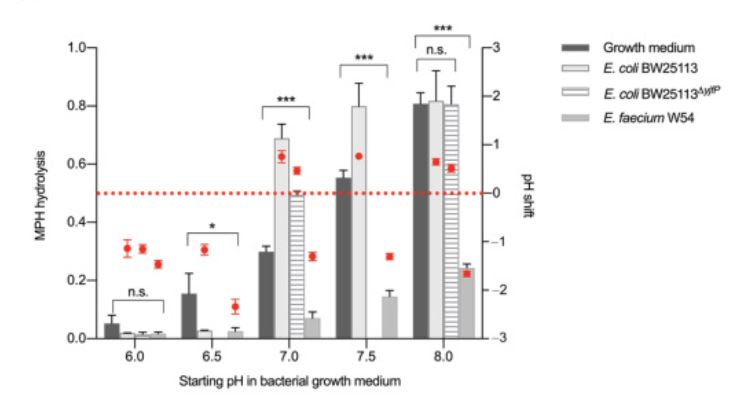 Source: Aresti-Sanz J, Schwalbe M, Pereira RR, Permentier H, El Aidy S (2021): Stability of Methylphenidate under Various pH Conditions in the Presence or Absence of Gut Microbiota. Pharmaceuticals (Basel). July 27, 2021;14(8):733. doi: 10.3390/ph14080733. PMID: 34451830; PMCID: PMC8398889 (unchanged)(E 4)158 Published under the terms of the Creative Commons Attribution (CC-BY)license.
However, these lab results pertain to the pH level in the small intestine, not the urine pH level.
A person with ADHD can benefit simultaneously from a low intestinal pH (favorable for MPH) and a high urine pH (favorable for amphetamine).
Scientific: pH in the Small Intestine and Urine (Independent or Linked?)
The pH levels of the small intestine and urine are not entirely independent, but they are regulated separately. The small intestine’s pH is the most stable value in the digestive tract. No study has been found that simultaneously measured and correlated both pH levels in the same individuals. All statements below are based on separate studies focusing on specific segments.
The coupling occurs via common influencing factors (diet, intestinal absorption capacity), not via a common regulatory loop. Urine pH is therefore not a surrogate for small intestinal pH. The stomach was highly acidic in all subjects (pH 1.0 to 2.5). In the upper small intestine, the mean value during the first hour of recording was 6.6 (± 0.5), and in the terminal ileum, it was 7.5 (± 0.4) (p < 0.001). Upon entering the cecum, the value dropped sharply to 6.4 (± 0.4) in all subjects (p < 0.001) and then rose again from the right to the left colon to 7.0 (± 0.7) (p < 0.001). (Note: According to Yang et al. (2016)161, this is precisely where the sustained-release components of multi-part formulations are released. The lower pH at this point limits the chemical hydrolysis of methylphenidate but simultaneously increases its ionization, thereby impairing absorption.)
Data were recorded for up to 48 hours during normal daily activities. (Radiotelemetry capsule measurements in 66 healthy individuals, without any dietary restrictions, intentionally consuming a mixed daily diet): (E 2b)162
| Section | n | pH (MW) | SD |
|---|---|---|---|
| Jejunum | 55 | 6.63 | 0.53 |
| Middle small intestine | 52 | 7.41 | 0.36 |
| Ileum | 58 | 7.49 | 0.46 |
| Total small intestine | 51 | 7.30 | 0.34 |
| Right colon | 66 | 6.37 | 0.58 |
| Mid-Colon | 51 | 6.61 | 0.83 |
| Left colon | 50 | 7.04 | 0.67 |
Of all the segments, the small intestine as a whole shows the least variation. Consistent with this, in a meta-analysis of 10 gastrointestinal segments, food intake significantly affected the pH in the stomach and duodenum, but not in the rest of the small intestine or the colon. (E 2a)163
The measurement is of the intraluminal pH of the chyme, not the mucosal pH. (E 2b)162
Urine pH reflects the systemic acid load
-
Dietary Acid Load (PRAL):
- from approximately +23.6 mEq/100 g (hard cheese) to approximately −3 mEq/100 g (fruit, vegetables) (E 2b)156
-
Population data: A correlation has been established, but it is weak
- In a substudy of EPIC-Norfolk, spontaneous urine pH correlated with 24-hour urine pH only to a degree of r = 0.22 (n = 363, E 2b)164The interaction between pH and gender was significant (p = 0.009). The agreement between the two dietary assessment methods for the PRAL value was 0.48. The authors believe that their correlations are likely underestimated by a factor of two due to measurement error in spontaneous urine.
-
In type 2 diabetes (n = 173), urine pH vs. PRAL: r = −0.24, p = 0.002 (E 3)165
- The dietary acid load thus accounted for about 6% of the variation in urine pH. The area under the curve of 0.63 indicated that a single urine pH measurement cannot reliably predict dietary intake.
- Fruit and vegetable intake was associated with a higher urine pH (r = 0.15, p = 0.045).
- The mean urine pH was 6.0, and the mean PRAL was 5.8 mEq per day.
- The study identified a urine pH of 5.7 as the cutoff value for a high acid load in the diet (area under the curve 0.63, sensitivity 0.56, specificity 0.70, p = 0.004)
- Limitations: Dietary assessment via a recall questionnaire; single facility; small sample size; no control group without diabetes that was comparable in terms of body mass index; measurement using test strips on individual urine samples (average of three measurements) rather than 24-hour urine collection.
-
Intestinal alkali reabsorption → Urine pH (E 2b)166
- 14 healthy individuals (7 men, 7 women) were given identical meals at a study facility. After the meal, the women’s urine pH was 6.74 (± 0.11) and the men’s was 6.07 (± 0.17). There was no difference in the fasting state. In women, the pH value rose with meals, whereas in men it did not, and their net acid excretion fell to zero when they were satiated. The key factor was the intestinal absorption of dietary anions, which was significantly higher in women at 3.9 (± 0.6) compared to 1.8 (± 0.7) mEq/h. Citrate excretion was also higher in women, and citrate reabsorption in the kidneys was lower.
- (ADxS assessment): With regard to the duration of action of amphetamine medications, this would suggest a gender difference that has not yet been documented: A urine pH value that is approximately 0.67 units higher after meals results in lower excretion of unchanged drug in women and thus a tendency toward a longer duration of action than in men.
-
Intestinal bicarbonate loss → Urine pH (E 2b)167
- in cases of diarrhea (n = 8), urine pH 5.64 ± 0.1
- under ammonium chloride exposure (n = 7), 4.9 ± 0.03.
- The authors conclude that a negative anion gap indicates a loss of bicarbonate through the intestines.
- In cases of diarrhea, the urine pH does not fall below 5.3 despite the body’s acidosis, because ammonium excretion increases. The relationship between intestinal loss and urine pH is therefore not entirely direct
-
Gastric acid secretion → “alkaline flood” (disproved or controversial)
-
Unclear:
- Correlation between gastric acid response and urinary acidity: r = −0.79 and −0.73, respectively (14 healthy men, 7 men after vagotomy, E 2b)168According to the authors, this correlation is explicitly insufficient to draw conclusions about gastric function based on urinary acidity. Following vagotomy, the usual postprandial decrease in acid secretion was absent.
-
On the other hand:
-
Alkalosis persisted during treatment with cimetidine (E 2b)169
-
Identical decrease in urinary acid output even when fasting; no effect of ranitidine (E 2b)170The decrease in acid excretion occurred only after the high-protein meal, not after the meal with moderate protein content or the low-protein meal. In a second part of the study, 20 mg of omeprazole daily also had no effect on respiratory function after eating. The authors conclude that changes in urinary acid excretion are not due to the gastric acid response and that compensation for gastric acid via respiration or urine is too small to be physiologically or clinically significant.
-
Men showed no postprandial increase in urinary TCO₂ or pH when fed an identical diet (E 2b)171
-
-
Practical relevance:
- Urine pH measures the acid-base balance over the past few hours, not the intestinal pH
- The intestines influence urine pH through food intake and digestion, not through their own pH level.
- The key factor is the acid or base load ingested with food, which is absorbed and excreted by the kidneys. (E 2b)156
- In contrast, the pH in the small intestinal lumen is determined locally by bicarbonate secretion from the pancreas and the duodenal mucosa (E 4)172(E 4)173 and remains correspondingly low in the duodenum and the upper jejunum in cases of exocrine pancreatic insufficiency. (14 healthy subjects, E 2b)174
- the first 10 cm of the duodenum
- on an empty stomach, 2 to 5
- after a meal, 1.7 to 4.3
- up to the ileocecal junction, 5 to 6.
- Frequent, rapid, and wide fluctuations occurred in the duodenal bulb, which gradually smoothed out as they traveled along the duodenum.
- This is significant for methylphenidate absorption because the values listed are well below the 6.6 cited for the upper small intestine
- the first 10 cm of the duodenum
- It is unknown whether systemic alkalization in humans alters the pH of the small intestine. We are not aware of any studies on this topic.
- The intestine detects acid-base conditions and reacts to them. (E 4)173
- It remains unclear whether blood pH plays a role in this.
- Methylphenidate: chemical decomposition prior to ingestion: (E 4)175
- In the alkaline environment of the lower small intestine, the ester bond of MPH is hydrolyzed. At pH 6.0, approximately 20% of the MPH was hydrolyzed; at pH 8.0, approximately 80% was hydrolyzed; the correlation between hydrolysis and pH was high (r = 0.89; r² = 0.79; p = 0.0006).
- A bacterial strain from which the esterase gene had been specifically removed cleaved methylphenidate just as effectively as the unmodified strain. Gram-positive bacteria did not cleave it at all, and in the culture medium without any bacteria, approximately 20% was spontaneously cleaved. Cell lysates and filtered culture supernatants also did not break down the compound any more effectively than a pure buffer solution of the same pH. The breakdown is therefore purely chemical and pH-dependent, not enzymatic. An indirect influence by the gut flora remains possible because its metabolic products shift the pH.
- The pH in the small intestine rises from about 6.0 in the upper section to about 8.0 in the ileum. If methylphenidate is taken on an empty stomach, it is absorbed higher up in the intestine, where a pH below 7 limits its breakdown to about 10%. If, on the other hand, it reaches the ileum, approximately 60% would be broken down before it can be absorbed, according to these data. As soon as the lumen pH reaches 7.0, about 30 % Is broken down. The available comparisons between administration on an empty stomach and after a meal are scarce and contradictory.
- Diet also affects this pH value. In rodents, a high-fiber diet raised the small intestine pH from 7.5 to 8.0. In a person with an artificial small bowel outlet, the pH level rose over the course of the day from 5.6 in the morning to 6.8 in the afternoon. The bacterial breakdown of protein and amino acids produces amines and ammonia, which also raises the pH level.
- MPH is converted into pharmacologically inactive ritalinic acid before it enters the bloodstream. Approximately 85% of orally administered MPH is metabolized in the small intestine. (E 4)159
- The same study provides an explanation for the age-related variation. At the same weight-based dose, the calculated daily exposure was 179.2 ng/ml·h for six-year-olds, 130.6 ng/ml·h for fifteen-year-olds, and 107.1 ng/ml·h for adults. Children therefore reach higher levels than adults. The authors cite a lower intestinal clearance capacity for the inactive l-isomer in children as the most likely cause.
- In the studies reviewed, women required higher weight-adjusted doses than men to achieve the same methylphenidate levels, a finding the authors attribute to greater first-pass metabolism in women. This difference was not observed in children with ADHD.
- The rate of hepatic metabolism calculated from the enzyme data was 0.48 L/h/kg for d-methylphenidate and 3.06 L/h/kg for the inactive l-isomer, whereas for amphetamine, it was only 0.004 L/h/kg. Amphetamine is thus metabolized by the liver about 120 times more slowly, which contributes to its longer duration of action.
- A high intestinal pH thus reduces the amount of available active ingredient. In healthy adults, only 22% (± 8%) of d-MPH and 5% (± 3%) of l-MPH reach the systemic circulation. (E 1b)160
- Amphetamine: altered excretion following ingestion
- Amphetamine is a weak base. (E 4)157
- In acidic urine, it is predominantly present in a charged form, cannot re-enter the renal tubule wall, and is excreted. At a urine pH of 5.0, 54.5% of the dose was excreted renally in an unchanged form. (E 2b)149
- In alkaline urine, it is predominantly present in an uncharged form, is reabsorbed, and remains in the body longer. At a urine pH of 8.0, 2.9% of the dose was excreted renally in an unchanged form. (E 2b)149
- The molecule is not destroyed in the process, but is simply excreted more quickly or more slowly. (E 4)157
Whether the laboratory findings regarding MPH in humans are confirmed has not yet been investigated. The occasionally reported simultaneous shortening of the duration of action of amphetamine medications and MPH preparations in some people with ADHD cannot be explained by either of these mechanisms. No plausible mechanism for this is currently known.
Medikinet Retard, Medikinet Adult:
If the stomach pH is above 5.5, dose-dumping phenomena may occur with Medikinet retard and Medikinet adult: The active ingredient is released too quickly, resulting in increased effects and side effects. (E 4)96(E 4)97This can be caused by
- Proton pump inhibitors (e.g., pantoprazole, omeprazole)
- Stomach pH is significantly increased
- Urine pH
- We found no studies on MPH and proton pump inhibitors. The warnings appear to be based solely on theoretical considerations.
- Antacids
- H2 blockers (e.g., ranitidine, famotidine) (less likely)
- age-related increase
- atrophic gastritis
One person with ADHD reported that Medikinet, in doses ranging from 20 to 60 mg, had barely any effect. Eating dry rice crackers in addition to the medication resulted in a temporary effect that was unpredictable. Taking antacids (stomach acid inhibitors) in addition to MPH produced a reliable effect.
Ritalin for adults:
Ritalin for adults, on the other hand, releases MPH regardless of pH. The prescribing information cites reduced absorption as a likely interaction with antacids. (E 4)177
Wisker (2010) (E 4)146reports:
Gastro-resistant monolithic tablets, capsules, or coated tablets are completely coated on the outside with a film that prevents them from being broken down by stomach acid.
After a meal, the involuntary, wave-like muscle movements of the stomach wall (gastric peristalsis) can initially transport only smaller particles into the duodenum. Larger particles, such as monolithic tablets, often remain in the stomach for hours as a result. Only after the smaller, digestible particles have left the stomach—and following a period of rest and a phase of undirected motility—does a defined pattern of electrical and motor activity begin, in which strong propulsive contractions (housekeeper waves) that now also propel the remaining larger particles into the small intestine. Frequent, even small, meals prevent the housekeeper waves. As a consequence, larger particles—such as enteric-coated tablets—remain in the stomach much longer and sometimes do not leave it until nighttime. If, due to a continuous pattern of small meals, several tablets taken throughout the day accumulate so that they are transported together into the small intestine at night, there is a risk of overdose, including toxic side effects.
Gastro-resistant monolithic dosage forms should therefore be taken on an empty stomach (e.g., the anti-inflammatory drug diclofenac in its gastro-resistant monolithic form).
With regard to ADHD, this issue is of little significance. Jornay PM, which is approved in the U.S. but not in Europe, is the only methylphenidate formulation in which the entire dose bypasses the stomach. The micropellets are coated with two layers: an outer delayed-release layer (type B methacrylic acid copolymer), an inner extended-release layer, and beneath that, the fast-release core. The outer layer delays release by approximately 8 to 10 hours. According to the prescribing information, no more than 5% of the active ingredient is released during the first ten hours. The peak concentration is reached at a median of 14 hours. The medication should be taken in the evening between 6:30 p.m. and 9:30 p.m. so that the effect begins upon waking.
15.1.3. Acid-Base Balance and Memantine
Memantine has a prolonged effect when urine is alkalized.
In the case of alkaline urine (high pH), the renal clearance rate of memantine may be reduced by a factor of 7 to 9. The prescribing information lists the following causes: drastic changes in diet (e.g., switching from a meat-based to a vegetarian diet), massive intake of alkalizing antacids, renal tubular acidosis, and severe urinary tract infections caused by Proteus bacteria. (E 4)125
15.1.4. Factors That Increase Alkalinity (Raise the pH)
Information in the following list that does not include its own source citation is currently unsubstantiated. It comes from a website that is no longer accessible. In several cases, this information has proven to be incorrect and should therefore be verified on a case-by-case basis.
Factors that contribute to alkaline urine (high pH) include:
-
Environmental factors:
- Daily fluctuations
- There are various profiles: (E 3)147
- A “normal” pH curve with three peaks corresponding to morning and postprandial (after-meal) fluctuations, with a low nighttime pH level
- Meals cause a spontaneous increase in alkalinity (urine pH reaches at least 6.8 1 to 2 hours after meals)
- a consistently low pH level with no significant fluctuations
- a single afternoon peak with almost no morning fluctuation
- Inversion of the “normal” curve, with low daytime levels and a high nighttime plateau
- A “normal” pH curve with three peaks corresponding to morning and postprandial (after-meal) fluctuations, with a low nighttime pH level
- A single measurement doesn’t tell us much.
- For the same person, the value can fluctuate by more than two units over the course of a day, and the pattern varies from person to person but remains consistent within a single person. If you want to know your own pattern, you must take multiple measurements over the course of at least one day.
- There are various profiles: (E 3)147
- Daily fluctuations
-
Body surface area
- listed as a factor, but the direction of the relationship is not specified (E 3)178
-
Body mass
- A higher body mass index was associated (at least in men) with a lower urine pH (E 3)179
- this results in a shorter duration of action for AMP
- A higher body mass index was associated (at least in men) with a lower urine pH (E 3)179
-
Cadmium exposure
-
Heparin
-
Reduced air pressure; hypobaric ventilation (E 4)180
-
Mercury pollution
-
Youth:
- Stomach acid production is higher at a younger age
- Urine pH, on the other hand, decreases with age (see Section 5.5). (E 3)181
- In an analysis of n = 7,891 individuals with kidney stones, the urine pH decreased by approximately 0.3 units across all age groups, with the most significant decline occurring between the ages of 18 and 55. Women had higher urine pH levels than men in all age groups. Although body mass index was inversely correlated with pH, it accounted for only a small portion of the age-related decline. The strongest factor influencing pH across all age groups was the intestinal absorption of dietary anions. However, this intake increased with age, so that the age-related decline was even more pronounced after adjusting for it. The authors conclude that intestinal absorption has a counterregulatory effect and mitigates the decline, the actual cause of which remains unclear. (E 3)182
- The slower metabolic rate in older adults prolongs the duration of action of amphetamine medications, while the decreasing urine pH shortens it. It has not been studied which effect predominates.
-
low income (E 3)184(E 3)185 (socioeconomic status?). The data are contradictory; see the conflicting entry in Section 5.5
- Income correlates with the proportion of meat in the diet, which in turn affects urinary pH
-
Storing the urine at too high a temperature after collection (E 4)186
- Higher storage temperatures increase the urine pH level, and the warmer the temperature and the longer the storage period, the greater the increase. At 4 degrees in the refrigerator, the pH level rose by no more than 0.7 units over two weeks. At room temperature and above, the increases were more pronounced. The consequences of self-testing as described in Section 5.7 are as follows: Urine should be tested immediately after urination. A sample left in a warm bath for an hour will show an abnormally high value and give the false impression that the situation is better than it actually is.
-
Diseases:
- 21-hydroxylase deficiency
- 3-Hydroxydecahydrogenase deficiency
- Rejection of a kidney transplant
- Acute post-streptococcal glomerulonephritis
- Amyloidosis
- atrophic gastritis (age-related gastritis)
- Calcium deficiency (E 3)147
- Carbonic anhydrase II deficiency
- Chronic obstructive pulmonary disease
- Vomiting
- acquired adrenal insufficiency
- Familial methyl oxidase deficiency
- Galactosemia
- Gout
- Glycogen storage disease
- Urine dilution (E 3)147
- Increased urine flow (E 3)147
- Hereditary Fructose Intolerance
- Hyperventilation (E 3)147
- Hypoxia (lack of oxygen, such as at high altitudes)
- Hyperventilation leads to respiratory alkalosis and raises the urine pH (E 1b)187Twenty-seven healthy individuals, including 13 women, spent ten hours each in normal air and in an oxygen-deprived environment simulating an altitude of 5,000 meters, in random order and in a single-blind study. Under oxygen-deprived conditions, urine pH and venous blood pH increased, while blood bicarbonate levels decreased. Urine pH was measured half an hour before the start of the test and then every two hours. The authors interpret this as evidence of incomplete renal counterregulation: bicarbonate excretion increases but is insufficient to compensate for the alkalosis triggered by hyperventilation. Complete counterregulation can take several days, depending on the individual. The consequences of this for amphetamine-based medications are that urine becomes more alkaline during the first few hours and days, and the effect is therefore likely to last longer. Once adaptation is complete—when the kidneys have excreted the bicarbonate—the opposite effect would be expected. The study examined oxygen deprivation in the chamber, not actual altitude, and urine pH was a secondary parameter, not the main focus. Regarding the statement on altitude in Section 5.5, it supports the general direction of the conclusion, not the specific extent.
- Acute exposure to high altitude triggers hyperventilation and, consequently, respiratory alkalosis. The kidneys compensate for this by excreting bicarbonate, which temporarily makes the urine more alkaline. In a study of 48 healthy men and women in a low-pressure chamber (simulated altitudes of 1,780, 2,085, 2,455, and 2,800 meters, each for 24 hours), the urine pH rose significantly after six hours at all altitudes (p < 0.01). At the lower altitudes, it returned to baseline after 24 hours, while at the highest altitudes it remained elevated. (E 2b)188This could explain an altered effect of amphetamine medications during mountain hiking or skiing. The alkalizing effect—and thus the potential prolongation of the effects of amphetamine medications—primarily affects the first 24 hours. Above approximately 2,800 meters, this effect lasts longer. Therefore, a change is barely possible during a vacation in the low mountain range, but more likely during a stay in the high mountains.
-
Lactosuria
-
Light-chain multiple myeloma
-
Lowe syndrome
-
Lupus nephritis
-
Malabsorption
-
Medullary cystic disease
-
Metabolic alkalosis
-
Metachromatic leukodystrophy
-
Mineralocorticoid deficiency, transient in infancy
-
Wilson’s disease
-
Multiple myeloma
-
Kidney transplant
-
Renal vein thrombosis
-
obstructive nephropathy
-
Pseudohypoaldosteronism
-
Renovascular hypertension
-
Salt-loss nephritis
-
Sjögren’s syndrome
-
Tubulointerstitial disease
-
Tyrosinemia
-
Vitamin D deficiency
-
Vitamin D resistance
-
Medications:
- Acetazolamide causes systemic metabolic acidosis in the blood and, at the same time, alkaline urine. Acetazolamide inhibits carbonic anhydrase in the renal tubular cells. As a result, bicarbonate is not reabsorbed but excreted, and the urine becomes more alkaline. Increase in urine pH by +2.0 with intravenous administration (very strong); +0.39 (mild) with oral administration (E 1a)155Acetazolamide is therefore the most potent alkalinizing agent available and would significantly prolong the effects of amphetamine-based medications.
- Long-term treatment with acetazolamide is associated with a significantly increased risk of urolithiasis (E 3)189The annual rate was 11 times higher than in the untreated group and 15 times higher than the rate observed in the same individuals before treatment began. 75 percent of the participants developed a urinary stone during the first year of treatment.
- Common side effects: risk of urinary stones, paresthesia, fatigue, taste disturbances, electrolyte imbalances.
- Acetazolamide causes systemic metabolic acidosis in the blood and, at the same time, alkaline urine. Acetazolamide inhibits carbonic anhydrase in the renal tubular cells. As a result, bicarbonate is not reabsorbed but excreted, and the urine becomes more alkaline. Increase in urine pH by +2.0 with intravenous administration (very strong); +0.39 (mild) with oral administration (E 1a)155Acetazolamide is therefore the most potent alkalinizing agent available and would significantly prolong the effects of amphetamine-based medications.
-
ADV7103 (citrate + bicarbonate): Increase in urine pH by +1.27 (marked) (E 1a)155
-
Ambroxol (Note: not when used as a cough suppressant; only in a rat study with a very high dose administered by subcutaneous injection (60 mg/kg). Not applicable to the use of cough suppressants in humans (1.3 mg/kg orally)) (E 4)190
-
Amiloride
-
Aminoglycosides
-
Antibiotics (E 2b)191
- After two weeks of antibiotic treatment, the urine pH increased (p = 0.04 when fasting, p = 0.06 after a test meal), while it remained unchanged in the untreated control group. Accordingly, one would expect the effects of amphetamine medications to be prolonged during antibiotic treatment.
- A change in the gut microbiota is considered a possible mechanism. Seventeen carriers of Oxalobacter formigenes were treated with amoxicillin and clarithromycin for two weeks. Afterward, the bacterium was no longer detectable in three-quarters of the treated individuals and remained undetectable in most of them for over 24 weeks. The diversity of the gut microbiota decreased temporarily but recovered without the bacterium returning. (E 2b)191
-
Ascorbic acid (vitamin C): Increases urine pH by +0.03 (neutral) (E 1a)155
- In citrus fruits, it is the citrate that has an alkalizing effect, not the acid they contain, which has an acidifying effect. The available data on various citrus juices is inconsistent.
-
Bicarbonates (= hydrogen carbonates)
- mineral water rich in bicarbonate
- Increase in urine pH of +0.42 to +0.56 (moderate) (E 1a)155(E 4)192(E 1b)193 (E 2b)194. The key factor is the bicarbonate content, not the label “alkaline.” Waters containing 1,715 to 3,388 mg of bicarbonate per liter were effective (1.4 liters consumed per day by 5 healthy men over 5 days). The hydrogen carbonate content of the mineral water alkalizes the body by increasing urine pH and citrate excretion. In this setting, the mineral water was as effective as the medication. On a standardized diet, the urine pH during the control phase—with neutral fruit tea—was 6.15, 6.26, 6.10, and 6.10 on the four days, and with mineral water, it was 6.52, 6.64, 6.54, and 6.59—all significantly higher (mean: +0.42). Many waters marketed as alkaline do have a high pH in the bottle but contain barely any alkali. Their ability to significantly raise urine pH has not been proven. The key factor is the “hydrogen carbonate” content listed on the label. German medicinal waters often reach 1,800 to over 3,000 mg per liter, while common table waters are often below 300 mg.
- mineral water rich in bicarbonate
-
Bicarbonate loading (soda loading, baking soda loading): Increase in urine pH by +1.44 (very significant) (E 1a)155
- Taking sodium bicarbonate (= sodium hydrogen carbonate, baking soda, bicarbonate of soda, baking powder, Bullrich salt)
- 10 minutes before physical activity
- Dose: 0.2 to 0.3 g/kg
- one teaspoon of baking soda dissolved in a glass of still water
- Should not be used for more than 2 weeks
- Long-term use may trigger increased stomach acid production as a counter-reaction
- Baking soda in the stomach produces CO2—risk of overstretching the stomach wall
- Taking sodium bicarbonate (= sodium hydrogen carbonate, baking soda, bicarbonate of soda, baking powder, Bullrich salt)
-
Citrate: 0.61 (moderate) (E 1a)155(E 4)192
- Citrus juices
- In citrus fruits, it is the citrate that has an alkalizing effect, not the acid they contain, which has an acidifying effect. The free acid has an acidifying effect, while the potassium salt of citric acid has an alkalizing effect.
- Orange juice: Increases urine pH by +0.68 (moderate) (E 1a)155
- Citrus juices
-
Citro-Soda: Increases urine pH by +1.56 (very strong) (E 1a)155
- Ingredients: sodium bicarbonate 1.716 g, sodium citrate 0.613 g, citric acid 0.702 g, tartaric acid 0.858 g
-
Cholestyramine
-
Converting enzyme inhibitors
-
Corticotropin
-
Coumarin
-
Diazoxide
-
Melon juice (cantaloupe): Increases urine pH by +0.36 (slight) (E 1a)155; in the original study, approximately equivalent to orange juice (E 1b)195
-
Exenatide: Increase in urine pH by +0.51 following intravenous administration (moderate) (E 1a)155 (diabetes medication)
-
Glycine combined with L-tryptophan: Increase in urine pH by +0.20 (neutral) (E 1a)155
-
Indomethacin: Increase in urine pH by +1.0 (severe) (E 1a)155
-
Potassium citrate (E 1a)155
- Recommendation from the American Urological Association (AUA) on increasing the pH level of urine
- Food additive E332
- Dietary supplements, available over the counter in powder or capsule form
- Avoid in cases of hyperkalemia—therefore, always consult a doctor
- Prevalence of hyperkalemia in the general population: 2 to 3%
-
Potassium gluconate: Increases urine pH by +0.46 (slightly) (E 1a)155
- Potassium gluconate, a medication used to treat potassium deficiency
-
Potassium hydrogen carbonate (potassium bicarbonate): Increase in urine pH of +0.89 (moderate) (E 1a)155 by 10% (E 2b)196 at a fairly high dose of 90 mmol daily. 90 mmol daily corresponds to approximately 9 grams of potassium bicarbonate, an amount that cannot be recommended without medical supervision. Bicarbonate-rich therapeutic water containing 3,400 mg of hydrogen carbonate provides approximately 56 mmol/liter. The urine pH value was 7.23 ± 0.15 with 90 mmol of potassium bicarbonate daily, compared to 6.68 ± 0.11 without supplementation (p < 0.001)—that is, 10 ± 3 percent higher. The study involved healthy young men at the end of two 21-day periods of bed rest in a crossover design. This was a bed rest study designed to investigate oxidative stress and protein metabolism in the absence of physical activity, not a nutritional study conducted under everyday conditions.
-
Potassium sodium hydrogen citrate (E 2b)197
- Citrate is currently the safer and more effective agent for urinary alkalization than oral bicarbonate, because the latter reacts with stomach acid to form carbon dioxide. After three months of oral administration of potassium-sodium hydrogen citrate, the urine pH rose to over 6.0, the blood uric acid level decreased (p = 0.025), and the largest stone diameter decreased by about half. Analysis of only 12 individuals: of the 17 eligible participants, four discontinued the three-month treatment cycle, and one received a different medication. Potassium-sodium hydrogen citrate is considered more suitable than sodium and potassium citrate because the potassium-to-sodium ratio is more favorable and the risk of electrolyte imbalances is lower. No side effects occurred other than mild gastrointestinal discomfort. The urine pH correlated positively with the abundance of several genera of intestinal bacteria considered beneficial and negatively with the abundance of pro-inflammatory genera.
-
Magnesium salts without chloride (e.g., magnesium oxide, magnesium citrate, magnesium carbonate) (studies in rats) (E 4)198
- Magnesium chloride, on the other hand, causes hyperchloremic acidosis and lowers the urine pH (see below)
- Monomagnesium L-aspartate hydrochloride contains equal amounts of magnesium and chloride and therefore does not alter the balance of non-metabolizable acids and bases; rather, it is pH-neutral
People with ADHD who take magnesium but do not want to reduce the effectiveness of amphetamine-based medications should avoid magnesium chloride and choose a chloride-free form: magnesium citrate, oxide, or carbonate. In contrast, supplements based on magnesium L-aspartate hydrochloride (such as Magnesiocard) have no such effect.
-
Metolazone
-
Monosodium glutamate (flavor enhancer) (E 4)199
- After just two weeks, the intake raised the pH level in the rats’ urine
- The extent of the increase was not specified
-
Demonstrated only in animal studies; at high doses (1.5 g/kg, many times the amount consumed by humans), it is unclear whether the findings are applicable to typical consumption levels
-
Sodium hydrogen carbonate (sodium bicarbonate, baking soda): Increases urine pH by +1.19 when taken orally; +1.12 when administered intravenously; strong (E 1a)155
-
Sodium L-ascorbate and sodium saccharin (E 4)200
- Rat studies with a 5% concentration in the diet. This would correspond to 100 g in humans, which is far above any reasonable intake level. It is therefore of no significance for human nutrition.
- Sodium L-ascorbate promoted the development of bladder cancer, while L-ascorbic acid inhibited it. The authors attribute this difference to the opposing effects on urine pH. While ascorbic acid is considered acidifying, its salt form, ascorbate, is alkalizing.
-
Niacin
-
Omeprazole (proton pump inhibitor): Increase in urine pH by +0.10 (neutral) (E 1a)155
-
Spironolactone
-
Streptozocin
-
Topiramate: Increase in urine pH by +0.45 (mild) (E 1a)155
-
Food
-
DASH diet: Increase in urine pH of +0.50; not statistically significant in the only underlying study (n = 21, 56 days) (E 1a)155
- A diet rich in fruits, vegetables, whole grains, low-fat dairy products, fish, poultry, nuts, and seeds
-
Pickled cucumbers: Increase in urine pH of +0.17 (neutral, not significant) (E 1a)155
-
Potatoes: Increase in urine pH by +0.28 (slight) (E 1a)155
-
Lime juice: Increases urine pH by +0.25 (neutral, not significant) (E 1a)155
- It is unclear whether “lime juice” refers to lime syrup, water, and sugar, or pure lime juice
-
Lime powder (containing potassium and citrate): +0.52 (moderate) (E 1a)155
-
Milk: Increase in urine pH by +0.36 (slight) (E 1a)155
-
Diet rich in fruits and vegetables: Increase in urine pH of +0.35 (slight) (E 1a)155
-
French fries: Increase in urine pH by +0.25 (neutral) (E 1a)155
-
vegetarian diet
-
Vitamin C: Increase in urine pH by +0.03 (neutral) (E 1a)155
-
See below (PRAL value table)
-
15.1.5. Factors that increase acidity (lower the pH)
Information in the following list that does not include a specific source citation is currently unsubstantiated. According to earlier reports, it originated from a website that is no longer accessible. In several cases, this information has proven to be incorrect and should therefore be verified on a case-by-case basis.
Factors that contribute to acidic urine (low pH) include:
-
Environmental factors:
-
Bed rest
-
Aldosterone
-
Poisonings that damage the kidneys
- Lead exposure (documented only in animal studies involving high doses; in those studies, the drop in pH occurred as a sign of kidney damage following poisoning (E 4))201
-
Cadmium (E 4)202
- Administration of cadmium to rats via drinking water at increasing concentrations ranging from 100 to 1,600 mg/liter over a period of 20 weeks (= toxicological exposure doses)
- As a result of poisoning, the urine pH decreased along with elevated liver enzymes, elevated blood urea levels, and enlarged kidneys
-
-
Toluene
-
Vanadium
-
Age
-
male gender (E 4)183
-
physical exertion in a hot environment
- 189 sugarcane cutters in El Salvador: significant decrease in pH over the course of the work shift (E 3)
- Work as a rice field laborer in Thailand (cross-sectional findings based on pH test strips, without a control group; E 3)203
- 65 female rice field workers, of whom 83.0% had a urine pH between 5 and 6 and 38.5% had a specific gravity of 1.030, indicating highly concentrated urine.
- The authors do not attribute the findings to diet, but rather to working conditions, particularly prolonged exposure to heat and dehydration.
- A cross-sectional study of 194 male workers between the ages of 17 and 39 on the Pacific coast of Nicaragua: 86 sugarcane cutters, 56 construction workers, and 52 smallholder farmers (E 3)204
- Impaired kidney function was most common among sugarcane cutters, less common among construction workers, and barely observed among smallholder farmers (trend p = 0.003). The authors attribute this to heat stress and dehydration. The endpoint of this study is kidney function, not urine pH.
- This is caused by lactic acid produced during exertion and, in cases of dehydration, the increased reabsorption of sodium in exchange for hydrogen ions. It is noteworthy that the sugarcane cutters, who drank an average of 6.2 liters per workday (4.4 liters of water and 1.8 liters of sugary drinks), drank significantly more than the comparison groups and yet exhibited the most severe signs of dehydration. Thus, drinking large amounts of fluid alone does not prevent acidic urine during work in hot conditions.
- A low urine pH was found in 29% of sugarcane cutters compared with 12% of construction workers and smallholder farmers (p = 0.01). Within the group of sugarcane cutters, low fluid intake the previous day was strongly associated with acidic urine (odds ratio 8.7, p < 0.001) and moderately associated with concentrated urine (odds ratio 3.5, p = 0.06). This association was not observed in the other two occupational groups.
- Limitations: Cross-sectional design with no information on the direction of cause and effect; self-reported data on heat exposure and fluid intake; individual measurements without follow-up data. The urine samples were collected in the morning on an empty stomach between 5:30 and 6:00 a.m., that is, after a night’s sleep and not during work. According to the authors, the lower morning value indicates incomplete recovery of fluid balance following the previous workday. For people with ADHD taking amphetamine-based medication, this means that the effect can extend into the following day.
-
Stay in the desert: - 0.5 pHt (E 2b)205
- The urine pH dropped from 6.1 to 5.6 during the stay in the desert. Measurements were taken from three 24-hour urine collections: before deployment, after 30 days in the desert, and two weeks after returning. Despite a significantly increased daily fluid intake of 17 liters, daily urine output decreased by 68 percent to 0.52 liters. Thus, high fluid intake alone does not prevent acidification under heat stress. The excretion of calcium, uric acid, sodium, magnesium, and potassium decreased by 70, 41, 53, 22, and 36 percent, respectively.
- Complete normalization within two weeks of returning, except for a 22 percent decrease in oxalate levels.
- A change of 0.5 pH units is comparable to a high-protein diet (-0.65)
-
Sleep deprivation: 0.00 (no effect) (E 1a)155
-
Diseases:
-
Breathing problems
-
Obstruction of the airways or impairment of gas exchange in the lungs, e.g., in cases of pulmonary edema (fluid in the lungs)
-
Pneumonia
-
Loss of functional lung tissue, e.g., due to tuberculosis
-
insufficient respiratory drive, such as in cases of sleeping pill poisoning
-
Paralysis of the respiratory muscles, e.g., in polio
-
Malfunction of the respiratory reflexes
-
-
Adrenal hyperfunction
-
Adrenal insufficiency
-
Amyloidosis
-
Autoimmune thyroiditis
-
Balkan nephropathy
-
Chronic active hepatitis
-
Chronic kidney disease
-
Chronic kidney failure
-
Chronic pyelonephritis
-
Cystinosis
-
Diabetes mellitus
-
Distal renal tubular acidosis
-
Gastrinoma
- Zollinger-Ellison syndrome, a rare pancreatic tumor
- increases stomach acid
-
Fibrosing alveolitis
-
Urinary tract obstruction (a blockage in the urinary system that prevents urine from flowing from the kidneys to the urethra)
-
Helicobacter pylori infection
- increases stomach acid
-
Hepatolenticular degeneration
-
Hereditary fructose intolerance
-
Hypercalciuria, idiopathic
-
Hypergammaglobulinemia
-
Hyperparathyroidism
- increased stomach acid in 30% of people with ADHD
-
Cryoglobulinemia
-
Fabry disease
-
Wilson’s disease
-
Marfan syndrome
-
Medullary sponge kidney
-
Metabolic acidosis
-
Metabolic syndrome (E 3)206
- Low urine pH was associated with abdominal obesity, even after adjusting for environmental and lifestyle factors affecting urine pH
- Clinical relevance: Abdominal obesity is associated with more acidic urine, suggesting a shorter duration of amphetamine effects. This is consistent with the relationship between an increasing body mass index and a decreasing urine pH.
- Factors affecting a low urine pH:
- Waist-to-hip ratio: (odds ratio 2.439)
- Smoking (OR 1.244)
- female gender (OR 1.330)
- ongoing alcohol consumption (OR 1.186)
- a high-fiber diet (OR 0.993 per unit)
- High blood pressure—systolic pressure (OR 0.992).
- When it comes to the duration of action of amphetamine-based medications, lifestyle and body type have a greater impact than blood sugar or blood lipid levels.
- 4,626 individuals with a urine pH of 5.0 and 4,185 individuals with a urine pH above 5.0 from a Korean genomic and epidemiological study, age 52.2 ± 8.9 years, body mass index 24.6 ± 3.2;.
- Cross-sectional analysis. No conclusions can be drawn regarding the direction of the association—that is, whether the low urine pH is a consequence of metabolic status. A single urine sample was collected after an eight-hour fast rather than a 24-hour urine collection. The study included only Korean participants, so the applicability to Western dietary habits remains unclear.
-
-
Kidney transplant rejection
-
Kidney failure
-
Polyarteritis nodosa
-
Primary biliary cirrhosis
-
Proximal renal tubular acidosis (Type II)
-
Sickle cell anemia
-
Sjögren’s syndrome
-
Volumetric-dependent distal renal tubular acidosis (Type 1)
-
Vitamin D toxicity
-
Medications:
-
Acetaminophen = Paracetamol
-
Amiloride
-
Ammonium chloride (sal ammoniac): - 1.63; the highest single value found, based on only a small short-term study (n = 10, approximately 8 hours); not statistically significant in that study (E 1a)155(E 2b)149
-
Amphotericin B
-
Acetylsalicylic acid (Aspirin)
- inhibits prostaglandins, which protect the stomach lining from acid
- A prostaglandin deficiency leads to inflammation of the mucous membrane, which damages the parietal cells that produce stomach acid (gastritis)
-
Carbenoxolone
-
Cefdinir
-
Cimetidine
-
Citric acid: Decrease in urine pH by -0.05 (neutral, not significant) (E 1a)155
-
Dapagliflocin: Decreases urine pH by -0.10 (neutral) (E 1a)155 (diabetes medication)
-
Diclofenac
- inhibits prostaglandins, which protect the stomach lining from acid
- Prostaglandin deficiency leads to inflammation of the mucous membrane, which damages the parietal cells that produce stomach acid (gastritis) * Diflunisal
-
Etodolac
-
Fenoprofen
-
Flurbiprofen
-
Furosemide: Decrease in urine pH by -0.52 following intravenous administration (not statistically significant) (E 1a)155
-
Ibuprofen
- inhibits prostaglandins, which protect the stomach lining from acid
- A prostaglandin deficiency leads to inflammation of the mucous membrane, which damages the parietal cells that produce stomach acid (gastritis)
-
Ifosfamide
-
Indomethacin
-
Ketoprofen
-
Saline infusion (sodium chloride), intravenous, for inpatients (meta-analysis, k = 2, n = 226) (E 1a)155: - 0.48
-
Lithium
-
Mafenid
-
Methionine: Reduction in urine pH by -0.72 (moderate) (E 1a)155
- essential amino acid
- available without a prescription
- takes a few days to take effect
-
Monomagnesium L-aspartate hydrochloride (E 4)198
-
Mefenamic acid
-
Naproxen
-
Niacinamide
-
Ofloxacin
-
Orthophosphate
-
Parathyroid extract
-
Proton pump inhibitors: Contrary to earlier reports, a reduction in urinary pH has not been demonstrated (E 3)176
-
Ranitidine
-
Triamterene
-
-
Food
- Apple cider vinegar: Decrease in urine pH by -0.21 (very slight) (E 1a)155
- Cranberry: Reduces urine pH by -0.16 (neutral) (E 1a)155
- Protein: high intake of animal protein in the diet (E 2b)207
- eight patients with recurrent idiopathic calcium oxalate stones on a high-protein diet
- Urine pH decreased
- Urine citrate decreased by 25%
- Serum bicarbonate levels decreased
- Urinary calcium excretion increased by 35%
- Oxalate excretion remained unchanged
- The authors attributed the changes to the increased production of acidic metabolic byproducts from animal protein.
- A protein-rich meal shortens the duration of action of amphetamine medications
- eight patients with recurrent idiopathic calcium oxalate stones on a high-protein diet
-
Fasting: Decrease in urine pH by -1.2 (very significant) (E 1a)155
-
Fructose: Decrease in urine pH by -0.26 (very slight) (E 1a)155
-
Ketogenic diet: Decrease in urine pH of -0.55 (moderate) (E 1a)155
-
Low-oxalate diet: Decrease in urine pH by -0.10 (neutral, not significant) (E 1a)155
-
High-protein diet: Decrease in urine pH of -0.65 (moderate) (E 1a)155
-
see below (PRAL value table)
15.1.6. The Effect of Food on Acid-Base Balance (PRAL Value)
The ability of a food to produce acid or alkali is called the potential renal acid load (PRAL). Diets with a high PRAL lead to mild metabolic acidosis, which is associated with insulin resistance, diabetes, high blood pressure, kidney disease, bone loss, and low muscle mass.
Foods can significantly influence the pH of urine, but not that of blood. It is not so much the sour taste that matters, but rather the PRAL value. Consumption of foods with a negative PRAL value correlates with an alkaline urine pH. An acid-forming diet correlates with acidic urine pH levels below 6.0. The blood pH level in healthy adults remains unaffected by this, as it is maintained at a constant level between 7.35 and 7.45 by buffer systems, respiration, and the kidneys.
Within a single day, the urine pH in the same individuals fluctuated between the lowest and highest values by 0.77 to 2.48 units, with an average fluctuation of 1.5 units. (E 3)208209
This daily fluctuation is thus greater than the effect of nearly all dietary measures (vegan diet +0.52, high-protein diet -0.65). The timing of intake and the time of day are therefore likely to have a greater influence on the duration of the effect than the choice of individual foods.
When it comes to proteins, a distinction must be made between plant-based and animal-based proteins. In a randomized study of healthy young adults, the 24-hour urine pH increased by 0.52 ± 0.69 after seven consecutive days on a vegan diet. In contrast, when only two or three vegan days were incorporated throughout the week, the urine pH remained unchanged (-0.02 ± 0.56; difference between groups p = 0.048). The PRAL value decreased significantly in both groups. (Study of healthy college students, 21.8 ± 2.4 years) (E 1b)210 A consistently plant-based diet is thus mathematically associated with a prolonged effect of amphetamine medications, whereas individual meat-free days per week are not expected to have this effect. However, the standard deviation of ±0.69 was greater than the effect itself, meaning the finding was only marginally significant and not reliable for individual participants. Second, the calculated PRAL value of the diet decreased significantly in both groups—including those with two to three vegan days—without any change in urine pH. This directly demonstrates that the calculated PRAL value of the diet and the measured urine pH value are not identical. For people with ADHD, this means that occasional meat-free days do not prolong the amphetamine effect, whereas a permanent dietary change does.
Foods high in oxalate can increase acid production. (E 4)211
Scientific: Calculating the PRAL Value Based on Nutritional Composition
The potential acid load of a food (potential renal acid load, PRAL) is calculated based on five nutrients. The standard formula is: (E 2b)156(E 4)212
PRAL (mEq/day) = 0.49 × Protein (g/day) + 0.037 × Phosphorus (mg/day) − 0.021 × Potassium (mg/day) − 0.026 × Magnesium (mg/day) − 0.013 × calcium (mg/day)
A positive value indicates that a substance is acid-forming; a negative value indicates that it is base-forming. (Review article, E 4)213
The coefficients are derived from two factors: the percentage absorbed in the intestine and the atomic or equivalent weight. The original study assumes that 95% of the sodium, 80% of the potassium, 63% of the phosphorus, and 25% of the calcium are absorbed, and 75% of the sulfur contained in protein. Dividing these percentages by the respective atomic weights yields the conversion factors from milligrams to milliequivalents: 0.0418 for sodium, 0.0205 for potassium, 0.0125 for calcium, 0.0366 for phosphate, and 0.4888 per gram of protein. (Controlled nutritional study using a calculation model, n = 60 men, E 2b)156
There is a strong correlation between net renal acid excretion and urine pH (r = 0.83. P < 0.001), so that the PRAL value of a diet can be used to estimate the direction in which urine pH will shift. (E 2b)156
In other words: Foods with a strongly negative PRAL value result in alkaline urine (less acidic, higher pH) and thus prolong the effects of amphetamine-based medications. Foods with a strongly positive PRAL value result in acidic urine (lower pH) and thus shorten the duration of action of amphetamine medications.
It is not the phosphate anion that determines the acidity, but rather the cation to which it is bound. Phosphoric acid in cola is acidic because it releases hydrogen ions, whereas the additive trisodium phosphate is basic. For processed foods containing phosphate additives, therefore, the phosphate content alone does not indicate the food’s effect.
A table based solely on PRAL values does not adequately reflect the effect on urine pH of foods that contain hydrogen carbonate. The following table calculates a hypothetical PRAL value for foods containing hydrogen carbonate—the value a hydrogen carbonate-free food would need to have in order to produce the same effect on urine pH. Only then do the tables become a useful comparison tool.
Calculation method: 1 mEq of base raises the balance exactly as much as 1 mEq of PRAL lowers it. The fictitious PRAL is therefore simply the negative base equivalent: mEq = mg of hydrogen carbonate ÷ 61.02.
To achieve the same effect on urine pH as 1.5 liters of Apollinaris through PRAL alone, a food containing no hydrogen carbonate would need a PRAL value of −44.5 per daily serving. No single food achieves this. Spinach has the highest negative PRAL value at −28.0. Therefore, one would have to eat 1.6 daily servings of spinach or 7 daily servings of broccoli to achieve the same effect.
One level teaspoon of baking soda, at −36 mEq, is roughly equivalent to 1.2 liters of Apollinaris. With a hypothetical PRAL of −1,190 per 100 g, baking soda is 19 times more potent than dried chanterelles (−61.9).
The hypothetical PRAL value of baking powder is approximately zero. German baking powder consists of sodium bicarbonate and an acidulant—usually disodium diphosphate—as well as starch as an anti-caking agent. During baking, the first two ingredients react with each other: The bicarbonate is consumed stoichiometrically and escapes as CO₂. Thus, practically no base equivalent reaches the body. What remains is the sodium salt of phosphoric acid. In the PRAL formula, phosphorus is counted as an acid with a value of +0.037. This is why, although the actual PRAL of baking powder is +297.99, baking powder is still an acid-forming substance despite its bicarbonate content. Pure baking soda, on the other hand, is a very strong base-forming substance.
Note: Do not confuse the PRAL value with the increase in urine pH shown in the figure above. The values are inversely related.
The table is based primarily on data from 1995 and may overestimate the alkalizing effect of fruits, vegetables, and grains and underestimate the acid-forming effect of animal products, because it is based on nutrient data from the early 1990s and the mineral content of many foods has decreased since then. Storz & Ronco (2023) consider a recalculation necessary and write that the 1995 tables are only useful for indicating general trends, not for precise values. (E 4)213 It may be helpful to view the table more as a ranking.
A negative PRAL value increases the pH of urine, making it more alkaline; a positive value decreases it, making the urine more acidic.
| Food (unsweetened, untreated) | PRAL per daily serving | Daily serving | PRAL per individual serving | Individual serving | PRAL per 100 g/ml |
|---|---|---|---|---|---|
| Medicinal water 3388 mg/l, Hydrogen carbonate equivalent (as in the Siener 2004 study) | -83.3 hypothetical | 1500 ml (1.5 l) | -11.1 hypothetical | 200 ml (1 glass) | -5.6 hypothetical |
| Apollinaris Classic, hydrogen carbonate equivalent (1810 mg/l) | -44.5 (fictitious) | 1500 ml (1.5 l) | -5.9 (fictitious) | 200 ml (1 glass) | -3.0 (fictitious) |
| Medicinal water 1715 mg/l, Hydrogen carbonate equivalent (as in the Keßler & Hesse 2000 study) | -42.2 (fictitious) | 1500 ml (1.5 l) | -5.6 (fictitious) | 200 ml (1 glass) | -2.8 (fictitious) |
| Baking soda, hydrogen carbonate equivalent (pure) | -36 (fictitious) | 3 g (1 level teaspoon) | -36 (fictitious) | 3 g (1 level teaspoon) | -1190 (fictitious) |
| Minimum threshold for medicinal water: 1300 mg/l, hydrogen carbonate equivalent: | -32.0 (fictitious) | 1500 ml (1.5 l) | -4.3 (fictitious) | 200 ml (1 glass) | -2.1 (fictitious) |
| Spinach | -28.0 | 200 g (cooked) | -28.0 | 200 g (cooked) | -14.0 (E 2b)156 |
| Apollinaris Mineral Water | -27.0 | 1500 ml (1.5 l) | -3.6 | 200 ml (1 glass) | -1.8 (E 2b)156 |
| Fruit Tea -21.0 600 ml (3 cups) -7.0 200 ml (1 cup) -3.5 (E 4) | 211 | ||||
| Spinach leaves | -19.4 | 200 g | -19.4 | 200 g | -9.7 (E 4)213 |
| Carrot juice | -19.2 | 400 ml (2 glasses) | -9.6 | 200 ml (1 glass) | -4.8 |
| Potatoes | -17.0 | 200 g ((3 medium)) | -17.0 | 200 g ((3 medium)) | -8.5 (E 4)211 -4.0 (E 4)212 stored -4.0 (E 2b)156 |
| Kale | -16.0 | 200 g | -16.0 | 200 g | -8.0 (E 4)211 |
| Fennel | -15.8 | 200 g (1 bulb) | -15.8 | 200 g (1 bulb) | -7.9 |
| Swiss chard | -15.2 | 200 g | -15.2 | 200 g | -7.6 (E 4)213 |
| Beans | -14.8 | 200 g | -14.8 | 200 g | unclear: -7.4 (E 4)211 or 1.1 (E 4)211 |
| Orange juice | -14.8 | 400 ml (2 glasses) | -7.4 | 200 ml (1 glass) | -3.7 (E 4)211 -2.9 (E 2b)156 |
| Parsnip | -14.4 | 200 g | -14.4 | 200 g | -7.2 (E 4)213 |
| Kale | -13.6 | 200 g | -13.6 | 200 g | -6.8 (E 4)213 |
| Avocado | -12.8 | 150 g (1 small) | -12.8 | 150 g (1 small) | -8.5 (E 4)213 |
| Mineral Water -12.0 1500 ml (1.5 l) -1.6 200 ml (1 glass) -0.8 (E 4) | 211 | ||||
| Soy bread | -12.0 | 150 g (3 slices) | -4.0 | 50 g (1 slice) | -8 (E 4)213 |
| Raw spinach | -11.8 | 100 g (1 serving of salad) | -11.8 | 100 g (1 serving of salad) | -11.8 (E 4)211 |
| Brussels sprouts | -11.4 | 200 g | -11.4 | 200 g | -5.7 (E 4)213 |
| Tomato juice | -11.2 | 400 ml (2 glasses) | -5.6 | 200 ml (1 glass) | -2.8 (E 2b)156 |
| Zucchini | -9.2 | 200 g | -9.2 | 200 g | -4.6 (E 2b)156 |
| Unsweetened apple juice | -8.8 | 400 ml (2 glasses) | -4.4 | 200 ml (1 glass) | -2.2 (E 2b)156 |
| Beets | -8.8 | 150 g | -8.8 | 150 g | -5.9 (E 4)213 |
| Dried apricots | -8.5 | 40 g (4 pieces) | -8.5 | 40 g (4 pieces) | -21.2 (E 4)213 |
| Coffee (beverage) | -8.4 | 600 ml (3 cups) | -2.8 | 200 ml (1 cup) | -1.4 (E 2b)156 |
| Bananas | -8.3 | 120 g (1 piece) | -8.3 | 120 g (1 piece) | -6.9 (E 4)211 |
| Celery | -7.5 | 150 g | -7.5 | 150 g | -5.0 (E 4)211 -5.2 (E 2b)156 |
| Chestnuts, precooked and vacuum-sealed | -7.4 | 100 g | -7.4 | 100 g | -7.4 (E 4)213 |
| Mineral water, low in bicarbonate (300 mg/l), hydrogen carbonate equivalent | -7.4 (fictitious) | 1500 ml (1.5 l) | -1.0 (fictitious) | 200 ml (1 glass) | -0.5 (fictitious) |
| Broccoli | -7.2 | 200 g | -7.2 | 200 g | -3.6 (E 4)211 -1.2 (E 2b)156 |
| Dried kidney beans | -7.2 | 60 g (dry) | -7.2 | 60 g (dry) | -12 (E 4)213 |
| Dried figs | -7.2 | 40 g (3 pieces) | -7.2 | 40 g (3 pieces) | -18.1 |
| Radish | -7.1 | 100 g | -7.1 | 100 g | -7.1 (E 4)213 |
| Black currant | -6.5 | 100 g | -6.5 | 100 g | -6.5 (E 2b)156 |
| Grapefruit | -6.4 | 200 g (1/2) | -6.4 | 200 g (1/2) | -3.2 (E 4)211 -1.0 (E 2b)156 |
| Mushrooms | -6.3 | 150 g | -6.3 | 150 g | -4.2 (E 4)211 -1.4 (E 2b)156 |
| Raisins | -6.3 | 30 g (1 handful) | -6.3 | 30 g (1 handful) | -21.0 (E 2b)156 |
| Beet syrup/sugar beet molasses | -6.3 | 20 g (1 tbsp) | -6.3 | 20 g (1 tbsp) | -31.6 (E 4)213 |
| Green beans | -6.2 | 200 g | -6.2 | 200 g | -3.1 (E 2b)156 |
| Chanterelles, dried | -6.2 | 10 g (1 handful) | -6.2 | 10 g (1 handful) | -61.9 (E 4)213 |
| Tomatoes | -6.2 | 150 g (2 pieces) | -6.2 | 150 g (2 pieces) | -4.1 (E 4)211 -3.1 (E 2b)156 |
| Beans, white, dried | -5.9 | 60 g (dry) | -5.9 | 60 g (dry) | -9.9 (E 4)213 |
| Dark chocolate | -5.8 | 50 g (half a bar) | -3.5 | 30 g (3 pieces) | -11.5 |
| Tomato paste | -5.8 | 30 g (2 EL) | -5.8 | 30 g (2 EL) | -19.4 (E 4)213 |
| Carrots, raw | -5.7 | 100 g (2 pieces) | -5.7 | 100 g (2 pieces) | -5.7 (E 4)211 young -4.9 (E 2b)156 |
| Regular spaghetti | -5.5 | 250 g (cooked) | -5.5 | 250 g (cooked) | -2.2 (E 4)211 6.5 (E 2b)156 8.0 (E 4)212 |
| Asparagus | -5.5 | 250 g | -5.5 | 250 g | -2.2 (E 4)211 |
| Oranges | -5.4 | 150 g (1 piece) | -5.4 | 150 g (1 piece) | -3.6 (E 4)211 -2.7 (E 2b)156 |
| Banana chips (dried banana) | -4.9 | 25 g (1 handful) | -4.9 | 25 g (1 handful) | -19.6 (E 4)213 |
| Cocoa powder, highly defatted | -4.9 | 10 g (1 tbsp) | -4.9 | 10 g (1 tbsp) | -49 (E 4)213 |
| Prunes | -4.9 | 40 g (4 pieces) | -4.9 | 40 g (4 pieces) | -12.3 (E 4)213 |
| Apricots | -4.8 | 100 g (3 pieces) | -4.8 | 100 g (3 pieces) | -4.8 (E 2b)156 |
| Kiwi | -4.5 | 80 g (1 piece) | -4.5 | 80 g (1 piece) | -5.6 (E 4)211 -4.1 (E 2b)156 |
| Mango | -4.5 | 150 g (1/2) | -4.5 | 150 g (1/2) | -3.0 (E 4)211 |
| Red wine | -4.4 | 200 ml (1 glass) | -4.4 | 200 ml (1 glass) | -2.2 (E 4)211 -2.4 (E 4)212(E 2b)156 |
| Pears | -4.3 | 150 g (1 piece) | -4.3 | 150 g (1 piece) | -2.9 (E 2b)156 |
| Dried fruit, mixed | -4.1 | 40 g (1 handful) | -4.1 | 40 g (1 handful) | -10.3 (E 4)213 |
| Pineapple | -4.0 | 150 g (2 slices) | -4.0 | 150 g (2 slices) | -2.7 (E 2b)156 |
| Eggplant | -4.0 | 200 g | -4.0 | 200 g | -2.0 (E 4)211 -3.4 (E 2b)156 |
| Dates, dried | -4.0 | 40 g (4 pieces) | -4.0 | 40 g (4 pieces) | -10.1 (E 4)213 |
| Watermelon | -4.0 | 200 g | -4.0 | 200 g | -2.0 (E 4)211 -1.9 (E 2b)156 |
| Strawberries | -3.8 | 150 g | -3.8 | 150 g | -2.5 (E 4)211 -2.2 (E 2b)156 |
| Peaches | -3.6 | 150 g (1 piece) | -3.6 | 150 g (1 piece) | -2.4 (E 2b)156 |
| Soy flour | -3.5 | 30 g (baking portion) | -3.5 | 30 g (baking portion) | -11.5 (E 4)213 |
| Lamb’s lettuce | -3.3 | 50 g | -3.3 | 50 g | -6.6 |
| Cherries | -3.1 | 100 g | -3.1 | 100 g | -3.1 (E 4)211 3.6 (E 2b)156 |
| Lamb’s lettuce | -3.0 | 50 g (1 serving of salad) | -3.0 | 50 g (1 serving of salad) | -6 (E 4)213 |
| Dried pineapple | -2.9 | 30 g (1 handful) | -2.9 | 30 g (1 handful) | -9.6 (E 4)213 |
| Dried apple rings | -2.9 | 30 g (1 handful) | -2.9 | 30 g (1 handful) | -9.6 (E 4)213 |
| Soy | -2.9 | 100 g | -2.9 | 100 g | -2.9 (E 4)211 |
| Apples | -2.9 | 150 g (1 piece) | -2.9 | 150 g (1 piece) | -1.9 (E 4)211 -2.2 (E 2b)156 |
| Cauliflower | -2.6 | 200 g | -2.6 | 200 g | -1.3 (E 4)211 -4.0 (E 2b)156 |
| Lettuce | -2.6 | 60 g (1 serving of lettuce) | -2.6 | 60 g (1 serving of lettuce) | -4.3 (E 4)211 -2.5 (E 2b)156 |
| Cucumbers | -2.4 | 100 g (1/3 cucumber) | -2.4 | 100 g (1/3 cucumber) | -2.4 (E 4)211 -0.8 (E 2b)156 |
| Soy milk | -2.4 | 400 ml (2 glasses) | -1.2 | 200 ml (1 glass) | -0.6 |
| drinking chocolate milk -2.4 400 ml (2 glasses) -1.2 200 ml (1 glass) -0.6 (E 4) -0.4 (E 2b) | 211156 | ||||
| White Wine -2.4 200 ml (1 glass) -2.4 200 ml (1 glass) -1.2 (E 4) dry, -1.2 (E 2b) | 211156 | ||||
| Apple concentrate/fruit syrup | -2.2 | 20 g (1 tbsp) | -2.2 | 20 g (1 tbsp) | -11.2 (E 4)213 |
| Arugula | -2.2 | 30 g (1 serving of salad) | -2.2 | 30 g (1 serving of salad) | -7.5 |
| Chicory | -2.0 | 100 g (1 head) | -2.0 | 100 g (1 head) | -2.0 (E 2b)156 |
| Radishes | -1.9 | 50 g (1 bunch) | -1.9 | 50 g (1 bunch) | -3.7 (E 2b)156 |
| Volvic, bicarbonate equivalent (74 mg/l) | -1.8 fictional | 1500 ml (1.5 l) | -0.2 fictional | 200 ml (1 glass) | -0.1 fictional |
| Green tea | -1.8 | 600 ml (3 cups) | -0.6 | 200 ml (1 cup) | -0.3 (E 4)211 |
| Indian tea (beverage) | -1.8 | 600 ml (3 cups) | -0.6 | 200 ml (1 cup) | -0.3 (E 2b)156 |
| Leek | -1.8 | 100 g | -1.8 | 100 g | -1.8 (E 2b)156 |
| Potato starch | -1.7 | 15 g (1 tbsp) | -1.7 | 15 g (1 tbsp) | -11.5 (E 4)213 |
| Volvic Mineral Water | -1.6 | 1500 ml (1.5 l) | -0.2 | 200 ml (1 glass) | -0.1 (E 2b)156 |
| Green bell pepper | -1.4 | 100 g (1/2) | -1.4 | 100 g (1/2) | -1.4 (E 2b)156 |
| Apple pectin | -1.1 | 5 g (for gelling) | -1.1 | 5 g (for gelling) | -21.4 (E 4)213 |
| Iceberg lettuce | -1.0 | 60 g (1 serving) | -1.0 | 60 g (1 serving) | -1.6 (E 2b)156 |
| Draft Beer -1.0 500 ml (0.5 l) -0.4 200 ml (1 glass) -0.2 (E 2b) | 156 | ||||
| Asparagus | -1.0 | 250 g | -1.0 | 250 g | -0.4 (E 2b)156 |
| Onions | -1.0 | 50 g (1 medium) | -1.0 | 50 g (1 medium) | -2.0 (E 4)211 -1.5 (E 2b)156 |
| Hazelnuts | -0.7 | 25 g (1 handful) | -0.7 | 25 g (1 handful) | -2.8 (E 2b)156 |
| Guar gum | -0.6 | 5 g (1 tsp) | -0.6 | 5 g (1 tsp) | -11.5 (E 4)213 |
| Carob flour | -0.6 | 5 g (1 tsp) | -0.6 | 5 g (1 tsp) | -11.5 (E 4)213 |
| -0.6 40 g (2 tbsp) -0.3 20 g (1 tbsp on bread) -1.5 (E 2b) | 156 | ||||
| Parsley | -0.6 | 5 g (1 bunch) | -0.6 | 5 g (1 bunch) | -12.0 |
| Agar | -0.5 | 2 g (for gelling) | -0.5 | 2 g (for gelling) | -25.5 (E 4)213 |
| Hazelnuts | -0.5 | 25 g (1 handful) | -0.5 | 25 g (1 handful) | -1.9 (E 4)211 |
| Tofu | -0.5 | 150 g | -0.5 | 150 g | -0.3 |
| Onions, dried | -0.5 | 5 g (1 tsp) | -0.5 | 5 g (1 tsp) | -9.7 (E 4)213 |
| Basil | -0.4 | 5 g (seasoning amount) | -0.4 | 5 g (seasoning amount) | -7.3 |
| Milk Chocolate -0.4 30 g (3 bars) -0.4 30 g (3 bars) -1.3 | |||||
| Lemons | -0.4 | 20 g (juice, 2 squirts) | -0.2 | 10 g (juice, 1 squirt) | -2.3 (E 4)211 Lemon juice -2.5 (E 2b)156 |
| Chives | -0.3 | 5 g (seasoning amount) | -0.3 | 5 g (seasoning amount) | -5.3 |
| Strong Beer -0.3 330 ml (1 bottle) -0.2 200 ml (1 glass) -0.1 (E 2b) | 156 | ||||
| Honey | -0.2 | 40 g (2 tsp) | -0.1 | 20 g (1 tsp) | -0.3 (E 2b)156 |
| Margarine | -0.2 | 20 g (2 servings) | -0.1 | 10 g (1 serving on bread) | -0.8 (E 4)211 -0.5 (E 2b)156 |
| Cream | -0.2 | 50 g (in coffee and food) | -0.1 | 30 g (2 tbsp) | -0.2 (E 4)211 |
| Butter | 0.0 | 20 g (2 servings) | 0.0 | 10 g (1 serving on bread) | 0.1 (E 4)211 0.6 (E 2b)156 |
| Olive oil | 0.0 | 30 g (daily amount) | 0.0 | 10 g (1 tbsp) | 0 (E 4)211(E 2b)156 |
| Sunflower oil | 0.0 | 30 g (daily amount) | 0.0 | 10 g (1 EL) | 0 (E 4)211(E 2b)156 |
| White sugar | 0.0 | 30 g (daily amount) | 0.0 | 10 g (2 tsp) | -0.1 (E 2b)156 |
| Sour cream, fresh | +0.4 | 30 g (2 EL) | +0.4 | 30 g (2 EL) | 1.2 (E 2b)156 |
| Almonds | +0.5 | 25 g (1 handful) | +0.5 | 25 g (1 handful) | 2.0 (E 4)211 |
| Pistachios | +0.5 | 25 g (1 handful) | +0.5 | 25 g (1 handful) | 2.0 (E 4)211 |
| Vegetable broth, granulated (powder) | +0.6 | 5 g (1 tsp) | +0.6 | 5 g (1 tsp) | 11.1 (E 4)213 |
| Milk ice cream | +0.6 | 100 g (2 scoops) | +0.6 | 100 g (2 scoops) | 0.6 (E 2b)156 |
| Egg white | +0.7 | 35 g (1 egg white) | +0.7 | 35 g (1 egg white) | 2.1 (E 4)211 1.1 (E 2b)156 |
| Milk chocolate | +0.7 | 30 g (3 bars) | +0.7 | 30 g (3 bars) | 2.4 (E 2b)156 |
| Milk (whole milk, skim milk) | +0.8 | 400 ml (2 glasses) | +0.4 | 200 ml (1 glass) | 0.2 (E 4)211 0.7 (E 4)212 1.1 (E 2b)156 pasteurized UHT milk 0.7 (E 2b)156 |
| Biscuit | +0.9 | 30 g (3 pieces) | +0.9 | 30 g (3 pieces) | 3.0 (E 4)212 |
| Cola | +1.1 | 500 ml (0.5 l) | +0.4 | 200 ml (1 glass) | 0.2 (E 4)211 0.4 (E 2b)156 |
| Yeast | +1.1 | 10 g (1/4 cube) | +1.1 | 10 g (1/4 cube) | 10.6 (E 4)213 |
| Lentils | +1.3 | 60 g dry | +1.3 | 60 g dry | 2.1 (E 4)211 3.5 (E 2b)156 |
| Pine nuts | +1.3 | 15 g (1 EL) | +1.3 | 15 g (1 EL) | 8.8 (E 4)213 |
| Rice, unhusked | +1.4 | 60 g raw | +1.4 | 60 g raw | 2.3 (E 4)211 |
| Rye crispbread | +1.4 | 40 g (4 slices) | +0.7 | 20 g (2 slices) | 3.3 (E 2b)156 |
| Peanuts | +1.6 | 25 g (1 handful) | +1.6 | 25 g (1 handful) | 6.2 (E 4)211 |
| Chickpeas | +1.6 | 60 g dry | +1.6 | 60 g dry | 2.6 (E 4)211 |
| Walnuts | +1.7 | 25 g (1 handful) | +1.7 | 25 g (1 handful) | 6.8 (E 2b)156 |
| Fruit yogurt | +1.8 | 150 g (1 cup) | +1.8 | 150 g (1 cup) | 1.2 (E 2b)156 |
| Buttermilk | +1.9 | 400 ml (2 glasses) | +1.0 | 200 ml (1 glass) | 0.5 (E 2b)156 |
| Peanuts, unsalted | +2.1 | 25 g (1 handful) | +2.1 | 25 g (1 handful) | 8.3 (E 2b)156 |
| Sunflower seeds | +2.1 | 20 g (1 tbsp) | +2.1 | 20 g (1 tbsp) | 10.3 (E 4)213 |
| Beans | +2.2 | 200 g | +2.2 | 200 g | unclear: 1.1 (E 4)211 or -7.4 (E 4)211 |
| Madeira cake | +2.2 | 60 g (1 piece) | +2.2 | 60 g (1 piece) | 3.7 (E 2b)156 |
| Natural Yogurt +2.2 150 g (1 cup) +2.2 150 g (1 cup) 1.5 (E 2b) | 156 | ||||
| Pumpkin seeds | +2.3 | 20 g (1 tbsp) | +2.3 | 20 g (1 tbsp) | 11.3 (E 4)213 |
| Cornflakes | +2.4 | 40 g | +2.4 | 40 g | 6.0 (E 2b)156 |
| Peas | +2.4 | 200 g | +2.4 | 200 g | 1.2 (E 2b)156 |
| Corn tortilla | +2.4 | 50 g (1 piece) | +2.4 | 50 g (1 piece) | 4.8 (E 4)211 |
| Zwieback | +2.4 | 40 g (4 slices) | +1.2 | 20 g (2 slices) | 5.9 |
| Flaxseeds | +2.6 | 15 g (1 tbsp) | +2.6 | 15 g (1 tbsp) | 17.3 (E 4)213 |
| Rice, hulled, raw | +2.7 | 60 g raw | +2.7 | 60 g raw | 4.5 (E 4)212 4.6 (E 2b)156 |
| Whole-wheat bread | +2.7 | 150 g (3 slices) | +1.8 | 100 g (2 slices) | 1.8 (E 2b)156 |
| Sponge cake | +2.8 | 20 g (4 pieces) | +2.8 | 20 g (4 pieces) | 13.8 (E 4)213 |
| Macadamia nuts | +2.9 | 25 g (1 handful) | +2.9 | 25 g (1 handful) | 11.5 (E 4)213 |
| Brazil nuts | +3.2 | 20 g (1 handful) | +3.2 | 20 g (1 handful) | 16 (E 4)213 |
| Rice, cooked | +3.2 | 200 g cooked | +3.2 | 200 g cooked | 1.6 (E 2b)156 |
| Nuts | +3.5 | 25 g (1 handful) | +3.5 | 25 g (1 handful) | 13.8 (E 4)211 |
| Pork sausage | +3.5 | 60 g (1 piece) | +3.5 | 60 g (1 piece) | 5.8 (E 4)211 |
| Chicken egg yolk | +3.6 | 20 g (1 yolk) | +3.6 | 20 g (1 yolk) | 18.1 (E 4)211 23.4 (E 2b)156 |
| Hemp seeds, hulled | +4.3 | 20 g (1 tbsp) | +4.3 | 20 g (1 tbsp) | 21.34 (E 4)213 |
| Wheat tortilla | +4.3 | 60 g (1 piece) | +4.3 | 60 g (1 piece) | 7.2 (E 4)211 |
| White bread | +4.4 | 120 g (4 slices) | +2.2 | 60 g (2 slices) | 3.7 (E 4)212(E 2b)156 |
| Spelt (green spelt, whole grain) | +4.5 | 60 g raw | +4.5 | 60 g raw | 7.5 |
| Full-bodied beer, light | +4.5 | 500 ml (0.5 l) | +1.8 | 200 ml (1 glass) | 0.9 (E 2b)156 |
| Egg noodles | +5.1 | 80 g dry | +5.1 | 80 g dry | 6.4 (E 2b)156 |
| Smoked salmon | +5.2 | 50 g | +5.2 | 50 g | 10.5 (E 4)213 |
| Quinoa, raw | +5.3 | 60 g raw | +5.3 | 60 g raw | 8.9 (E 4)213 |
| Chicken egg (whole egg) | +5.4 | 60 g (1 egg) | +5.4 | 60 g (1 egg) | 9.0 (E 4)211 8.2 (E 2b)156 4.0 (E 4)212 |
| Blue cheese | +5.6 | 60 g (2 servings) | +2.8 | 30 g | 9.3 (E 4)213 |
| Wheat-blend bread | +5.7 | 150 g (3 slices) | +3.8 | 100 g (2 slices) | 3.8 (E 2b)156 |
| Whole-grain spaghetti | +5.8 | 80 g dry | +5.8 | 80 g dry | 7.3 (E 2b)156 |
| Whole-grain rye flour | +5.9 | 100 g (baking portion) | +5.9 | 100 g (baking portion) | 5.9 (E 2b)156 |
| Rye-wheat bread | +6.0 | 150 g (3 slices) | +4.0 | 100 g (2 slices) | 4.0 (E 2b)156 |
| Roquefort | +6.0 | 60 g (2 servings) | +3.0 | 30 g | 10 (E 4)213 |
| Lunch Meat | +6.1 | 60 g (2 slices) | +6.1 | 60 g (2 slices) | 10.2 (E 2b)156 |
| Rye bread | +6.2 | 150 g (3 slices) | +4.1 | 100 g (2 slices) | 4.1 (E 2b)156 |
| Oatmeal (whole grain) | +6.4 | 60 g | +6.4 | 60 g | 10.7 (E 2b)156 |
| Liver sausage | +6.4 | 60 g (2 servings) | +3.2 | 30 g on bread | 10.6 (E 2b)156 |
| Parmesan | +6.4 | 30 g (2 tbsp grated) | +3.2 | 15 g (1 tbsp grated) | 21.4 (E 4)211 34.2 (E 2b)156 |
| Sheep’s milk cheese | +6.6 | 80 g (2 servings) | +4.1 | 50 g | 8.2 (E 4)213 |
| Vienna Sausages / Frankfurt Sausages | +6.7 | 100 g (2 pieces) | +6.7 | 100 g (2 pieces) | 6.7 (E 2b)156 |
| Wheat flour, extract | +6.9 | 100 g (baking portion) | +6.9 | 100 g (baking portion) | 6.9 (E 2b)156 |
| Salami | +7.0 | 60 g (2 servings) | +3.5 | 30 g on bread | 11.6 (E 2b)156 |
| White bread | +7.2 | 120 g (4 slices) | +3.6 | 60 g (2 slices) | 6.0 (E 4)212 |
| Cream cheese | +7.4 | 60 g (2 servings) | +3.7 | 30 g (1 serving on bread) | 12.4 (E 4)211 |
| Brown rice | +7.5 | 60 g raw | +7.5 | 60 g raw | 12.5 (E 2b)156 |
| Shrimp | +7.6 | 100 g | +7.6 | 100 g | 7.6 |
| Edam | +7.8 | 60 g (2 slices) | +3.9 | 30 g (1 slice) | 13.1 (E 4)213 |
| Corned beef | +7.9 | 60 g (2 slices) | +7.9 | 60 g (2 slices) | 13.2 (E 2b)156 |
| Cottage cheese | +7.9 | 100 g | +7.9 | 100 g | 7.9 (E 4)211 8.7 (E 2b)156 |
| Mountain Cheese +8.0 60 g (2 slices) +4.0 30 g (1 slice) 13.3 (E 4) | 213 | ||||
| Greek yogurt | +8.0 | 150 g (1 cup) | +8.0 | 150 g (1 cup) | 5.3 (E 4)211 |
| Butter cheese | +8.2 | 60 g (2 slices) | +4.1 | 30 g (1 slice) | 13.7 (E 4)213 |
| Whole wheat flour | +8.4 | 100 g (baking portion) | +8.4 | 100 g (baking portion) | 8.4 (E 2b)156 |
| Camembert | +9.0 | 60 g (2 servings) | +4.5 | 30 g | 15.0 (E 4)214 14.6 (E 2b)156 |
| Cornmeal, whole grain | +9.6 | 100 g (baking portion) | +9.6 | 100 g (baking portion) | 9.6 (E 4)213 |
| Haddock | +10.2 | 150 g (1 fillet) | +10.2 | 150 g (1 fillet) | 6.8 (E 2b)156 |
| Herring | +10.5 | 150 g | +10.5 | 150 g | 7.0 (E 2b)156 |
| Shrimp | +11.1 | 100 g | +11.1 | 100 g | 11.1 (E 4)213 |
| Baking powder (sodium bicarbonate + acid + anti-caking agent) | +11.9 | 4 g (1 packet) | +11.9 | 4 g (1 packet) | 297.99 (E 4)213 |
| Cheddar | +12.0 | 60 g (2 slices) | +6.0 | 30 g (1 slice) | 20.0 (E 4)212 |
| Einkorn flour | +12.0 | 100 g (baking portion) | +12.0 | 100 g (baking portion) | 12 (E 4)213 |
| Fish | +12.0 | 150 g | +12.0 | 150 g | 8.0 (E 4)214 |
| Meat | +12.0 | 150 g | +12.0 | 150 g | 8.0 (E 4)214 |
| Gouda | +12.0 | 60 g (2 slices) | +6.0 | 30 g (1 slice) | 20.0 (E 4)211 18.6 (E 2b)156 |
| Mozzarella | +12.9 | 125 g (1 ball) | +6.2 | 60 g (1/2 ball) | 10.4 (E 4)213 |
| Emmentaler | +13.0 | 60 g (2 slices) | +6.5 | 30 g (1 slice) | 21.5 |
| Shrimp | +13.2 | 100 g | +13.2 | 100 g | 13.2 (E 4)211 |
| Kasseler | +13.2 | 150 g | +13.2 | 150 g | 8.8 (E 4)213 |
| Veal fillet | +13.5 | 150 g | +13.5 | 150 g | 9.0 (E 2b)156 |
| Salmon | +13.7 | 150 g (1 fillet) | +13.7 | 150 g (1 fillet) | 9.1 (E 4)213 |
| Redfish | +13.7 | 150 g (1 fillet) | +13.7 | 150 g (1 fillet) | 9.1 (E 4)213 |
| Schnitzel, pork | +13.9 | 150 g (1 schnitzel) | +13.9 | 150 g (1 schnitzel) | 9.3 (E 4)213 |
| Gruyère | +14.0 | 60 g (2 slices) | +7.0 | 30 g (1 slice) | 23.32 (E 4)213 |
| Duck | +14.2 | 150 g | +14.2 | 150 g | 9.5 (E 4)213 |
| Turkey meat | +14.8 | 150 g | +14.8 | 150 g | 9.9 (E 2b)156 |
| Herring | +15.2 | 150 g | +15.2 | 150 g | 10.1 (E 4)213 |
| Shrimp | +15.5 | 100 g | +15.5 | 100 g | 15.5 |
| Cheddar, low-fat | +15.8 | 60 g (2 slices) | +7.9 | 30 g (1 slice) | 26.4 (E 2b)156 |
| Turkey | +15.8 | 150 g | +15.8 | 150 g | 10.5 (E 4)213 |
| Oil-packed sardines | +15.9 | 100 g (1 can, drained) | +15.9 | 100 g (1 can, drained) | 15.9 (E 4)211 |
| Brown trout, steamed | +16.2 | 150 g (1 fillet) | +16.2 | 150 g (1 fillet) | 10.8 (E 2b)156 |
| Veal liver, raw | +16.4 | 150 g | +16.4 | 150 g | 10.9 (E 4)213 |
| Rump steak | +17.6 | 200 g (1 small steak) | +17.6 | 200 g (1 small steak) | 8.8 (E 2b)156 |
| Lamb | +18.0 | 150 g | +18.0 | 150 g | 12 (E 4)213 |
| Beef | +18.8 | 150 g | +18.8 | 150 g | 12.5 (E 4)211 lean 7.8 (E 2b)156 |
| Salmon | +21.0 | 150 g (1 fillet) | +21.0 | 150 g (1 fillet) | 14.0 (E 4)211 |
| Veal liver | +21.3 | 150 g | +21.3 | 150 g | 14.2 |
| Beef liver | +22.1 | 150 g | +22.1 | 150 g | 14.7 (E 4)213 |
| Pork | +22.1 | 150 g | +22.1 | 150 g | 14.7 (E 4)211 lean 7.9 (E 2b)156 |
| Quark | +22.2 | 200 g | +22.2 | 200 g | 11.1 (E 2b)156 |
| Mussels | +22.8 | 150 g | +22.8 | 150 g | 15.2 (E 4)211 |
| Chicken meat | +24.8 | 150 g | +24.8 | 150 g | 16.5 (E 4)211, 11.81 (E 4)213, 8.7 (E 2b)156 |
| Cod | +29.7 | 150 g (1 fillet) | +29.7 | 150 g (1 fillet) | 19.8 (E 4)211 fillet 7.1 (E 2b)156 |
15.1.7. Measuring Urine pH
You can measure your urine pH at home using urine test strips. pH test strips from a drugstore or online are perfectly adequate for this purpose (Spearman’s correlation coefficient: 0.94 to 0.95 in the laboratory; 0.86 to 0.87 when measured by participants themselves).(E 3)208 However, a single measurement from a spontaneous urine sample was not sufficient to identify someone as a chronically acidic excretor. Two measurements per day—early in the morning and early in the evening—over four consecutive days classified individuals just as reliably as two daily measurements over an entire week. With six consecutive morning samples and seven evening samples showing a value of 6.0 or lower, only 20 percent of the participants met the criterion for consistently acidic urine.208
Another study reports an accuracy of 70 to 80 percent:(E 2b)215 In 114 patients with urinary stones treated with potassium citrate, test strips showed values of 6.07 ± 0.74 in the 24-hour urine sample and 6.02 ± 0.82 in the fasting sample. In contrast, a digital meter measured 5.8 ± 0.78 and 5.75 ± 0.83 (p > 0.05). These would still be useful values. However, measurements of the same samplee Using test strips and the digital meter differed significantly from one another (p < 0.05).
15.2. Excretion: Renal Blood Flow
Implications for People with ADHD
The amount of blood flowing through the kidneys helps determine how quickly active ingredients are excreted. Renal blood flow decreases with age.
In the case of lisdexamfetamine, elimination was slowed in older adults, and the amount of active drug in the body was correspondingly higher. In otherwise healthy older adults, however, the difference was minimal.
This is particularly significant in practice when considered in conjunction with other factors. Older adults who take multiple medications and also have declining kidney function may be able to manage with lower doses than they would in their younger years.
Since amphetamine is excreted by the kidneys, renal blood flow—in addition to the total dose—plays a small but measurable role in the duration of action. (E 4)5
Another consequence of this is that blood levels of amphetamine change more slowly and are less prone to rebound than with methylphenidate. (E 4)5
Scientific: Age-Related Kidney Function and People with ADHD and Psychotropic Drugs
Serum creatinine levels often remain within the normal range in older adults despite a decrease in the glomerular filtration rate, due to reduced muscle mass and decreased physical activity; as a result, serum creatinine levels no longer reflect normal kidney function in older adults. The elimination of psychotropic drugs excreted by the kidneys is reduced in older adults. (E 4)96(E 4)97
With lisdexamfetamine, the clearance of the active d-amphetamine decreased with age, regardless of creatinine clearance. After a single dose of 50 mg LDX, total exposure (AUC to infinity) in men increased from 915.0 ± 164.9 (ages 55 to 64) to 1,123.0 ± 227.0 (ages 65 to 74) and then to 1,325.0 ± 464.4 ng·h/mL (ages 75 and older), and in women from 1,034.5 ± 154.6 to 988.4 ± 80.5 to 1,347.8 ± 198.9 ng·h/mL. The median Tmax was 4.5, 3.5, and 5.5 hours in men, and 3.5, 4.1, and 5.5 hours in women. Creatinine clearance was normal in all three age groups (102.5 ± 26.1, 105.3 ± 23.1, and 94.9 ± 27.3 ml/min), so the age-related variation cannot be explained by glomerular filtration. (Double-blind, placebo-controlled crossover study in healthy subjects, N = 47, manufacturer-funded, E 1b)216
16. Blood-Brain Barrier: Passage into the Brain
Implications for People with ADHD
For an ADHD medication to be effective, it must pass from the bloodstream into the brain. The blood-brain barrier allows only certain substances to pass through.
Methylphenidate is readily absorbed. On average, its concentration in the brain is about eight times higher than in the blood. This explains why even seemingly low blood levels can be effective.
The study investigated whether differences in the efficiency of transport systems across the blood-brain barrier could explain individual variations. For two of the transport systems examined, this has not yet been confirmed. The findings are based on cell and animal studies and rely on small sample sizes.
The drug’s penetration into the brain and the sensitivity of the target structures cannot be measured in the blood. Therefore, measuring blood levels cannot predict the drug’s effect.
The blood-brain barrier tightly seals off the blood vessels in the brain to prevent uncontrolled exchange of substances into the brain. Ideally, only a controlled exchange via transporters and vesicles should take place.
In addition to P-glycoprotein, a small animal study also investigated organic cation transporter 3 (OCT3) for amphetamine and ruled it out as a relevant transporter for amphetamine across the blood-brain barrier. In cell experiments, dexamfetamine was not found to be a substrate for this transporter, and in mice lacking a functional transporter, the distribution of dexamfetamine in the brain, liver, heart, kidneys, muscle, intestine, spleen, and plasma did not differ from that in normal mice, neither between genotypes nor between sexes. Dexamfetamine only weakly inhibited the uptake of dopamine and serotonin mediated by this transporter (half-maximal inhibitory concentrations of 41.5 ± 7.5 and 24.1 ± 7.0 µM, respectively), and did not reach even half that of norepinephrine, even at the highest concentration tested (100 µM). (Cell and animal studies, 6 animals, 6 cell experiments, E 4)217 The transporter was not investigated for methylphenidate in this study.
Scientific: Structure of the Blood-Brain Barrier and the Transport Systems Involved
The blood-brain barrier comprises a series of physiological properties that must either be induced (tight junctions, transporters, metabolic enzymes) or inhibited (transcytosis, LAM) in the endothelial cells of the brain compared to those in the rest of the body.(E 4)218
A basic introduction to the blood-brain barrier in German can be found at Physiologie.cc(E 4)219, and in English in Daneman and Prat. (E 4)218
Example:
- P-glycoprotein (MDR1 gene): regulates the transport of drugs into the brain
- MDR1 gene variants influence its effectiveness. Reduced MDR1 function weakens the blood-brain barrier, allowing drugs to cross into the brain in greater quantities, which can increase their effect even though plasma levels remain unchanged. (E 4)119
- The degree of P-glycoprotein dependence varies among ADHD active ingredients. In P-glycoprotein knockout mice compared to wild-type mice, the absence of the transporter did not alter the pharmacokinetics or motor activity following d-amphetamine (3.0 mg/kg intraperitoneally), whereas d-methylphenidate (2.5 mg/kg intraperitoneally) proved to be a weak P-glycoprotein substrate, whose entry into the brain can be limited by the transporter. (Animal study, E 4)220Mice lacking P-glycoprotein had 33% higher d-methylphenidate concentrations in the brain 10 minutes after administration (p < 0.05) and 67.5% higher brain-to-plasma ratios (p < 0.01) than the control animals. No difference in the brain-to-plasma ratio was found for dexamfetamine. Six animals were examined per time point and group. Animal study; applicability to humans is uncertain. The authors classify MPH as a weak P-glycoprotein substrate.
- In cell cultures as well, d- and l-methylphenidate showed only weak affinity for P-glycoprotein. The accumulation of d-methylphenidate was 32.0% higher in P-glycoprotein-free cells than in cells overexpressing P-glycoprotein. Atomoxetine, as well as the methylphenidate and amphetamine isomers, increased the accumulation of the P-glycoprotein substrates doxorubicin and rhodamine 123 at higher concentrations, thus acting as inhibitors of the transporter themselves. (In vitro study, E 4)221 The most potent active ingredients reached half-maximal inhibitory concentrations of 76.87 ± 9.13 µM and 389.11 ± 71.05 µM. Therapeutic plasma MPH levels range from 10 to 40 nmol/L, which is three to four orders of magnitude lower. Clinically significant inhibition of P-glycoprotein by ADHD medications is therefore unlikely.
Imbalances in the gut microbiome can affect the blood-brain barrier, thereby impairing the brain’s protection against toxins and pathogens or its supply of nutrients. Learn more at Gut-Brain Axis and ADHD in the chapter “ : Causes”
Learn more about the blood-brain barrier at Blood-Brain Barrier and ADHD in the chapter “ : Causes”
17. Receptor Sensitivity
Implications for People with ADHD
An active ingredient is effective only where it binds to receptor structures. The sensitivity of these receptors varies from person to person and also fluctuates throughout the day.
The effect wears off in the afternoon, even though the blood level remains high. Many people with ADHD are familiar with this. If the blood level remains steady for hours, the medication loses about 40 percent of its effectiveness. If, on the other hand, the blood level continues to rise throughout the day, the effect is maintained. This phenomenon is known as acute tolerance.
Modern extended-release formulations are therefore designed so that the amount of active ingredient increases throughout the day rather than remaining constant. For methylphenidate and amphetamine, an increase of about 50 percent beyond the morning peak level is reported.
Two doses administered in quick succession are less effective than two doses administered far apart. If you take a second dose too soon, you will benefit less than expected.
This acute tolerance must be distinguished from tolerance that develops over months and years. An analysis of patient records shows that this occurred exclusively in individuals who received more than 60 mg of methylphenidate daily. Below this threshold, no one developed tolerance. In people with ADHD, it often disappeared again after taking a different active ingredient for one month.
Active pharmaceutical ingredients can bind to receptors, transporters, ion channels, or enzymes and trigger effects there. The sensitivity of these receptor structures influences the drug’s efficacy.
However, transporter occupancy alone does not explain the potency of MPH. In ten healthy subjects, 60 mg of oral methylphenidate blocked 60% (SD 11) of the dopamine transporters and increased extracellular dopamine—measured as displacement of the radioligand in the striatum—by 16% (SD 8). There was no significant correlation between the extent of transporter blockade and the increase in dopamine. Thus, for the same degree of blockade, the increase in dopamine varies depending on how actively the dopamine-producing cells in each individual release dopamine. (Imaging study in healthy subjects, n = 10, E 2b)222 This calls into question the causal chain dose → blood level → target binding → effect at the final stage. Individual dopamine release activity helps determine the strength of a given transporter blockade. This explains some of the differences in potency that cannot be accounted for by pharmacokinetics alone and complements the findings on genetic variants in Section 17. Limitations: n = 10, men only, healthy individuals without ADHD, single dose only (60 mg, above the usual single dose).
This sensitivity is not constant but varies throughout the day. In a special education school, three release patterns of methylphenidate were compared in children with ADHD. With a steady (flat) blood level curve, efficacy decreased throughout the day and was significantly lower in the afternoon than with twice-daily dosing, whereas a rising curve achieved the same efficacy in the afternoon as twice-daily dosing. In a second experiment, the increase in effect from the second of two single doses administered in quick succession was reduced, but not from the second of two doses administered far apart. Shortly after high concentrations, the effect of the same concentration is therefore reduced, resulting in acute tolerance. The flat release pattern lost approximately 40% of its effect by the afternoon. (Two double-blind crossover studies in a laboratory school, n = 38 and n = 32, E 1b)223
Strictly speaking, acute tolerance is not a receptor sensitivity issue in the sense of genetic variants, but rather a short-term desensitization. It is included here because Section 13 is the only section on pharmacodynamics. Alternatively, it would make sense to have a separate section titled “Acute Tolerance,” possibly following Section 2.
In practical terms, this means that blood levels must rise throughout the day to maintain the effect. For methylphenidate and amphetamine, an increase of about 50% above the morning peak level is specified for this purpose. Second-generation extended-release formulations are designed precisely for this purpose. Thus, the perceived duration of action is not determined solely by pharmacokinetics: a blood level that is still measurable may already be below the threshold required for the desired effect. (Narrative review, E 4)224 The peak concentration occurs about 1.5 to 2 hours after ingestion and then drops by about half within 2 to 3 hours. And a blockade of more than 50% of dopamine transporters did not produce a euphoric effect.
A distinction must be made between acute tolerance, which develops within a single day, and tolerance that develops over a longer period of time. According to a review, 24.7% of patients in one clinical study developed tolerance to stimulants, while in another study, 2.7% developed tolerance over a ten-year period. Long-term follow-up studies show that the effect diminishes over extended treatment periods in a high proportion of patients. The study suggests the following options: switching between drug classes, taking medication breaks, and undergoing a new clinical evaluation. To date, there is no uniform definition of clinical tolerance to stimulants. (Review article with three case reports, E 4)225 However, tolerance occurred exclusively at doses exceeding 60 mg of methylphenidate or 40 mg of dexamfetamine per day; below this threshold, it did not occur in a single one of the 98 patients treated, which calls into question the relevance of the percentage figure. This is a 1.5-page letter to the editor without an abstract, a retrospective chart review without a control group, DSM-III diagnoses, and a treatment period from 1976 to 1990, during which the sustained-release formulations commonly used today were not yet available.
The primary source for this information shows that the tolerance was linked to the dose level. The records of 166 randomly selected children and adolescents with ADHD (117 boys, 49 girls) who had been treated with methylphenidate between 1976 and 1990 at a practice in Windsor, Ontario, were analyzed. Sixty-eight of them (41%) required more than 60 mg daily. Of these 68, 41 (60%) developed tolerance, 36 (52%) experienced loss of appetite, and 26 (39%) had sleep disturbances. In contrast, among the 98 patients treated with less than 60 mg per day, none developed tolerance; 9 (9%) experienced loss of appetite, and 16 (16%) had sleep disturbances. In some, tolerance developed within a few days; in others, it took over a year. After switching to a different active ingredient one month later, tolerance had often disappeared and the original efficacy of methylphenidate was restored, often for the same duration as before. The authors also note that an effective dose cannot be calculated based on body weight alone: symptoms in children with severe symptoms can sometimes be controlled with low doses, while children with mild symptoms may require high doses. (Retrospective chart review, N = 166, E 3)226 The study fits into the four-pattern scheme35, which identifies acute and chronic tolerance as two of the four patterns underlying the misleading term “fast metabolizer.”
The sensitivity of the receptor structures can be influenced by variants in the genes that encode them.
Examples:
-
A combination of six polymorphisms in genes that encode the 5-HT2A, 5-HT2C, histamine H2 receptors, and the serotonin transporter predicted a response to clozapine in schizophrenia with a 76.7% accuracy rate in an early study. (E 4)227(E 3)228 The six polymorphisms were selected from 33 polymorphisms in 19 genes examined in 200 subjects. When selecting the most suitable combinations from 33 candidates, a high accuracy rate is statistically to be expected in the same sample. The results could not be replicated in a German sample of 163 individuals. (E 4)229
This section discusses clozapine for schizophrenia, not ADHD medications. It serves merely as a cautionary example of the limitations of pharmacogenetic predictions.
-
Lack of efficacy of tamoxifen in breast cancer in the absence of estrogen receptor expression (E 4)119 Another example outside the ADHD field.
-
With regard to ADHD medications, there is discussion about the influence of the DAT gene on the response to MPH; however, this has not yet been confirmed (E 2a)230
-
Two studies examine the same ADRA2A polymorphism (MspI = rs1800544 = -1291C>G) and reach different conclusions. One finds an association with overall response, while the other does not.
- A meta-study limited to the ADRA2A variant rs1800544 (MspI, -1291C>G), a meta-analysis found greater symptom improvement in G-allele carriers compared to non-carriers (odds ratio 3.08; 1.71 to 5.56. P = 0.002) and a higher response rate, measured as at least a 50% reduction in symptoms (odds ratio 2.68; 1.23 to 5.82. P = 0.01), but not in terms of response based on the examiner’s global impression (odds ratio 1.86; 0.54 to 6.41; P = 0.33). Of the 14 studies reviewed, 7 found no association, 4 found mixed results, and 3 found significant associations. The clinical significance therefore remains unclear. (METASTUDY, k = 14, of which 9 were included in the meta-analysis, E 2a)231
- Correlations were also found in the norepinephrine system. Individuals carrying a specific variant of the norepinephrine transporter gene responded more frequently to methylphenidate and showed greater improvement in hyperactivity and impulsivity. Overall, variants of the alpha-2A receptor gene were not associated with treatment response. In contrast, there were positive meta-analysis findings for the noradrenergic pathway. Individuals carrying the T allele of the norepinephrine transporter polymorphism rs28386840 responded more frequently to methylphenidate (odds ratio 2.051; 95% confidence interval 1.316 to 3.197; P < 0.001) and showed greater improvement in hyperactivity and impulsivity (mean difference 1.70; 0.24 to 3.16; P < 0.001). Overall, polymorphisms in the alpha-2A-adrenoceptor gene ADRA2A were not associated with the MPH response. However, carriers of the G allele of the MspI polymorphism showed greater improvement in inattention (mean difference 0.31; 0.15 to 0.47; P < 0.001). (Meta-analysis, k = 15, N = 1,382, E 2a)232
-
Even when blood levels of vitamin D are sufficient, less sensitive receptors can still lead to a functional vitamin D deficiency
18. Gene Variants and Response
Implications for People with ADHD
Genetic factors influence not only the breakdown of an active ingredient but also how well a person responds to it in the first place.
The study focused primarily on variants of genes in the dopamine and norepinephrine systems. Individual gene variants are associated with better or worse responses. An analysis also showed that gene variants not only alter the response rate but also the steepness of the dose-response curve. For some genotypes, therefore, an increase in dose is more effective than for others.
In practice, the clinical significance has been limited so far. The effects of individual variants are small, the results of various studies are sometimes contradictory, and most studies are small. Genetic testing to predict response to methylphenidate or amphetamine is therefore not generally recommended at this time.
A lack of response is not a personal failure and is often not a matter of dosage; rather, it may be due to genetic factors. In such cases, switching to a different class of active ingredients is often more sensible than further increasing the dose.
Gene variants influence not only whether a person responds to an active ingredient, but also the steepness of the dose-response curve. Eighty-nine children aged 7 to 11 who had no prior experience with stimulants received placebo and three dose levels of a long-acting methylphenidate in a randomized, double-blind, crossover design. Parents and teachers assessed the effects. The most pronounced gene-by-dose interactions were observed for hyperactive-impulsive symptoms. Children without the 10-repeat allele of the dopamine transporter gene showed greater improvement with increasing dose than carriers of this allele (p = 0.008), children without the 4-repeat allele of the dopamine D4 receptor gene showed less improvement across the dose levels than carriers (p = 0.02). No such interaction was found for COMT and ADRA2A. (Randomized, double-blind crossover study, N = 89, E 1b)233
Scientific: Individual genetic loci from genome-wide association studies
A study that combined a genome-wide association study (GWAS) with machine learning methods identified the effects of various genes on the response to MPH and ATX:(E 2b)234
- on chromosome 12, SNP: rs10880574 (p = 2.39 × 10⁻⁹), in the 5’-UTR-intron region of the TMEM117 gene (transmembrane protein 117). TMEM117 is located in the plasma membrane and is also involved in the intrinsic apoptotic signaling pathway in response to stress in the endoplasmic reticulum.
- on chromosome 18, SNP: rs2000900 (p = 3.31 × 10⁻⁹). Nearest gene: MYO5B (myosin 5B), which is involved in vesicular transport and is required, in a complex with RAB11A and RAB11FIP2, for the transport of NPC1L1 to the plasma membrane. MYO5B is primarily expressed in digestive organs and plays a role in metabolic processes.
- NKAIN2, a candidate gene for ADHD
- PUS7L
- CTD-2561J22.3.
The study summarizes the response to methylphenidate and atomoxetine, which the authors attribute to shared signaling pathways. However, the individual analyses show that the findings apply almost exclusively to methylphenidate. In the analysis limited to atomoxetine, no variant reached the significance threshold (rs10880574 p = 0.014, rs2000900 p = 0.037), which the authors attribute partly to the smaller sample size of 80 treated patients and partly to a weaker effect.
The predictive model developed from the data achieved an accuracy of only 61% in the independent test sample. When it came to identifying non-responders, the accuracy rate was as low as 26%. The model is therefore not suitable for clinical use, as the authors themselves acknowledge. (E 2b)234
Limitations: a small number of cases with unsuccessful validation at the less stringent thresholds, the second finding described as possibly random, and the model’s poor predictive performance.
Individual gene variants were repeatedly associated with response to methylphenidate, though the associations were weak in each case. A meta-analysis of 36 studies involving 3,647 participants found an association for six variants and no association for three.
Scientific: Individual gene variants and their effect sizes
Candidate studies show reproducible but small effects for individual variants. A meta-analysis found significant associations between the MPH response and rs1800544 in the ADRA2A gene (odds ratio 1.69; 95% confidence interval 1.12 to 2.55), rs4680 in the COMT gene (1.40; 1.04 to 1.87), rs5569 (1.73; 1.26 to 2.37), and rs28386840 (2.93; 1.76 to 4.90) in the norepinephrine transporter gene SLC6A2, the VNTR-4 variant of the DRD4 gene (1.66; 1.16 to 2.37), as well as the VNTR-10 variant of the dopamine transporter gene SLC6A3 (0.74; 0.60 to 0.90). The following were not statistically significant: rs1947274 (0.95; 0.71 to 1.26) and rs5661665 (1.07; 0.84 to 1.37) in the LPHN3 gene, as well as the VNTR-7 variant of the DRD4 gene (0.68; 0.47 to 1.00) were not statistically significant. (Meta-analysis, k = 36, N = 3,647, E 2a)235 An odds ratio below 1 for the VNTR-10 variant of the dopamine transporter gene indicates a lower probability of response.
Limitations:
- Publication bias was found for the 10-repeat variant of the dopamine transporter gene. After correction using the trim-and-fill method and the inclusion of four missing studies, the association remained significant but weakened to an odds ratio of 0.82 (0.67 to 1.00).
- Publication bias was also found for rs6551665. After correction, the association was no longer significant.
- High heterogeneity for rs1800544, rs4680, and the two LPHN3 variants (I² between 70 and 81%).
Weih, Haen (2023): Therapeutisches Drug Monitoring in der Psychiatrie; NeuroTransmitter 2023; 34 (7-8), S. 25 - 29; deutsch ↥ ↥
Le (2022): Übersicht Pharmakokinetik; MSD manuals deutsch ↥ ↥
Le (2022): Übersicht Pharmakokinetik; MSD manuals englisch ↥
Rodden (2021): Short-Acting Stimulants Vs. Long-Acting Stimulants: Comparing ADHD Medications and Durations; Stand 14.09.2022 ↥ ↥
Dodson WW (2005): Pharmacotherapy of adult ADHD. J Clin Psychol. 2005 May;61(5):589-606. doi: 10.1002/jclp.20122. PMID: 15723384. REVIEW ↥ ↥ ↥ ↥ ↥ ↥
Addepta XL 10 mg Modified-release capsule, Summary of Product Characteristics (SmPC), Abschnitt 5.2; electronic medicines compendium, Produkt 102481 ↥
Sonuga-Barke EJ, Van Lier P, Swanson JM, Coghill D, Wigal S, Vandenberghe M, Hatch S (2008): Heterogeneity in the pharmacodynamics of two long-acting methylphenidate formulations for children with attention deficit/hyperactivity disorder. A growth mixture modelling analysis. Eur Child Adolesc Psychiatry. 2008 Jun;17(4):245-54. doi: 10.1007/s00787-007-0667-3. PMID: 18071840. ↥ ↥
Arvidsson M, Franck J, Ackehed G, Pettersson Bergstrand M, Ekström L, Rosenborg S, Dahl ML (2022): Plasma concentrations of methylphenidate enantiomers in adults with ADHD and substance use disorder, with focus on high doses and relationship to carboxylesterase activity. Basic Clin Pharmacol Toxicol. 2022 Apr;130(4):492-500. doi: 10.1111/bcpt.13707. PMID: 35040257; PMCID: PMC9303366. ↥
Brams M, Moon E, Pucci M, López FA (2010): Duration of effect of oral long-acting stimulant medications for ADHD throughout the day. Curr Med Res Opin. 2010 Aug;26(8):1809-25. doi: 10.1185/03007995.2010.488553. PMID: 20491612. METASTUDY; k = 15 ↥
Wigal SB, Kollins SH, Childress AC, Squires L; 311 Study Group (2009): A 13-hour laboratory school study of lisdexamfetamine dimesylate in school-aged children with attention-deficit/hyperactivity disorder. Child Adolesc Psychiatry Ment Health. 2009 Jun 9;3(1):17. doi: 10.1186/1753-2000-3-17. PMID: 19508731; PMCID: PMC2704174. ↥
Umfrage ADxS.org, n = 23; Stand 09.09.23 ↥
Elbe, Black, McGrane, Procyshyn (Hrsg.) (2019): Clinical Handbook of Psychotrophic Drugs for Children and Adolescents, 4th edition ↥ ↥ ↥ ↥
https://www.kinderaerzte-im-netz.de/media/53ec94e833af614b730097d1/source/20080530092715_adhs2.pdf ↥ ↥ ↥ ↥
Umfrage ADxS.org, n = 100; Stand 09.09.23 ↥
Umfrage ADxS.org, n = 20; Stand 09.09.23 ↥
Rodden (2021): Short-Acting Stimulants Vs. Long-Acting Stimulants: Comparing ADHD Medications and Durations; Stand14.09.2022 ↥
Umfrage ADxS.org, n = 15; Stand 09.09.23 ↥
Medikamenten-Fachinformation des Herstellers ratiopharm ↥
Fachinformation Gelbe Liste Methylphenidathydrochlorid Hexal ↥
Kohns (2019): Arzneimittel in der Therapie der Aufmerksamkeitsdefizit-/Hyperaktivitätsstörung (ADHS), neue Akzente 3/19 ↥
Ermer JC, Pennick M, Frick G (2016): Lisdexamfetamine Dimesylate: Prodrug Delivery, Amphetamine Exposure and Duration of Efficacy. Clin Drug Investig. 2016 May;36(5):341-56. doi: 10.1007/s40261-015-0354-y. PMID: 27021968; PMCID: PMC4823324. REVIEW ↥
Dolder PC, Strajhar P, Vizeli P, Hammann F, Odermatt A, Liechti ME (2017): Pharmacokinetics and Pharmacodynamics of Lisdexamfetamine Compared with D-Amphetamine in Healthy Subjects. Front Pharmacol. 2017 Sep 7;8:617. doi: 10.3389/fphar.2017.00617. PMID: 28936175; PMCID: PMC5594082. ↥
Kämmerer W (2024): Comparative pharmacology and abuse potential of oral dexamphetamine and lisdexamfetamine-A literature review. Hum Psychopharmacol. 2024 Jul 18:e2910. doi: 10.1002/hup.2910. PMID: 39024047. REVIEW ↥ ↥ ↥ ↥
Wettstein RKRW, Pirgon E, Mathôt RAA, Dumont GJH (2026): Comparing daytime pharmacokinetic and pharmacodynamic profiles of once-daily lisdexamfetamine versus twice-daily dexamfetamine in adult ADHD. Prog Neuropsychopharmacol Biol Psychiatry. 2026 Apr 2;146:111704. doi: 10.1016/j.pnpbp.2026.111704. PMID: 41990960. n = 16 ↥ ↥
Krishnan SM, Stark JG (2008): Multiple daily-dose pharmacokinetics of lisdexamfetamine dimesylate in healthy adult volunteers. Curr Med Res Opin. 2008 Jan;24(1):33-40. doi: 10.1185/030079908x242737. PMID: 18021493. ↥
Boellner SW, Stark JG, Krishnan S, Zhang Y (2010): Pharmacokinetics of lisdexamfetamine dimesylate and its active metabolite, d-amphetamine, with increasing oral doses of lisdexamfetamine dimesylate in children with attention-deficit/hyperactivity disorder: a single-dose, randomized, open-label, crossover study. Clin Ther. 2010 Feb;32(2):252-64. doi: 10.1016/j.clinthera.2010.02.011. PMID: 20206783. ↥ ↥
Childress AC, Findling RL, Wu J, Kollins SH, Wang Y, Martin P, Robertson B (2020): Lisdexamfetamine Dimesylate for Preschool Children with Attention-Deficit/Hyperactivity Disorder. J Child Adolesc Psychopharmacol. 2020 Apr;30(3):128-136. doi: 10.1089/cap.2019.0117. PMID: 32233956; PMCID: PMC7153646. ↥
Adler LA, Alperin S, Leon T, Faraone SV (2017): Pharmacokinetic and Pharmacodynamic Properties of Lisdexamfetamine in Adults with Attention-Deficit/Hyperactivity Disorder. J Child Adolesc Psychopharmacol. 2017 Mar;27(2):196-199. doi: 10.1089/cap.2016.0121. PMID: 27935735. ↥ ↥
Jasinski DR, Krishnan S (2009): Human pharmacology of intravenous lisdexamfetamine dimesylate: abuse liability in adult stimulant abusers. J Psychopharmacol. 2009 Jun;23(4):410-8. doi: 10.1177/0269881108093841. PMID: 18635707. ↥
Ermer J, Corcoran M, Lasseter K, Marbury T, Yan B, Martin PT (2016): A Single-Dose, Open-Label Study of the Pharmacokinetics, Safety, and Tolerability of Lisdexamfetamine Dimesylate in Individuals With Normal and Impaired Renal Function. Ther Drug Monit. 2016 Aug;38(4):546-55. doi: 10.1097/FTD.0000000000000296. PMID: 26926668; PMCID: PMC4949011. ↥
Weiss MD, Surman CBH, Elbe D (2018): Stimulant ‘rapid metabolizers’: wrong label, real phenomena. Atten Defic Hyperact Disord. 2018 Jun;10(2):113-118. doi: 10.1007/s12402-017-0242-9. PMID: 29103196. REVIEW ↥ ↥
Patrick, Straughn, Minhinnett, Yeatts, Herrin, DeVane, Malcolm, Janis, Markowitz (2007): Influence of ethanol and gender on methylphenidate pharmacokinetics and pharmacodynamics. Clin Pharmacol Ther. 2007 Mar;81(3):346-53. doi: 10.1038/sj.clpt.6100082. PMID: 17339864; PMCID: PMC3188424. ↥ ↥ ↥ ↥
Wolraich ML, Doffing MA (2004): Pharmacokinetic considerations in the treatment of attention-deficit hyperactivity disorder with methylphenidate. CNS Drugs. 2004;18(4):243-50. doi: 10.2165/00023210-200418040-00004. PMID: 15015904. REVIEW ↥
Ermer J, Homolka R, Martin P, Buckwalter M, Purkayastha J, Roesch B (2010): Lisdexamfetamine dimesylate: linear dose-proportionality, low intersubject and intrasubject variability, and safety in an open-label single-dose pharmacokinetic study in healthy adult volunteers. J Clin Pharmacol. 2010 Sep;50(9):1001-10. doi: 10.1177/0091270009357346. PMID: 20173084. ↥ ↥ ↥ ↥ ↥ ↥ ↥ ↥
Shappell SA, Kearns GL, Valentine JL, Neri DF, DeJohn CA (1996): Chronopharmacokinetics and chronopharmacodynamics of dextromethamphetamine in man. J Clin Pharmacol. 1996 Nov;36(11):1051-63. doi: 10.1177/009127009603601109. PMID: 8973994. ↥
Krishnan S, Zhang Y (2008): Relative bioavailability of lisdexamfetamine 70-mg capsules in fasted and fed healthy adult volunteers and in solution: a single-dose, crossover pharmacokinetic study. J Clin Pharmacol. 2008 Mar;48(3):293-302. doi: 10.1177/0091270007310381. PMID: 18285619. ↥ ↥ ↥ ↥ ↥ ↥ ↥ ↥ ↥ ↥ ↥ ↥
Volkow ND, Wang GJ, Fowler JS, Gatley SJ, Logan J, Ding YS, Hitzemann R, Pappas N (1998): Dopamine transporter occupancies in the human brain induced by therapeutic doses of oral methylphenidate. Am J Psychiatry. 1998 Oct;155(10):1325-31. doi: 10.1176/ajp.155.10.1325. PMID: 9766762. ↥
Nourredine M, Jurek L, Hamza T, Cipriani A, Subtil F, Parlatini V, Farhat LC, Fusetto Veronesi G, Efthimiou O, Salanti G, Cortese S (2026): Pharmacological interventions for ADHD: a systematic review and dose-effect network meta-analysis. Lancet Psychiatry. 2026 Jun;13(6):485-495. doi: 10.1016/S2215-0366(26)00091-X. PMID: 42134365. METASTUDY; k = 113, N = 25.154 ↥ ↥
Chang Y, Ju PC, Hsieh MH, Liu YC, Chang CC (2026): Dose-response, net clinical benefit and optimal dose ranges of stimulants in children and adolescents with ADHD: a network meta-analysis. Eur Child Adolesc Psychiatry. doi: 10.1007/s00787-026-03025-3. METASTUDY ↥ ↥
Farhat LC, Flores JM, Avila-Quintero VJ, Polanczyk GV, Cipriani A, Furukawa TA, Bloch MH, Cortese S (2024): Treatment Outcomes With Licensed and Unlicensed Stimulant Doses for Adults With Attention-Deficit/Hyperactivity Disorder: A Systematic Review and Meta-Analysis. JAMA Psychiatry. 2024 Feb 1;81(2):157-166. doi: 10.1001/jamapsychiatry.2023.3985. PMID: 37878348. METASTUDY; k = 47, N = 7.714 ↥ ↥
Information Takeda, 24.04.2024 ↥
Knebel W, Rogers J, Polhamus D, Ermer J, Gastonguay MR (2015): Modeling and simulation of the exposure-response and dropout pattern of guanfacine extended-release in pediatric patients with ADHD. J Pharmacokinet Pharmacodyn. 2015 Feb;42(1):45-65. doi: 10.1007/s10928-014-9397-6. PMID: 25373474. METASTUDY; k = 10 ↥
Rapport MD, Denney C (1997): Titrating methylphenidate in children with attention-deficit/hyperactivity disorder: is body mass predictive of clinical response? J Am Acad Child Adolesc Psychiatry. 1997 Apr;36(4):523-30. doi: 10.1097/00004583-199704000-00015. PMID: 9100427. ↥
Newcorn JH, Stein MA, Cooper KM (2010): Dose-response characteristics in adolescents with attention-deficit/hyperactivity disorder treated with OROS methylphenidate in a 4-week, open-label, dose-titration study. J Child Adolesc Psychopharmacol. 2010 Jun;20(3):187-96. doi: 10.1089/cap.2009.0102. PMID: 20578931. ↥
Bharate SS (2021): Recent developments in pharmaceutical salts: FDA approvals from 2015 to 2019. Drug Discov Today. 2021 Feb;26(2):384-398. doi: 10.1016/j.drudis.2020.11.016. PMID: 33221522. ↥ ↥
Cutler AJ, Hanaie J (2025): Understanding the delivery technology used in ADHD stimulant medications can help to individualize treatment. CNS Spectr. 2025 Feb 13;30(1):e30. doi: 10.1017/S1092852925000070. PMID: 39940104; PMCID: PMC13064703. REVIEW ↥
Elder DP, Delaney E, Teasdale A, Eyley S, Reif VD, Jacq K, Facchine KL, Oestrich RS, Sandra P, David F (2010): The utility of sulfonate salts in drug development. J Pharm Sci. 2010 Jul;99(7):2948-61. doi: 10.1002/jps.22058. PMID: 20112423. REVIEW ↥
Ermer JC, Adeyi BA, Pucci ML (2010): Pharmacokinetic variability of long-acting stimulants in the treatment of children and adults with attention-deficit hyperactivity disorder. CNS Drugs. 2010 Dec;24(12):1009-25. doi: 10.2165/11539410-000000000-00000. PMID: 21090837. REVIEW ↥ ↥
Haffey MB, Buckwalter M, Zhang P, Homolka R, Martin P, Lasseter KC, Ermer JC (2009): Effects of omeprazole on the pharmacokinetic profiles of lisdexamfetamine dimesylate and extended-release mixed amphetamine salts in adults. Postgrad Med. 2009 Sep;121(5):11-9. doi: 10.3810/pgm.2009.09.2048. PMID: 19820270. ↥ ↥ ↥
Birmaher B, Greenhill LL, Cooper TB, Fried J, Maminski B (1989): Sustained release methylphenidate: pharmacokinetic studies in ADDH males. J Am Acad Child Adolesc Psychiatry. 1989 Sep;28(5):768-72. doi: 10.1097/00004583-198909000-00020. PMID: 2793805. ↥
Lyauk YK, Stage C, Bergmann TK, Ferrero-Milliani L, Bjerre D, Thomsen R, Dalhoff KP, Rasmussen HB, Jürgens G (2016): Population Pharmacokinetics of Methylphenidate in Healthy Adults Emphasizing Novel and Known Effects of Several Carboxylesterase 1 (CES1) Variants. Clin Transl Sci. 2016 Dec;9(6):337-345. doi: 10.1111/cts.12423. PMID: 27754602; PMCID: PMC5351003. ↥
Park-Wyllie L, van Stralen J, Castillon G, Sherman SE, Almagor D (2017): Differences in Adverse Event Reporting Rates of Therapeutic Failure Between Two Once-daily Extended-release Methylphenidate Medications in Canada: Analysis of Spontaneous Adverse Event Reporting Databases. Clin Ther. 2017 Oct;39(10):2006-2023. doi: 10.1016/j.clinthera.2017.08.018. PMID: 28988700. ↥
Meyer MC, Straughn AB, Jarvi EJ, Patrick KS, Pelsor FR, Williams RL, Patnaik R, Chen ML, Shah VP (2000): Bioequivalence of methylphenidate immediate-release tablets using a replicated study design to characterize intrasubject variability. Pharm Res. 2000 Apr;17(4):381-4. doi: 10.1023/a:1007560500301. PMID: 10870979. ↥
Patrick KS, Radke JL, Raymond JR, Koller L, Nguyen LV, Rodriguez W, Straughn AB (2019): Drug Regimen Individualization for Attention-Deficit/Hyperactivity Disorder: Guidance for Methylphenidate and Dexmethylphenidate Formulations. Pharmacotherapy. 2019 Jun;39(6):677-688. doi: 10.1002/phar.2190. PMID: 30351459. REVIEW ↥
Patrick KS, Straughn AB (2016): Absorption Differences between Immediate-Release Dexmethylphenidate and dl-Methylphenidate. Drug Metab Dispos. 2016 Mar;44(3):418-21. doi: 10.1124/dmd.115.067975. PMID: 26729760; PMCID: PMC4767384. ↥
[Sandoz: Fachinformation FOCALIN XR Ret Kaps 5 mg}(https://compendium.ch/product/1143544-focalin-xr-ret-kaps-5-mg/mpro) ↥
Childress AC, Komolova M, Sallee FR (2019): An update on the pharmacokinetic considerations in the treatment of ADHD with long-acting methylphenidate and amphetamine formulations. Expert Opin Drug Metab Toxicol. 2019 Nov;15(11):937-974. doi: 10.1080/17425255.2019.1675636. PMID: 31581854. REVIEW ↥
Tekada Fachinformation Elvanse abgerufen 04.02.23 ↥ ↥ ↥
Auiler JF, Liu K, Lynch JM, Gelotte CK (2002): Effect of food on early drug exposure from extended-release stimulants: results from the Concerta, Adderall XR Food Evaluation (CAFE) Study. Curr Med Res Opin. 2002;18(5):311-316. PMID: 12240794. Sowie die Kritik: Gonzalez MA, Polli JE, Morgan JA (2002): Curr Med Res Opin. 2002;18(7):vii-x. PMID: 12487510, und die Erwiderung: Auiler JF, Lynch JM, Gelotte CK (2003): Curr Med Res Opin. 2003;19(1):64-65. ↥
González MA, Polli JE, Morgan JA (2002): Comments on effect of food on early drug exposure from extended-release stimulants: results from the Concerta, Adderall XR food evaluation study. Curr Med Res Opin. 2002;18(7):vii-x. doi: 10.1185/030079902125001218. PMID: 12487510. ↥
Guanfacine 1 mg prolonged-release tablets, Summary of Product Characteristics (SmPC), Abschnitte 5.2 und 4.5; electronic medicines compendium, Produkt 101843 ↥
Weisler RH, Stark JG, Sikes C (2018): Fed and Fasted Administration of a Novel Extended-Release Methylphenidate Orally Disintegrating Tablet Formulation for the Treatment of ADHD. Clin Pharmacol Drug Dev. 2018 Feb;7(2):160-167. doi: 10.1002/cpdd.361. PMID: 28544344. ↥
Modi NB, Wang B, Hu WT, Gupta SK (2000): Effect of food on the pharmacokinetics of osmotic controlled-release methylphenidate HCl in healthy subjects. Biopharm Drug Dispos. 2000 Jan;21(1):23-31. doi: 10.1002/1099-081X(200001)21:1<23::AID-BDD212>3.0.CO;2-V. PMID: 11038435. ↥
Wang Z, Kosheleff AR, Adeojo LW, Odebo O, Liranso T, Schwabe S, Nasser A (2022): Impact of a High-Fat Meal and Sprinkled Administration on the Bioavailability and Pharmacokinetics of Viloxazine Extended-Release Capsules (Qelbree) in Healthy Adult Subjects. Eur J Drug Metab Pharmacokinet. 2022 Jan;47(1):69-79. doi: 10.1007/s13318-021-00729-6. PMID: 34652564. ↥
https://adhs-forum.adxs.org/t/medi-wirkdauer-bei-sport/11700 ↥
Roelands B, Hasegawa H, Watson P, Piacentini MF, Buyse L, De Schutter G, Meeusen RR (2008): The effects of acute dopamine reuptake inhibition on performance. Med Sci Sports Exerc. 2008 May;40(5):879-85. doi: 10.1249/MSS.0b013e3181659c4d. PMID: 18408610. ↥
García-Trabanino R, Jarquín E, Wesseling C, Johnson RJ, González-Quiroz M, Weiss I, Glaser J, José Vindell J, Stockfelt L, Roncal C, Harra T, Barregard L (2015): Heat stress, dehydration, and kidney function in sugarcane cutters in El Salvador–A cross-shift study of workers at risk of Mesoamerican nephropathy. Environ Res. 2015 Oct;142:746-55. doi: 10.1016/j.envres.2015.07.007. PMID: 26209462. ↥
Lenz TL (2011): The effects of high physical activity on pharmacokinetic drug interactions. Expert Opin Drug Metab Toxicol. 2011 Mar;7(3):257-266. doi: 10.1517/17425255.2011.553190. PMID: 21244343. ↥
Noven Therapeutics: DAYTRANA (methylphenidate transdermal system), US-Fachinformation, FDA-Label 2010 ↥
Schoretsanitis, de Leon, Eap, Kane, Paulzen (2019): Clinically Significant Drug-Drug Interactions with Agents for Attention-Deficit/Hyperactivity Disorder. CNS Drugs. 2019 Dec;33(12):1201-1222. doi: 10.1007/s40263-019-00683-7. ↥ ↥ ↥ ↥
Patrick KS, Straughn AB, Reeves OT 3rd, Bernstein H, Bell GH, Anderson ER, Malcolm RJ (2013): Differential influences of ethanol on early exposure to racemic methylphenidate compared with dexmethylphenidate in humans. Drug Metab Dispos. 2013 Jan;41(1):197-205. doi: 10.1124/dmd.112.048595. PMID: 23104969; PMCID: PMC3533423. ↥
Zhu HJ, Patrick KS, Straughn AB, Reeves OT 3rd, Bernstein H, Shi J, Johnson HJ, Knight JM, Smith AT, Malcolm RJ, Markowitz JS (2017): Ethanol Interactions With Dexmethylphenidate and dl-Methylphenidate Spheroidal Oral Drug Absorption Systems in Healthy Volunteers. J Clin Psychopharmacol. 2017 Aug;37(4):419-428. doi: 10.1097/JCP.0000000000000721. PMID: 28590363; PMCID: PMC5484776. ↥
Jacobs E, D’Esposito M (2011): Estrogen shapes dopamine-dependent cognitive processes: implications for women’s health. J Neurosci. 2011 Apr 6;31(14):5286-93. doi: 10.1523/JNEUROSCI.6394-10.2011. PMID: 21471363; PMCID: PMC3089976. ↥
Quinn PO, Madhoo M (2014): A review of attention-deficit/hyperactivity disorder in women and girls: uncovering this hidden diagnosis. Prim Care Companion CNS Disord. 2014;16(3):PCC.13r01596. doi: 10.4088/PCC.13r01596. PMID: 25317366; PMCID: PMC4195638. ↥
Justice AJ, de Wit H (1999): Acute effects of d-amphetamine during the follicular and luteal phases of the menstrual cycle in women. Psychopharmacology (Berl). 1999 Jul;145(1):67-75. doi: 10.1007/s002130051033. PMID: 10445374. ↥
Findeis H, Strauß M (2025): The effects of psychostimulants in menstruating women with ADHD - A gender health gap in ADHD treatment? Prog Neuropsychopharmacol Biol Psychiatry. 2025 Mar 20;137:111261. doi: 10.1016/j.pnpbp.2025.111261. PMID: 39837362. REVIEW ↥
de Jong M, Wynchank DSMR, van Andel E, Beekman ATF, Kooij JJS (2023): Female-specific pharmacotherapy in ADHD: premenstrual adjustment of psychostimulant dosage. Front Psychiatry. 2023 Dec 13;14:1306194. doi: 10.3389/fpsyt.2023.1306194. PMID: 38152361; PMCID: PMC10751335. ↥
Pennick M (2010): Absorption of lisdexamfetamine dimesylate and its enzymatic conversion to d-amphetamine. Neuropsychiatr Dis Treat. 2010 Jun 24;6:317-27. doi: 10.2147/ndt.s9749. PMID: 20628632; PMCID: PMC2898170. ↥ ↥ ↥ ↥ ↥ ↥ ↥ ↥ ↥ ↥ ↥
Comiran E, Carlos G, Barreto F, Pechanksy F, Fröehlich PE, Limberger RP (2021): Lisdexamfetamine and amphetamine pharmacokinetics in oral fluid, plasma, and urine after controlled oral administration of lisdexamfetamine. Biopharm Drug Dispos. 2021 Jan;42(1):3-11. doi: 10.1002/bdd.2254. PMID: 33119133. n = 6 ↥ ↥ ↥ ↥ ↥ ↥ ↥ ↥ ↥ ↥
Faison SL, Fry N, Adewole T, Odebo O, Wang Z, Maletic V, Nasser A (2021): Pharmacokinetics of Coadministered Viloxazine Extended-Release (SPN-812) and Lisdexamfetamine in Healthy Adults. J Clin Psychopharmacol. 2021 Mar-Apr 01;41(2):155-162. doi: 10.1097/JCP.0000000000001361. PMID: 33587403; PMCID: PMC7919699. n = 35 ↥ ↥ ↥
Pennick M (2013): Metabolism of the prodrug lisdexamfetamine dimesylate in human red blood cells from normal and sickle cell disease donors. J Drug Assess. 2013 Feb 13;2(1):17-20. doi: 10.3109/21556660.2013.775132. PMID: 27536433; PMCID: PMC4937656. ↥ ↥ ↥ ↥ ↥
Pennick M (2010): Absorption of lisdexamfetamine dimesylate and its enzymatic conversion to d-amphetamine. Neuropsychiatr Dis Treat. 2010 Jun 24;6:317-27. doi: 10.2147/ndt.s9749. PMID: 20628632; PMCID: PMC2898170. ↥ ↥ ↥
Sharman J, Pennick M (2014): Lisdexamfetamine prodrug activation by peptidase-mediated hydrolysis in the cytosol of red blood cells. Neuropsychiatr Dis Treat. 2014 Nov 20;10:2275-80. doi: 10.2147/NDT.S70382. PMID: 25489246; PMCID: PMC4257105. ↥ ↥ ↥
Sharman J, Pennick M (2014): Lisdexamfetamine prodrug activation by peptidase-mediated hydrolysis in the cytosol of red blood cells. Neuropsychiatr Dis Treat. 2014 Nov 28;10:2275-80. doi: 10.2147/NDT.S70382. PMID: 25489246; PMCID: PMC4257105. ↥ ↥ ↥ ↥ ↥
Hahn, Wolters (2001): Lebensmittel-Medikamenten-Interaktionen. in: LEXIKON DER ERNÄHRUNG. Spektrum.de. Abgerufen 28.01.23 ↥
Yang X, Duan J, Fisher J (2016): Application of Physiologically Based Absorption Modeling to Characterize the Pharmacokinetic Profiles of Oral Extended Release Methylphenidate Products in Adults. PLoS One. 2016 Oct 10;11(10):e0164641. doi: 10.1371/journal.pone.0164641. PMID: 27723791; PMCID: PMC5056674. ↥ ↥ ↥ ↥
Ruscin, Linnebur (2021): Pharmakokinetik bei Älteren; MSD manuals deutsch ↥ ↥ ↥ ↥ ↥ ↥ ↥
Ruscin, Linnebur (2021): Pharmacokinetics in Older Adults; MSD manuals englisch ↥ ↥ ↥ ↥ ↥ ↥ ↥
Ermer JC, Haffey MB, Doll WJ, Martin P, Sandefer EP, Dennis K, Corcoran M, Trespidi L, Page RC (2012): Pharmacokinetics of lisdexamfetamine dimesylate after targeted gastrointestinal release or oral administration in healthy adults. Drug Metab Dispos. 2012 Feb;40(2):290-7. doi: 10.1124/dmd.111.040691. PMID: 22039171. ↥
Doong ML, Lu CC, Kau MM, Tsai SC, Chiao YC, Chen JJ, Yeh JY, Lin H, Huang SW, Chen TS, Chang FY, Wang PS (1998): Inhibition of gastric emptying and intestinal transit by amphetamine through a mechanism involving an increased secretion of CCK in male rats. Br J Pharmacol. 1998 Jul;124(6):1123-30. doi: 10.1038/sj.bjp.0701937. PMID: 9720782; PMCID: PMC1565493. ↥
Krabseth HM, Strømmen M, Helland A, Spigset O (2025): Effect of bariatric surgery on the pharmacokinetics of drugs used for attention-deficit hyperactivity disorder-A case series. Basic Clin Pharmacol Toxicol. 2025 Jan;136(1):e14099. doi: 10.1111/bcpt.14099. PMID: 39497274; PMCID: PMC11655785. ↥ ↥ ↥
Liu AQ, Choy EK, Siu BWH, Lai CM, Yuen SK, Ko ICH, Chiu PK, Teoh JYC, Lam CC, Liu SY, Ng CF (2026): 24-hour urine chemistry shows higher stone formation risk after malabsorptive than restrictive type bariatric surgery. Sci Rep. 2026 Jan 29;16(1):6590. doi: 10.1038/s41598-026-37440-y. PMID: 41606098; PMCID: PMC12913783. ↥
Doyle A, Stes S, Berkmans E, Destoop M (2025); Methylfenidaat- en lisdexamfetamine-intoxicatie bij een patiënte met ADHD na gastric bypass; Tijdschrift voor Psychiatrie 2025 ↥
Jones (2022): Pharmakokinetik bei Kindern, MDS manuals deutsch ↥
Jones (2022): Pharmacokinetics in Children, MDS manuals englisch ↥
WikiBooks: Pharmakologie und Toxikologie: Pharmakokinetik, 26.01.2023 ↥ ↥
Incledon B, Incledon C, Gomeni R, Uchida CL, Morris A, Perry K, Kapuscinski J (2022): Effect of Colonic Absorption on the Pharmacokinetic Properties of Delayed-Release and Extended-Release Methylphenidate: In Vivo, In Vitro, and Modeling Evaluations. Clin Pharmacol Drug Dev. 2022 Aug;11(8):966-975. doi: 10.1002/cpdd.1089. PMID: 35316579; PMCID: PMC9541386. ↥
Le (2022): Overview of Pharmacokinetics; MSD manuals englisch ↥
Childress A, Newcorn J, Stark JG, McMahen R, Tengler M, Sikes C (2016): A Single-Dose, Single-Period Pharmacokinetic Assessment of an Extended-Release Orally Disintegrating Tablet of Methylphenidate in Children and Adolescents with Attention-Deficit/Hyperactivity Disorder. J Child Adolesc Psychopharmacol. 2016 Aug;26(6):505-12. doi: 10.1089/cap.2015.0261. PMID: 27228207; PMCID: PMC4991613. ↥
Zhu HJ, Appel DI, Jiang Y, Markowitz JS (2009): Age- and sex-related expression and activity of carboxylesterase 1 and 2 in mouse and human liver. Drug Metab Dispos. 2009 Sep;37(9):1819-25. doi: 10.1124/dmd.109.028209. PMID: 19487248. ↥
Chalon SA, Desager JP, Desante KA, Frye RF, Witcher J, Long AJ, Sauer JM, Golnez JL, Smith BP, Thomasson HR, Horsmans Y (2003): Effect of hepatic impairment on the pharmacokinetics of atomoxetine and its metabolites. Clin Pharmacol Ther. 2003 Mar;73(3):178-91. doi: 10.1067/mcp.2003.25. PMID: 12621383. ↥
Atomoxetine 10 mg hard capsules, Summary of Product Characteristics (SmPC), Abschnitt 5.2; electronic medicines compendium, Produkt 100466 ↥
Hungund BL, Perel JM, Hurwic MJ, Sverd J, Winsberg BG (1979): Pharmacokinetics of methylphenidate in hyperkinetic children. Br J Clin Pharmacol. 1979 Dec;8(6):571-6. doi: 10.1111/j.1365-2125.1979.tb01046.x. PMID: 533578; PMCID: PMC1429909. ↥
Patrick KS, Straughn AB, Reeves OT 3rd, Bernstein H, Bell GH, Anderson ER, Malcolm RJ (2013): Differential influences of ethanol on early exposure to racemic methylphenidate compared with dexmethylphenidate in humans. Drug Metab Dispos. 2013 Jan;41(1):197-205. doi: 10.1124/dmd.112.048595. PMID: 23104969; PMCID: PMC3533423. ↥
Patrick KS, Markowitz JS (1997): Pharmacology of methylphenidate, amphetamine enantiomers and pemoline in attention-deficit hyperactivity disorder. Hum Psychopharmacol. 1997 Nov/Dec;12(6):527-546. doi: 10.1002/(SICI)1099-1077(199711/12)12:6<527::AID-HUP932>3.0.CO;2-U. REVIEW ↥
Härtter S, Nordmark A, Rose DM, Bertilsson L, Tybring G, Laine K (2003): Effects of caffeine intake on the pharmacokinetics of melatonin, a probe drug for CYP1A2 activity. Br J Clin Pharmacol. 2003 Dec;56(6):679-82. doi: 10.1046/j.1365-2125.2003.01933.x. PMID: 14616429; PMCID: PMC1884289. ↥
Zanni S, Del Prete J, Capogrossi A, Papapietro G, Del Cimmuto A, Gazzanelli S, Caronna A, Protano C (2025): Influence of cigarette smoking on drugs’ metabolism and effects: a systematic review. Eur J Clin Pharmacol. 2025 May;81(5):667-695. doi: 10.1007/s00228-025-03817-7. PMID: 40111454; PMCID: PMC12003457. METASTUDY; k = 37 ↥
Ursing C, von Bahr C, Brismar K, Röjdmark S (2005): Influence of cigarette smoking on melatonin levels in man. Eur J Clin Pharmacol. 2005 May;61(3):197-201. doi: 10.1007/s00228-005-0908-7. PMID: 15824912. ↥
Klein, Grau (2001): Arzneimittelnebenwirkungen vermeiden: Möglichkeiten der pharmakogenetischen Diagnostik. J Lab Med 2001; 25 (11/12): 477-484 ↥ ↥
Schwab, Matthias; Marx, Claudia; Zanger, Ulrich M.; Eichelbaum, Michel; Fischer-Bosch, Margarete (2002): Pharmakogenetik der Zytochrom-P-450-Enzyme: Bedeutung für Wirkungen und Nebenwirkungen von Medikamenten. Dtsch Arztebl 2002; 99(8): A-497 / B-400 / C-377 ↥ ↥ ↥ ↥ ↥
Stage C, Jürgens G, Guski LS, Thomsen R, Bjerre D, Ferrero-Miliani L, Lyauk YK, Rasmussen HB, Dalhoff K; INDICES Consortium (2017): The impact of CES1 genotypes on the pharmacokinetics of methylphenidate in healthy Danish subjects. Br J Clin Pharmacol. 2017 Jul;83(7):1506-1514. doi: 10.1111/bcp.13237. PMID: 28087982; PMCID: PMC5465325. ↥
Mattay, Goldberg, Fera, Hariri, Tessitore, Egan, Kolachana, Callicott, Weinberger (2003): Catechol O-methyltransferase val158-met genotype and individual variation in the brain response to amphetamine; doi: 10.1073/pnas.0931309100; PNAS May 13, 2003 vol. 100 no. 10 6186-6191 ↥ ↥
Wardle MC, Hart AB, Palmer AA, de Wit H (2013): Does COMT genotype influence the effects of d-amphetamine on executive functioning? Genes Brain Behav. 2013 Feb;12(1):13-20. doi: 10.1111/gbb.12012. PMID: 23231539; PMCID: PMC3553317. ↥
Brown JT, Abdel-Rahman SM, van Haandel L, Gaedigk A, Lin YS, Leeder JS (2016): Single dose, CYP2D6 genotype-stratified pharmacokinetic study of atomoxetine in children with ADHD. Clin Pharmacol Ther. 2016 Jun;99(6):642-50. doi: 10.1002/cpt.319. PMID: 26660002. ↥
Choi CI, Bae JW, Lee YJ, Lee HI, Jang CG, Lee SY (2014): Effects of CYP2C19 genetic polymorphisms on atomoxetine pharmacokinetics. J Clin Psychopharmacol. 2014 Feb;34(1):139-42. doi: 10.1097/JCP.0b013e3182a608a2. PMID: 24346747. ↥
Memantine Merz, ANHANG I, ZUSAMMENFASSUNG DER MERKMALE DES ARZNEIMITTELS ↥ ↥ ↥ ↥
Wang Z, Liranso T, Maldonado-Cruz Z, Kosheleff AR, Nasser A (2024): Impact of Viloxazine Extended-Release Capsules (Qelbree) on Select Cytochrome P450 Enzyme Activity and Evaluation of CYP2D6 Genetic Polymorphisms on Viloxazine Pharmacokinetics. Clin Drug Investig. 2024 May;44(5):303-317. doi: 10.1007/s40261-024-01356-0. PMID: 38598106. ↥
Kaddurah-Daouk R, Hankemeier T, Scholl EH, Baillie R, Harms A, Stage C, Dalhoff KP, Jürgens G, Taboureau O, Nzabonimpa GS, Motsinger-Reif AA, Thomsen R, Linnet K, Rasmussen HB (2018): Pharmacometabolomics Informs About Pharmacokinetic Profile of Methylphenidate. CPT Pharmacometrics Syst Pharmacol. 2018 Aug;7(8):525-533. doi: 10.1002/psp4.12309. PMID: 30169917; PMCID: PMC6118295. ↥
Markowitz JS, Melchert PW (2022): The Pharmacokinetics and Pharmacogenomics of Psychostimulants. Child Adolesc Psychiatr Clin N Am. 2022 Jul;31(3):393-416. doi: 10.1016/j.chc.2022.03.003. PMID: 35697392. REVIEW ↥
Hazell P, Becker K, Nikkanen EA, Trzepacz PT, Tanaka Y, Tabas L, D’Souza DN, Witcher J, Long A, Dittmann RW (2009): Relationship between atomoxetine plasma concentration, treatment response and tolerability in attention-deficit/hyperactivity disorder and comorbid oppositional defiant disorder. Atten Defic Hyperact Disord. 2009 Dec;1(2):201-10. doi: 10.1007/s12402-009-0012-4. PMID: 20234828; PMCID: PMC2837233. ↥
Guo HL, Wu DD, Fu D, Li Y, Wang J, Zhang YY, Wang WJ, Huang J, Fang WR, Xu J, Hu YH, Liu QQ, Chen F (2024): Individualized atomoxetine response and tolerability in children with ADHD receiving different dosage regimens: the need for CYP2D6 genotyping and therapeutic drug monitoring to dance together. Transl Psychiatry. 2024 Mar 19;14(1):151. doi: 10.1038/s41398-024-02859-2. PMID: 38504095; PMCID: PMC10951231. ↥
Yu G, Li GF, Markowitz JS (2016): Atomoxetine: A Review of Its Pharmacokinetics and Pharmacogenomics Relative to Drug Disposition. J Child Adolesc Psychopharmacol. 2016 May;26(4):314-26. doi: 10.1089/cap.2015.0137. PMID: 26859445; PMCID: PMC4876529. REVIEW ↥
Brown JT, Bishop JR, Sangkuhl K, Nurmi EL, Mueller DJ, Dinh JC, Gaedigk A, Klein TE, Caudle KE, McCracken JT, de Leon J, Leeder JS (2019): Clinical Pharmacogenetics Implementation Consortium Guideline for Cytochrome P450 (CYP)2D6 Genotype and Atomoxetine Therapy. Clin Pharmacol Ther. 2019 Jul;106(1):94-102. doi: 10.1002/cpt.1409. PMID: 30801677; PMCID: PMC6612570. REVIEW ↥
Sager JE, Tripathy S, Price LS, Nath A, Chang J, Stephenson-Famy A, Isoherranen N (2017): In vitro to in vivo extrapolation of the complex drug-drug interaction of bupropion and its metabolites with CYP2D6; simultaneous reversible inhibition and CYP2D6 downregulation. Biochem Pharmacol. 2017 Jan 1;123:85-96. doi: 10.1016/j.bcp.2016.11.007. Erratum in: Biochem Pharmacol. 2021 Jan;183:114306. PMID: 27836670; PMCID: PMC5164944. ↥ ↥
Qian Y, Markowitz JS (2022): Prediction of Carboxylesterase 1-mediated In Vivo Drug Interaction between Methylphenidate and Cannabinoids using Static and Physiologically Based Pharmacokinetic Models. Drug Metab Dispos. 2022 Jul;50(7):968-979. doi: 10.1124/dmd.121.000823. PMID: 35512806; PMCID: PMC11022897. ↥
Markowitz JS, De Faria L, Zhang Q, Melchert PW, Frye RF, Klee BO, Qian Y (2022): The Influence of Cannabidiol on the Pharmacokinetics of Methylphenidate in Healthy Subjects. Med Cannabis Cannabinoids. 2022 Nov 4;5(1):199-206. doi: 10.1159/000527189. PMID: 36467779; PMCID: PMC9710314. ↥
Qian Y, Markowitz JS (2020): Natural Products as Modulators of CES1 Activity. Drug Metab Dispos. 2020 Oct;48(10):993-1007. doi: 10.1124/dmd.120.000065. PMID: 32591414. METASTUDY, k = 20 ↥
Belle DJ, Ernest CS, Sauer JM, Smith BP, Thomasson HR, Witcher JW (2002): Effect of potent CYP2D6 inhibition by paroxetine on atomoxetine pharmacokinetics. J Clin Pharmacol. 2002 Nov;42(11):1219-27. doi: 10.1177/009127002762491307. PMID: 12412820. ↥
Jung EH, Lee YJ, Kim DH, Kang P, Lim CW, Cho CK, Jang CG, Lee SY, Bae JW (2020): Effects of paroxetine on the pharmacokinetics of atomoxetine and its metabolites in different CYP2D6 genotypes. Arch Pharm Res. 2020 Dec;43(12):1356-1363. doi: 10.1007/s12272-020-01300-8. PMID: 33245517. ↥
Li A, Yeo K, Welty D, Rong H (2018): Development of Guanfacine Extended-Release Dosing Strategies in Children and Adolescents with ADHD Using a Physiologically Based Pharmacokinetic Model to Predict Drug-Drug Interactions with Moderate CYP3A4 Inhibitors or Inducers. Paediatr Drugs. 2018 Apr;20(2):181-194. doi: 10.1007/s40272-017-0270-0. PMID: 29098603; PMCID: PMC5856887. ↥
Behar D, Schaller J, Spreat S (1998): Extreme reduction of methylphenidate levels by carbamazepine. J Am Acad Child Adolesc Psychiatry. 1998 Nov;37(11):1128-9. doi: 10.1097/00004583-199811000-00006. PMID: 9808919. ↥
Sager JE, Tripathy S, Price LS, Nath A, Chang J, Stephenson-Famy A, Isoherranen N (2017): In vitro to in vivo extrapolation of the complex drug-drug interaction of bupropion and its metabolites with CYP2D6; simultaneous reversible inhibition and CYP2D6 downregulation. Biochem Pharmacol. 2017 Jan 1;123:85-96. doi: 10.1016/j.bcp.2016.08.017. PMID: 27836670; PMCID: PMC5164944. ↥
Chua SS, Benrimoj SI, Triggs EJ (1989): Pharmacokinetics of non-prescription sympathomimetic agents. Biopharm Drug Dispos. 1989 Jan-Feb;10(1):1-14. doi: 10.1002/bdd.2510100102. PMID: 2647163. ↥
Silva-Carvalho M, Barbosa DJ, Dias da Silva D, Dinis-Oliveira RJ (2025): Multidimensional Evaluation of Lisdexamfetamine: Pharmacology, Therapeutic Use, Toxicity and Forensic Implications. Basic Clin Pharmacol Toxicol. 2025 Nov;137(5):e70111. doi: 10.1111/bcpt.70111. PMID: 41001763; PMCID: PMC12464896. REVIEW ↥
Supernus: QELBREE (viloxazine extended-release capsules), US-Fachinformation, FDA-Label 2025 ↥
Wisker (2010): Interaktionen zwischen Nahrung und Arzneimitteln; Ernährungs Umschau | 3/10 ↥ ↥ ↥
ELLIOT JS, SHARP RF, LEWIS L (1959): Urinary pH. J Urol. 1959 Feb;81(2):339-43. doi: 10.1016/S0022-5347(17)66022-1. PMID: 13631832. ↥ ↥ ↥ ↥ ↥ ↥ ↥
BECKETT AH, ROWLAND M, TURNER P (1965): INFLUENCE OF URINARY PH ON EXCRETION OF AMPHETAMINE. Lancet. 1965 Feb 6;1(7380):303. doi: 10.1016/s0140-6736(65)91033-0. PMID: 14247879. ↥ ↥ ↥ ↥ ↥ ↥ ↥ ↥ ↥ ↥
Kim I, Oyler JM, Moolchan ET, Cone EJ, Huestis MA (2004): Urinary pharmacokinetics of methamphetamine and its metabolite, amphetamine following controlled oral administration to humans. Ther Drug Monit. 2004 Dec;26(6):664-72. doi: 10.1097/00007691-200412000-00013. PMID: 15570192. ↥ ↥
Clarke, E. G. C. (Ed.). (1969). Isolation and identification of drugs (Vol. 1, pp. 192-193). London: Pharmaceutical press. ↥
ADDERALL (dextroamphetamine saccharate, amphetamine aspartate, dextroamphetamine sulfate, amphetamine sulfate) tablets. FDA Drug Label. ↥
Wan SH, Matin SB, Azarnoff DL (1978): Kinetics, salivary excretion of amphetamine isomers, and effect of urinary pH. Clin Pharmacol Ther. 1978 May;23(5):585-90. doi: 10.1002/cpt1978235585. PMID: 25157. ↥
Wesley-Hadzija B (1971): A note on the influence of diet in West Africa on urinary pH and excretion of amphetamine in man. J Pharm Pharmacol. 1971 May;23(5):366-8. doi: 10.1111/j.2042-7158.1971.tb09928.x. PMID: 4396981. ↥
Chan C, Sui W, Breeggemann MC, Stoller M (2025): Modulators of urinary pH in the context of urinary stone disease: a literature review. Transl Androl Urol. 2025 Aug 30;14(8):2428-2438. doi: 10.21037/tau-2025-275. Epub 2025 Aug 26. PMID: 40949433; PMCID: PMC12433178. REVIEW ↥ ↥ ↥ ↥ ↥ ↥ ↥ ↥ ↥ ↥ ↥ ↥ ↥ ↥ ↥ ↥ ↥ ↥ ↥ ↥ ↥ ↥ ↥ ↥ ↥ ↥ ↥ ↥ ↥ ↥ ↥ ↥ ↥ ↥ ↥ ↥ ↥ ↥ ↥ ↥ ↥ ↥ ↥ ↥ ↥ ↥
Remer T, Manz F (1995): Potential renal acid load of foods and its influence on urine pH. J Am Diet Assoc. 1995 Jul;95(7):791-7. doi: 10.1016/S0002-8223(95)00219-7. PMID: 7797810. ↥ ↥ ↥ ↥ ↥ ↥ ↥ ↥ ↥ ↥ ↥ ↥ ↥ ↥ ↥ ↥ ↥ ↥ ↥ ↥ ↥ ↥ ↥ ↥ ↥ ↥ ↥ ↥ ↥ ↥ ↥ ↥ ↥ ↥ ↥ ↥ ↥ ↥ ↥ ↥ ↥ ↥ ↥ ↥ ↥ ↥ ↥ ↥ ↥ ↥ ↥ ↥ ↥ ↥ ↥ ↥ ↥ ↥ ↥ ↥ ↥ ↥ ↥ ↥ ↥ ↥ ↥ ↥ ↥ ↥ ↥ ↥ ↥ ↥ ↥ ↥ ↥ ↥ ↥ ↥ ↥ ↥ ↥ ↥ ↥ ↥ ↥ ↥ ↥ ↥ ↥ ↥ ↥ ↥ ↥ ↥ ↥ ↥ ↥ ↥ ↥ ↥ ↥ ↥ ↥ ↥ ↥ ↥ ↥ ↥ ↥ ↥ ↥ ↥ ↥ ↥ ↥
Huang W, Czuba LC, Isoherranen N (2020): Mechanistic PBPK Modeling of Urine pH Effect on Renal and Systemic Disposition of Methamphetamine and Amphetamine. J Pharmacol Exp Ther. 2020 Jun;373(3):488-501. doi: 10.1124/jpet.120.264994. PMID: 32198137; PMCID: PMC7250368. ↥ ↥ ↥ ↥ ↥
Aresti-Sanz J, Schwalbe M, Pereira RR, Permentier H, El Aidy S (2021): Stability of Methylphenidate under Various pH Conditions in the Presence or Absence of Gut Microbiota. Pharmaceuticals (Basel). 2021 Jul 27;14(8):733. doi: 10.3390/ph14080733. PMID: 34451830; PMCID: PMC8398889. ↥ ↥
Yang X, Morris SM, Gearhart JM, Ruark CD, Paule MG, Slikker W Jr, Mattison DR, Vitiello B, Twaddle NC, Doerge DR, Young JF, Fisher JW (2014): Development of a physiologically based model to describe the pharmacokinetics of methylphenidate in juvenile and adult humans and nonhuman primates. PLoS One. 2014 Sep 3;9(9):e106101. doi: 10.1371/journal.pone.0106101. PMID: 25184666; PMCID: PMC4153582. ↥ ↥ ↥ ↥ ↥
Srinivas NR, Hubbard JW, Korchinski ED, Midha KK (1993): Enantioselective pharmacokinetics of dl-threo-methylphenidate in humans. Pharm Res. 1993 Jan;10(1):14-21. doi: 10.1023/a:1018956526016. PMID: 8430051. ↥ ↥
Yang Z, Zhu Y, Dong Z, Li W, Yang N, Wang X, Feng L, Zhang Y (2016): Using the physiologically based pharmacokinetic model to simulate the pharmacokinetics of extended-release methylphenidate formulations. AAPS J. 2016 Nov;18(6):1503-1514. doi: 10.1208/s12248-016-9973-3. PMID: 27723791; PMCID: PMC5056674. ↥
Evans DF, Pye G, Bramley R, Clark AG, Dyson TJ, Hardcastle JD (1988): Measurement of gastrointestinal pH profiles in normal ambulant human subjects. Gut. 1988 Aug;29(8):1035-41. doi: 10.1136/gut.29.8.1035. PMID: 3410329; PMCID: PMC1433896. ↥ ↥
Abuhelwa AY, Foster DJR, Upton RN (2016): A Quantitative Review and Meta-Models of the Variability and Factors Affecting Oral Drug Absorption-Part I: Gastrointestinal pH. AAPS J. 2016 Sep;18(5):1309-1321. doi: 10.1208/s12248-016-9952-8. PMID: 27495120. REVIEW ↥
Welch AA, Mulligan A, Bingham SA, Khaw KT (2008): Urine pH is an indicator of dietary acid-base load, fruit and vegetables and meat intakes: results from the European Prospective Investigation into Cancer and Nutrition (EPIC)-Norfolk population study. Br J Nutr. 2008 Jun;99(6):1335-43. doi: 10.1017/S0007114507862350. PMID: 18042305. ↥
Miki A, Hashimoto Y, Tanaka M, Kobayashi Y, Wada S, Kuwahata M, Kido Y, Yamazaki M, Fukui M (2017): Urinary pH reflects dietary acid load in patients with type 2 diabetes. J Clin Biochem Nutr. 2017 Jul;61(1):74-77. doi: 10.3164/jcbn.16-118. PMID: 28751813; PMCID: PMC5525012. ↥
Worcester EM, Bergsland KJ, Gillen DL, Coe FL (2018): Mechanism for higher urine pH in normal women compared with men. Am J Physiol Renal Physiol. 2018 Apr 1;314(4):F623-F629. doi: 10.1152/ajprenal.00494.2017. PMID: 29357436; PMCID: PMC5966764. ↥
Batlle DC, Hizon M, Cohen E, Gutterman C, Gupta R (1988): The use of the urinary anion gap in the diagnosis of hyperchloremic metabolic acidosis. N Engl J Med. 1988 Mar 10;318(10):594-9. doi: 10.1056/NEJM198803103181002. PMID: 3344005. ↥
Johnson CD, Harris PA, Wastell C (1990): Quantitative relation between gastric acid secretion and changes in urinary acid excretion. Gut. 1990 Aug;31(8):862-6. doi: 10.1136/gut.31.8.862. PMID: 2387506; PMCID: PMC1378610. ↥
Vaziri ND, Byrne C, Ryan G, Wilson A (1980): Preservation of urinary postprandial alkaline tide despite inhibition of gastric acid secretion. Am J Gastroenterol. 1980 Oct;74(4):328-31. PMID: 6779625. ↥
Johnson CD, Mole DR, Pestridge A (1995): Postprandial alkaline tide: does it exist? Digestion. 1995;56(2):100-6. doi: 10.1159/000201228. PMID: 7750662. ↥
Worcester EM, Bergsland KJ, Gillen DL, Coe FL (2018): Mechanism for higher urine pH in normal women compared with men. Am J Physiol Renal Physiol. 2018 Apr 1;314(4):F623-F629. doi: 10.1152/ajprenal.00494.2017. PMID: 29357436; PMCID: PMC5966764. ↥
Fallingborg J (1999): Intraluminal pH of the human gastrointestinal tract. Dan Med Bull. 1999 Jun;46(3):183-96. PMID: 10421978. REVIEW ↥
Becker HM, Seidler UE (2024): Bicarbonate secretion and acid/base sensing by the intestine. Pflugers Arch. 2024 Apr;476(4):593-610. doi: 10.1007/s00424-024-02914-3. PMID: 38374228; PMCID: PMC11006743. REVIEW ↥ ↥
Ovesen L, Bendtsen F, Tage-Jensen U, Pedersen NT, Gram BR, Rune SJ (1986): Intraluminal pH in the stomach, duodenum, and proximal jejunum in normal subjects and patients with exocrine pancreatic insufficiency. Gastroenterology. 1986 Apr;90(4):958-62. doi: 10.1016/0016-5085(86)90873-5. PMID: 3949122. ↥
Aresti-Sanz J, Schwalbe M, Pereira RR, Permentier H, El Aidy S (2021): Stability of Methylphenidate under Various pH Conditions in the Presence or Absence of Gut Microbiota. Pharmaceuticals (Basel). 2021 Jul 27;14(8):733. doi: 10.3390/ph14080733. PMID: 34451830; PMCID: PMC8398889. ↥
Sui W, Miller NL, Gould ER, Zhang KC, Koyama T, Hsi RS (2022): Proton pump inhibitors use and risk of incident nephrolithiasis. Urolithiasis. 2022 Aug;50(4):401-409. doi: 10.1007/s00240-022-01326-1. PMID: 35499617. ↥ ↥
Zieglmaier (2014): Methylphenidat bei Erwachsenen. Was ist bei der Therapie zu beachten? DAZ.ONLINE DAZ / AZ DAZ 44/2014 ↥
Alguacil J, Kogevinas M, Silverman DT, Malats N, Real FX, García-Closas M, Tardón A, Rivas M, Torà M, García-Closas R, Serra C, Carrato A, Pfeiffer RM, Fortuny J, Samanic C, Rothman N (2011): Urinary pH, cigarette smoking and bladder cancer risk. Carcinogenesis. 2011 Jun;32(6):843-7. doi: 10.1093/carcin/bgr048. PMID: 21402590; PMCID: PMC3106435. ↥
Maalouf NM, Sakhaee K, Parks JH, Coe FL, Adams-Huet B, Pak CY (2004): Association of urinary pH with body weight in nephrolithiasis. Kidney Int. 2004 Apr;65(4):1422-5. doi: 10.1111/j.1523-1755.2004.00522.x. PMID: 15086484. n = 880 ↥
Guiol C, Montastruc P, Prévost MC (1986): Renal effect of acute hypobaric pressure breathing in normal and diabetes insipidus rats. J Physiol (Paris). 1986;81(1):41-4. PMID: 3761205. ↥
Otto BJ, Bozorgmehri S, Kuo J, Canales M, Bird VG, Canales B (2017): Age, Body Mass Index, and Gender Predict 24-Hour Urine Parameters in Recurrent Idiopathic Calcium Oxalate Stone Formers. J Endourol. 2017 Dec;31(12):1335-1341. doi: 10.1089/end.2017.0352. PMID: 29084490. ↥ ↥
Menezes CJ, Worcester EM, Coe FL, Asplin J, Bergsland KJ, Ko B (2019): Mechanisms for falling urine pH with age in stone formers. Am J Physiol Renal Physiol. 2019 Jul 1;317(7):F65-F72. doi: 10.1152/ajprenal.00066.2019. PMID: 31017011; PMCID: PMC6692718. ↥ ↥ ↥
Beara-Lasic L, Goldfarb DS (2020): Nephrolithiasis in women: how different from men? Curr Opin Nephrol Hypertens. 2020 Mar;29(2):201-206. doi: 10.1097/MNH.0000000000000577. PMID: 31789849. REVIEW ↥ ↥
Taylor GO, Oyediran AB, Adesina HA (1979): The effect of seasonal changes and socio-economic status on urinary pH and specific gravity. Trop Geogr Med. 1979 Mar;31(1):105-10. PMID: 39374. ↥ ↥
Zechner O, Latal D, Pflüger H, Scheiber V (1981): Die soziale Infrastruktur von Harnsteinpatienten [The social infrastructure of patients with urinary calculi (author’s transl)]. Wien Klin Wochenschr. 1981 Oct 30;93(20):635-8. German. PMID: 7324475. ↥ ↥
Cook JD, Strauss KA, Caplan YH, Lodico CP, Bush DM (2007): Urine pH: the effects of time and temperature after collection. J Anal Toxicol. 2007 Oct;31(8):486-96. doi: 10.1093/jat/31.8.486. PMID: 17988463. ↥
Barclay H, Mukerji S, Kayser B, O’Donnell T, Tzeng YC, Hill S, Knapp K, Legg S, Frei D, Fan JL (2021): Respiratory alkalinization and posterior cerebral artery dilatation predict acute mountain sickness severity during 10 h normobaric hypoxia. Exp Physiol. 2021 Jan;106(1):175-190. doi: 10.1113/EP088938. PMID: 33347666. ↥
Ge RL, Babb TG, Sivieri M, Resaland GK, Karlsen T, Stray-Gundersen J, Levine BD (2006): Urine acid-base compensation at simulated moderate altitude. High Alt Med Biol. 2006 Spring;7(1):64-71. doi: 10.1089/ham.2006.7.64. PMID: 16544968. ↥
Kass MA, Kolker AE, Gordon M, Goldberg I, Gieser DK, Krupin T, Becker B (1981): Acetazolamide and urolithiasis. Ophthalmology. 1981 Mar;88(3):261-5. doi: 10.1016/s0161-6420(81)35041-6. PMID: 7231915. ↥
Drewa T, Wolski Z, Gruszka M, Misterek B, Lysik J (2007): Uric acid plasma level and urine pH in rats treated with ambroxol. Acta Pol Pharm. 2007 Nov-Dec;64(6):565-7. PMID: 18323253. ↥
Nazzal L, Francois F, Henderson N, Liu M, Li H, Koh H, Wang C, Gao Z, Perez GP, Asplin JR, Goldfarb DS, Blaser MJ (2021): Effect of antibiotic treatment on Oxalobacter formigenes colonization of the gut microbiome and urinary oxalate excretion. Sci Rep. 2021 Aug 12;11(1):16428. doi: 10.1038/s41598-021-95992-7. PMID: 34385560; PMCID: PMC8361114. ↥ ↥
Siener R (2016): Can the manipulation of urinary pH by beverages assist with the prevention of stone recurrence? Urolithiasis. 2016 Feb;44(1):51-6. doi: 10.1007/s00240-015-0844-7. PMID: 26614113. REVIEW ↥ ↥
Kessler T, Hesse A (2000): Cross-over study of the influence of bicarbonate-rich mineral water on urinary composition in comparison with sodium potassium citrate in healthy male subjects. Br J Nutr. 2000 Dec;84(6):865-71. PMID: 11177203. ↥
Siener R, Jahnen A, Hesse A (2004): Influence of a mineral water rich in calcium, magnesium and bicarbonate on urine composition and the risk of calcium oxalate crystallization. Eur J Clin Nutr. 2004 Feb;58(2):270-6. doi: 10.1038/sj.ejcn.1601778. PMID: 14749747. ↥
Baia Lda C, Baxmann AC, Moreira SR, Holmes RP, Heilberg IP (2012): Noncitrus alkaline fruit: a dietary alternative for the treatment of hypocitraturic stone formers. J Endourol. 2012 Sep;26(9):1221-6. doi: 10.1089/end.2012.0092. PMID: 22500592. ↥
Biolo G, Di Girolamo FG, Heer M, Sturma M, Mazzucco S, Agostini F, Situlin R, Vinci P, Giordano M, Buehlmeier J, Frings-Meuthen P, Mearelli F, Fiotti N (2019): Alkalinization with potassium bicarbonate improves glutathione status and protein kinetics in young volunteers during 21-day bed rest. Clin Nutr. 2019 Apr;38(2):652-659. doi: 10.1016/j.clnu.2018.04.006. PMID: 29739680. ↥
Cao C, Li F, Ding Q, Jin X, Tu W, Zhu H, Sun M, Zhu J, Yang D, Fan B (2024): Potassium sodium hydrogen citrate intervention on gut microbiota and clinical features in uric acid stone patients. Appl Microbiol Biotechnol. 2024 Dec;108(1):51. doi: 10.1007/s00253-023-12953-y. PMID: 38183479; PMCID: PMC10771603. ↥
Classen HG, Fischer G, Marx J, Schimatschek H, Schmid C, Stein C (1987): Prevention of stress-induced damage in experimental animals and livestock by monomagnesium-L-aspartate hydrochloride. Magnesium. 1987;6(1):34-9. PMID: 3821173. ↥ ↥
Nahok K, Phetcharaburanin J, Li JV, Silsirivanit A, Thanan R, Boonnate P, Joonhuathon J, Sharma A, Anutrakulchai S, Selmi C, Cha’on U (2021): Monosodium Glutamate Induces Changes in Hepatic and Renal Metabolic Profiles and Gut Microbiome of Wistar Rats. Nutrients. 2021 May 30;13(6):1865. doi: 10.3390/nu13061865. PMID: 34070818; PMCID: PMC8229789. ↥
Fukushima S, Uwagawa S, Shirai T, Hasegawa R, Ogawa K (1990): Synergism by sodium L-ascorbate but inhibition by L-ascorbic acid for sodium saccharin promotion of rat two-stage bladder carcinogenesis. Cancer Res. 1990 Jul 15;50(14):4195-8. PMID: 2364375. ↥
Ghorbe F, Boujelbene M, Makni-Ayadi F, Guermazi F, Kammoun A, Murat J, Croute F, Soleilhavoup JP, El-Feki A (2001): Effect of chronic lead exposure on kidney function in male and female rats: determination of a lead exposure biomarker. Arch Physiol Biochem. 2001 Dec;109(5):457-63. doi: 10.1076/apab.109.5.457.8035. PMID: 11935388. ↥
Schneider SN, Liu Z, Wang B, Miller ML, Afton SE, Soleimani M, Nebert DW (2014): Oral cadmium in mice carrying 5 versus 2 copies of the Slc39a8 gene: comparison of uptake, distribution, metal content, and toxicity. Int J Toxicol. 2014 Jan-Feb;33(1):14-20. doi: 10.1177/1091581813513530. PMID: 24345748. ↥
Arphorn S, Manothum A, Santiwung K, Pangunta K, Hara K, Ishimaru T (2021): Working Conditions and Urinalysis Dipstick Testing among Female Rice Farmers: A Preliminary Cross-Sectional Study. Int J Environ Res Public Health. 2021 Aug 25;18(17):8942. doi: 10.3390/ijerph18178942. PMID: 34501531; PMCID: PMC8430999. ↥
Wesseling C, Aragón A, González M, Weiss I, Glaser J, Rivard CJ, Roncal-Jiménez C, Correa-Rotter R, Johnson RJ (2016): Heat stress, hydration and uric acid: a cross-sectional study in workers of three occupations in a hotspot of Mesoamerican nephropathy in Nicaragua. BMJ Open. 2016 Dec 8;6(12):e011034. doi: 10.1136/bmjopen-2016-011034. Erratum in: BMJ Open. 2017 Jan 25;7(1):e011034corr1. doi: 10.1136/bmjopen-2016-011034corr1. PMID: 27932336; PMCID: PMC5168614. ↥
Masterson JH, Jourdain VJ, Collard DA, Choe CH, Christman MS, L’Esperance JO, Auge BK (2013): Changes in urine parameters after desert exposure: assessment of stone risk in United States Marines transiently exposed to a desert environment. J Urol. 2013 Jan;189(1):165-70. doi: 10.1016/j.juro.2012.08.097. PMID: 23174258. ↥
Lee J, Chang HK, Lee S (2020): Association of low urine pH as a metabolic feature with abdominal obesity. J Int Med Res. 2020 Jan;48(1):300060519898615. doi: 10.1177/0300060519898615. PMID: 31992101; PMCID: PMC7113708. ↥
Fellström B, Danielson BG, Karlström B, Lithell H, Ljunghall S, Vessby B, Wide L (1984): Effects of high intake of dietary animal protein on mineral metabolism and urinary supersaturation of calcium oxalate in renal stone formers. Br J Urol. 1984 Jun;56(3):263-9. doi: 10.1111/j.1464-410x.1984.tb05384.x. PMID: 6544608. ↥
Alguacil J, Pfeiffer RM, Moore LE, Del Fresno MR, Medina-Lopez R, Kogevinas M, Vermeulen R, Dosemeci M, Silverman DT, Rothman N, García-Closas M (2007): Measurement of urine pH for epidemiological studies on bladder cancer. Eur J Epidemiol. 2007;22(2):91-8. doi: 10.1007/s10654-006-9101-2. PMID: 17334820. ↥ ↥ ↥
[ELLIOT JS, SHARP RF, LEWIS L (1959): Urinary pH. J Urol. 1959 Feb;81(2):339-43. doi: 10.1016/S0022-5347(17)66022-1. PMID: 13631832.](https://pubmed.ncbi.nlm.nih.gov/13631832/) ↥
Cosgrove K, Johnston CS (2017): Examining the Impact of Adherence to a Vegan Diet on Acid-Base Balance in Healthy Adults. Plant Foods Hum Nutr. 2017 Sep;72(3):308-313. doi: 10.1007/s11130-017-0620-7. PMID: 28677099. ↥
Osuna-Padilla IA, Leal-Escobar G, Garza-García CA, Rodríguez-Castellanos FE (2019): Dietary Acid Load: mechanisms and evidence of its health repercussions. Nefrologia (Engl Ed). 2019 Jul-Aug;39(4):343-354. English, Spanish. doi: 10.1016/j.nefro.2018.10.005. PMID: 30737117. REVIEW ↥ ↥ ↥ ↥ ↥ ↥ ↥ ↥ ↥ ↥ ↥ ↥ ↥ ↥ ↥ ↥ ↥ ↥ ↥ ↥ ↥ ↥ ↥ ↥ ↥ ↥ ↥ ↥ ↥ ↥ ↥ ↥ ↥ ↥ ↥ ↥ ↥ ↥ ↥ ↥ ↥ ↥ ↥ ↥ ↥ ↥ ↥ ↥ ↥ ↥ ↥ ↥ ↥ ↥ ↥ ↥ ↥ ↥ ↥ ↥ ↥ ↥ ↥ ↥ ↥ ↥ ↥ ↥ ↥ ↥ ↥ ↥
Passey C (2017): Reducing the Dietary Acid Load: How a More Alkaline Diet Benefits Patients With Chronic Kidney Disease. J Ren Nutr. 2017 May;27(3):151-160. doi: 10.1053/j.jrn.2016.11.006. PMID: 28117137 REVIEW ↥ ↥ ↥ ↥ ↥ ↥ ↥ ↥ ↥ ↥ ↥
Storz MA, Ronco AL (2023): The 1995 potential renal acid load (PRAL) values may no longer adequately reflect the actual acid-base impact of certain foods: A hypothesis. Nutr Health. 2023 Sep;29(3):363-368. doi: 10.1177/02601060231164667. PMID: 36922789. ↥ ↥ ↥ ↥ ↥ ↥ ↥ ↥ ↥ ↥ ↥ ↥ ↥ ↥ ↥ ↥ ↥ ↥ ↥ ↥ ↥ ↥ ↥ ↥ ↥ ↥ ↥ ↥ ↥ ↥ ↥ ↥ ↥ ↥ ↥ ↥ ↥ ↥ ↥ ↥ ↥ ↥ ↥ ↥ ↥ ↥ ↥ ↥ ↥ ↥ ↥ ↥ ↥ ↥ ↥ ↥ ↥ ↥ ↥ ↥ ↥ ↥ ↥ ↥ ↥ ↥ ↥ ↥ ↥
Vormann (2021): Ausführliche PRAL-Tabelle zu Wunderwaffe Basenfood ↥ ↥ ↥
da Silva IBL, Amaro CP, Amaro JL, Cunha NB, Callegari MA, Yamamoto HA, Guerra R, Quitzan JG, Reis LO, Kawano PR (2022): Fasting and 24-h urine pH in patients with urolithiasis using potassium citrate. Am J Clin Exp Urol. 2022 Jun 15;10(3):188-193. PMID: 35874289; PMCID: PMC9301065. ↥
Ermer J, Haffey MB, Richards C, Lasseter K, Adeyi B, Corcoran M, Stanton B, Martin P (2013): Double-blind, placebo-controlled, two-period, crossover trial to examine the pharmacokinetics of lisdexamfetamine dimesylate in healthy older adults. Neuropsychiatr Dis Treat. 2013;9:219-29. doi: 10.2147/NDT.S38377. PMID: 23431065; PMCID: PMC3575217. ↥
Zhu HJ, Appel DI, Gründemann D, Markowitz JS (2010): Interaction of organic cation transporter 3 (SLC22A3) and amphetamine. J Neurochem. 2010 Jul;114(1):142-9. doi: 10.1111/j.1471-4159.2010.06738.x. PMID: 20402963; PMCID: PMC3775896. ↥
Daneman R, Prat A (2015): The blood-brain barrier. Cold Spring Harb Perspect Biol. 2015 Jan 5;7(1):a020412. doi: 10.1101/cshperspect.a020412. PMID: 25561720; PMCID: PMC4292164. REVIEW ↥ ↥
Zhu HJ, Wang JS, DeVane CL, Williard RL, Donovan JL, Middaugh LD, Gibson BB, Patrick KS, Markowitz JS (2006): The role of the polymorphic efflux transporter P-glycoprotein on the brain accumulation of d-methylphenidate and d-amphetamine. Drug Metab Dispos. 2006 Jul;34(7):1116-21. doi: 10.1124/dmd.106.009605. PMID: 16621932. ↥
Zhu HJ, Wang JS, Donovan JL, Jiang Y, Gibson BB, DeVane CL, Markowitz JS (2008): Interactions of attention-deficit/hyperactivity disorder therapeutic agents with the efflux transporter P-glycoprotein. Eur J Pharmacol. 2008 Jan 14;578(2-3):148-58. doi: 10.1016/j.ejphar.2007.09.035. PMID: 17963743; PMCID: PMC2659508. ↥
Volkow ND, Wang GJ, Fowler JS, Logan J, Franceschi D, Maynard L, Ding YS, Gatley SJ, Gifford A, Zhu W, Swanson JM (2002): Relationship between blockade of dopamine transporters by oral methylphenidate and the increases in extracellular dopamine: therapeutic implications. Synapse. 2002 Mar 1;43(3):181-7. doi: 10.1002/syn.10038. PMID: 11793423. ↥
Swanson J, Gupta S, Guinta D, Flynn D, Agler D, Lerner M, Williams L, Shoulson I, Wigal S (1999): Acute tolerance to methylphenidate in the treatment of attention deficit hyperactivity disorder in children. Clin Pharmacol Ther. 1999 Sep;66(3):295-305. doi: 10.1016/S0009-9236(99)70038-X. PMID: 10511066. ↥
Volkow ND, Swanson JM (2003): Variables that affect the clinical use and abuse of methylphenidate in the treatment of ADHD. Am J Psychiatry. 2003 Nov;160(11):1909-18. doi: 10.1176/appi.ajp.160.11.1909. PMID: 14594733. REVIEW ↥
Handelman K, Sumiya F (2022): Tolerance to Stimulant Medication for Attention Deficit Hyperactivity Disorder: Literature Review and Case Report. Brain Sci. 2022 Jul 22;12(8):959. doi: 10.3390/brainsci12080959. PMID: 35892400; PMCID: PMC9332474. REVIEW ↥
Ross DC, Fischhoff J, Davenport B (2002): Treatment of ADHD when tolerance to methylphenidate develops. Psychiatr Serv. 2002 Jan;53(1):102. doi: 10.1176/appi.ps.53.1.102. PMID: 11773663. ↥
Arranz MJ, Collier D, Kerwin RW (2001): Pharmacogenetics for the individualization of psychiatric treatment. Am J Pharmacogenomics. 2001;1(1):3-10. doi: 10.2165/00129785-200101010-00001. PMID: 12173312. ↥
Arranz MJ, Munro J, Birkett J, Bolonna A, Mancama D, Sodhi M, Lesch KP, Meyer JF, Sham P, Collier DA, Murray RM, Kerwin RW (2000): Pharmacogenetic prediction of clozapine response. Lancet. 2000 May 6;355(9215):1615-6. doi: 10.1016/s0140-6736(00)02221-2. PMID: 10821369. ↥
Schumacher J, Schulze TG, Wienker TF, Rietschel M, Nöthen MM (2000): Pharmacogenetics of the clozapine response. Lancet. 2000 Aug 5;356(9228):506-7. doi: 10.1016/s0140-6736(05)74176-3. PMID: 10981913. ↥
Kambeitz, Romanos, Ettinger (2013): Meta-analysis of the association between dopamine transporter genotype and response to methylphenidate treatment in ADHD. Pharmacogenomics J. 2014 Feb;14(1):77-84. doi: 10.1038/tpj.2013.9. PMID: 23588108. ↥
Hain DT, Al Habbab T, Cogan ES, Johnson HL, Law RA, Lewis DJ (2021): Review and Meta-analysis on the Impact of the ADRA2A Variant rs1800544 on Methylphenidate Outcomes in Attention-Deficit/Hyperactivity Disorder. Biol Psychiatry Glob Open Sci. 2021 Aug 4;2(2):106-114. doi: 10.1016/j.bpsgos.2021.07.009. PMID: 36325160; PMCID: PMC9616268. METASTUDY; k = 14 ↥
Yuan D, Zhang M, Huang Y, Wang X, Jiao J, Huang Y (2021): Noradrenergic genes polymorphisms and response to methylphenidate in children with ADHD: A systematic review and meta-analysis. Medicine (Baltimore). 2021 Nov 19;100(46):e27858. doi: 10.1097/MD.0000000000027858. PMID: 34797323; PMCID: PMC8601359. METASTUDY; k = 15, N = 1.382 ↥
Froehlich TE, Epstein JN, Nick TG, Melguizo Castro MS, Stein MA, Brinkman WB, Graham AJ, Langberg JM, Kahn RS (2011): Pharmacogenetic predictors of methylphenidate dose-response in attention-deficit/hyperactivity disorder. J Am Acad Child Adolesc Psychiatry. 2011 Nov;50(11):1129-1139.e2. doi: 10.1016/j.jaac.2011.08.002. PMID: 22024001; PMCID: PMC3225067. ↥
Zhao Y, Fu Z, Barnett EJ, Wang N, Zhang K, Gao X, Zheng X, Tian J, Zhang H, Ding X, Li S, Li S, Cao Q, Chang S, Wang Y, Faraone SV, Yang L (2025): Genome data based deep learning identified new genes predicting pharmacological treatment response of attention deficit hyperactivity disorder. Transl Psychiatry. 2025 Feb 7;15(1):46. doi: 10.1038/s41398-025-03250-5. PMID: 39920114; PMCID: PMC11806042. ↥ ↥
Myer NM, Boland JR, Faraone SV (2018): Pharmacogenetics predictors of methylphenidate efficacy in childhood ADHD. Mol Psychiatry. 2018 Sep;23(9):1929-1936. doi: 10.1038/mp.2017.234. PMID: 29230023; PMCID: PMC7039663. METASTUDY; k = 36, N = 3.647 ↥