

Late-Onset ADHD
In the professional literature, “late-onset ADHD” generally refers to cases in which ADHD is not diagnosed until adolescence or adulthood. This does not mean that the condition did not develop until then. According to the DSM and ICD, it is sufficient if a few symptoms were already present before the age of 12. A late diagnosis is therefore consistent with the diagnostic criteria.
The age cutoff for symptom onset lacks a solid scientific basis. People whose symptoms began between the ages of 7 and 12 differed barely from those with an earlier onset in terms of severity, comorbidities, and functioning. They also did not respond any worse to methylphenidate. Furthermore, when re-interviewed years later, participants often recalled the onset of symptoms as occurring later than they had previously reported.
There are three different cases:
- ADHD that went undiagnosed in childhood
- ADHD that is only mildly pronounced in childhood but becomes more severe later on, and
- ADHD that begins later in life without any prior warning signs.
The last case is controversial and appears to be rare.
1. Late-Onset ADHD vs. Subthreshold Late-Onset ADHD vs. De Novo Late-Onset ADHD
The term “late-onset” is used in English-language professional literature to describe a later onset of ADHD that was only mild in childhood.
The vast majority of the literature uses the term “late-onset” to refer to a late initial diagnosis (in adulthood) that was not present during previous evaluations between the ages of 7 and 17 (DSM-IV) or 12 and 17 (DSM-5), without distinguishing whether or not individual symptoms were present during the first 6 or 11 years.
As we understand it, this conflicts with the classification systems of the DSM and ICD, for which the timing of the diagnosis is completely irrelevant as long as several (= at least 2 of the 18 listed) symptoms had already appeared by age 6 (DSM-IV) or age 11 (DSM-5).
The term “late-onset” therefore does not describe anything particularly unusual, since the DSM and ICD naturally assume that the severity of symptoms can change with age.
For full-spectrum ADHD that develops during adolescence without more than isolated symptoms having been present in childhood, Liu et al. coined the term “de novo late-onset” (no more than 2 symptoms per symptom domain at ages 8 and 12, and at least 6 symptoms at age 14 or 16). (Cohort study of the TEDS twin cohort, n = 9,875, 8 years, E 2b.)1 Groups defined based on parental reports (Conners’ Parent Rating Scale, recoded to symptom counts per domain, 0 to 9) at ages 8, 12, 14, and 16:
- 1.2% (n = 123) De novo late-onset = 0 to 2 symptoms per domain at ages 8 and 12, and at least 6 symptoms at ages 14 or 16
- 1.7% (n = 164) Subthreshold Late-Onset = 3 to 5 symptoms in childhood
They defined a full-blown diagnosis in adolescence—based on 3 to 5 symptoms per symptom category during childhood—as “subthreshold late-onset ADHD” (subclinical late-onset ADHD). We consider the term “late-diagnosed ADHD” (genetic case-control study, N = 61,615 (common variants), N = 16,299 (rare variants), E 3)2, i.e., late-diagnosed ADHD, to be more appropriate.
(E 2b): Some studies (cohort study, n = 1,037, 38 years, E 2b)3 refer to an “adult-onset form of ADHD” (narrative review, E 4)4, while others use the term “late-onset” (or “adult-onset”) to refer to a “de novo late-onset” condition, which shows that the term is not only misleading for us (as discussed earlier).
Relaxing the onset criterion changed the prevalence of ADHD among:
- Exclusion of the onset criterion: 5.8% instead of 2.1% according to DSM-5 criteria, nearly three times as high (individuals around age 30 from a birth cohort) (Cross-sectional study, birth cohort, n = 3,574, E 3.)5
- Extension of the onset criterion to age 12: only 2 additional cases; prevalence 0.1% higher, since nearly all children with ADHD at age 12 (3.3%, 95% CI 2.5 to 4.1%) already met the onset criterion before age 7 (British birth cohort studied prospectively at ages 7 and 12) (cohort study, twins, n = 2,232, 5 years, E 2b.)6 The authors conclude that adults who recall symptom onset by age 12 usually already had symptoms by age 7, even if they are unable to report this.
In a follow-up survey conducted 5 years later, the onset of ADHD symptoms was recalled as occurring later than previously reported for all age groups and informants (both parents and self-reports); the same was true for oppositional defiant disorder, conduct disorder, and depression. Among people with ADHD who continued to meet all other ADHD criteria, 46% now failed to meet the DSM-IV onset criterion (onset before age 7). When the onset criterion was disregarded, an onset between ages 7 and 16 accounted for approximately 10% of all ADHD cases. (Cohort study, twins, ages 7 to 19 at baseline, 5 years, E 2b.)7 The proportion of people with ADHD who met all criteria except the onset criterion rose from 14% to 21.8% according to parental assessment, and from 13% to 54% according to self-report. The 46% figure refers to n = 13 individuals (based on parental assessment), so the sample size is small. The 13 new late-onset cases had a mean recalled onset age of 9.4 years (range: 7 to 16 years). The authors recommended revising the onset criterion for DSM-5 and ICD-11.
No evidence was found—whether historical, empirical, conceptual, or pragmatic—to support the age criterion used in the DSM-IV at that time (onset of distressing symptoms before age 7). The authors recommended abandoning the criterion or expanding it to encompass the entire childhood, as it was scientifically untenable, complicated the assessment of older adolescents and adults, and could have an arbitrarily exclusionary effect. (Narrative review, E 4.)8 This study served as the historical basis for the subsequent increase to age 12 in the DSM-5. It was criticized that the increase in the age limit for symptom onset in the DSM-5 from 7 to 12 years was based on data of limited reliability. (Literature review with a high risk of bias; prevalence estimate from a study of 68 children with ADHD). (Methodological review, E 4.)9
(E 2b): People with ADHD whose symptoms or impairments began after age 7 did not differ—or did not differ in a negative way—from people with ADHD whose symptoms or impairments began earlier in terms of:
- Correlates and risk factors (children, onset of symptoms between ages 7 and 12) (cohort study, twins, n = 2,232, 5 years, E 2b.)6
- Response to methylphenidate (at a dose of 0.5 mg/kg/day) (patients meeting all DSM-IV criteria except the age criterion), Adults with late-onset ADHD responded even better, even after adjusting for baseline severity and subtype (children and adolescents: F = 0.865, p = 0.354; adults: F = 5.760, p = 0.018) (cohort study, n = 291, 1 month, E 2b.)10
- Severity and comorbidity (adolescents, onset of symptoms between ages 7 and 12) (cross-sectional study, n = 1,894, E 3.)11
- Impairment of similar severity (children, ADHD onset between ages 7 and 12) (cross-sectional study, n = 232, E 3.)12
- symptoms, CBCL scales, and global impairment—that is, no impairment whatsoever (12- to 14-year-olds meeting all DSM-IV criteria except for the onset of impairment 7 years ago) (Cross-sectional study, n = 191, E 3.)13 Both groups were more severely impaired than adolescents without ADHD.
- cognitive and attentional performance (adults, onset of impairment between ages 7 and 12) (cross-sectional study, n = 415, E 3.)14 Early onset was associated with higher novelty seeking.
The requirement that symptoms had been present 7 years ago reduced the accuracy of identification in cases currently exhibiting symptoms. (Cross-sectional study, DSM-IV field study, n = 380, full text not available to us, E 3.)15 Of the children and adolescents who met the symptom criteria, none showed signs of impairment 7 years ago: (Cross-sectional study, DSM-IV field study, n = 380, full text not available to us, E 3.)15
- 43% with a predominantly inattentive subtype
- 18% with a mixed type
- virtually none with a predominantly hyperactive-impulsive subtype
Major changes in the DSM-5 compared to the DSM-IV concerned the onset of the Disorder (symptoms by age 12 instead of age 7), a reduced number of required criteria for individuals aged 17 and older, and the removal of autism spectrum disorders as an exclusion criterion. The authors generally welcomed the changes but considered the raising of the age criterion for onset to be potentially problematic. (Narrative review, full text not available to us, E 4.)16
2. Late Initial Diagnosis
Implications for People with ADHD
Many people are not diagnosed with ADHD until adulthood. In a large survey, about 7 out of 10 adults with ADHD had not been diagnosed until they were 18 or older. In another study, nearly all of those diagnosed in adulthood reported that their symptoms had begun in childhood or adolescence. Those diagnosed later had, on average, slightly milder symptoms and fewer comorbid conditions than those diagnosed early, but they experienced significantly greater distress than people without ADHD.
Diagnosis in adulthood is difficult. ADHD is often initially misdiagnosed as depression, an anxiety disorder, or another Disorder. Memories of one’s own childhood are unreliable. Therefore, information from parents or elementary school report cards should be taken into account. Poor sleep or exaggerated responses on questionnaires can also mimic ADHD.
In Bavaria and Catalonia, ADHD was diagnosed in adults far less frequently than would be expected based on its prevalence. In several countries, the number of diagnoses among adults rose significantly. Many people with ADHD found the process of obtaining a diagnosis to be arduous. After receiving a diagnosis, many felt relieved because it provided an explanation for difficulties that had long been unexplained.
Various long-term studies show that the ADHD criteria may not be met until adolescence or adulthood. The proportion of these cases varies considerably depending on the study. For example, one study found that only 12.6% of young adults with ADHD (ages 18 to 19) already had ADHD at age 11 (as assessed using a calibrated screening questionnaire). (Cohort study, n = 5,249, 19 years, E 2b.)17 ADHD in childhood at age 11 was not assessed as a clinical diagnosis but rather using the hyperactivity subscale of the SDQ (calibrated to DSM-IV diagnoses based on DAWBA interviews). At ages 18 to 19, the DSM-5 criteria (excluding the age criterion) were assessed. Therefore, this does not constitute “diagnosed” ADHD in the clinical sense.
However, according to the definitions in DSM-5 or ICD-11, there is no requirement that ADHD be diagnosed for the first time only up to a certain age.
In cases of late initial diagnosis, a distinction must be made as to whether the symptoms were already severe enough during childhood that an ADHD diagnosis could have been made (missed diagnosis), whether the symptoms were not severe enough during childhood and only intensified later, or whether all ADHD symptoms first developed after the age thresholds specified by the DSM and ICD (de novo late-onset ADHD).
There is ongoing debate as to whether ADHD diagnosed later in life differs substantially from ADHD diagnosed in childhood. One study found that only 17.2% of children with ADHD still had ADHD as young adults, and only 12.6% of young adults with ADHD had ADHD in childhood (screened at age 11). (Cohort study, n = 5,249, 19 years, E 2b.)18 However, the DSM and ICD do not require a full-blown diagnosis in childhood, but rather only several (= at least 2) symptoms by age 11 (ICD-11 and DSM-5), which limits the significance of these figures. Other studies on the persistence of childhood ADHD into adulthood report rates of up to 66% (see above).
While ADHD in childhood showed a higher genetic overlap with hyperactivity and autism and the highest burden of rare protein-truncating variants in evolutionarily constrained genes, ADHD diagnosed later (aged 18 and older), ADHD showed greater genetic overlap with depression and no increased burden of rare protein-truncating variants. (Genetic case-control study, N = 61,615 (common variants), N = 16,299 (rare variants), E 3.)2
Of 13,527 adults with a self-reported ADHD diagnosis, 71.5% had been diagnosed only in adulthood (age 18 and older). (Cross-sectional study, n = 13,527, E 3.)19 Of 214 adults with ADHD at a specialized outpatient clinic, only 34.4% had been diagnosed during childhood or adolescence. (Cross-sectional study, n = 214, E 3.)20 95% of those diagnosed in adulthood reported that their symptoms began in childhood or adolescence. (Cross-sectional study, full text not available to us, E 3.)21
(E 3): Those diagnosed only in adulthood showed
- compared to those diagnosed in childhood or adolescence:
- more severe ADHD symptoms (cross-sectional study, n = 214, E 3.)20
- similar clinical characteristics (cross-sectional study; full text not available to us; E 3.)21
- a milder profile after adjusting for age and gender in: (cross-sectional study, n = 13,527, E 3.)19
- psychiatric comorbidities (8 out of 9 lower), e.g., PTSD −7.50 percentage points (−9.25 to −5.88), bipolar disorder −7.44 (−8.99 to −6.00), personality disorder −4.78 (−5.89 to −3.81)
- Impairment (lower on 7 out of 9 measures), e.g., physical health: −3.63 percentage points (−4.83 to −2.44)
- somatic diseases (lower in 6 out of 9 categories), e.g., lung diseases: −7.88 percentage points (−9.73 to −5.79)
- polygenic ADHD risk score, d = −0.17 (−0.21 to −0.12)
- Similarly, individuals diagnosed in childhood or adolescence had significantly more comorbidities and impairments and higher polygenic ADHD risk scores compared with matched controls without ADHD, e.g., for: (cross-sectional study, n = 13,527, E 3.)19
- Depression
- +39.33 percentage points for diagnoses in adulthood
- +36.92 percentage points for diagnoses in childhood/adolescence
- polygenic ADHD risk score
- d = 0.21 for diagnoses in childhood or adolescence
- d = 0.12 for diagnoses made in adulthood
- Depression
The odds ratios for a diagnosis made only in adulthood were as follows: (cross-sectional study, n = 214, E 3.)20
- more years of education, OR 1.207 (1.023 to 1.425)
- older age, OR 1.172 (1.050 to 1.308)
- more severe maladaptive daydreaming (excessive, disruptive daydreaming), OR 1.012 (1.002 to 1.022)
- current ADHD medication, OR 0.398 (0.208 to 0.762)
The authors hypothesized that maladaptive daydreaming may mask ADHD symptoms and delay diagnosis. (Cross-sectional study, n = 214, E 3.)20
(E 2b): The number of ADHD diagnoses rose significantly in several countries. It increased
- the annual prevalence of diagnosed ADHD:
- among children aged 5 to 11, from 2.96% to 3.74% (2007 to 2016, Kaiser Permanente Northern California health insurance) (Cohort study, insurance data, n = 5,282,877 adults, n = 867,453 children, 10 years, E 2b.)22
- among adults, from 0.43% to 0.96% (2007 to 2016, Kaiser Permanente Northern California health insurance) (Cohort study, insurance data, n = 5,282,877 adults, n = 867,453 children, 10 years, E 2b.)22
- across all age groups, from 1.1 to 4.8 per 1,000 (2006 to 2011, Sweden) (registry study, manufacturer-funded, author employed by the manufacturer, E 2b.)23
- among adults, from 0.58 (2006) to 3.54 per 1,000 (2011, Sweden) (registry study, N = 44,364, manufacturer-funded, author employed by the manufacturer, E 2b.)24
- the incidence of new ADHD diagnoses:
- among adults, from 9.43 to 13.49 per 10,000 person-years (2007 to 2016, Kaiser Permanente Northern California) (Cohort study, insurance data, n = 5,282,877 adults, n = 867,453 children, 10 years, E 2b.)22
- across all age groups (rate of new diagnoses) from 0.6 (2007) to 1.3 per 1,000 (2011, Sweden) (registry study, manufacturer-funded, author employed by the manufacturer, E 2b.)23
- among adults, from 0.39 (2007) to 0.90 per 1,000 (2011, Sweden, n = 24,921 new diagnoses) (Registry study, N = 44,364, manufacturer-funded, author employed by the manufacturer, E 2b.)24
- exponential growth in diagnoses made for the first time in adulthood (1995 to 2012, Denmark) (registry study, n = 6,701, 17 years, E 2b.)25
Adults were less frequently diagnosed with: (Cohort study, insurance data, n = 5,282,877 adults, n = 867,453 children, 10 years, E 2b.)22
- over 65 years of age (compared to 18 to 24 years of age), OR = 0.094 (0.088 to 0.101)
- Asian descent (compared to Caucasians), OR = 0.248 (0.240 to 0.257)
- retired (compared to those in the workforce), OR = 0.278 (0.267 to 0.290)
- Women, OR = 0.943 (0.928 to 0.959)
Of those diagnosed for the first time in adulthood in Denmark, the following were diagnosed for the first time: (Registry study, n = 6,701, 17 years, E 2b.)25
- 56.5% are between the ages of 18 and 29
- 3.0% for those aged 50 and older
The diagnoses were unstable: (Registry study, n = 6,701, 17 years, E 2b.)25
- 40.4% had another psychiatric diagnosis prior to their ADHD diagnosis
- of which 25.8% were previous diagnoses consistent with stimulant use (primarily psychotic disorders, in addition to substance use)
- 17.4% with another diagnosis following the ADHD diagnosis
- of which 40.0% were subsequent other diagnoses indicating that stimulants should not be prescribed
The median age at the time of a new diagnosis in Sweden rose from 21.2 (2007) to 22.3 years (2011). Among adults, substance use disorders (15.1%) and anxiety disorders (12.1%) were the most common comorbidities; among children, they were autism, Asperger syndrome, and oppositional defiant disorder. Depression, anxiety, bipolar disorder, personality disorder, and substance abuse increased with age. Most of those diagnosed received medication regardless of age, most commonly methylphenidate. (Registry study, manufacturer-funded, author employed by manufacturer, E 2b.)23 52.6% of adults diagnosed with ADHD had at least one comorbidity (54.0% of newly diagnosed individuals), most commonly anxiety disorders, substance use disorders, and depression. (Registry study, N = 44,364, manufacturer-funded, author employed by manufacturer, E 2b.)24
(E 3): The documented prevalence of ADHD diagnoses among adults was well below the expected prevalence and amounted to:
- approximately 0.1% among adults with statutory health insurance in Bavaria in 2012, with an expected prevalence of approximately 3% (comprehensive analysis of routine data, n = 10,529; author(s) employed by the manufacturer, E 3.)26
- 0.04% among 18- to 44-year-olds receiving primary care, corresponding to 1/85 of the population prevalence of 3.4%; by gender: (Cross-sectional study, n = 2,452,107, E 3.)27
- 0.07% for men
- 0.02% among women
In Bavaria, primary care physicians accounted for approximately 56% of new diagnoses. Of these patients, 29% (710) consulted a specialist in central nervous system disorders within one year. There, the ADHD diagnosis was confirmed in 142 cases; in 568 cases, another disorder (primarily mood disorders, anxiety disorders, or stress-related disorders) was the primary diagnosis. (Comprehensive survey of routine data, n = 10,529, author(s) employed by the data provider, E 3.)26 In primary care, 32.05% of those diagnosed received ADHD-specific medication. (Cross-sectional study, n = 2,452,107, E 3.)27
(E 2b): Retrospective reports of ADHD symptoms in childhood and the onset of symptoms were unreliable. (Cohort study, N = 271, 33 years, E 2b.)28 (Cohort study, N = 344, 16 years, E 2b.)29 (Cohort study, n = 138, E 2b.)30 (Longitudinal study, n = 177, 1 year, E 3.)31 (Follow-up study, n = 40, E 3.)32 Specifically, the following were found for:
- Self-report at an average age of 41 (cohort with 33 years of follow-up): 5% of the controls in whom ADHD had been ruled out during childhood had ADHD. All 7 reported retrospectively that they had experienced disruptive symptoms before age 12, 6 of them before age 7, but only 1 out of 7 had ADHD at age 18, according to both parental and self-reports. Among the participants, self-reported ADHD increased from 4% at age 25 to 22% at age 41. The authors view this as casting doubt on the reliability of adults’ retrospective accounts of their childhood. (Cohort study, N = 271, 33 years, E 2b.)28
- Retrospective survey with an average age of 25: 78% of participants diagnosed as children and 11% of the control group were classified as having ADHD as children. When extrapolated to population prevalence, the positive predictive value was only 0.27. This means that only 27% of adults retrospectively classified as having childhood ADHD would have been correctly identified. (Cohort study, N = 344, 16 years, E 2b.)29 The best predictors were distractibility, concentration problems, complaints of inattention, acting before thinking, restlessness, and fidgeting.
- Data from 25-year-olds with ADHD symptoms and impairment at the onset of their symptoms: barely any difference between individuals with and without ADHD symptoms actually assessed during childhood; AUC of the four assessment methods for: (Cohort study, n = 138, E 2b.)30
- at least six reported symptoms of inattention or hyperactivity/impulsivity: AUC 0.68 (95% CI 0.61 to 0.76)
- at least three recalled symptoms: AUC 0.62 (95% CI 0.55 to 0.69)
- Age at symptom onset: AUC 0.60 (95% CI 0.52 to 0.69)
- at least one recalled symptom between the ages of 7 and 12: AUC 0.57 (95% CI 0.51 to 0.62), sensitivity 94%, specificity 20%
- Parental reports of age at symptom onset: only moderately stable after one year (median Kappa 0.48) (longitudinal study, n = 177, 1 year, E 3.)31
- the Wender Utah Rating Scale (WURS) in adults who had been hospitalized during childhood for ADHD or for a conduct disorder (CD, excluding ADHD): Only the 5 IDA items of the WURS showed a significant difference between the two groups (p = 0.001, d = 1.14); the WURS and its other short forms did not. With a sensitivity of 90%, the specificity was only 40%, meaning that 60% of the former SSV patients would have been incorrectly diagnosed with childhood ADHD. (Follow-up study, n = 40, E 3.)32
- Milwaukee: Only 47% of those diagnosed as children reported having childhood ADHD themselves in young adulthood (YARS self-assessment); the agreement with parental assessments of childhood symptoms was 20%; secondary citation from Simon et al. (Systematic review, k = 11, E 3.)33
Retrospective self-assessment of ADHD symptoms in children should therefore be supplemented by information from others (e.g., parents) or school reports. (Follow-up study, n = 40, E 3.)32
Elementary school report cards can help provide evidence of the onset of symptoms in childhood for adolescents and young adults, as required by the S3 guideline. The ADHD-ZEBRA algorithm is a method that systematically evaluates report card texts for inattention, impulsivity, and hyperactivity based on ICD-10, ICD-11, and DSM-5 criteria. (Methodological article; full text not available to us; E 4.)34 This does not imply that the content of elementary school report cards is a mandatory prerequisite for an ADHD diagnosis. They are merely a potential diagnostic tool.
Scientific: Genetic Overlap Between Late-Diagnosed ADHD and Intelligence
ADHD diagnosed late in life (at age 18 or older) showed the strongest negative genetic correlation with intelligence (rg = -0.42; childhood ADHD, rg = -0.34). The genetic loci shared with intelligence were more likely to be associated with synaptic and neuronal signaling pathways, while those shared with childhood ADHD were associated with early neuronal developmental processes. (Genome-wide cross-trait analysis, N > 300,000, E 3.)35
(E 4): Many adults with ADHD remain undiagnosed and untreated; in Spain, this is the case for the majority. (Narrative review, 99 articles, industry-funded, author(s) employed by the manufacturer, E 4.)36 (Narrative review, full text not available to us, E 4.)37 They present at psychiatric clinics more frequently due to comorbid disorders (depression, anxiety disorders, alcohol abuse) than due to ADHD, and ADHD symptoms such as mood instability, inner tension, and restlessness are often attributed to the comorbidity—for example, misdiagnosed as an anxiety disorder. (Narrative review, 99 articles, manufacturer-funded, author(s) employed by the manufacturer, E 4.)36
(E 3): The following were cited as barriers to diagnosis in adulthood:
- High rates of psychiatric comorbidity and overlapping symptoms with other mental disorders, with frequent prior misdiagnoses and delayed diagnoses (Rapid review of qualitative studies, k = 35, E 3.)38 (Narrative review, 99 articles, manufacturer-funded, author(s) employed by the manufacturer, E 4.)36 (Narrative review, full text not available to us, E 4.)37
- Stigma, including stigmatization of adult ADHD by physicians (rapid review of qualitative studies, k = 35, E 3.)38 (narrative review, full text not available to us, E 4.)37
- the mistaken assumption that ADHD does not persist into adulthood (narrative review, 99 articles, industry-funded, author(s) employed by the manufacturer, E 4.)36 (bibliometric analysis, k = 747, E 3.)39
- In France, publications by exclusively French authors show a lower recognition of the persistence of ADHD into adulthood (29.10% versus 42.14%) and a higher prevalence of psychodynamic concepts (10.45% versus 1.67%), meaning that a late or absent diagnosis in adulthood may also stem from professional traditions (Bibliometric analysis, k = 747, E 3.)39
- Lack of psychiatric resources (rapid review of qualitative studies, k = 35, E 3.)38
- Unclear diagnostic criteria for adults (narrative review, 99 articles, industry-funded, author(s) employed by the manufacturer, E 4.)36
- the assumption that ADHD is less severe than its comorbidities (narrative review, 99 articles, industry-funded, author(s) employed by the manufacturer, E 4.)36(Irrig - siehe Folgen von ADHS: reduced life expectancy by 7 to 11 years).
- Inadequate training of specialized staff (narrative review; full text not available to us; E 4.)37
- Lack of transition protocols from child and youth care (narrative review; full text not available to us; E 4.)37
Adults with a late ADHD diagnosis described the diagnostic process as arduous. Often, the diagnosis was not made until after their children had been diagnosed. Following the diagnosis, many initially reported feeling relieved because it provided an explanation for previously unexplained symptoms and their sense of being different. (Rapid review of qualitative studies, n = 35, E 3.)38
Adults in Israel who were diagnosed in middle age described both the disadvantages and the advantages of a late diagnosis. They had experienced being “different” without a diagnosis. According to their own accounts, the late diagnosis freed them from medical and societal expectations and enabled some of them to develop their own knowledge and coping strategies. (Ethnographic study; full text not available to us; E 4.)40
The symptom profile of ADHD (item-response analysis of the 18 DSM-IV symptoms) did not differ among adults with an age of onset of: (cross-sectional study, population survey, N = 34,653, full text not available to us, E 3.)41
- up to 7 years old (n = 364)
- ages 7 to 12 (n = 252)
- ages 12 to 18 (n = 148)
The authors concluded that the criterion for age at onset could be extended to 18 years without altering the psychometric properties of the symptoms.
Among students, 56% were poor sleepers. Even after controlling for depressive symptoms, these students reported more inattentive and hyperactive-impulsive symptoms, more SCT symptoms, more executive function problems, and greater impairment; however, they did not differ from good sleepers on objective cognitive tests. Poor sleep can therefore lead to misdiagnoses when ADHD-like symptoms are first reported during college; a thorough sleep history is necessary. (Cross-sectional study, n = 99, E 3.)42
In the assessment of ADHD in adults, extremely high BAARS-IV self-report scores may indicate symptom overreporting. (Cross-sectional study, retrospective, n = 162, full text not available to us, E 3.)43 Classification accuracy compared to symptom validation tests for: (cross-sectional study, retrospective, n = 162, full text not available to us, E 3.)43
- Current Total and Current SCT combined: sensitivity 57%, specificity 90% or higher
- Current Total, raw score of 56 or higher: AUC 0.83, sensitivity 47%, specificity 90% or higher
- Current Inattention, 31 or higher: Sensitivity 47%, Specificity 90%
- Current SCT, 29 or higher: sensitivity 46%, specificity 88%
The authors recommend treating values above both thresholds as, at the very least, a reason to conduct further validity testing.
Whether an ADHD diagnosis made for the first time in adulthood helps people with ADHD is a matter of debate. Weniger argued that the diagnosis is based on a holistic view of a conspicuous lifestyle and fosters a self-concept that is difficult to resolve. Alm and Sobanski countered that patients experience the diagnosis as a framework for understanding their emotions and actions and for utilizing their resources. (Controversy, E 4.)44
Among adults with ADHD attending a memory clinic (average age 37 years), ADHD was usually first diagnosed in adulthood, predominantly as the combined type. The main symptoms were forgetfulness and distractibility. A stressor that exacerbated symptoms was identified in 59% of the patients. The most common comorbidity was depression, which was significantly more frequent in women. (Case series, n = 86, 53% men; full text not available to us, E 4.)45
2.1. Overlooked ADHD in Childhood: ADHD Diagnosed Late
Implications for People with ADHD
Many adults who are diagnosed with ADHD late in life already exhibited clear symptoms as children. It’s just that ADHD wasn’t recognized back then. In the past, only a few doctors and psychologists were familiar with ADHD. The term “late-diagnosed ADHD” is proposed for this situation.
In studies, most individuals diagnosed late had already experienced mild ADHD symptoms during childhood, and half recalled that they had already met all the diagnostic criteria. Often, another mental disorder had been diagnosed previously. On average, women received their diagnosis about 4 years later than men. Sometimes parents first notice ADHD when their child is examined. In one study, early and sustained treatment with methylphenidate was associated with a lower incidence of mood disorders later in life.
The late diagnosis evoked mixed feelings. Many felt relief and less guilt, while others felt sadness or anger that the diagnosis had not been made sooner.
Many people with ADHD who are diagnosed for the first time as adults already had enough and severe enough symptoms during childhood to have been diagnosed with ADHD back then.
In the last millennium, ADHD was known only to a few doctors and psychologists.
In this case, we propose the term “late-onset ADHD” or “late-recognized ADHD,” and in German, “spät erkanntes ADHD.”
Scientific: Genetic Correlations in Late-Diagnosed ADHD
For ADHD diagnosed only after age 18 (with retrospectively recalled childhood symptoms), the genetic correlation with major depression (rg 0.58 versus 0.38) and suicide attempts (rg 0.74 vs. 0.46) was stronger, and the negative correlation with educational attainment (rg −0.63 vs. −0.48) was stronger than for ADHD diagnosed in childhood. (Genetic association study, secondary analysis, n = 14,878 childhood and 6,961 adult diagnoses, 38,303 controls, E 3.)46
Of 508 adolescents (ages 13 to 17) who received inpatient psychiatric treatment between 2001 and 2006, 29 were diagnosed with ADHD before age 18 and 55 were diagnosed only after turning 18 (follow-up through 2023). In 2021 and 2022, the number of new diagnoses rose sharply. (Cohort study, n = 508, full text not available to us, E 2b.)47
(E 2b): A late ADHD diagnosis was associated with:
- female (cohort study, n = 508, full text not available to us, E 2b.)47 (Registry study, cross-sectional, n = 85,330 with ADHD, 426,626 controls, manufacturer-funded, E 3.)48
- Diagnosis or medication is initiated, on average, about 4 years later in women than in men (23.5 versus 19.6 years) (Registry study, cross-sectional, n = 85,330 with ADHD, 426,626 controls, manufacturer-funded, E 3.)48
- Higher likelihood of a late diagnosis among females with anxiety disorders (cohort study, n = 508; full text not available to us, E 2b.)47
- more psychiatric comorbidities or previous other psychiatric diagnoses (cohort study, n = 508, full text not available to us, E 2b.)47 (Cohort study, twins, n = 74 with adult-onset diagnosis, n = 14,474 controls, E 2b.)49
- A prior psychiatric diagnosis before age 18 in 50% of those diagnosed in adulthood (comparison group: 20.14%) (Cohort study, twins, n = 74 with an adult diagnosis, n = 14,474 controls, E 2b.)49
- less frequent disruptive behavior or fewer social disorder problems during childhood and adolescence (cohort study, n = 508; full text not available to us, E 2b.)47 (cross-sectional study, n = 100, E 3.)50
- Disruptive behavior during childhood and adolescence was observed in 5% of those referred to a specialist only in adulthood (n = 40), compared with 41.7% of those referred before the age of 18 (n = 60) (cross-sectional study, n = 100, E 3.)50
- Social behavior disorders are associated with early diagnosis (cohort study, n = 508; full text not available to us, E 2b.)47
- fewer ADHD symptoms reported during adolescence (compared to adolescents without a subsequent ADHD diagnosis) (cohort study, n = 508, full text not available to us, E 2b.)47
(E 2b): Of those diagnosed with ADHD only in adulthood, the following had already exhibited ADHD symptoms during childhood:
- 88% (majority) with milder symptoms, according to parental reports (symptom scores approximately three times higher than in unaffected individuals) (cohort study, twins, n = 74 with adult-onset diagnosis, n = 14,474 controls, E 2b.)49
- 75% according to the participants’ own reports (first diagnosed at an average age of 57; none were diagnosed as children) (Qualitative study, n = 24, author(s) employed by the manufacturer, E 3.)51
- half met half the full symptom criteria (6 symptoms in at least one domain) between 5 and 12 years of age, based on their own recollection (104 in-hospital patients) (cross-sectional study, n = 104, E 3.)52
It is not uncommon for parents to realize, while filling out ADHD questionnaires for their child, that they themselves have had or are currently experiencing similar difficulties. The authors recommend asking parents about ADHD whenever a child is being evaluated for the condition and, if necessary, referring them for their own evaluation. (Clinical commentary with case examples, E 4.)53
(E 3): Those diagnosed in adulthood often experienced the diagnosis as a relief, with less self-reproach or feelings of guilt. (Scoping review, k = 41, E 3.)54 (Cross-sectional study with qualitative interviews, n = 201; full text not available to us, E 3.)55 Reactions were often mixed (optimism, but also hopelessness, fear, and confusion). Many wished for an earlier diagnosis and felt anger or sadness. Initially, identity uncertainty and doubts about the diagnosis were common. Research gaps exist, among other things, regarding women and middle- and older-aged adults. (Scoping review, k = 41, E 3.)54 The late diagnosis was generally well accepted. 47% of those diagnosed with ADHD in adulthood experienced their diagnostic journey as difficult to very difficult. Interviews revealed serious consequences of misdiagnoses. (Cross-sectional study with qualitative interviews, n = 201, full text not available to us, E 3.)55
Adults with ADHD and comorbid conditions whose ADHD had not been diagnosed during childhood or adolescence (n = 31) had lower emotional intelligence (MSCEIT) than non-affected individuals (n = 25) and than adults with ADHD without comorbid conditions and without a previous diagnosis (n = 31) or with comorbid conditions and a previous diagnosis (n = 29). The severity of ADHD in childhood (WURS) or in adulthood (CAARS) was not associated with emotional intelligence. (Cross-sectional study, n = 116, E 3.)56The findings suggest that a late diagnosis in people with ADHD is associated with lower emotional competence.
Among adults with ADHD, people who had been referred to a specialist early (before age 18) but had never received continuous treatment with methylphenidate (MPH) exhibited the most severe current ADHD symptoms. Continuous MPH treatment (at least 12 months) before age 18 (n = 20) was associated with a lower incidence of affective disorders over the course of life (40% compared to 80% among those not treated early, n = 80) and with less emotional dysregulation. The association between early MPH treatment and affective disorders was entirely mediated by negative emotionality. (Cross-sectional study, n = 100, 69% lifetime bipolar spectrum disorders, non-randomized, E 3.)50
2.2. Subclinical ADHD in Children: Subclinical Late-Onset ADHD
Implications for People with ADHD
For an ADHD diagnosis in adulthood, a full-blown ADHD diagnosis during childhood is not required. It is sufficient if at least two symptoms were present before the age of 12. For some people, the symptoms were milder in childhood and did not become significantly more pronounced until adolescence, usually between the ages of 12 and 16.
Large-scale, long-term studies have found that ADHD in children and ADHD in adults often affect different individuals. However, many cases that appeared to develop later in life actually involved individuals who had elevated ADHD scores or behavioral problems as children. These were likely offset by strong abilities, talent, or a supportive environment. The symptoms may not become apparent until the demands of school, college, or work increase or that support is no longer available.
People with late-onset ADHD were similarly impaired at age 18 as those who had had ADHD since childhood. Memories of one’s own childhood proved to be unreliable in this case as well.
Adults who are diagnosed with ADHD for the first time do not necessarily have to have had diagnosable ADHD during childhood. It is sufficient that some (at least two) symptoms were already present by age 6 (DSM-IV, ICD-10) or age 11 (DSM-5, ICD-11). This is consistent with the standard definitions in the DSM and ICD.
To distinguish this case from those in which at most isolated ADHD symptoms were evident during childhood (de novo late-onset), the term “subthreshold late-onset ADHD” coined by Liu et al. (subclinical late-onset ADHD) to be appropriate. However, Liu et al. drew the line at 3 to 5 symptoms per symptom domain (subthreshold) as opposed to 0 to 2 symptoms (de novo).
There is now clear evidence from extensive cohort studies in various countries that ADHD can first appear even after the age of 12, most often between the ages of 12 and 16. A complete absence of precursors (individual ADHD symptoms or an externalizing Disorder such as oppositional defiant disorder) in childhood is rare. Data on onset in later adulthood are largely lacking. (Narrative review, E 4.)57 A report in a specialized journal summarized several cohort studies. (E 4.)58
In the control group of the MTA study (children without ADHD, 8 assessments between the ages of approximately 10 and 24), approximately 95% of those who tested positive for late-onset ADHD on symptom checklists were not classified as having ADHD following comprehensive diagnostic evaluation, mostly because symptoms or impairments occurred exclusively in the context of heavy substance use. Most of the remaining late-onset cases began in adolescence. No cases of adult-onset ADHD independent of other psychiatric history were found. (Cohort study, n = 239, 15 years, E 2b.)59
(E 2b): Population-based longitudinal studies show that, in a subset of people with ADHD, ADHD symptoms do not increase until after childhood, and they first meet the criteria for ADHD in late adolescence or early adulthood. (Cohort study, n = 9,875, 8 years, E 2b)1 (Twin cohort study, n = 5,634 twin pairs, 8 years, E 2b)60 (Cohort study, n = 1,571, 10 years, E 2b)61 (Cohort study, n = 1,571, 8 years, E 2b)62 (Twin cohort study, n = 2,040, 13 years, E 2b)63 (Cohort study, n = 5,249, 19 years, E 2b)17 (Twin cohort study, n = 8,395 twin pairs, 8 years, E 2b)64 (Cohort study, n = 2,000, 16 years, E 2b)65 (Narrative review, secondary citation from Shaw and Sudre (2021), E 4.)66 (Cohort study, n = 4,953, 10 years, E 2b)67
In one of these cohort studies, 75% of the apparent late-onset cases had already shown elevated ADHD scores at least once earlier in childhood. The remaining 19 individuals (25%) did not exhibit a typical neurodevelopmental profile (autism symptoms, language, executive functions, and IQ were similar to those of unaffected individuals), but only had reading and spelling difficulties at age 9. (Cohort study, n = 4,953, 10 years, E 2b.)68 One study found that 45% of people with ADHD who were diagnosed only as adults (retrospective survey using DIVA 2.0) did not have a full-blown ADHD diagnosis during childhood. These individuals exhibited fewer hyperactivity/impulsivity symptoms, lower impulsivity, fewer childhood traumas, less frequent cannabis use disorders, fewer working memory problems, and higher educational attainment. There were no differences in age, gender, psychiatric symptoms, or quality of life. (Case-control study, n = 101, full text not available to us, E 3.)69 We view both of these as indications of a higher likelihood of a missed diagnosis in childhood among individuals with good coping skills. In addition, greater resilience due to various protective factors is conceivable.
(E 2b): ADHD that is subclinical or compensated for during childhood may not become apparent until demands increase or support diminishes. (Cohort study, n = 4,224 to 9,764, up to age 25, E 2b.)70 (Cross-sectional study, n = 104, E 3.)52 (Editorial, E 4.)71 (Narrative review, E 4.)72 (Narrative review, E 4.)73 (Case report, n = 1, full text not available to us, E 4.)74 The following were cited:
- as compensating factors:
- Higher childhood resources (verbal IQ, reading ability, socioeconomic advantages) in late-onset ADHD than in childhood ADHD, suggesting that these factors may compensate for or mitigate symptoms during childhood (Cohort study, n = 4,224 to 9,764, up to age 25, E 2b.)70
- intellectual abilities and a structured environment in cases of suspected subclinical childhood ADHD, which only becomes decompensated when this support is removed (Editorial, E 4.)71
- Giftedness in individuals without hyperactivity, whose attention problems may not become apparent until middle to late adolescence or early adulthood as demands on executive functions increase during development (Narrative Review, E 4.)72 An age criterion set 7 years ago makes it difficult to identify such cases.
- high cognitive abilities in a patient with ADHD that is presumed to have been present since childhood but did not become clinically apparent until age 72 due to the onset of Alzheimer’s disease (case report, n = 1; full text not available to us, E 4.)74
- as conditions for standing out:
- Increasing demands or diminishing support over the course of development, against which symptoms and impairment emerge according to a dimensional model (author’s interpretation) (cross-sectional study, n = 104, E 3.)52
- changes in environmental conditions or comorbidities, particularly academic, occupational, or social stress resulting from the demands of college or work, in cases of ADHD symptoms that have been compensated for in adulthood (narrative review, E 4.)73
The full-blown symptoms of a Disorder developed over time in:
- 37% of 54 children aged 7 to 9 with subclinical psychiatric disorders (most commonly specific phobia and ADHD) developed a full-blown diagnosis of at least one mental disorder after 3 years (cohort study, n = 54, 3 years, E 2b.)75 In 46.4% of cases, the symptoms had disappeared
- About 15% of children with velo-cardio-facial syndrome (22q11.2 deletion) without ADHD at about 11 years of age met ADHD criteria by about 15 years of age (cohort study, n = 72, 4 years, E 2b.)76 All of these newly diagnosed cases already had subthreshold ADHD symptoms at the start of the study
- Approximately 14% of children with subclinical ADHD symptoms at age 9 met diagnostic criteria four years later (population-based study) (narrative review, secondary citation from Shaw and Sudre (2021), E 4.)66
- 9.8% of children without ADHD aged 6 to 12 had full-blown or subclinical ADHD four years later (French population sample) (cohort study, N = 1,012, n = 875, 4 years, full text not available to us, E 2b.)77
- 3.4% of children without ADHD aged 6 to 12 years met ADHD criteria four years later (French population sample) (cohort study, N = 1,012, n = 875, 4 years, full text not available to us, E 2b.)77
- 1.1% of children without ADHD aged 6 to 12 years, meeting ADHD criteria nine years later, at an average age of 18 (French population sample) (cohort study, N = 1,012, n = 492, 9 years, full text not available to us, E 2b.)78
From ages 4 to 25, 6% of children in the general population showed a course characterized by late-onset ADHD and autism traits (as assessed by parents), 6% showed a course that declined during childhood and adolescence, and 87% consistently had low scores. Compared with the typical majority, the late-onset group had a higher prevalence of emotional, behavioral, and relationship problems (especially in young adulthood), a lower IQ, a higher prevalence of childhood seizures, a higher polygenic score for schizophrenia (mean difference 0.15, p = 0.03), and a lower score for executive functions (−0.24, p = 0.001). The polygenic ADHD score showed only a trend toward elevation (0.14, p = 0.06). The late-onset group was gender-balanced (54% male), while the declining group was predominantly male (73%). (Cohort study, n = 11,316, 21 years, E 2b.)79
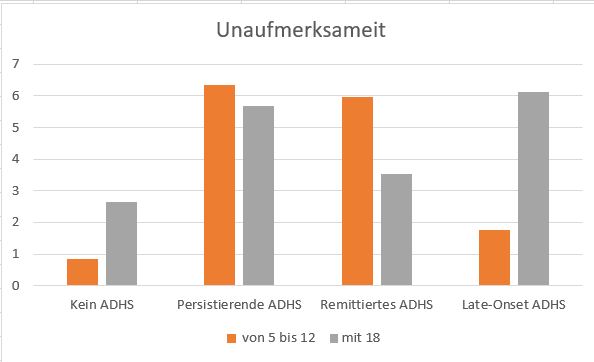
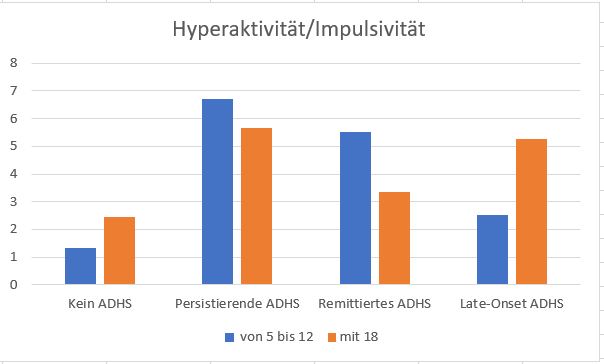
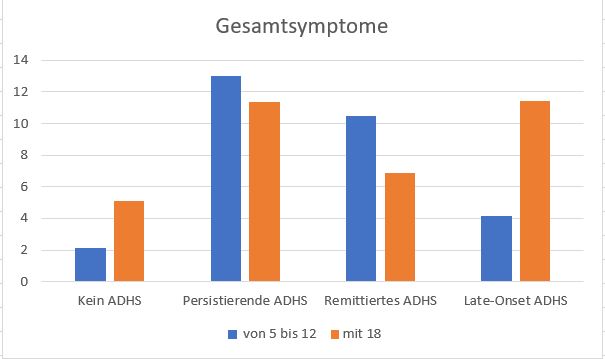
The data from Agnew-Blais et al., based on a twin cohort study (twin cohort study, n = 2,040, 13 years, E 2b)63, provide insight into the development of ADHD symptoms in
- Those not affected
- People with childhood ADHD and ADHD that later went into remission
- People with persistent childhood ADHD
- (subthreshold) late-onset ADHD
The symptoms of each group at ages 5 through 12 are compared with those at age 18 (N = 2,040):
 Another study examined the Pelotas birth cohort, consisting of N = 5,249 individuals born in Pelotas, Brazil, in 1993, following them until they were 18 to 19 years old; 81.3% of the cohort participated in the study. (Cohort study, n = 5,249, 19 years, E 2b)18
At age 11, 393 (8.9%) were found to have ADHD (based on a screening questionnaire calibrated to DSM-IV diagnoses). Most of the people with ADHD were male (63.9%).
At ages 18 to 19, 492 participants (12.2%) met all DSM-5 criteria (excluding age at onset). After excluding comorbidities, the prevalence remained at 6.3% (256). Women were overrepresented in this group (only 39.0% were male, compared to 50.4% among peers without ADHD).
Both groups exhibited higher rates of traffic accidents, criminal behavior, incarceration, suicide attempts, and comorbidities in adulthood.
The results suggest a discontinuity in ADHD and the possibility of late-onset ADHD.
Several long-term studies (following participants up to age 38) found that ADHD in children and ADHD in adults often affect distinct groups of people. (Cohort study, n = 1,037, 38 years, E 2b)80 An editorial interpreted the consistent findings from three cohorts (New Zealand, the United Kingdom, Brazil) as strong epidemiological evidence for the possibility of adult-onset ADHD. (Editorial, E 4.)81
(E 2b): Of the
- Children with ADHD still met the criteria for ADHD in adulthood:
- Adults with ADHD did not have ADHD as children:
In the Dunedin cohort, the gender distribution among adults with ADHD was balanced, while among children, males predominated. In the Pelotas cohort, females predominated among young adults with ADHD. (Cohort study, n = 5,249, 19 years, E 2b)82 Increasing irritability beginning in adolescence was predominantly found among girls and was associated with adolescent depression as well as with polygenic risk for depression and ADHD. (Cohort study, n = 7,924, 8 years, E 2b.)83 In the U.S., the gender gap in self-reported, lifetime ADHD diagnoses among 18- to 64-year-olds decreased by 31.1% (from 2.06 percentage points) between 2007 and 2012, due to an increased prevalence among women of all age groups. (Repeated Cross-Sectional Survey, E 3.)84 This, too, could suggest a divergence between the two groups.
The updated 2018 European Consensus on the Diagnosis and Treatment of ADHD in Adults (Consensus, E 4.)85 notes that adults with ADHD often do not recall their childhood behavior, and that reports regarding the onset of symptoms often differ both within and between informants. In addition, there are reports of adults whose symptoms did not begin until after age 7 (DSM-IV) or age 12 (DSM-5). In one study, the retrospectively reported onset of symptoms in such late-onset cases ranged from 7 to 45 years of age (83% between 7 and 12 years of age). (Case-control study, N = 370, n = 79, E 3.)86
Late-onset: all DSM-IV criteria except for onset before age 7; n = 79; full-spectrum ADHD, n = 127. 83% of late-onset cases had symptom onset before age 12. (Case-control study, N = 370, manufacturer-funded, E 3.)87
(E 2b): Late-onset ADHD differed barely from early-onset ADHD or persistent ADHD in:
- Impairment or Consequences at age 18 compared with persistent ADHD (twin cohort study, n = 2,040, 13 years, E 2b.)88 at age 17, more similar to those with early-onset ADHD than to unaffected individuals (cohort study, n = 1,571, 10 years, E 2b.)61 (case-control study, n = 316, E 3.)89
(Case-control study, N = 370, manufacturer-funded, E 3.)87
- Comorbidity or rates of mental disorders at age 18 compared with persistent ADHD (twin cohort study, n = 2,040, 13 years, E 2b.)88 (Case-control study, n = 316, E 3.)89
(Case-control study, N = 370, manufacturer-funded, E 3.)87
- familial clustering (case-control study, n = 316, E 3.)89
(Case-control study, N = 370, manufacturer-funded, E 3.)87
- ADHD symptoms at age 18, compared with persistent ADHD (twin cohort study, n = 2,040, 13 years, E 2b.)88
- Intelligence (case-control study, n = 316, E 3.)89
- Personality Profile (Case-Control Study, N = 370, n = 79, E 3.)86
- the pattern of neuropsychological deficits (late-onset, with onset after age 7); executive functions were most severely impaired in cases of full-spectrum ADHD (case-control study, N = 370, manufacturer-funded, E 3.)90
- polygenic risk and cognitive performance, as assessed by parents (cohort study, n = 4,224 to 9,764, up to age 25, E 2b.)70
A later onset of symptoms also indicated a milder subtype. (Cohort study, n = 1,571, 10 years, E 2b.)61
Subclinical ADHD (symptom threshold never reached, n = 41) was milder and exhibited a different pattern of familial transmission. (Case-control study, N = 370, manufacturer-funded, E 3.)87 Subclinical ADHD differed barely from non-affected individuals in neuropsychological terms. (Case-control study, N = 370, manufacturer-funded, E 3.)90
Among people with ADHD diagnosed at age 18 or older, 27% had comorbid major depression. (Genetic case-control study, N = 61,615, E 3.)91 Irritability beginning in adolescence occurred predominantly among girls and was associated with depression and polygenic risk for depression and ADHD, although childhood ADHD diagnoses were rare in this group. The authors speculate that a genetic predisposition to ADHD in this predominantly female group might manifest as a mood disorder. (Cohort study, n = 7,924, 8 years, E 2b.)83
A comparison of childhood symptoms recalled by participants at age 22 with data collected at age 11 revealed low scores among young adults with current ADHD (n = 518) for: (Cohort study, N = 3,810, n = 518, age 11, E 2b.)92
- negative predictive value of 62.1%
- Overall accuracy: 55.4%
- positive predictive value of 40.7%
- Sensitivity 32.8%
False-positive memories were associated with social phobia, while false-negative memories were associated with being male and having a lower level of education. The authors consider the recall of childhood symptoms to be an unreliable method for determining developmental trajectories. (Cohort study, N = 3,810, n = 518, 11 years, E 2b.)92
Of 104 adults diagnosed with ADHD at a specialized outpatient clinic, the following met the criteria based on a retrospective self-assessment for the ages of 5 to 12: (cross-sectional study, n = 104, E 3.)52
- 75% with at least 4 symptoms in at least one symptom category
- 50% of the full childhood criteria (6 symptoms in at least one symptom domain)
The risk of meeting the criteria for ADHD only in adolescence or adulthood also appears to be linked to prior mental disorders.
(E 2b): The following were identified as childhood precursors of late-onset ADHD:
- Baseline clinical characteristics and a family history of ADHD that predicted both persistence and new-onset cases (cohort study, N = 1,012, n = 875, 4 years, full text not available to us, E 2b.)77 (Cohort study, N = 1,012, n = 492, 9 years, full text not available to us, E 2b.)78
- oppositional defiant behavior and social behavior disorders, which are more common than in individuals without ADHD (Comment, E 4.)93
in many cases of ADHD that appear to have emerged in adulthood among large population cohorts (Editorial, E 4.)71
- increased behavioral problems that predicted de novo late-onset ADHD (cohort study, n = 9,875, 8 years, E 2b.)94
- Greater variability in reaction time and time-production measures among siblings with late-onset ADHD compared to stable, typically developing siblings (cohort study, n = 193 ADHD, 34 late-onset, 111 typically developing siblings, 186 controls, age 6 years, E 2b.)95
- Increased ADHD symptoms in many cases of ADHD that appear to have emerged in adulthood within large population cohorts (Brazil, the United Kingdom, New Zealand) (Editorial, E 4.)71 In the Brazilian cohort, only 38% of adult-onset cases were neurotypical based on ADHD and social-behavioral symptoms in childhood
In a Danish registry study, each group of mental disorders increased the risk for every subsequent group of disorders, and this relationship worked both ways. ADHD was grouped together with social behavior disorders and childhood emotional disorders in that study. (Cohort study, N = 5,940,778, 17 years, E 2b.)96 (Commentary, E 4.)93 This is consistent with the (long-known) inverse association—that ADHD in childhood increases the risk of later comorbidities—and with a shared vulnerability to mental disorders.
Among 318 children with perinatal risks and 64 controls without perinatal risks, a positive ADHD screening result (not a diagnosis) was found at age 40 in: (Cohort study, n = 382, age 40, E 2b.)97
- 21.6% of those with ADHD in childhood (n = 37). These individuals also had a lower level of education, more ADHD symptoms, more executive function problems, and more frequent substance use.
- 6.3% of those with attention problems but without a full-blown diagnosis of ADHD in childhood (n = 64)
- 6.0% of those without attention problems in childhood (n = 217)
- 1.6% of checkups with no perinatal risks (n = 64)
Subclinical symptoms in childhood were not associated with adverse consequences in adulthood in this cohort. (Cohort study, n = 382, age 40, E 2b.)97 According to this study, approximately 6% of children with perinatal risks who did not have childhood ADHD might show symptoms suggestive of ADHD for the first time at age 40 (controls: 1.6%).
Among adolescents (mean age 18.65 years), in addition to the 1.51% diagnosed with ADHD according to DSM-III-R, another 1.94% met the symptom criteria but not the age-of-onset criterion. (Cross-sectional study, population sample, n = 490, E 3.)98
Scientific: Symptom progression, gray matter, and polygenic risk
Among children in a Chinese general population cohort (ages 6 to 15, with two follow-up assessments approximately 1.14 years apart), three courses of ADHD symptoms were identified: increasing-high (late-onset), stable-low, and decreasing-moderate (remission). These trajectories were associated with gray matter volume in regions involved in attention regulation (left ACC/mPFC, right IPL, bilateral MFG/PCG). The polygenic risk score for ADHD was highest in the increasing-high course, followed by the decreasing-moderate and stable-low courses. (Cohort study, n = 487, E 2b.)99
Subclinical ADHD in women (ages 35 to 88, n = 82) was associated, like full-blown ADHD (n = 43), with more distressing childhood experiences and weaker parental bonding. Unlike with full-blown ADHD, a family history did not play a significant role (OR 1.92, 95% CI 0.75 to 4.95; full-blown ADHD OR 7.56, 95% CI 3.54 to 16.17). (Cross-sectional study, population-based, N = 2,741, E 3.)100
Some people with ADHD first meet the criteria for ADHD during adolescence. In a population-based study, approximately 14% of children with subclinical ADHD symptoms at age 9 met the diagnostic criteria four years later. (Narrative review, secondary citation from Shaw and Sudre (2021), E 4.)66
ADHD symptoms may be masked in adulthood and only become apparent when environmental conditions change or comorbidities arise, particularly under academic, occupational, or social stress resulting from the demands of college or work. (Narrative review, E 4.)73
3. Late-onset ADHD: De Novo Late-Onset ADHD
Implications for People with ADHD
Whether ADHD can first develop in adolescence or adulthood without any prior signs in childhood is a matter of debate. Several large long-term studies have identified many adults with ADHD who did not have the disorder as children. Upon closer examination, however, most of these cases had already shown mild symptoms or other abnormalities during childhood. Other cases could be explained by other mental disorders, heavy substance use, sleep problems, or measurement errors. A true late-onset diagnosis remained only in a small proportion of cases, mostly with onset in adolescence.
If symptoms first appear in adulthood, other causes should therefore be carefully ruled out. These include, for example, depression, anxiety disorders, substance use, sleep disorders, thyroid disorders, brain injuries, or side effects of medications.
Based on the limited data available to date, standard ADHD treatment was no less effective in cases of late-onset symptoms. The absence of elementary school report cards does not justify refusing treatment if the symptoms indicate a full-blown case of ADHD.
Whether there is a form of ADHD in which no ADHD symptoms were observable during childhood is a matter of debate.
Barkley argues—and we believe he is correct—that symptoms do not necessarily have to have appeared during childhood or adolescence, but can also appear for the first time even after the brain has finished developing (around age 23).
Findings from the Dunedin Birth Cohort Study (1,037 participants, followed until age 38) go even further. This study found a prevalence of ADHD in childhood of 6% (predominantly male) and at age 38 of 3% (equally distributed between genders). The authors considered it possible that adults with ADHD symptoms do not have a neurodevelopmental disorder that began in childhood and called for replication of the findings. The groups with childhood ADHD and adult ADHD barely showed overlap: (cohort study, n = 1,037, 38 years, E 2b.)3
- Only 3 of the 61 childhood cases (5%) still met the diagnostic criteria at age 38
- 90% of the 31 adult cases did not have ADHD during childhood
- According to parental assessments, the symptom scores for adult cases during childhood did not differ from those of the control group and were only slightly elevated in teacher assessments (ES = 0.31 SD)
- The adult group showed no neuropsychological deficits either in childhood or in adulthood and no polygenic risk for childhood ADHD
Given that ADHD is a syndrome that can arise from hundreds or even thousands of different causes, we believe that the varying developmental trajectories may also represent different sources of environmental influence. Possible examples include certain environmental toxins or diseases that contributed at different times. To investigate this, a study involving multiple birth cohorts from different countries could be helpful.
In a prospective study of 263 children (198 with a family history of ADHD and/or ASD, 65 without) aged 6 to 12 years, 50% of the total sample were in classes with typically developing children, compared to 75% in the group without a family history. (Cohort study, N = 263, n = 198, E 2b.)101
Depending on the age by which the first symptoms must have appeared, a population-based survey of adults (based on respondents’ retrospective recollection) identified individuals with clinical ADHD characteristics as follows: (Systematic review, k = 31, secondary citation from Kieling et al. 2010, E 3.)102
- 99% for those aged 16 and older
- 95% for those aged 12 and under
- 50% for animals up to 7 years of age
Most (but not all) cases of late-onset disorder developed between the ages of 12 and 16. (Narrative review, E 4.)103
According to this, however, (based on retrospective recollection) one in every hundred cases of ADHD would still have had the onset of the first symptoms after the age of 16. Assuming a prevalence of ADHD of 8%, this would amount to 64,000 people in Germany; at 5%, there would be 40,000 people with ADHD whose symptoms began after age 16. (ADxS estimate)
In most cases, it was found that several symptoms were already present during childhood or that high ADHD scores were observed at least once during childhood. (Consensus, E 4.)104
(E 3): Among adults with ADHD, the proportion by age at symptom onset was as follows: (cross-sectional study, N = 446, n = 388, E 3.)105
- 95% of adults diagnosed with ADHD for the first time had symptoms that began in childhood or adolescence (cross-sectional study; full text not available to us; E 3.)21
- 89.9% with onset in childhood among 388 adults at an ADHD specialty clinic who currently meet the full criteria for ADHD (DIVA-2)
- 6.9% with onset in adulthood (27 cases, 9 of which had subtle childhood symptoms)
- 3.2% with onset between the ages of 12 and 17
- 2.8% (n = 11) with isolated adult-onset ADHD after accounting for prior mental disorders and hypersomnolence
Based on the 95% prevalence rate, the authors concluded that adult-onset ADHD, if it exists, is rare. (Cross-sectional study; full text not available to us; E 3.)21 In the specialized outpatient clinic, adult-onset cases were more likely to present with the inattentive subtype (66.7% versus 41.7%) compared to 108 cases with childhood-onset ADHD of the same age and gender, milder symptoms, and a tendency toward more frequent hypersomnolence (33.3% versus 17.6%, p = 0.07). (Cross-sectional study, N = 446, n = 388, E 3.)105
Furthermore, it cannot be denied that there are environmental factors that can trigger or exacerbate ADHD symptoms even in adulthood. For more on this, see Physical ADHD Risk Factors and Psychological ADHD Risk Factors in the chapter “ : Causes”.
This would be consistent with the assumption that the heritability of adult ADHD is lower than that of childhood ADHD. (E 3): This would suggest that environmental factors may play a greater role in the development of ADHD in adults than in children. (Narrative review, E 4)106 (Twin study, n = 15,198, E 3)107 (E 2b): However, this is contradicted by the fact that the heritability of ADHD in adults was lower, particularly in self-report studies. Self-report measures were generally associated with lower heritability estimates. (Narrative review, E 4.)108 (Twin study, longitudinal, n = 44,607, E 2b.)109 (Case-control study, n = 275, E 3.)110 (Twin study, n = 6,372 twin pairs, E 3.)111 (Narrative review, E 4.)112 (E 3): The heritability of ADHD ranged, depending on the assessment method: (Twin study, n = 6,372 twin pairs, E 3.)111
- 82% based on parental ratings of 11- to 12-year-old twins
- up to 70 to 80% among adults in studies involving multiple informants or clinical diagnoses (narrative review, E 4.)108
- 60% based on teacher ratings of 11- to 12-year-old twins
- 48% based on self-assessment among 11- to 12-year-old twins
- 30 to 40% among adults in self-report studies (narrative review, E 4.)108
Regardless, it does not benefit people with ADHD if they are denied treatment in adulthood simply because certain ADHD symptoms were not identified during their childhood. There are no reports indicating that standard treatment methods (particularly stimulants) are less effective or less frequently effective in cases of late-onset ADHD. However, the available data on treatment response in late-onset ADHD is limited. Preliminary, retrospectively collected data suggest that response to medication depended on ADHD symptoms and impairments, regardless of the age of onset. (Narrative review, E 4.)103 Among children, adolescents, and adults who did not meet the earlier age criterion (onset of symptoms before age 7), the response to stimulants was similar to that of those who did meet it. (Systematic review, k = 31, E 3.)102 In this regard, close monitoring by the treating physician may be advisable; however, denying treatment would constitute a breach of the physician’s duty of care. We see this particularly when treatment in adulthood is denied solely on the basis of missing elementary school report cards, even though the symptoms indicate a full-blown case of ADHD.
A study examined 239 participants from the control group of the MTA study who did not have ADHD as children and who were assessed 8 times from childhood (mean age 9.9 years) through young adulthood (mean age 24.4 years): (Cohort study, n = 239, 14 years, E 2b.)113
- 97 adolescents met the DSM-5 symptom threshold based on a combined assessment by parents, teachers, and the adolescents themselves
- 32 of them also exhibited clinically significant impairments
- According to at least one source, 11 of them had already reached the symptom threshold before the age of 12 and were therefore considered cases with onset in childhood
- Of the remaining 21, cannabis use disorder was a better explanation for the symptoms in 3 of them
- Of the remaining 18, 9 had preexisting or comorbid mental disorders. In 5 cases, a clinical panel attributed the symptoms primarily to the other Disorder.
- Of the remaining 13 cases in which increased ADHD symptoms and impairments first appeared during adolescence, 7 were excluded because their symptoms were reported only by a teacher (6) or by a teacher and the student themselves, but only during class (1)
The study thus identified 6 cases (2.5% of the comparison group without ADHD at the start of the study) with de novo late-onset ADHD in adolescence (mean age of onset: 14.2 years). In 4 of these 6 cases, the symptoms were limited to adolescence. Five of the 6 cases had above-average but subclinical ADHD symptoms during childhood. The study identified 2 cases (0.8%) with onset in adulthood, both of whom had a complex psychiatric history. The most common cause of excluded late-onset symptoms in young adulthood was heavy substance use.
In our view, the study underestimates the prevalence of late-onset ADHD, since impairments during adolescence were assessed solely based on parental reports, and cases in which symptoms were reported by only one source during adolescence were excluded. The latter, however, is consistent with the DSM-5 requirement for symptoms to be present across multiple areas of life. Furthermore, the follow-up period extended only until the mid-20s.
However, the study reliably concludes that, even when viewed from the most critical perspective, there is a small group of people with late-onset ADHD in adolescence—though this condition usually followed subtle childhood symptoms and often remained limited to adolescence. (Brief review with literature search, n = 7, E 4)114
Late-Onset ADHD: ADHD that develops later in life or is diagnosed later?
Until DSM-IV, the diagnostic criteria for ADHD required that the first symptoms appear no later than age 6. With DSM-5, this was raised to an age of under 12. This does not mean that the diagnosis is merely a late one of ADHD that was already present at that time. The DSM and ICD do not require that enough symptoms had already been present by age 11 to warrant a diagnosis at that time; rather, they only require that some symptoms were recognizable. The consequences of this are that the DSM and ICD themselves assume that symptoms can still develop or intensify for the first time after the age of 12.
Nevertheless, we believe that a first-time onset in adulthood (de novo late-onset) is likely to be rather rare. We assume that ADHD first appearing in adulthood generally already existed previously and, in most cases, had either been overlooked, misdiagnosed, or masked by intensive coping mechanisms until then. This kind of coping takes a great deal of energy and very few people can sustain it over the long term. Once that energy is exhausted, the facade of coping collapses and the ADHD becomes apparent. This is particularly true for women.
The well-known poor long-term memory of people with ADHD and the increased disorganization characteristic of ADHD—where the fact that the person in question is able to store their elementary school report cards in a way that allows them to be found later would almost be an argument against ADHD— cannot, in such a case, justify refusing to make a diagnosis for that reason alone.
We do believe that ADHD generally existed earlier but simply went undiagnosed (whether due to a lack of knowledge on the part of doctors or therapists, because of effective coping mechanisms—such as being highly gifted—or because of a well-structured home environment that is no longer present in independent adult life). Nevertheless, some questions regarding this remain unanswered.114
In an editorial, de novo late-onset ADHD in adolescents was hypothetically linked to the chronobiological rhythm, which is typically delayed in adolescents. (Editorial, E 4.)115 For more on circadian rhythms, see Circadian Rhythms and the Influence of Genes in the article Sleep Problems in ADHD—Neurophysiological Correlates In the section “Neurophysiological Correlates of ADHD” in the chapter “ ” Neurological.
Three population-based studies reported high rates of adult-onset ADHD: (Narrative review, E 4.)116
- 10.3% in Brazil
- 5.5% in the United Kingdom
- 2.7% in New Zealand
The high rates of adult-onset ADHD in population cohorts may be overestimated. (Editorial, E 4.)71 Significant limitations of these studies included:
- Informants (childhood diagnoses based on parental assessments, adult diagnoses based on self-reports) (Narrative review, E 4.)116 (childhood diagnoses based on parental or teacher assessments, adult diagnoses based on less reliable self-reports) (Editorial, E 4.)71
- false-positive diagnoses (with a 5% prevalence and a 5% false-positive rate, half of the diagnoses would be false positives, the “false-positive paradox”) (Narrative review, E 4.)116 (Editorial, E 4.)71
- Age of participants (in Brazil and the United Kingdom, only 18 to 19 years old) (Narrative review, E 4.)116
- Prevalence of persistent childhood ADHD (significantly lower than expected, suggesting that some childhood cases may have been overlooked) (Narrative review, E 4.)116
- Low heritability of adult ADHD in the British cohort (35%) as a possible indication of measurement error (Editorial, E 4.)71
In all three studies, many cases of adult-onset ADHD had already exhibited increased ADHD symptoms, a social behavior disorder, or oppositional defiant behavior during childhood. The authors proposed the term “apparent adult-onset ADHD.” Following brain injuries, diagnosable secondary ADHD can also develop in adulthood. (Narrative review, E 4.)116
In the MTA comparison group, the most common “late-onset” form was one in which symptoms began in adolescence and then went into remission by adulthood. Only 2 cases with onset in adulthood were identified (less than 1% of the comparison group), both with a complex psychiatric history. Between 53% and 83% of the cases that initially met the criteria for late-onset ADHD were excluded upon review of a more complete medical history. The authors estimate that their correction would exclude approximately 80% of the presumed adult-onset cases identified in epidemiological studies. (Letter to the Editor, E 4.)117
Previous studies on adult-onset ADHD were methodologically insufficient to assess its existence. Symptoms that appear later in life do appear to exist. The authors cited as possible sources symptoms previously masked by low environmental demands or supportive factors, inadequately investigated phenocopies, and symptoms overlooked during childhood. (Systematic review, k = 9, E 2b.)118
Of 507 individuals with ADHD aged 22, after excluding cases with a history of mental health issues, abnormal IQ scores, other mental disorders in adulthood, or significant substance use, only 31 individuals (6.1%) met the criteria for a true onset in adolescence or adulthood. (Cohort study, n = 4,676, 11 years, E 2b.)119 In a longitudinal analysis (latent classes), the proportions were as follows: (Cohort study, n = 4,676, 11 years, E 2b.)119
- stable (neurodevelopmental) symptom progression, 78.1%
- Symptoms that worsen after puberty, 21.9%
The ascending course was associated with female sex (71% of people with ADHD) and a higher IQ (OR 1.04). (Cohort study, n = 4,676, 11 years, E 2b.)119
Of 87 women who did not have ADHD in childhood, 17 (19.5%) met the ADHD symptom criteria during adolescence or adulthood. Of these, 15 showed no evidence of onset in childhood, 10 exhibited significant impairment, and 9 had symptoms across multiple situations. Of these 9, all but one woman had clinically relevant comorbid or pre-existing mental disorders or substance use that could explain the symptoms. (Cohort study, n = 87, 16 years, E 2b.)120
Of 74 Swedish twins (born between 1992 and 1999) who were not diagnosed with ADHD until adulthood, only 9 (0.06% of the total sample, including 6 women) showed no discernible neuropsychiatric symptoms during childhood. (Cohort study, twins, n = 74 with adult diagnosis, n = 194 with childhood diagnosis, n = 394 with adolescent diagnosis, n = 14,474 controls, E 2b.)49 The proportion with another psychiatric diagnosis before the age of 18 was: (Cohort study, twins, n = 74 with an adult diagnosis, n = 194 with a childhood diagnosis, n = 394 with an adolescent diagnosis, n = 14,474 controls, E 2b.)49
- ADHD diagnosis in childhood (more than 12 years ago), 73.20%, OR = 9.54 (6.96 to 13.27)
- ADHD diagnosis in adolescence (ages 12 to 18), 63.45%, OR = 6.54 (5.31 to 8.08)
- ADHD diagnosis in adulthood, 50%, OR = 4.29 (2.70 to 6.82)
- Control group, 20.14%
(E 2b): In cases of ADHD that first appeared or were diagnosed during adolescence or adulthood, abnormalities were already present in childhood
- For ADHD symptoms:
- ADHD symptom scores approximately three times higher than those of unaffected individuals at ages 9 or 12 (based on parent interviews) among Swedish twins diagnosed with ADHD in adulthood (cohort study, twins, n = 74 with an adult diagnosis, n = 194 with a childhood diagnosis, n = 394 with an adolescent diagnosis, n = 14,474 controls, E 2b.)49
- At least subclinical ADHD symptoms at age 11 or 15 in 67.5% of 507 individuals with ADHD at age 22 (cohort study, n = 4,676, 11 years, E 2b.)119
- in cases of other psychopathology: (cohort study, n = 924, approximately 3 years, E 2b.)121
- more autistic traits, tics, and oppositional behavior than in unaffected individuals (Swedish twins diagnosed with ADHD in adulthood) (Cohort study, twins, n = 74 with an adult diagnosis, n = 194 with a childhood diagnosis, n = 394 with an adolescent diagnosis, n = 14,474 controls, E 2b.)49
- more symptoms in other psychopathological areas than in those not affected (adolescents whose symptoms began during adolescence, in childhood without an ADHD diagnosis)
- a higher general psychopathology factor (p-factor) than in unaffected individuals (adolescents whose symptoms began during adolescence)
- regarding neurocognitive functions: (cohort study, n = 193 with ADHD, 34 with late-onset ADHD, 111 unaffected siblings, 186 controls, 6 years, E 2b.)95
- greater variability in reaction times and time-production than in stable, unaffected siblings (siblings of children with ADHD who developed late-onset ADHD after age 12; mean age 11.3 years)
- as seen in children with childhood ADHD, longer reaction times or more errors on all neurocognitive measures compared to controls (siblings with later-onset ADHD)
- more executive dysfunction than in unaffected individuals (adolescents with symptom onset during adolescence) (cohort study, n = 924, approximately 3 years, E 2b.)121
- for school-related problems:
- greater academic impairment than among those not affected (adolescents with symptom onset during adolescence) (cohort study, n = 924, approximately 3 years, E 2b.)121
- Learning difficulties (Swedish twins diagnosed with ADHD in adulthood) (Cohort study, twins, n = 74 with an adult diagnosis, n = 194 with a childhood diagnosis, n = 394 with an adolescent diagnosis, n = 14,474 controls, E 2b.)49
- in cases of motor problems (Swedish twins diagnosed with ADHD in adulthood) (Cohort study, twins, n = 74 with an adult diagnosis, n = 194 with a childhood diagnosis, n = 394 with an adolescent diagnosis, n = 14,474 controls, E 2b.)49
In 52% (28 of 54) of adolescents with ADHD in a Brazilian community-based cohort, symptoms did not begin until adolescence. These adolescents were similarly impaired as adolescents with ADHD that had been present since childhood. (Cohort study, n = 924, approximately 3 years, E 2b.)121
Several longitudinal studies have observed ADHD symptoms that first emerged during adolescence or adulthood. The etiology of this group is unclear. These individuals did not meet current diagnostic criteria at the known age of onset, which calls into question the concept of ADHD as a neurodevelopmental disorder. (Narrative review, E 4.)122 With regard to the polygenic risk for ADHD, late-onset ADHD showed:
- No association with polygenic ADHD risk scores in three studies (with low statistical power) (Narrative review, E 4.)122
- When identified in the parental assessment (onset in adolescence or early adulthood), a polygenic ADHD risk similar to that of persistent ADHD with childhood onset and comparable performance on cognitive tests (Cohort study, n = 4,224 to 9,764, up to age 25, E 2b.)70
- When assessed through self-report, no polygenic ADHD risk resembling persistent ADHD beginning in childhood and no comparable performance on cognitive tests (Cohort study, n = 4,224 to 9,764, up to age 25, E 2b.)70
- a lower polygenic risk of ADHD than in cases with childhood onset (adolescents with symptom onset during adolescence) (cohort study, n = 924, approximately 3 years, E 2b.)121
Scientific: Polygenic risk for ADHD that does not manifest until age 18
Individuals whose ADHD first appeared at age 18 (5.5%, n = 112) did not have an elevated polygenic risk score for ADHD, unlike individuals with persistent or remitted childhood ADHD. (Cohort study, twins, n = 2,232, 13 years, E 2b.)123
Late-onset ADHD (onset in adolescence or young adulthood) was associated with greater childhood resources (verbal IQ, reading ability, maternal education, family income) than childhood ADHD and was not significantly associated with risk factors for depression. The authors speculated that childhood resources may delay the onset of ADHD. (Cohort study, n = 4,224 to 9,764, up to age 25, E 2b.)70
The prevalence rates of 5 ADHD symptom subtypes among children aged 3 to 17 were as follows: (Cohort study, n = 10,262, 14 years, E 2b.)124
- unencumbered, 37.6%
- slightly polluted, 34.8%
- subclinical relapsing-remitting, 14.4%
- Onset during adolescence, 7.6%
- consistently high, 5.6%
Adolescents whose symptoms began during adolescence were, at age 17, similarly affected by peer victimization, mental health issues, and delinquency as the group with consistently high levels of these factors, but not in terms of substance use. Those with subclinical remission had lower self-esteem and well-being than those without such issues. (Cohort study, n = 10,262, 14 years, E 2b.)124
Adults whose ADHD symptoms began between the ages of 7 and 12 (as permitted by the DSM-5) experienced greater impairment at work compared to adults whose symptoms began before age 7 and received less family support; however, they were similarly impaired in other areas. Quality of life was reduced compared to non-affected individuals, regardless of age at onset. Lower levels of family support and current symptoms of anxiety and depression partially mediated the association between ADHD and quality of life or impairment. (Cross-sectional study, n = 147 with onset 7 years prior, n = 42 with onset between 7 and 12 years prior, n = 153 controls, E 3.)125
Scientific: Heritability of Clinically Diagnosed Adult ADHD
Clinically diagnosed ADHD in adults was highly heritable, with a heritability coefficient of 0.72 (95% CI 0.56 to 0.84). According to the authors, lower previous estimates were due to rater effects resulting from self-reporting. (Twin study, registry, n = 59,514, E 2b.)126
Scientific: Rater Effects in the Heritability of Adult ADHD
Twin studies in adults found a heritability of 30 to 40 percent when ADHD was assessed solely through self-reports, but 70 to 80 percent (as in children) when self-reports and parental assessments were combined or clinical diagnoses were used. The lower heritability in adults therefore reflects an assessor effect rather than a genuine developmental change. Furthermore, self-reported ADHD trajectories were not predicted by the cognitive-neurophysiological markers that had distinguished between persistent and remitted ADHD in parental assessments. (Comment, E 4.)127
Reports of de novo ADHD with onset in adulthood are controversial. Upon closer examination, they are usually explained by previously subclinical childhood symptoms, other psychological or physical causes, or measurement errors. (Narrative review; full text not available to us; E 4.)128 (E 4): If the onset of symptoms in childhood (before age 12) cannot be substantiated, newly emerging symptoms should be examined with particular care before diagnosing adult-onset ADHD, and mimics should be systematically ruled out. (Narrative review, full text not available to us, E 4.)128 (Letter to the editor, E 4.)129 This includes a search for triggering environmental or biological factors. (Letter to the editor, E 4.)129 The authors cited the following as non-ADHD causes of ADHD-like symptoms or false-positive ADHD symptom reports in adults:
- Brain injuries or traumatic brain injury (narrative review; full text not available to us, E 4.)128 (letter to the editor, E 4.)129
- Diseases that affect cognition and neurological disorders (Letter to the Editor, E 4.)129
- neurodegenerative diseases whose early symptoms may initially appear as ADHD-like symptoms that first become noticeable in adulthood (in a 34-year-old man with inattention, restlessness, impulsivity, and mood swings, with no reliably documented childhood symptoms, the differential diagnosis revealed Huntington’s chorea) (Case report, E 4.)130
- affective disorders (narrative review; full text not available to us; E 4.)128
- Anxiety Disorders (Narrative Review, full text not available to us, E 4.)128
- Substance Use Disorders (Narrative Review, full text not available to us, E 4.)128
- Sleep Disorders (Narrative Review, full text not available to us, E 4.)128
- Thyroid disorders (Narrative review; full text not available to us; E 4.)128
- Side effects of medications (narrative review; full text not available to us; E 4.)128
- Stress Responses (Letter to the Editor, E 4.)129
- an unhealthy lifestyle (sleep, diet, exercise) (Letter to the Editor, E 4.)129
- extreme environmental conditions (Letter to the Editor, E 4.)129
- Deprivation (Letter to the Editor, E 4.)129
- Behavioral addictions (Letter to the Editor, E 4.)129
Among adults referred for neuropsychological ADHD evaluation, clinically elevated emotional/internalizing dysfunction (MMPI-2-RF-EID, T-score of 65 or higher, n = 238) reported more current, but not childhood, ADHD symptoms (small effects, η²p 0.021 to 0.045). The effect was strongest among individuals without ADHD (η²p 0.045 to 0.046). In this group, elevated emotional dysfunction raised the overall ADHD score from the normal range to a mild clinical risk. The authors concluded that symptoms that appear convincing as ADHD may stem from nosologically distinct disorders and emphasized the importance of assessing childhood symptoms, which remained unaffected by current emotional dysfunction. (Cross-sectional study, n = 527, E 3.)131
4. Very Late-Onset ADHD / Senile-Onset / ADHD in Older Adults
Implications for People with ADHD
ADHD can also be diagnosed for the first time in older adults. In memory and dementia clinics, a small proportion of people with memory problems were diagnosed with ADHD rather than early-stage dementia. According to the authors, these were cases of previously well-managed ADHD that only became apparent later in life. They were often preceded by a stressful life event.
The symptoms primarily involved memory, concentration, and attention. ADHD and mild cognitive impairment (MCI) sometimes exhibited very similar performance profiles in older adults, which can lead to misdiagnoses. Women who were diagnosed after the age of 60 found that the diagnosis and treatment helped them accept themselves better.
ADHD was diagnosed in:
- 9.7% of psychiatric patients aged 65 and older (controls: 1.5%) (cross-sectional study, n = 261; full text not available to us, E 3.)132 Probable childhood ADHD (WURS score of 36 or higher) was present in 22.5%
- 2.2% (13 out of 583) of new patients with cognitive symptoms at a French memory clinic (10 women, mean age 50.2 years, ranging from 22 to 75 years) (case series, n = 13, E 4.)133
- 1.6% (7 out of 446) of patients consecutively admitted to a specialized dementia outpatient clinic who were initially suspected of having Alzheimer’s dementia (6 out of 7 were suspected of having early-onset Alzheimer’s dementia) (Observational study, N = 446, n = 7, E 3.)134
The authors now more accurately described the condition they had previously termed “very-late-onset ADHD” as a late manifestation of previously compensated ADHD. The 7 people with ADHD had four characteristics in common: (Observational study, N = 446, n = 7, E 3.)134
- significantly younger (median age 56, 6 out of 7 under 65) than the rest of the study population (median age 75)
- exclusively inattention-related symptoms (all met at least 5 inattention criteria, none met 5 hyperactivity/impulsivity criteria)
- latent manifestation
- a stressful life event prior to the onset of symptoms (stressful experience)
The 13 patients at the Memory Center diagnosed with ADHD
- reported problems with: (case series, n = 13, E 4.)133
- Memory, 85%
- Concentration, 77%
- Attention, 69%
- Organization, 54%
- exhibited neuropsychological deficits in: (case series, n = 13, E 4.)133
- Processing speed, 75%
- Sustained attention, 67%
- Working memory, 46%
- divided attention, 45%
- Executive functions, 38%
More than 20% exhibited motor, verbal, or mental restlessness. 85% had a history of psychiatric disorders or comorbidities, primarily anxiety and depression. 46% had children or grandchildren with ADHD. Imaging (in 8 patients) revealed no explanatory abnormalities. (Case series, n = 13, E 4.)133
In older patients at a memory clinic, ADHD could be distinguished from MCI by an encoding deficit (rather than a storage deficit) and preserved semantic retrieval. (Cross-sectional study, n = 40 ADHD, 29 MCI, 37 controls, E 3.)135
The cognitive profiles of older adults with ADHD and MCI did not differ in any of the areas tested, which may contribute to misdiagnoses. (Cross-sectional study, n = 107, E 3.)136
Women who were diagnosed with ADHD after the age of 60 (ages 62 to 91) reported, in retrospect, experiencing rejection by their peers, a sense of being different, and difficulties at work and in their relationships. They had found creative solutions to their attention problems. According to them, diagnosis and treatment fostered self-acceptance and an appreciation of their own strengths. (Qualitative interview study, n = 9, E 4.)137
5. Late-Onset ADHD in Women
Implications for People with ADHD
In women, ADHD is particularly often diagnosed only in adulthood. In childhood, significantly more boys are diagnosed; in adulthood, the ratio is more balanced, and in some cases, even more women have been diagnosed. On average, women received the diagnosis about 4 years later than men, often after depression or anxiety disorders had previously been identified. Girls are more likely to exhibit inattention and less noticeable hyperactivity. Their symptoms are therefore more easily overlooked.
Hormones can influence ADHD symptoms. Many women with ADHD have reported more severe symptoms before their period, after childbirth, and during menopause. A drop in estrogen levels can intensify symptoms or cause them to appear for the first time. Women with ADHD were more likely to have premenstrual dysphoric disorder (PMDD) and, after childbirth, were more likely to experience depression and anxiety disorders.
To date, there have been no studies on ADHD medication specifically during menopause. Recommendations include individualized dosing, monitoring of heart and circulatory function, and consideration of hormone therapy as a complementary treatment.
It is relatively common for women to be diagnosed with ADHD only in adulthood. While many more boys than girls are diagnosed during childhood, the ratio is more balanced in adulthood.
(Registry study, n = 6,173, 6 years, E 2b.)138 (Registry study, n = 228,029, 8 years, E 3.)139 (Cross-sectional study, birth cohort, n = 3,574, E 3.)5 (Narrative review, k = 73, E 4.)140 (Narrative review, E 4.)141 (Narrative review, E 4.)116
In the Dunedin Cohort, ADHD in childhood was predominantly male, but by age 38, the prevalence was balanced across genders. (Cohort study, n = 1,037, age 38, E 2b.)3 In U.S. health surveys, the gender difference in ADHD prevalence among adults decreased by 31.1% from 2007 to 2012, due to an increase in prevalence among women of all age groups. (Cross-sectional study, E 3.)84
Girls meet the ADHD criteria about half as often as boys, but by adulthood, the ratio becomes much more similar. (Narrative review, E 4.)141
(E 2b): The sex ratio (male to female) for ADHD was
- based on the prevalence of:
- Children, depending on the sample (clinical or population-based), 10 to 1 to 3 to 1 (narrative review, k = 73, E 4.)140
- People under 20 years of age (administrative prevalence, Taiwanese health insurance, 2000–2007) 3.87 to 4.31 (registry study, n = 228,029, 8 years, E 3.)139
- Adults, regardless of sample origin: 1 to 1 to approximately 2 to 1 (narrative review, k = 73, E 4.)140
- People aged 20 to 65 (administrative prevalence, Taiwanese health insurance, 2000–2007) 0.35 to 0.98 (registry study, n = 228,029, 8 years, E 3.)139
- based on incidence data from the Taiwanese health insurance system (2000–2007) for: (register-based study, n = 228,029, 8 years, E 3.)139
- People under 20: 3.39 to 4.07
- People aged 20 to 65: 0.24 to 0.76
- in Taiwan, below 1 (more women than men are diagnosed with or treated for ADHD in adulthood) for:
In child and adolescent psychiatric hospitals, about 80% of ADHD cases are male, while in adult hospitals the figure is closer to 50%. (Narrative review, E 4.)116
(E 2b): A late onset of symptoms or a late ADHD diagnosis was more common among women. (Cohort study, n = 4,676, 11 years, E 2b.)119 (Cohort study, n = 508, full text not available to us, E 2b.)47 (Cross-sectional study, n = 13,527, E 3.)19 (Cross-sectional study, population sample, n = 490, E 3.)98
(E 2b): The proportion of women among individuals with ADHD was:
- 75.3% among adults who were not diagnosed with ADHD until age 18 or older (cross-sectional study, n = 13,527, E 3.)19
- 71.5% among those diagnosed in childhood or adolescence (cross-sectional study, n = 13,527, E 3.)19
- 71% for an ADHD symptom trajectory that increases after puberty (21.9% of individuals with ADHD at age 22) (cohort study, n = 4,676, 11 years, E 2b.)119 This pattern was associated with a higher IQ (OR 1.04). The stable pattern, which began in childhood, was more common among men.
- 67.1% at around age 30 (DSM-5), regardless of the chosen symptom threshold, birth cohort (cross-sectional study, birth cohort, n = 3,574, E 3.)5
Among adolescents receiving inpatient psychiatric treatment, ADHD diagnoses made after age 18 were more common among females, while early diagnoses were more common among males. Being female in combination with anxiety disorders increased the likelihood of a late diagnosis. (Cohort study, n = 508, full text not available to us, E 2b.)47
Among adolescents in a population sample (mean age 18.65 years), the weighted prevalence of ADHD according to DSM-III-R was 1.51% (2.62% for males, 0.54% for females). An additional 1.94% met the symptom criteria but not the age-of-onset criterion (within the past 7 years). In this group, females (3.2%) were represented more frequently than males (0.3%). (Cross-sectional study, population sample, n = 490, E 3.)98
(E 3): On average, women received their ADHD diagnosis nearly 4 years later than men (at 23.5 years versus 19.6 years). (Registry study, cross-sectional, n = 85,330 with ADHD, 426,626 controls, manufacturer-funded, E 3.)48 (Commentary, secondary citation from Agnew-Blais 2024, E 4.)142 The reference point was the first ADHD diagnosis or the first ADHD medication (95% CI for the difference: 3.74 to 4.11). Before and after this point in time, women had more frequent psychiatric comorbidities, received more medication, and utilized health care services more frequently than men with ADHD and women in the control group. (Registry study, cross-sectional, n = 85,330 with ADHD, 426,626 controls, manufacturer-funded, E 3.)48 Women had frequently been in contact with psychiatric care previously, often with diagnoses of mood or anxiety disorders. The commentator sees this as an indication of diagnostic overshadowing and calls for women-specific factors, such as phases of hormonal change, to be taken into account in diagnosis and treatment. (Commentary, secondary citation from Agnew-Blais 2024, E 4.)142
Among 87 women without childhood ADHD, 19.5% later met the criteria for ADHD symptoms, but only one woman exhibited impairment and cross-situational symptoms without a comorbid disorder that could explain the symptoms. (Cohort study, n = 87, 16 years, E 2b.)120
Women who are diagnosed later in life, in particular, experience the most severe symptoms and often suffer from comorbid conditions such as anxiety disorders or depression, which are typical consequences of long-term, untreated ADHD.
On the other hand, women are more prone to developing emotional disorders that emerge later in life (on average during adolescence), such as depression, dysthymia, various anxiety disorders, or eating disorders. Sex hormones are often cited as possible causes. (Narrative review, E 4)143
In animal and human studies, high estrogen levels alleviated deficits in learning and memory. (Narrative review, E 4)144 This could possibly explain why ADHD symptoms are often not yet detectable in girls during their school years and only become more apparent in women starting at age 35.
(E 3): Women with ADHD were more likely than men with ADHD to experience anxiety and depression or to have more affective and anxiety disorders. (Cross-sectional study, n = 212, E 3.)145 (Narrative review, E 4.)146 Women also had more eating disorders. Self-reported, but not clinician-reported, ADHD severity was higher in women than in men. Emotional dysregulation mediated 79.4% of this gender effect. (Cross-sectional study, n = 212, E 3.)145 According to a review, women with ADHD are more likely than men with ADHD to internalize symptoms and are more frequently emotionally dysregulated. Girls with ADHD were 5.4 times more likely to receive a diagnosis of major depression and were three times more likely to have been treated for depression prior to their ADHD diagnosis. Eating disorders (particularly binge eating and bulimia) are associated with ADHD in girls and women. (Narrative review, E 4.)146
Women with ADHD may feel more impaired than men, even when symptom severity is comparable. Gender differences among adults with ADHD (prevalence, persistence, impairment, comorbidity, cognition, treatment response) are based, at least in part, on methodological artifacts or social and cultural influences, rather than on fundamental differences in severity. (Narrative review, k = 73, E 4.)140
(E 4): Girls and women with ADHD predominantly exhibit inattention and less obvious hyperactivity and impulsivity. (Narrative review, E 4.)141 (Narrative review, full text not available to us, E 4.)147 In addition, there are internalizing problems (Narrative review, E 4.)141 as well as emotional dysregulation and verbal aggression. (Narrative review, full text not available to us, E 4.)147 ADHD in girls usually persists into adulthood. (Narrative review, full text not available to us, E 4.)147
In late adolescence, hyperactivity/impulsivity in boys declines to the same level as in girls, while gender differences in inattention persist. (Narrative review, E 4.)116
(E 2b): ADHD is often overlooked or underdiagnosed in girls and women. (Twin cohort with registry linkage, n = 19,804, E 2b.)148 (Narrative review, E 4.)141 (Narrative review, full text not available to us, E 4.)147 (Narrative review, full text not available to us, E 4.)149 Their symptoms and impairments are less obvious, and people with ADHD often employ compensatory strategies. (Narrative review, E 4.)141 ADHD is underdiagnosed, particularly among adults, women, and trans and non-binary individuals. Gender-related biases complicate diagnosis and treatment. (Narrative review, full text not available to us, E 4.)149
(E 2b): Girls with ADHD were less likely to receive medication, even when their symptoms were equally severe (narrative review; full text not available to us, E 4.)147 or when they did not have pronounced externalizing problems. (Twin cohort with registry linkage, n = 19,804, E 2b.)148
In the general population, 9-year-old boys scored higher than girls in all symptom domains (inattention, hyperactivity/impulsivity, behavioral problems, learning problems); clinically diagnosed boys and girls, however, were affected to the same degree. Hyperactivity/impulsivity and behavioral problems were stronger predictors of diagnosis and medication use among girls than among boys. Girls with ADHD who do not exhibit pronounced externalizing problems are therefore more easily overlooked and less likely to receive medication. Odds ratios for girls: (twin cohort with registry linkage, n = 19,804, E 2b.)148
- Medication for behavioral problems: OR 2.20 (1.05 to 4.63)
- Diagnosis of behavioral problems: OR 1.43 (1.09 to 1.87)
- Medication for hyperactivity/impulsivity: OR 1.24 (1.02 to 1.50)
- Diagnosis of hyperactivity/impulsivity: OR 1.08 (95% CI 1.01 to 1.15)
Scientific: Estrogen Loss and Serotonergic Circuits During Menopause
One possible mechanism that could explain late-onset symptoms, particularly in women, is masking by estradiol, which declines with age and especially during menopause, potentially revealing executive function problems. A placebo-controlled crossover study of 33 postmenopausal women found evidence that early childhood stress may have lasting effects on the serotonergic circuits underlying executive functions, which are unmasked by the loss of estradiol during menopause. ADHD was not investigated in this study. (RCT, crossover, n = 33, E 1b.)150
(E 4): A decline in estrogen levels (during the menstrual cycle or in perimenopause, menopause, and postmenopause) can exacerbate or reveal ADHD symptoms. (Narrative review, E 4.)151 (Narrative review, E 4.)152 (Theoretical review, E 4.)153
During perimenopause, menopause, and postmenopause, increasing inattention, emotional dysregulation, anxiety or depressive symptoms, hot flashes, sleep disturbances, and subjective cognitive complaints (brain fog, memory problems) are common. (Narrative review, E 4.)151
Estradiol promotes prefrontal executive functions and influences dopaminergic and noradrenergic transmission (upregulation of tyrosine hydroxylase, downregulation of MAO, inhibition of the dopamine transporter). Low estrogen levels during the menstrual cycle or in menopause are therefore often associated with an exacerbation of symptoms. This increase does not affect all women with ADHD to the same extent. Longitudinal studies with repeated measurements within the same individuals are lacking. (Narrative review, E 4.)152
A theoretical model posits that women with ADHD are subject to a dual burden from the organizing (pubertal) and activating (cyclical) effects of ovarian hormones. Rapid drops in estrogen levels could impair executive functions and behavioral control. (Theoretical review, E 4.)153
(E 3): The studies examining the association between sex hormones and ADHD in girls and women were small, heterogeneous, or contradictory. (Systematic review, k = 11, E 3.)154 (Narrative review, E 4.)155 The evidence from 11 studies largely supported a link between sex hormones and ADHD symptoms, particularly during puberty and the menstrual cycle. (Systematic review, k = 11, E 3.)154 Sex hormones can regulate intracellular signaling pathways that are thought to be altered in ADHD. No study had examined the relationship between menstrual cycle phase, hormone levels, and ADHD symptoms. The authors call for the menstrual cycle and life stages (premenarche, puberty, fertile phase, premenopause, postmenopause) to be taken into account in ADHD studies involving women. (Narrative review, E 4.)155
(E 3): Studies on ADHD during menopause or in later stages of adult women’s lives were largely lacking. The following were missing:
- Empirical studies on ADHD during menopause (systematic review, k = 11, E 3.)154
- Randomized controlled trials on ADHD medication specifically in menopausal women (Narrative review, E 4.)151
- Research on later stages of adult women’s lives, experiences during pregnancy, underrepresented populations, and the distinction between biological sex and gender (scoping review, k = 487, full text not available to us, E 4.)156 The number of studies on ADHD in girls and women increased approximately sixfold between 1989 and 2024.
(E 3): Women with ADHD reported higher levels of perimenopausal and menopausal symptoms. (Cohort study, cross-sectional analysis, n = 535 with ADHD, 4,857 without ADHD, E 3.)157 (Cross-sectional study, n = 209, E 3.)158
Women with ADHD had higher scores for perimenopausal symptoms (Menopause Rating Scale: 18.0 vs. 13.0), most notably among those aged 35 to 39 (19.0 vs. 12.5). Severe perimenopausal symptoms were more common among women with ADHD: (cohort study, cross-sectional analysis, n = 535 with ADHD, 4,857 without ADHD, E 3.)157
- somatic symptoms, 30.4% versus 13.9%, PR 2.20 (95% CI 1.88 to 2.57)
- Total symptoms: 54.2% vs. 30.1%, PR 1.80 (95% CI 1.64 to 1.98)
- mental health problems, 58.6% versus 36.0%, PR 1.63 (95% CI 1.51 to 1.76)
- urogenital symptoms, 43.2% versus 27.5%, PR 1.57 (95% CI 1.40 to 1.77)
The authors saw this as an indication that perimenopause begins earlier in individuals with ADHD.
Among women with ADHD during and after menopause (n = 37), menopausal symptoms were elevated compared to normative values across all subscales of the Greene Climacteric Scale (anxiety, depression, sexual dysfunction, vasomotor symptoms, and somatic symptoms). (Cross-sectional study, n = 209, E 3.)158
After adjusting for FDR, women with ADHD aged 45 to 60 reported no more menopausal symptoms than women without ADHD at any stage of menopause (pre-, peri-, or postmenopausal), even when stratified by ADHD medication use. ADHD symptoms and menopausal symptoms correlated across all participants, but the correlation was weaker among women with ADHD. The authors considered it possible that the symptoms were attributed differently. (Cross-sectional study, online survey, n = 656, of whom 245 had ADHD, E 3.)159
(E 3): Women with ADHD reported a worsening of their ADHD symptoms during periods of hormonal change (menstrual cycle, postpartum period, menopause). (Cross-sectional study, online survey, n = 600, E 3.)160 (Qualitative interview study, n = 14, E 4.)161
Women diagnosed with ADHD reported, in retrospect, a worsening of their ADHD symptoms in the following situations: (cross-sectional study, online survey, n = 600, E 3.)160
- Menopause, 97.5% of respondents (of whom 91.7% reported a worsening of inattention)
- Postpartum period, 70.4% of respondents
88.6% of premenopausal women not receiving hormone therapy reported cycle-related changes in symptoms, most often with a worsening of symptoms during the luteal phase. In contrast, ASRS scores did not differ across the different hormonal phases of life in this cross-sectional study. (Cross-sectional study, online survey, n = 600, E 3.)160
Women with ADHD of childbearing age described cyclical patterns characterized by high energy and productivity around ovulation and low energy as well as difficulty completing tasks during the premenstrual week, along with fluctuations throughout different life stages. As possible solutions, they cited hormone therapy to stabilize mood and impulsivity, as well as adjusted doses of stimulants. They lamented a lack of knowledge within the healthcare system regarding the influence of hormones on ADHD. (Qualitative interview study, n = 14, E 4.)161
(E 2b): ADHD symptoms and cognitive performance fluctuated with the menstrual cycle in women with ADHD. Deterioration was observed in:
- the mid-luteal phase and the premenstrual phase in women with ADHD (4 studies) and in women with premenstrual syndrome (PMS) or premenstrual dysphoric disorder (PMDD) (6 studies) regarding attention, executive functions, and impulsivity (Narrative Review, k = 29, E 4.)162, premenstrual (luteal phase, low estradiol), especially with high impulsivity (narrative review, E 4.)152, mostly during the luteal phase according to self-reports (cross-sectional study, online survey, n = 600, E 3.)160, during the premenstrual week with low energy and difficulty completing tasks (qualitative interview study, n = 14, E 4.)161
- menstruation, with comparatively mild symptoms during the mid-follicular phase, in women with ADHD taking amphetamine salts (pilot study, daily online survey, n = 30, 35 days, full text not available to us, E 2b.)163
- the early follicular phase and early luteal phase (after ovulation) in young women from a nonclinical sample (longitudinal study, daily measurements, n = 32, 35 days, E 2b.)164
- the period after ovulation for hyperactive-impulsive symptoms and around menstruation for inattention (theoretical model) (Theoretical Review, E 4.)153
Women with ADHD also reported more ADHD and depressive symptoms during the mid-luteal and premenstrual phases, as well as reduced efficacy of their stimulants. In non-clinical women (7 studies), however, attention performance tended to improve during the mid-luteal phase. The authors cited increased sensitivity to allopregnanolone, the perimenstrual drop in estrogen, and a lack of compensatory neural adaptations as possible mechanisms. Due to heterogeneous methodology and small sample sizes, the findings are considered preliminary. (Narrative review, k = 29, E 4.)162
In women with ADHD taking amphetamine salts, the difference in ADHD symptoms between menstruation and the mid-follicular phase correlated positively with changes in negative mood. (Pilot study, daily online survey, n = 30, 35 days, full text not available to us, E 2b.)163
In young women with regular menstrual cycles from a non-clinical sample, a decrease in estradiol levels accompanied by a simultaneous increase in progesterone or testosterone levels (saliva samples) was associated with more ADHD symptoms the following day, particularly among those with high trait impulsivity. (Longitudinal study, daily measurements, n = 32, 35 days, E 2b.)164
A scoping review identified 20 studies on the association between menstrual health and ADHD symptoms (participants aged 13 to 49, sample sizes ranging from 1 to 405), most of which were published after 2020 and used non-randomized, cross-sectional, qualitative, or case study designs. They addressed: (Scoping Review, k = 20, E 3.)165
- ADHD symptoms associated with menstrual disorders
- Menstrual cramps and ADHD symptoms
- Menstrual-cycle-related worsening of ADHD symptoms
- Menstrual side effects of stimulants
- Impaired attention due to menstrual cramps
- interventions tailored to the cycle
(E 2b): Women with ADHD were more likely to meet the criteria for (provisional) premenstrual dysphoric disorder (PMDD), and women with premenstrual disorder were more likely to have ADHD. (Register-based cohort study with embedded case-control analysis, N = 3,630,028, n = 104,972, 8.2 years, E 2b.)166 (Cross-sectional study, n = 715, E 3.)167 (Cross-sectional study, N = 199, n = 89, E 3.)168 (Cross-sectional study, n = 209, E 3.)158 (Cross-sectional study, n = 2,000, E 3.)169 (Case-control study, n = 58 with PMDS, 50 controls, full text not available to us, E 3.)170 (Cross-sectional study, n = 423, E 3.)171
(E 3): For a (provisional) PMDS, the amount was
- the rate among women with:
- 66.3% ADHD among those not using hormonal contraception (ages 20 to 40, PSST screening; autism 61.5%, controls 33.8%) (Cross-sectional study, N = 199, n = 89, E 3.)168
- 45.5% ADHD (ages 18 to 71, evidence of PMDD, n = 95; 28.7% in a population-based study) (Cross-sectional study, n = 209, E 3.)158 Women with indications of PMDD were less likely to use contraception (50.6% versus 68.1%). Antidepressants were associated with more PMDD symptoms.
- 41.1% ADHD based on symptom and impairment thresholds (ASRS, n = 229, ages 18 to 34), RR 4.17 (2.87 to 6.07) (Cross-sectional study, n = 715, E 3.)167
- 31.4% self-reported clinical ADHD diagnosis (n = 102, ages 18 to 34; 9.8% without ADHD), RR 3.19 (95% CI 2.04 to 4.98) (Cross-sectional study, n = 715, E 3.)167
- the risk is highest in cases of comorbid depression or anxiety disorder, in: (cross-sectional study, n = 715, E 3.)167
- ASRS-based ADHD with depression and/or an anxiety disorder: RR 4.53 (3.10 to 6.61)
- ASRS-based ADHD without depression or anxiety disorder: RR 3.09 (1.83 to 5.21)
- Clinical ADHD diagnosis without depression or anxiety disorder: RR 2.03 (0.86 to 4.78), not significant
In the study by Groenman et al., premenstrual symptoms were dimensionally associated with inattention, hyperactivity/impulsivity, and social difficulties. The authors assume that selection bias resulted from the recruitment process. The PMDS rate among the controls was 60.5% and 3.2%, respectively, in the two subsamples. (Cross-sectional study, N = 199, n = 89, E 3.)168
Among working women (ages 20 to 44, not using contraception and with no prior pregnancy), 8.6% exhibited ADHD symptoms (ASRS), and 5.1% had premenstrual dysphoric disorder (PMDD). ADHD symptoms were associated with a more than sixfold increased risk of PMDD (aOR 6.49, 95% CI 4.10 to 10.2), whereas autism traits were not (aOR 1.35, 0.76 to 2.26). (Cross-sectional study, n = 2,000, E 3.)169
Women with premenstrual disorder (PMD, premenstrual syndrome, or PMDS) were twice as likely to have previously received an ADHD diagnosis (OR 2.01, 95% CI 1.94 to 2.09) and were 3.55 times more likely to receive a first ADHD diagnosis following the PMD diagnosis (HR 3.55, 3.32 to 3.80). In a comparison of siblings (all mental disorders combined), the associations weakened but remained significant (OR 1.95, HR 1.82). (Register-based cohort study with embedded case-control analysis, N = 3,630,028, n = 104,972, 8.2 years, E 2b.)166
Women with premenstrual dysphoric disorder (PMDD) were more likely to have comorbid ADHD. From the preovulatory to the late luteal phase, their prospective daily memory problems and difficulties sustaining attention increased more markedly than those of the control group. Women with PMDD and ADHD exhibited more memory problems and dysfunctional impulsivity during the preovulatory and mid-luteal phases than women with PMDD without ADHD. (Case-control study, n = 58 with PMDS, 50 controls; full text not available to us; E 3.)170
Of 423 women with bipolar disorder, 187 (44.2%) met the DSM-5 criteria for provisional premenstrual dysphoric disorder (PMDD). They had higher scores on all ADHD scales (WURS, ASRS total, inattention, hyperactivity; p < 0.001 for each). A higher polygenic ADHD risk was associated with more severe PMDS symptoms (beta = 1.395, 95% CI 0.340 to 2.450) and more severe ADHD symptoms. (Cross-sectional study, n = 423, E 3.)171
Scientific: Polygenic risk, premenstrual symptoms, and reproductive traits
21.7% of pregnant women reported premenstrual symptoms (depression, irritability before menstruation). These symptoms were associated with a higher polygenic risk for several mental disorders, even among women with no history of psychiatric disorders, but were not associated with the polygenic score for height. Association of premenstrual symptoms with polygenic risk for: (Genetic association study, n = 56,725, E 3.)172
- Major depression β = 0.13 (95% CI 0.11 to 0.15)
- Schizophrenia β = 0.11 (0.09 to 0.13)
- bipolar disorder β = 0.07 (0.05 to 0.09)
- ADHD β = 0.07 (0.04 to 0.09)
- Autism β = 0.03 (0.01 to 0.05)
A higher polygenic risk of ADHD was associated with women who had an earlier first birth, earlier first sexual intercourse, more live births, and earlier menopause. These associations were primarily due to pleiotropy and barely at all to causal effects. Genetic correlation with ADHD risk for: (Genetic association study, N = 220,685, E 3.)173
- Age at first birth rg = -0.68 (± 0.03)
- Age at first sexual intercourse rg = -0.56 (± 0.03)
- Number of live births rg = 0.36 (± 0.04)
- Age at menopause rg = -0.27 (± 0.04)
(E 2b): Women with ADHD were more likely to experience depression during the perinatal period or after childbirth than women without ADHD. (Register-based cohort study, N = 773,047, n = 3,515, E 2b.)174 (Systematic review, k = 10, full text not available to us, E 3.)175 (Cross-sectional study, n = 209, E 3.)158
(E 2b): The prevalence of depression among women with ADHD was:
- 16.76% to 57.6% during the perinatal period (k = 10, increased risk compared to women without ADHD, OR 1.8 to 2.63) (Systematic review, k = 10, full text not available to us, E 3.)175 ADHD symptoms were associated with depressive symptoms. Most of the included studies were of moderate quality.
- 57.6% reported postpartum depression after their first birth (49 out of 85 mothers; in systematic reviews, 14.5% in high-income countries and 19.6% in low- to middle-income countries) (Cross-sectional study, n = 209, E 3.)158
- 16.76% were diagnosed with depression in the first year after childbirth among those with ADHD diagnosed before pregnancy; prevalence ratio (PR) 5.09 (95% CI 4.68 to 5.54) (Register-based cohort study, N = 773,047, n = 3,515, E 2b.)174
Women diagnosed with ADHD prior to pregnancy were approximately five times more likely to receive a diagnosis of depression or an anxiety disorder in the first year after giving birth, even when controlling for other known risk factors. An anxiety disorder was diagnosed in 24.92% of cases, with a probability ratio (PR) of 5.41 (5.06 to 5.78). Monitoring bias due to more frequent psychiatric contacts is possible. (Register-based cohort study, N = 773,047, n = 3,515, E 2b.)174
Girls and young women with ADHD (ages 15 to 24) had a threefold increased risk of depression, regardless of hormonal contraception use (aHR 3.69, 95% CI 3.60 to 3.78). Oral hormonal contraception was associated with a particularly high risk of depression in those with ADHD, while non-oral hormonal contraception was associated with a similarly moderately increased risk in both groups. Risk of depression in ADHD: (Register-based cohort study, N = 792,913, n = 29,767, E 2b.)176
- Compared with users without ADHD who take oral combination contraceptives, aHR 6.10 (5.79 to 6.43)
- women taking oral combination contraceptives compared with non-users without ADHD: aHR 5.19 (4.94 to 5.47)
- Progestin-only pill: aHR 5.00 (4.56 to 5.49)
There is a lack of randomized controlled trials on ADHD medication specifically in menopausal women. Current practice is based on expert consensus, the extrapolation of data from younger age groups, and small observational studies. Recommendations include individualized dosing, cardiovascular monitoring, and consideration of menopausal hormone therapy as a complementary measure. (Narrative review, E 4.)151
(E 1b): In women without ADHD who experienced new-onset executive function, memory, or concentration difficulties during midlife or after surgical menopause, ADHD medications resulted in greater improvement compared to placebo
- lisdexamfetamine (up to 60 mg/day, 6 weeks) following risk-reducing removal of the ovaries and fallopian tubes (surgical menopause) for: (RCT, crossover, n = 69, E 1b.)177
- Self-reported executive function (Brown ADD Scale, total score), 15.36 points; greater decrease (10.40 to 20.33)
- Response rate: 81.7% versus 45.8%, 3.64 times higher (range: 2.01 to 6.57)
- Attention/working memory (Letter-N-Back), 1.50 points better (p = 0.037)
- lisdexamfetamine (40 to 60 mg/day for 4 weeks) in healthy peri- and early postmenopausal women for: (RCT, crossover, n = 32, manufacturer-funded, E 1b.)178
- subjective executive functions (BADDS total score), p = 0.0001
- 4 out of 5 BADDS subscales, each with a p-value below 0.004
- delayed retrieval of text content, p = 0.018
- Atomoxetine (80 mg/day for 6 weeks) in healthy peri- and postmenopausal women with subjective memory and concentration problems for: (RCT, crossover, n = 16, manufacturer-funded, E 1b.)179
- BADDS working memory cluster (trend in the attention/concentration cluster). Atomoxetine reduced the total BADDS score compared to baseline
Under lisdexamfetamine treatment following surgical menopause, sustained attention and verbal memory did not improve any more than under placebo. A diagnosis of ADHD was an exclusion criterion. (RCT, crossover, n = 69, E 1b.)177
Other cognitive tests did not improve with lisdexamfetamine in peri- and early postmenopausal women. Systolic blood pressure (p = 0.017) and heart rate (p = 0.006) increased but remained within the normal range on average. (RCT, crossover, n = 32, manufacturer-funded, E 1b.)178
Atomoxetine had no effect on neuropsychological tests, behavioral measures, or cardiac vital signs that differed from that of placebo. (RCT, crossover, n = 16, manufacturer-funded, E 1b.)179
Some women experience cognitive difficulties in midlife that closely resemble the cognitive impairments seen in adults with ADHD. A commentary therefore asked whether symptoms of adult ADHD are related to menopausal symptoms, whether menopausal estrogen deficiency interacts with ADHD symptoms, and whether psychostimulants might be suitable for treating menopausal executive function impairments. The available data are insufficient to establish a clear association. (Commentary, E 4.)180
(E 2b): Prescriptions for ADHD medications increased more sharply among women in Norway than among men or in the general population. (Prescription registry study, 17 years, E 2b.)181 (Prescription registry study, 3 years, manufacturer-funded, E 2b.)182
(E 2b): In Norway, the use and prescriptions of ADHD medications increased
- Among people aged 6 to 64, the rate rose from 5.2 to 19.4 per 1,000 between 2006 and 2022, with the sharpest increase occurring starting in 2020, including an increase in: (Prescription Registry Study, 17 years, E 2b.)181
- Women: nearly six times as high (3.0 to 18.1 per 1,000)
- Almost three times as high for men (7.3 to 20.6 per 1,000)
- from 2020 to 2022 (prescription registry study, 3 years, manufacturer-funded, E 2b.)182
- in the incidence rate for:
- Women: 108.0%, particularly those aged 12 to 27
- all individuals by 68.1%
- in terms of prevalence for:
- Women, at 52.4%, particularly those aged 12 to 27
- all individuals by 36.5%
- in the incidence rate for:
The relative increase was greatest among adults, particularly among adult women. The male-to-female ratio decreased from 1.6 to 0.9 among adults and from 3.2 to 2.0 among children. Among 18- to 24-year-olds, women’s usage recently exceeded that of men. Starting in 2020, the rate of new prescriptions among women aged 13 to 34 was higher than that among men. (Prescription registry study, 17 years, E 2b.)181
Prescriptions for other psychotropic medications (anxiolytics, hypnotics/sedatives—stable; antidepressants—slightly increasing) and the activity of public psychiatric outpatient clinics did not increase to the same extent. Among 6- to 11-year-olds, the prevalence in 2022 remained higher among boys than among girls (2.77% versus 1.02%). (Prescription registry study, 3 years, manufacturer-funded, E 2b.)182
The proportion of births with an ADHD diagnosis in the year before or after delivery increased by 290% among privately insured women in the United States from 2008 to 2020, from 101 (95% CI 92 to 111) to 394 (371 to 419) per 10,000 births. Overall, this accounted for 2.28% of births. White women had the highest rates, followed by Black, Hispanic, and Asian women. (Serial cross-sectional study, n = 736,325 deliveries, E 3.)183
Liu, Asherson, Viding, Greven, Pingault (2019): Early Predictors of De Novo and Subthreshold Late-Onset ADHD in a Child and Adolescent Cohort. J Atten Disord. 2019 Dec 30:1087054719892888. PMID 31884885. doi: 10.1177/1087054719892888. ↥ ↥
Rajagopal, Duan, Vilar-Ribó, Grove, Zayats, Ramos-Quiroga, Satterstrom, Artigas, Bybjerg-Grauholm, Bækvad-Hansen, Als, Rosengren, Daly, Neale, Nordentoft, Werge, Mors, Hougaard, Mortensen, Ribasés, Børglum, Demontis (2022): Differences in the genetic architecture of common and rare variants in childhood, persistent and late-diagnosed attention-deficit hyperactivity disorder. Nat Genet. 2022 Aug;54(8):1117-1124. doi: 10.1038/s41588-022-01143-7. PMID: 35927488. PMC: PMC10028590 n = 77.914 ↥ ↥
Moffitt TE, Houts R, Asherson P, Belsky DW, Corcoran DL, Hammerle M, Harrington H, Hogan S, Meier MH, Polanczyk GV, Poulton R, Ramrakha S, Sugden K, Williams B, Rohde LA, Caspi A (2015): Is Adult ADHD a Childhood-Onset Neurodevelopmental Disorder? Evidence From a Four-Decade Longitudinal Cohort Study. Am J Psychiatry. 2015 Oct;172(10):967-77. doi: 10.1176/appi.ajp.2015.14101266. PMID: 25998281; PMCID: PMC4591104. ↥ ↥ ↥ ↥ ↥
Zeng XW, Hu LF, Cao XL, Yang BR, Wu ZM (2025): Fluctuating course of attention-deficit/hyperactivity disorder across development: Multifactorial influences. World J Psychiatry. 2025 Aug 19;15(8):107780. doi: 10.5498/wjp.v15.i8.107780. PMID: 40837790; PMCID: PMC12362609. REVIEW ↥
Vitola ES, Bau CH, Salum GA, Horta BL, Quevedo L, Barros FC, Pinheiro RT, Kieling C, Rohde LA, Grevet EH (2016): Exploring DSM-5 ADHD criteria beyond young adulthood: phenomenology, psychometric properties and prevalence in a large three-decade birth cohort. Psychol Med. 2016;47(4):744-754. doi: 10.1017/S0033291716002853. PMID: 27866484. ↥ ↥ ↥
Polanczyk G, Caspi A, Houts R, Kollins SH, Rohde LA, Moffitt TE (2010): Implications of extending the ADHD age-of-onset criterion to age 12: results from a prospectively studied birth cohort. J Am Acad Child Adolesc Psychiatry. 2010;49(3):210-6. PMID: 20410710. ↥ ↥
Todd RD, Huang H, Henderson CA (2008): Poor utility of the age of onset criterion for DSM-IV attention deficit/hyperactivity disorder: recommendations for DSM-V and ICD-11. J Child Psychol Psychiatry. 2008;49(9):942-9. doi: 10.1111/j.1469-7610.2008.01892.x. PMID: 18564071. ↥
Barkley RA, Biederman J (1997): Toward a broader definition of the age-of-onset criterion for attention-deficit hyperactivity disorder. J Am Acad Child Adolesc Psychiatry. 1997;36(9):1204-10. doi: 10.1097/00004583-199709000-00012. PMID: 9291721. REVIEW ↥
Sanders S, Thomas R, Glasziou P, Doust J (2019): A review of changes to the attention deficit/hyperactivity disorder age of onset criterion using the checklist for modifying disease definitions. BMC Psychiatry. 2019;19(1):357. doi: 10.1186/s12888-019-2337-7. PMID: 31718626; PMCID: PMC6849294. REVIEW ↥
Reinhardt MC, Benetti L, Victor MM, Grevet EH, Belmonte-de-Abreu P, Faraone SV, Rohde LA (2007): Is age-at-onset criterion relevant for the response to methylphenidate in attention-deficit/hyperactivity disorder?. J Clin Psychiatry. 2007;68(7):1109-16. doi: 10.4088/jcp.v68n0720. PMID: 17685750. ↥
Vande Voort JL, He JP, Jameson ND, Merikangas KR (2014): Impact of the DSM-5 attention-deficit/hyperactivity disorder age-of-onset criterion in the US adolescent population. J Am Acad Child Adolesc Psychiatry. 2014;53(7):736-44. doi: 10.1016/j.jaac.2014.03.005. PMID: 24954823; PMCID: PMC11503659. ↥
Lee T, Park KJ, Lee HJ, Kim HW (2016): Clinical and Neuropsychological Characteristics of ADHD According toAge-of-Onset Criterion in Korean Children and Adolescents. J Atten Disord. 2016;24(1):20-28. doi: 10.1177/1087054716684378. PMID: 28030984. ↥
Rohde LA, Biederman J, Zimmermann H, Schmitz M, Martins S, Tramontina S (2000): Exploring ADHD age-of-onset criterion in Brazilian adolescents. Eur Child Adolesc Psychiatry. 2000;9(3):212-8. doi: 10.1007/s007870070045. PMID: 11095044. ↥
Guimarães-da-Silva PO, Silva KL, Grevet EH, Salgado CA, Karam RG, Victor MM, Vitola ES, Mota NR, Fischer AG, Picon FA, Bertuzzi GP, Polina ER, Rohde LA, Belmonte-de-Abreu P, Bau CH (2012): Does age of onset of impairment impact on neuropsychological and personality features of adult ADHD? J Psychiatr Res. 2012;46(10):1307-11. doi: 10.1016/j.jpsychires.2012.06.010. PMID: 22817999. ↥
Applegate B, Lahey BB, Hart EL, Biederman J, Hynd GW, Barkley RA, Ollendick T, Frick PJ, Greenhill L, McBurnett K, Newcorn JH, Kerdyk L, Garfinkel B, Waldman I, Shaffer D (1997): Validity of the age-of-onset criterion for ADHD: a report from the DSM-IV field trials. J Am Acad Child Adolesc Psychiatry. 1997;36(9):1211-21. PMID: 9291722. ↥ ↥
Banaschewski T, Döpfner M (2014): [DMS-5 - attention-deficit/hyperactivity disorder]. Z Kinder Jugendpsychiatr Psychother. 2014;42(4):271-5; quiz 276-7. doi: 10.1024/1422-4917/a000299. PMID: 25005904. REVIEW ↥
Caye, Rocha, Anselmi, Murray, Menezes, Barros, Gonçalves, Wehrmeister, Jensen, Steinhausen, Swanson, Kieling, Rohde (2016): Attention-Deficit/Hyperactivity Disorder Trajectories From Childhood to Young Adulthood: Evidence From a Birth Cohort Supporting a Late-Onset Syndrome. JAMA Psychiatry. 2016 Jul 1;73(7):705-12. PMID: 27192050. doi: 10.1001/jamapsychiatry.2016.0383. ↥ ↥
Caye A, Rocha TB, Anselmi L, Murray J, Menezes AM, Barros FC, Gonçalves H, Wehrmeister F, Jensen CM, Steinhausen HC, Swanson JM, Kieling C, Rohde LA (2016): Attention-Deficit/Hyperactivity Disorder Trajectories From Childhood to Young Adulthood: Evidence From a Birth Cohort Supporting a Late-Onset Syndrome. JAMA Psychiatry. 2016 Jul 1;73(7):705-12. doi: 10.1001/jamapsychiatry.2016.0383. PMID: 27192050. ↥ ↥ ↥ ↥
Leffa DT, Bauer-Negrini G, Bellaver B, Lussier FZ, Ferreira PCL, Povala G, Cortese S, Rohde LA, Molina BSG, Pascoal TA (2026): Age at Diagnosis and Clinical and Genetic Profiles Among Adults With Attention-Deficit/Hyperactivity Disorder. JAMA Netw Open. 2026;9(9):e2634125. doi: 10.1001/jamanetworkopen.2026.34125. PMID: 42747853; PMCID: PMC13583653. ↥ ↥ ↥ ↥ ↥ ↥
Kandeğer A, Güler HA, Özaltın MS, Bayırlı Ö, Söylemez H, Yıldız E, Semerci B (2025): Could Maladaptive Daydreaming Delay ADHD Diagnosis Until Adulthood? Clinical Characteristics of Adults With ADHD Based on Diagnosis Age. J Atten Disord. 2025;29(5):387-396. doi: 10.1177/10870547241310990. PMID: 39758016. ↥ ↥ ↥ ↥
Hutt Vater C, DiSalvo M, Ehrlich A, Parker H, O’Connor H, Faraone SV, Biederman J (2024): ADHD in Adults: Does Age at Diagnosis Matter?. J Atten Disord. 2024;28(5):614-624. doi: 10.1177/10870547231218450. PMID: 38166536. ↥ ↥ ↥ ↥
Chung W, Jiang SF, Paksarian D, Nikolaidis A, Castellanos FX, Merikangas KR, Milham MP (2019): Trends in the Prevalence and Incidence of Attention-Deficit/Hyperactivity Disorder Among Adults and Children of Different Racial and Ethnic Groups. JAMA Netw Open. 2019;2(11):e1914344. doi: 10.1001/jamanetworkopen.2019.14344. PMID: 31675080; PMCID: PMC6826640. ↥ ↥ ↥ ↥
Giacobini M, Medin E, Ahnemark E, Russo LJ, Carlqvist P (2018): Prevalence, Patient Characteristics, and Pharmacological Treatment of Children, Adolescents, and Adults Diagnosed With ADHD in Sweden. J Atten Disord. 2018;22(1):3-13. doi: 10.1177/1087054714554617. PMID: 25376193. ↥ ↥ ↥
Polyzoi M, Ahnemark E, Medin E, Ginsberg Y (2018): Estimated prevalence and incidence of diagnosed ADHD and health care utilization in adults in Sweden - a longitudinal population-based register study. Neuropsychiatr Dis Treat. 2018;14:1149-1161. doi: 10.2147/NDT.S155838. PMID: 29765219; PMCID: PMC5944447. ↥ ↥ ↥
Kristiansen CB, Shanmuganathan JW, Gustafsson LN, Løkke KP, Munk-Jørgensen P (2015): Increasing incidence and diagnostic instability in adult attention-deficit hyperactivity disorder nationwide between 1995 and 2012. Atten Defic Hyperact Disord. 2015;7(2):151-6. doi: 10.1007/s12402-014-0155-9. PMID: 25304687. ↥ ↥ ↥
Thome J, Behnke K, Gleitz M, Steer L, Weiher M, Hasford J (2019): [Quality and Structure of Outpatient Care for Adults with ADHD (Attention Deficit Hyperactivity Disorder) - Results of the RAABE-Study [Retrospective Data Analysis of ADHD Treatment in Adults]]. Psychiatr Prax. 2019;46(6):317-323. doi: 10.1055/a-0880-1804. PMID: 31408892. ↥ ↥
Aragonès E, Lluís Piñol J, Ramos-Quiroga JA, López-Cortacans G, Caballero A, Bosch R (2010): Prevalence in adults of attention deficit hyperactivity disorder using the medical records of primary care. Rev Esp Salud Publica. 2010;84(4):417-22. PMID: 21141268. ↥ ↥
Klein RG, Mannuzza S, Olazagasti MA, Roizen E, Hutchison JA, Lashua EC, Castellanos FX (2012): Clinical and functional outcome of childhood attention-deficit/hyperactivity disorder 33 years later. Arch Gen Psychiatry. 2012;69(12):1295-303. doi: 10.1001/archgenpsychiatry.2012.271. PMID: 23070149; PMCID: PMC3597443. ↥ ↥
Mannuzza S, Klein RG, Klein DF, Bessler A, Shrout P (2002): Accuracy of adult recall of childhood attention deficit hyperactivity disorder. Am J Psychiatry. 2002;159(11):1882-8. doi: 10.1176/appi.ajp.159.11.1882. PMID: 12411223. ↥ ↥
Riglin L, Blakey R, Langley K, Thapar AK, Agha SS, Davey Smith G, Stergiakouli E, Thapar A (2021): Assessment of age-at-onset criterion for adult attention-deficit hyperactivity disorder. Br J Psychiatry. 2021;220(2):73-75. doi: 10.1192/bjp.2021.122. PMID: 35049487; PMCID: PMC7612274. ↥ ↥
Green SM, Loeber R, Lahey BB (1991): Stability of mothers’ recall of the age of onset of their child’s attention and hyperactivity problems. J Am Acad Child Adolesc Psychiatry. 1991;30(1):135-7. doi: 10.1097/00004583-199101000-00020. PMID: 2005048. ↥ ↥
Wolf F, Heinzel-Gutenbrunner M, Becker K (2018): [Retrospective recording of childhood ADHD symptoms : Follow-up of adults formerly diagnosed with childhood ADHD and/or childhood conduct disorder]. Nervenarzt. 2018;89(3):327-334. doi: 10.1007/s00115-017-0321-3. PMID: 28382487. ↥ ↥ ↥
Simon V, Czobor P, Bálint S, Mészáros A, Murai Z, Bitter I (2007): [Detailed review of epidemiologic studies on adult Attention Deficit/Hyperactivity Disorder (ADHD)]. Psychiatr Hung. 2007;22(1):4-19. PMID: 17558040. REVIEW ↥
Waltereit J, Borghoff C, Schulte-Rüther M, Roessner V, Waltereit R (2026): [Algorithm for the Retrospective Diagnostic Assessment of ICD-10, ICD-11, and DSM-5 ADHD Symptoms in Primary School Reports]. Z Kinder Jugendpsychiatr Psychother. 2026;54(5):269-279. doi: 10.1024/1422-4917/a001078. PMID: 42262184. ↥
Zhao Q, Yang K, Liu M, Shi Z, Zhao J, Wu Y, Wu Q, Zhai Y, Xu J, Zhang Z, Lei M, Gao Y, Zhang Q, Zheng Y, Liu F (2026): Shared genetic architecture between ADHD and intelligence varies across ADHD subtypes. BMC Med. 2026;24:459. doi: 10.1186/s12916-026-04998-3. PMID: 42298576; PMCID: PMC13501616. ↥
Ginsberg Y, Quintero J, Anand E, Casillas M, Upadhyaya HP (2014): Underdiagnosis of attention-deficit/hyperactivity disorder in adult patients: a review of the literature. Prim Care Companion CNS Disord. 2014;16(3):. doi: 10.4088/PCC.13r01600. PMID: 25317367; PMCID: PMC4195639. REVIEW ↥ ↥ ↥ ↥ ↥ ↥
Neves Muniz S (2026): [Adult ADHD: Underdiagnosis, healthcare barriers, and the role of primary care]. Semergen. 2026;52(7):102797. doi: 10.1016/j.semerg.2026.102797. PMID: 42407212. REVIEW ↥ ↥ ↥ ↥ ↥
Ginapp CM, Macdonald-Gagnon G, Angarita GA, Bold KW, Potenza MN (2022): The lived experiences of adults with attention-deficit/hyperactivity disorder: A rapid review of qualitative evidence. Front Psychiatry. 2022;13:949321. doi: 10.3389/fpsyt.2022.949321. PMID: 36032220; PMCID: PMC9403235. REVIEW ↥ ↥ ↥ ↥
Caci H, Bouchez J, Baylé FJ (2023): Bibliometric analysis of publications on attention deficit hyperactivity disorder (ADHD) in France since 1974. Arch Pediatr. 2023;30(8):525-529. doi: 10.1016/j.arcped.2023.08.007. PMID: 37798217. ↥ ↥
Tal L, Goodman YC (2025): “For Me, ‘Normality’ is Not Normal”: Rethinking Medical and Cultural Ideals of Midlife ADHD Diagnosis. Cult Med Psychiatry. 2025;49(1):183-204. doi: 10.1007/s11013-023-09825-5. PMID: 37148483. ↥
Peyre H, Hoertel N, Cortese S, Acquaviva E, De Maricourt P, Limosin F, Delorme R (2014): Attention-deficit/hyperactivity disorder symptom expression: a comparison of individual age at onset using item response theory. J Clin Psychiatry. 2014;75(4):386-92. doi: 10.4088/JCP.13m08638. PMID: 24813406. ↥
Gloger EM, Suhr JA (2020): Correlates of Poor Sleep and Subsequent Risk of Misdiagnosis in College Students Presenting with Cognitive Complaints. Arch Clin Neuropsychol. 2020;35(6):692-670. doi: 10.1093/arclin/acaa023. PMID: 32380521. ↥
Finley JA, Robinson AD, Cerny BM, Ovsiew GP, Pliskin NH, Calamia M, Ulrich DM, Phillips MS, Soble JR (2024): Examining the utility of the BAARS-IV scales as embedded symptom validity indicators for adult attention-deficit/hyperactivity disorder evaluations. Clin Neuropsychol. 2024;39(6):1581-1597. doi: 10.1080/13854046.2024.2420376. PMID: 39465583. ↥ ↥
Weniger T, Alm B, Sobanski E (2007): [For and against: attention deficit syndrome (ADS)–a diagnosis that neither helps patients nor therapists]. Psychiatr Prax. 2007;34(1):4-6. doi: 10.1055/s-2006-940149. PMID: 17211779. ↥
González-Hernández J, Galdames-Contreras D, Oporto-Segura S, Nervi-Nattero A, von Bernhardi R (2007): Adult attention-deficit/hyperactivity disorder: descriptive study in a Memory Unit. Rev Neurol. 2007;44(9):519-23. PMID: 17492608. ↥
Breunig S, Lawrence JM, Foote IF, Gebhardt HJ, Willcutt EG, Grotzinger AD (2024): Examining Differences in the Genetic and Functional Architecture of Attention-Deficit/Hyperactivity Disorder Diagnosed in Childhood and Adulthood. Biol Psychiatry Glob Open Sci. 2024;4(3):100307. doi: 10.1016/j.bpsgos.2024.100307. PMID: 38633226; PMCID: PMC11021367. ↥
Haavisto R, Räsänen V, Jallow J, Riipinen P, Riala K, Hakko H, Säynäjäkangas V, Halt AH (2026): Differences between early-diagnosed and late-diagnosed ADHD: a follow-up study of former adolescent psychiatric inpatients. Nord J Psychiatry. 2026;80(6):404-412. doi: 10.1080/08039488.2026.2700405. PMID: 42437387. ↥ ↥ ↥ ↥ ↥ ↥ ↥ ↥ ↥
Skoglund C, Sundström Poromaa I, Leksell D, Ekholm Selling K, Cars T, Giacobini M, Young S, Kopp Kallner H (2023): Time after time: failure to identify and support females with ADHD - a Swedish population register study. J Child Psychol Psychiatry. 2023;65(6):832-844. doi: 10.1111/jcpp.13920. PMID: 38016697. ↥ ↥ ↥ ↥
Taylor MJ, Larsson H, Gillberg C, Lichtenstein P, Lundström S (2018): Investigating the childhood symptom profile of community-based individuals diagnosed with attention-deficit/hyperactivity disorder as adults. J Child Psychol Psychiatry. 2018;60(3):259-266. doi: 10.1111/jcpp.12988. PMID: 30338854. ↥ ↥ ↥ ↥ ↥ ↥ ↥ ↥ ↥
Brancati GE, De Rosa U, De Dominicis F, Petrucci A, Nannini A, Medda P, Schiavi E, Perugi G (2023): History of Childhood/Adolescence Referral to Speciality Care or Treatment in Adult Patients with Attention-Deficit/Hyperactivity Disorder: Mutual Relations with Clinical Presentation, Psychiatric Comorbidity and Emotional Dysregulation. Brain Sci. 2023;13(9). doi: 10.3390/brainsci13091251. PMID: 37759852; PMCID: PMC10526193. ↥ ↥ ↥
Brod M, Schmitt E, Goodwin M, Hodgkins P, Niebler G (2011): ADHD burden of illness in older adults: a life course perspective. Qual Life Res. 2011;21(5):795-9. doi: 10.1007/s11136-011-9981-9. PMID: 21805205. ↥
Solanto MV (2018): The Prevalence of “Late-Onset” ADHD in a Clinically Referred Adult Sample. J Atten Disord. 2018;23(9):1026-1034. doi: 10.1177/1087054718765672. PMID: 29629842. ↥ ↥ ↥ ↥
Weiss M, Hechtman L, Weiss G (2000): ADHD in parents. J Am Acad Child Adolesc Psychiatry. 2000;39(8):1059-61. doi: 10.1097/00004583-200008000-00023. PMID: 10939236. REVIEW ↥
Rosenthal EA, Mitchell JT, Weisner TS, Silverstein N, Yi C, Arnold LE, Hechtman LT, Hinshaw SP, Jensen PS (2025): What Can Adults With ADHD Tell Us About Their Experiences? A Review of Qualitative Methods to Map a New Research Agenda. J Atten Disord. 2025;29(13):1190-1212. doi: 10.1177/10870547251352589. PMID: 40685894; PMCID: PMC12480623. REVIEW ↥ ↥
Verwaerde O, Galera C, Bouvard M, Briot K (2026): Experience of the diagnostic journey for ADHD in adulthood: A quantitative and qualitative study. Encephale. 2026;52(4):394-399. doi: 10.1016/j.encep.2025.12.004. PMID: 41833504. ↥ ↥
Quintero J, Vera R, Morales I, Zuluaga P, Fernández A (2017): Emotional Intelligence as an Evolutive Factor on Adult With ADHD. J Atten Disord. 2017;24(10):1462-1470. doi: 10.1177/1087054716688251. PMID: 28095738. ↥
Asherson, Agnew-Blais (2019): Annual Research Review: Does late-onset attention-deficit/hyperactivity disorder exist? J Child Psychol Psychiatry. 2019 Mar 7. doi: 10.1111/jcpp.13020. ↥
Müller (2018): Kinder tragen ADHS nur selten ins Erwachsenenalter. Ärztezeitung online 07.06.2018 ↥
Sibley MH, Rohde LA, Swanson JM, Hechtman LT, Molina BSG, Mitchell JT, Arnold LE, Caye A, Kennedy TM, Roy A, Stehli A (2017): Late-Onset ADHD Reconsidered With Comprehensive Repeated Assessments Between Ages 10 and 25. Am J Psychiatry. 175(2):140-149. Epub 2017 Oct 20. doi: 10.1176/appi.ajp.2017.17030298. PMID: 29050505; PMCID: PMC5814300. ↥
Liu, Li, Viding, Asherson, Pingault (2018): The developmental course of inattention symptoms predicts academic achievement due to shared genetic aetiology: a longitudinal twin study. Eur Child Adolesc Psychiatry. 2019 Mar;28(3):367-375. doi: 10.1007/s00787-018-1200-6. ↥
Murray, Booth, Auyeung, Eisner, Ribeaud, Obsuth (2018): Outcomes of ADHD Symptoms in Late Adolescence: Are Developmental Subtypes Important? J Atten Disord. 2018 Aug 22:1087054718790588. doi: 10.1177/1087054718790588. ↥ ↥ ↥
Murray, Eisner, Obsuth, Ribeaud (2017): Identifying Early Markers of “Late Onset” Attention Deficit and Hyperactivity/Impulsivity Symptoms. J Atten Disord. 2017 Apr 1:1087054717705202. doi: 10.1177/1087054717705202. ↥
Agnew-Blais, Polanczyk, Danese, Wertz, Moffitt, Arseneault (2016): Evaluation of the Persistence, Remission, and Emergence of Attention-Deficit/Hyperactivity Disorder in Young Adulthood. JAMA Psychiatry. 2016 Jul 1;73(7):713-20. doi: 10.1001/jamapsychiatry.2016.0465. ↥ ↥
Pingault, Viding, Galéra, Greven, Zheng, Plomin, Rijsdijk (2015): Genetic and Environmental Influences on the Developmental Course of Attention-Deficit/Hyperactivity Disorder Symptoms From Childhood to Adolescence. JAMA Psychiatry. 2015 Jul;72(7):651-8. doi: 10.1001/jamapsychiatry.2015.0469. n = 8.395 twin pairs ↥
Pingault, Tremblay, Vitaro, Carbonneau, Genolini, Falissard, Côté (2011): Childhood trajectories of inattention and hyperactivity and prediction of educational attainment in early adulthood: a 16-year longitudinal population-based study. Am J Psychiatry. 2011 Nov;168(11):1164-70. doi: 10.1176/appi.ajp.2011.10121732. n = 2.000 ↥
Shaw P, Sudre G (2021): Adolescent Attention-Deficit/Hyperactivity Disorder: Understanding Teenage Symptom Trajectories. Biol Psychiatry. 2021;89(2):152-161. doi: 10.1016/j.biopsych.2020.06.004. PMID: 32753233; PMCID: PMC7736482. REVIEW ↥ ↥ ↥
Cooper, Hammerton, Collishaw, Langley, Thapar, Dalsgaard, Stergiakouli, Tilling, Davey Smith, Maughan, O’Donovan, Thapar, Riglin (2018): Investigating late-onset ADHD: a population cohort investigation. J Child Psychol Psychiatry. 2018 Oct;59(10):1105-1113. doi: 10.1111/jcpp.12911. ↥
Cooper M, Hammerton G, Collishaw S, Langley K, Thapar A, Dalsgaard S, Stergiakouli E, Tilling K, Davey Smith G, Maughan B, O’Donovan M, Thapar A, Riglin L (2018): Investigating late-onset ADHD: a population cohort investigation. J Child Psychol Psychiatry. 2018 Oct;59(10):1105-1113. doi: 10.1111/jcpp.12911. PMID: 29683192; PMCID: PMC6175329. ↥
Jurek L, Montègue S, Larrieu A, Icard C, Rolland B (2023): Compared Profile of Late-Onset Versus Childhood-Onset ADHD: A Case-Control Study Among Treatment-Seeking Adult Patients. J Atten Disord. 2023 Aug 11:10870547231191756. doi: 10.1177/10870547231191756. PMID: 37565344. ↥
Riglin L, Wootton RE, Livingston LA, Agnew-Blais J, Arseneault L, Blakey R, Agha SS, Langley K, Collishaw S, O’Donovan MC, Davey Smith G, Stergiakouli E, Tilling K, Thapar A (2022): “Late-onset” ADHD symptoms in young adulthood: Is this ADHD? J Atten Disord. 2022;26(10):1271-1282. doi: 10.1177/10870547211066486. PMID: 35034501; PMCID: PMC7612898. ↥ ↥ ↥ ↥ ↥ ↥
Faraone SV, Biederman J (2016): Can Attention-Deficit/Hyperactivity Disorder Onset Occur in Adulthood? JAMA Psychiatry. 2016;73(7):655-6. doi: 10.1001/jamapsychiatry.2016.0400. PMID: 27191055. ↥ ↥ ↥ ↥ ↥ ↥ ↥ ↥
Kordon A, Kahl KG, Wahl K (2006): A new understanding of attention-deficit disorders–beyond the age-at-onset criterion of DSM-IV. Eur Arch Psychiatry Clin Neurosci. 2006;256 Suppl 1:i47-54. doi: 10.1007/s00406-006-1007-1. PMID: 16977552. REVIEW ↥ ↥
Pérez-Hernández S, Macias-Paz IU, Cruz-Rosas A (2024): Attention Deficit/Hyperactivity Disorder: Persistence in adulthood. Vertex. 2024;35(165, jul.-sep.):67-73. doi: 10.53680/vertex.v35i165.661. PMID: 39432002. REVIEW ↥ ↥ ↥
Carrillo P, Rey R, Padovan C, Herrmann M, Dorey JM (2022): Association Between Mild Neurocognitive Disorder Due to Alzheimer’s Disease and Possible Attention-deficit/Hyperactivity Disorder: A Case Report. J Psychiatr Pract. 2022;28(3):251-258. doi: 10.1097/PRA.0000000000000627. PMID: 35511103. ↥ ↥
Esin IS, Turan B, Akıncı MA, Karabak M, Dursun OB (2020): Do we need to re-think on subthreshold childhood psychiatric cases? A follow-up study. Med Hypotheses. 2020 Jun;139:109697. doi: 10.1016/j.mehy.2020.109697. PMID: 32247189. ↥
Antshel KM, Hendricks K, Shprintzen R, Fremont W, Higgins AM, Faraone SV, Kates WR (2013): The longitudinal course of attention deficit/hyperactivity disorder in velo-cardio-facial syndrome. J Pediatr. 2013;163(1):187-93.e1. doi: 10.1016/j.jpeds.2012.12.026. PMID: 23337092; PMCID: PMC3692611. ↥
Lecendreux M, Konofal E, Cortese S, Faraone SV (2015): A 4-year follow-up of attention-deficit/hyperactivity disorder in a population sample. J Clin Psychiatry. 2015;76(6):712-9. doi: 10.4088/JCP.14m09555. PMID: 26132672. ↥ ↥ ↥
Lecendreux M, Silverstein M, Konofal E, Cortese S, Faraone SV (2019): A 9-Year Follow-Up of Attention-Deficit/Hyperactivity Disorder in a Population Sample. J Clin Psychiatry. 2019;80(3). doi: 10.4088/JCP.18m12642. PMID: 31087826. ↥ ↥
Shakeshaft A, Heron J, Blakey R, Riglin L, Davey Smith G, Stergiakouli E, Tilling K, Thapar A (2023): Co-development of attention deficit hyperactivity disorder and autistic trait trajectories from childhood to early adulthood. J Child Psychol Psychiatry. 2023;64(11):1596-1607. doi: 10.1111/jcpp.13851. PMID: 37350028; PMCID: PMC7615536. ↥
Moffitt, Houts, Asherson, Belsky, Corcoran, Hammerle, Harrington, Hogan, Meier, Polanczyk, Poulton, Ramrakha, Sugden, Williams, Rohde, Caspi (2015): Is Adult ADHD a Childhood-Onset Neurodevelopmental Disorder? Evidence From a Four-Decade Longitudinal Cohort Study; American Journal of Psychiatry 2015 172:10, 967-977 ↥
Shaw, Polanczyk (2017): Combining epidemiological and neurobiological perspectives to characterize the lifetime trajectories of ADHD. Eur Child Adolesc Psychiatry (2017) 26: 139. https://doi.org/10.1007/s00787-017-0944-8 ↥
Caye, Rocha, Anselmi, Murray, Menezes, Barros, Gonçalves, Wehrmeister, Jensen, Steinhausen, Swanson, Kieling, Rohde (2016): Attention-Deficit/Hyperactivity Disorder Trajectories From Childhood to Young Adulthood: Evidence From a Birth Cohort Supporting a Late-Onset Syndrome. JAMA Psychiatry. 2016 Jul 1;73(7):705-12. doi: 10.1001/jamapsychiatry.2016.0383. ↥
Riglin, Eyre, Thapar, Stringaris, Leibenluft, Pine, Tilling, Smith, O’Donovan, Thapar (2019): Identifying Novel Types of Irritability Using a Developmental Genetic Approach. Am J Psychiatry. 2019 Aug 1;176(8):635-642. doi: 10.1176/appi.ajp.2019.18101134. ↥ ↥
London, Landes (2019): Cohort Change in the Prevalence of ADHD Among U.S. Adults: Evidence of a Gender-Specific Historical Period Effect. J Atten Disord. 2019 Jun 13:1087054719855689. doi: 10.1177/1087054719855689. ↥ ↥
Kooij, Bijlenga, Salerno, Jaeschke, Bitter, Balázs, Thome, Dom, Kasper, Filipe, Stes, Mohr, Leppämäki, Brugué, Bobes, Mccarthy, Richarte, Philipsen, Pehlivanidis, Niemela, Styr, Semerci, Bolea-Alamanac, Edvinsson, Baeyens, Wynchank, Sobanski, Philipsen, McNicholas, Caci, Mihailescu, Manor, Dobrescu, Krause, Fayyad, Ramos-Quiroga, Foeken, Rad, Adamou, Ohlmeier, Fitzgerald, Gill, Lensing, Mukaddes, Brudkiewicz, Gustafsson, Tania, Oswald, Carpentier, De Rossi, Delorme, Simoska, Pallanti, Young, Bejerot, Lehtonen, Kustow, Müller-Sedgwick, Hirvikoski, Pironti, Ginsberg, Félegeházy, Garcia-Portilla, Asherson (2018): Updated European Consensus Statement on diagnosis and treatment of adult ADHD, European Psychiatrie, European Psychiatry 56 (2019) 14–34, http://dx.doi.org/10.1016/j.eurpsy.2018.11.001, Seite 17 ↥
Faraone, Kunwar, Adamson, Biederman (2009): Personality traits among ADHD adults: implications of late-onset and subthreshold diagnoses; Psychol Med. 2009 Apr; 39(4): 685–693. doi: [10.1017/S0033291708003917]; PMCID: PMC2874959; NIHMSID: NIHMS199982; PMID: 18588742 ↥ ↥
Faraone SV, Biederman J, Spencer T, Mick E, Murray K, Petty C, Adamson JJ, Monuteaux MC (2006): Diagnosing adult attention deficit hyperactivity disorder: are late onset and subthreshold diagnoses valid?. Am J Psychiatry. 2006;163(10):1720-9; quiz 1859. doi: 10.1176/ajp.2006.163.10.1720. PMID: 17012682. ↥ ↥ ↥ ↥ ↥
Agnew-Blais JC, Polanczyk GV, Danese A, Wertz J, Moffitt TE, Arseneault L (2016): Evaluation of the Persistence, Remission, and Emergence of Attention-Deficit/Hyperactivity Disorder in Young Adulthood. JAMA Psychiatry. 2016 Jul 1;73(7):713-20. doi: 10.1001/jamapsychiatry.2016.0465. PMID: 27192174; PMCID: PMC5475268. ↥ ↥ ↥
Chandra, Biederman, Faraone (2016): Assessing the Validity of the Age at Onset Criterion for Diagnosing ADHD in DSM-5; J Atten Disord. 2016 Feb 27. pii: 1087054716629717. ↥ ↥ ↥ ↥
Faraone SV, Biederman J, Doyle A, Murray K, Petty C, Adamson JJ, Seidman L (2006): Neuropsychological studies of late onset and subthreshold diagnoses of adult attention-deficit/hyperactivity disorder. Biol Psychiatry. 2006;60(10):1081-7. doi: 10.1016/j.biopsych.2006.03.060. PMID: 16876139. ↥ ↥
Rajagopal, Duan, Vilar-Ribó, Grove, Zayats, Ramos-Quiroga, Satterstrom, Artigas, Bybjerg-Grauholm, Bækvad-Hansen, Als, Rosengren, Daly, Neale, Nordentoft, Werge, Mors, Hougaard, Mortensen, Ribasés, Børglum, Demontis (2022): Differences in the genetic architecture of common and rare variants in childhood, persistent and late-diagnosed attention-deficit hyperactivity disorder. Nat Genet. 2022 Aug;54(8):1117-1124. doi: 10.1038/s41588-022-01143-7. PMID: 35927488; PMCID: PMC10028590. ↥
Breda V, Rohde LA, Menezes AMB, Anselmi L, Caye A, Rovaris DL, Vitola ES, Bau CHD, Grevet EH (2019): Revisiting ADHD age-of-onset in adults: to what extent should we rely on the recall of childhood symptoms?. Psychol Med. 2019;50(5):857-866. doi: 10.1017/S003329171900076X. PMID: 30968792. ↥ ↥
Polanczyk, Casella, Jaffee (2019): Commentary: ADHD lifetime trajectories and the relevance of the developmental perspective to Psychiatry: reflections on Asherson and Agnew-Blais. J Child Psychol Psychiatry. 2019 Apr;60(4):353-355. doi: 10.1111/jcpp.13050. ↥ ↥
Liu CY, Asherson P, Viding E, Greven CU, Pingault JB (2019): Early Predictors of De Novo and Subthreshold Late-Onset ADHD in a Child and Adolescent Cohort. J Atten Disord. 2019 Dec 30:1087054719892888. doi: 10.1177/1087054719892888. PMID: 31884885. ↥
Ilbegi S, Buitelaar JK, Hoekstra PJ, Hartman CA, Franke B, Faraone SV, Oosterlaan J, Luman M, van Lieshout M, Rommelse NNJ (2020): Neurocognitive markers of late-onset ADHD: a 6-year longitudinal study. J Child Psychol Psychiatry. 2020;62(2):244-252. doi: 10.1111/jcpp.13272. PMID: 33059383. ↥ ↥
Plana-Ripoll, Pedersen, Holtz, Benros, Dalsgaard, de Jonge, Fan, Degenhardt, Ganna, Greve, Gunn, Iburg, Kessing, Lee, Lim, Mors, Nordentoft, Prior, Roest, Saha, Schork, Scott, Scott, Stedman, Sørensen, Werge, Whiteford, Laursen, Agerbo, Kessler, Mortensen, McGrath (2019): Exploring Comorbidity Within Mental Disorders Among a Danish National Population. JAMA Psychiatry. 2019;76(3):259-270. doi:10.1001/jamapsychiatry.2018.3658 201976(3):259–270. ↥
Schiavone, Virta, Leppämäki, Launes, Vanninen, Tuulio-Henriksson, Immonen, Järvinen, Lehto, Michelsson, Hokkanen (2019): ADHD and subthreshold symptoms in childhood and life outcomes at 40 years in a prospective birth-risk cohort. Psychiatry Res. 2019 Sep 25;281:112574. doi: 10.1016/j.psychres.2019.112574. ↥ ↥
Cuffe SP, McKeown RE, Jackson KL, Addy CL, Abramson R, Garrison CZ (2001): Prevalence of attention-deficit/hyperactivity disorder in a community sample of older adolescents. J Am Acad Child Adolesc Psychiatry. 2001;40(9):1037-44. doi: 10.1097/00004583-200109000-00012. PMID: 11556627. ↥ ↥ ↥
Wang Y, Ma L, Wang J, Ding Y, Liu N, Men W, Tan S, Gao JH, Qin S, He Y, Dong Q, Tao S (2024): The neural and genetic underpinnings of different developmental trajectories of Attention-Deficit/Hyperactivity Symptoms in children and adolescents. BMC Med. 2024;22(1):223. doi: 10.1186/s12916-024-03449-1. PMID: 38831366; PMCID: PMC11149188. ↥
Buadze A, Ajdacic-Gross V, Müller M, Xu Y, Seifritz E, Wagner EN, von Känel R, Glaus J, Ranjbar S, Castelao E, Strippoli MF, Preisig M, Vandeleur CL (2026): Factors associated with the occurrence and persistence of subthreshold and full attention-deficit hyperactivity disorder in women: A population-based epidemiological study. PLoS One. 2026;21(5):e0340179. doi: 10.1371/journal.pone.0340179. PMID: 42133692; PMCID: PMC13175469. ↥
Charman T, Bazelmans T, Pasco G, Begum Ali J, Johnson MH, Jones EJH; BASIS/STAARS Team (2026): Mid-childhood developmental and behavioural outcomes in infants with a family history of autism and/or attention deficit hyperactivity disorder. J Child Psychol Psychiatry. 2026 Feb;67(2):282-295. doi: 10.1111/jcpp.70048. PMID: 40923413; PMCID: PMC12812788. n = 263 ↥
Kieling, Kieling, Rohde, Frick, Moffitt, Nigg, Tannock, Castellanos (2010): Am J Psychiatry. 2010 Jan;167(1):14-6. doi: 10.1176/appi.ajp.2009.09060796. ↥ ↥
Asherson P, Agnew-Blais J (2019): Annual Research Review: Does late-onset attention-deficit/hyperactivity disorder exist? J Child Psychol Psychiatry. 2019 Apr;60(4):333-352. doi: 10.1111/jcpp.13020. PMID: 30843223. REVIEW ↥ ↥
Kooij JJS, Bijlenga D, Salerno L, Jaeschke R, Bitter I, Balázs J, Thome J, Dom G, Kasper S, Nunes Filipe C, Stes S, Mohr P, Leppämäki S, Casas M, Bobes J, Mccarthy JM, Richarte V, Kjems Philipsen A, Pehlivanidis A, Niemela A, Styr B, Semerci B, Bolea-Alamanac B, Edvinsson D, Baeyens D, Wynchank D, Sobanski E, Philipsen A, McNicholas F, Caci H, Mihailescu I, Manor I, Dobrescu I, Saito T, Krause J, Fayyad J, Ramos-Quiroga JA, Foeken K, Rad F, Adamou M, Ohlmeier M, Fitzgerald M, Gill M, Lensing M, Motavalli Mukaddes N, Brudkiewicz P, Gustafsson P, Tani P, Oswald P, Carpentier PJ, De Rossi P, Delorme R, Markovska Simoska S, Pallanti S, Young S, Bejerot S, Lehtonen T, Kustow J, Müller-Sedgwick U, Hirvikoski T, Pironti V, Ginsberg Y, Félegyházy Z, Garcia-Portilla MP, Asherson P (2019): Updated European Consensus Statement on diagnosis and treatment of adult ADHD. Eur Psychiatry. 2019 Feb;56:14-34. doi: 10.1016/j.eurpsy.2018.11.001. PMID: 30453134. Page 20 ↥
Lopez R, Micoulaud-Franchi JA, Galera C, Dauvilliers Y (2017): Is adult-onset attention deficit/hyperactivity disorder frequent in clinical practice?. Psychiatry Res. 2017;257:238-241. doi: 10.1016/j.psychres.2017.07.080. PMID: 28780281. ↥ ↥
Tistarelli, Fagnani, Troianiello, Stazi, Adriani (2019): The nature and nurture of ADHD and its comorbidities: a narrative review on twin studies. Neurosci Biobehav Rev. 2019 Dec 12. pii: S0149-7634(19)30552-4. doi: 10.1016/j.neubiorev.2019.12.017. ↥
Larsson H, Asherson P, Chang Z, Ljung T, Friedrichs B, Larsson JO, Lichtenstein P (2013): Genetic and environmental influences on adult attention deficit hyperactivity disorder symptoms: a large Swedish population-based study of twins. Psychol Med. 2013 Jan;43(1):197-207. doi: 10.1017/S0033291712001067. PMID: 22894944. ↥
Brikell I, Kuja-Halkola R, Larsson H (2015): Heritability of attention-deficit hyperactivity disorder in adults. Am J Med Genet B Neuropsychiatr Genet. 2015 Sep;168(6):406-413. doi: 10.1002/ajmg.b.32335. PMID: 26129777. REVIEW ↥ ↥ ↥
Kan KJ, Dolan CV, Nivard MG, Middeldorp CM, van Beijsterveldt CE, Willemsen G, Boomsma DI (2013): Genetic and environmental stability in attention problems across the lifespan: evidence from the Netherlands twin register. J Am Acad Child Adolesc Psychiatry. 2013 Jan;52(1):12-25. doi: 10.1016/j.jaac.2012.10.009. PMID: 23265630. REVIEW ↥
Du Rietz E, Cheung CH, McLoughlin G, Brandeis D, Banaschewski T, Asherson P, Kuntsi J (2016): Self-report of ADHD shows limited agreement with objective markers of persistence and remittance. J Psychiatr Res. 2016 Nov;82:91-9. doi: 10.1016/j.jpsychires.2016.07.020. PMID: 27478936; PMCID: PMC5036506. ↥
Merwood A, Greven CU, Price TS, Rijsdijk F, Kuntsi J, McLoughlin G, Larsson H, Asherson PJ (2013): Different heritabilities but shared etiological influences for parent, teacher and self-ratings of ADHD symptoms: an adolescent twin study. Psychol Med. 2013 Sep;43(9):1973-84. doi: 10.1017/S0033291712002978. PMID: 23298428; PMCID: PMC3818571. ↥ ↥
Faraone, Larsson (2019): Genetics of attention deficit hyperactivity disorder. Mol Psychiatry. 2019 Apr;24(4):562-575. doi: 10.1038/s41380-018-0070-0. PMID: 29892054; PMCID: PMC6477889. REVIEW ↥
Sibley MH, Rohde LA, Swanson JM, Hechtman LT, Molina BSG, Mitchell JT, Arnold LE, Caye A, Kennedy TM, Roy A, Stehli A; Multimodal Treatment Study of Children with ADHD (MTA) Cooperative Group (2018): Late-Onset ADHD Reconsidered With Comprehensive Repeated Assessments Between Ages 10 and 25. Am J Psychiatry. 2018 Feb 1;175(2):140-149. doi: 10.1176/appi.ajp.2017.17030298. PMID: 29050505; PMCID: PMC5814300. ↥
Ilario C1, Alt A1, Bader M2, Sentissi (2019): Can ADHD have an adulthood onset? (Article in French). Encephale. 2019 Jun 26. pii: S0013-7006(19)30206-4. doi: 10.1016/j.encep.2019.05.004. ↥ ↥
Lunsford-Avery JR, Kollins SH (2018): Editorial Perspective: Delayed circadian rhythm phase: a cause of late-onset attention-deficit/hyperactivity disorder among adolescents? J Child Psychol Psychiatry. 2018 Dec;59(12):1248-1251. doi: 10.1111/jcpp.12956. PMID: 30176050; PMCID: PMC6487490. ↥
Franke B, Michelini G, Asherson P, Banaschewski T, Bilbow A, Buitelaar JK, Cormand B, Faraone SV, Ginsberg Y, Haavik J, Kuntsi J, Larsson H, Lesch KP, Ramos-Quiroga JA, Réthelyi JM, Ribases M, Reif A (2018): Live fast, die young? A review on the developmental trajectories of ADHD across the lifespan. Eur Neuropsychopharmacol. 2018;28(10):1059-1088. doi: 10.1016/j.euroneuro.2018.08.001. PMID: 30195575; PMCID: PMC6379245. REVIEW ↥ ↥ ↥ ↥ ↥ ↥ ↥ ↥ ↥
Sibley MH, Arnold LE, Swanson JM, Kennedy TM, Molina BSG, Hechtman LT, Roy A, Mitchell JT (2018): Addressing Incomplete Psychiatric Histories in Adult ADHD: Response to Agnew-Blais and Arseneault. Am J Psychiatry. 2018;175(5):482-483. doi: 10.1176/appi.ajp.2018.17111240r. PMID: 29712471. ↥
Taylor LE, Kaplan-Kahn EA, Lighthall RA, Antshel KM (2021): Adult-Onset ADHD: A Critical Analysis and Alternative Explanations. Child Psychiatry Hum Dev. 2021;53(4):635-653. doi: 10.1007/s10578-021-01159-w. PMID: 33738692. REVIEW ↥
Breda V, Rohde LA, Menezes AMB, Anselmi L, Caye A, Rovaris DL, Vitola ES, Bau CHD, Grevet EH (2021): The neurodevelopmental nature of attention-deficit hyperactivity disorder in adults. Br J Psychiatry. 2021;218(1):43-50. doi: 10.1192/bjp.2020.200. PMID: 33263274. ↥ ↥ ↥ ↥ ↥ ↥
Ahmad SI, Owens EB, Hinshaw SP (2019): Little evidence for late-onset ADHD in a longitudinal sample of women. J Consult Clin Psychol. 2019;87(1):112-117. doi: 10.1037/ccp0000353. PMID: 30570306; PMCID: PMC6610733. ↥ ↥
Manfro AG, Santoro M, Polanczyk GV, Gadelha A, Pan PM, Bressan RA, Brietzke E, Talarico F, Belangero S, Rohde LA, Salum GA (2018): Heterotypic trajectories of dimensional psychopathology across the lifespan: the case of youth-onset attention deficit/hyperactivity disorder. J Child Psychol Psychiatry. 2018;60(5):533-544. doi: 10.1111/jcpp.12987. PMID: 30329156. ↥ ↥ ↥ ↥ ↥
Thapar A, Riglin L (2020): The importance of a developmental perspective in Psychiatry: what do recent genetic-epidemiological findings show? Mol Psychiatry. 2020;25(8):1631-1639. doi: 10.1038/s41380-020-0648-1. PMID: 31959848; PMCID: PMC7387296. REVIEW ↥ ↥
Agnew-Blais JC, Belsky DW, Caspi A, Danese A, Moffitt TE, Polanczyk GV, Sugden K, Wertz J, Williams BS, Lewis CM, Arseneault L (2021): Polygenic Risk and the Course of Attention-Deficit/Hyperactivity Disorder From Childhood to Young Adulthood: Findings From a Nationally Representative Cohort. J Am Acad Child Adolesc Psychiatry. 2021;60(9):1147-1156. doi: 10.1016/j.jaac.2020.12.033. PMID: 33440202; PMCID: PMC8417462. ↥
Carter L, Speyer L, Caye A, Rohde L, Murray AL (2024): Late adolescent outcomes of different developmental trajectories of ADHD symptoms in a large longitudinal study. Eur Child Adolesc Psychiatry. 2024;34(2):709-719. doi: 10.1007/s00787-024-02516-5. PMID: 38971931; PMCID: PMC11868152. ↥ ↥
Lin YJ, Lo KW, Yang LK, Gau SS (2015): Validation of DSM-5 age-of-onset criterion of attention deficit/hyperactivity disorder (ADHD) in adults: Comparison of life quality, functional impairment, and family function. Res Dev Disabil. 2015;47:48-60. doi: 10.1016/j.ridd.2015.07.026. PMID: 26318976. ↥
Larsson H, Chang Z, D’Onofrio BM, Lichtenstein P (2014): The heritability of clinically diagnosed attention deficit hyperactivity disorder across the lifespan. Psychol Med. 2014;44(10):2223-9. doi: 10.1017/S0033291713002493. PMID: 24107258; PMCID: PMC4071160. ↥
Larsson H (2017): Commentary: Important design features to consider in observational research on the long-term outcomes of ADHD - reflections on Sibley et al. (2017) and Swanson et al. (2017). J Child Psychol Psychiatry. 2017;58(6):679-681. doi: 10.1111/jcpp.12758. PMID: 28524460. ↥
Hulsey B, Walker C (2025): Beyond childhood: Understanding ADHD in adults. JAAPA. 2025;38(12):22-29. doi: 10.1097/01.JAA.0000000000000286. PMID: 41217388. REVIEW ↥ ↥ ↥ ↥ ↥ ↥ ↥ ↥ ↥
Sibley MH, Arnold LE, Swanson JM, Kennedy TM, Molina BSG, Hechtman LT, Roy A, Mitchell JT (2018): The Importance of Scrutinizing Emergent ADHD Symptoms in Adults: Response to Chamberlain and Müller. Am J Psychiatry. 2018;175(5):480-481. doi: 10.1176/appi.ajp.2018.17121308r. PMID: 29712477. ↥ ↥ ↥ ↥ ↥ ↥ ↥ ↥ ↥
Kraemer M, Haertig S, Hill A, Uekermann J, Wiltfang J, Kis B (2011): [Huntington’s chorea mimicking adult attention deficit hyperactivity disorder]. Nervenarzt. 2011;82(3):360-2. doi: 10.1007/s00115-011-3251-5. PMID: 21308357. ↥
Turchmanovych-Hienkel N, Dykins M, Abalos SA, Shapiro G, Wang Y, Finley JA, Robinson AD, Cerny BM, Phillips MS, Ulrich DM, Soble JR, Ovsiew GP (2026): Emotional dysfunction as a predictor of reported current, but not childhood, ADHD symptoms among adults with and without ADHD. J Psychiatr Res. 2026;201:292-298. doi: 10.1016/j.jpsychires.2026.06.029. PMID: 42361594. ↥
Yeşiloğlu C, Tamam L, Demirkol ME, Şenbayram Güzelbaba Ş, Çetin Demirtaş S, Sun T, Kurt AM (2026): Attention-Deficit/Hyperactivity Disorder in Psychiatric Outpatients Aged 65 and Over: Prevalence, Impulsivity, and Clinical Outcomes. Clin Gerontol. 2026;49(3):704-715. doi: 10.1080/07317115.2026.2639140. PMID: 41773320. ↥
Pierre M, Cogez J, Lebain P, Loisel N, Lalevée C, Bonnet AL, De La Sayette V, Viader F (2019): Detection of adult attention deficit hyperactivity disorder with cognitive complaint: Experience of a French memory center. Rev Neurol (Paris). 2019;175(6):358-366. doi: 10.1016/j.neurol.2018.09.021. PMID: 31056192. ↥ ↥ ↥ ↥
Sasaki, Jono, Fukuhara, Honda, Ishikawa, Boku, Takebayashi (2022): Late-manifestation of attention-deficit/hyperactivity disorder in older adults: an observational study. BMC Psychiatry. 2022 May 24;22(1):354. doi: 10.1186/s12888-022-03978-0. PMID: 35610630; PMCID: PMC9128193. ↥ ↥
Callahan BL, Ramakrishnan N, Shammi P, Bierstone D, Taylor R, Ozzoude M, Goubran M, Stuss DT, Black SE (2021): Cognitive and Neuroimaging Profiles of Older Adults With Attention Deficit/Hyperactivity Disorder Presenting to a Memory Clinic. J Atten Disord. 2021;26(8):1118-1129. doi: 10.1177/10870547211060546. PMID: 34784815; PMCID: PMC9066671. ↥
Mendonca F, Sudo FK, Santiago-Bravo G, Oliveira N, Assuncao N, Rodrigues F, Soares R, Calil V, Bernardes G, Erthal P, Drummond C, Tovar-Moll F, Mattos P (2021): Mild Cognitive Impairment or Attention-Deficit/Hyperactivity Disorder in Older Adults? A Cross Sectional Study. Front Psychiatry. 2021;12:737357. doi: 10.3389/fpsyt.2021.737357. PMID: 34616321; PMCID: PMC8488111. ↥
Henry E, Jones SH (2011): Experiences of older adult women diagnosed with attention deficit hyperactivity disorder. J Women Aging. 2011;23(3):246-62. doi: 10.1080/08952841.2011.589285. PMID: 21767088. ↥
Huang CL, Chu CC, Cheng TJ, Weng SF (2014): Epidemiology of treated attention-deficit/hyperactivity disorder (ADHD) across the lifespan in Taiwan: a nationwide population-based longitudinal study. PLoS One. 2014;9(4):e95014. doi: 10.1371/journal.pone.0095014. PMID: 24736469; PMCID: PMC3988191. ↥ ↥
Huang CL, Weng SF, Ho CH (2016): Gender ratios of administrative prevalence and incidence of attention-deficit/hyperactivity disorder (ADHD) across the lifespan: A nationwide population-based study in Taiwan. Psychiatry Res. 2016;244:382-7. doi: 10.1016/j.psychres.2016.08.023. PMID: 27525828. ↥ ↥ ↥ ↥ ↥
Williamson D, Johnston C (2015): Gender differences in adults with attention-deficit/hyperactivity disorder: A narrative review. Clin Psychol Rev. 2015;40:15-27. doi: 10.1016/j.cpr.2015.05.005. PMID: 26046624. REVIEW ↥ ↥ ↥ ↥
Hinshaw SP, Nguyen PT, O’Grady SM, Rosenthal EA (2021): Annual Research Review: Attention-deficit/hyperactivity disorder in girls and women: underrepresentation, longitudinal processes, and key directions. J Child Psychol Psychiatry. 2021;63(4):484-496. doi: 10.1111/jcpp.13480. PMID: 34231220. REVIEW ↥ ↥ ↥ ↥ ↥ ↥
Agnew-Blais JC (2024): Hidden in plain sight: delayed ADHD diagnosis among girls and women - a commentary on Skoglund et al. (2023). J Child Psychol Psychiatry. 2024;65(10):1398-1400. doi: 10.1111/jcpp.14023. PMID: 38798101. ↥ ↥
Martel MM, Klump K, Nigg JT, Breedlove SM, Sisk CL (2009): Potential hormonal mechanisms of attention-deficit/hyperactivity disorder and major depressive disorder: a new perspective. Horm Behav. 2009 Apr;55(4):465-79. doi: 10.1016/j.yhbeh.2009.02.004. PMID: 19265696; PMCID: PMC3616481. ↥
Iqbal J, Huang GD, Xue YX, Yang M, Jia XJ (2024): Role of estrogen in sex differences in memory, emotion and neuropsychiatric disorders. Mol Biol Rep. 2024 Mar 12;51(1):415. doi: 10.1007/s11033-024-09374-z. PMID: 38472517. REVIEW ↥
Magnesa A, Costagli E, Dominicis F, De Rosa U, Iriti A, Petrucci A, Rimoldi B, Medda P, Schiavi E, Brancati GE, Perugi G (2026): Sex Differences in Adult ADHD: A Multidimensional Multi-Informant Observational Study. J Clin Med. 2026;15(15). doi: 10.3390/jcm15155954. PMID: 42590054; PMCID: PMC13467028. ↥ ↥
Quinn PO (2008): Attention-deficit/hyperactivity disorder and its comorbidities in women and girls: an evolving picture. Curr Psychiatry Rep. 2008;10(5):419-23. doi: 10.1007/s11920-008-0067-5. PMID: 18803916. REVIEW ↥ ↥
Kopp S, Gillberg C (2022): Symptoms, diagnostic process and outcome in girls and women with ADHD. Lakartidningen. 2022;119. PMID: 36794415. ↥ ↥ ↥ ↥ ↥
Mowlem FD, Rosenqvist MA, Martin J, Lichtenstein P, Asherson P, Larsson H (2018): Sex differences in predicting ADHD clinical diagnosis and pharmacological treatment. Eur Child Adolesc Psychiatry. 2018;28(4):481-489. doi: 10.1007/s00787-018-1211-3. PMID: 30097723; PMCID: PMC6445815. ↥ ↥ ↥
Brunetti C, Clair C, Schlueter V, Eggimann A, Candaux F (2025): ADHD in adults and gender differences : identification by general practitioners. Rev Med Suisse. 2025;21(938):1970-1975. doi: 10.53738/REVMED.2025.21.938.47825. PMID: 41195669. REVIEW ↥ ↥
Shanmugan S, Loughead J, Cao W, Sammel MD, Satterthwaite TD, Ruparel K, Gur RC, Epperson CN (2017): Impact of Tryptophan Depletion on Executive System Function during Menopause is Moderated by Childhood Adversity. Neuropsychopharmacology. 2017 Nov;42(12):2398-2406. doi: 10.1038/npp.2017.64. PMID: 28322235; PMCID: PMC5645747. ↥
Wynchank D, Kooij S (2026): Pharmacological Management of ADHD in Women Across Perimenopause, Menopause and Post-Menopause. Drugs Aging. 2026;43(5):385-395. doi: 10.1007/s40266-026-01291-z. PMID: 42018215; PMCID: PMC13149623. REVIEW ↥ ↥ ↥ ↥
May E, Comasco E, Tiepolt S, Strauß M, Kundakovic M, Hesse S, Sabri O, Villringer A, Sacher J (2026): Timing Matters: Leveraging Positron Emission Tomography Imaging and Hormonal Cycles for Precision Psychiatry in Female Mental Health. Biol Psychiatry. 2026;99(9):713-727. doi: 10.1016/j.biopsych.2026.01.021. PMID: 41740642. REVIEW ↥ ↥ ↥
Eng AG, Nirjar U, Elkins AR, Sizemore YJ, Monticello KN, Petersen MK, Miller SA, Barone J, Eisenlohr-Moul TA, Martel MM (2024): Attention-deficit/hyperactivity disorder and the menstrual cycle: Theory and evidence. Horm Behav. 2024;158:105466. doi: 10.1016/j.yhbeh.2023.105466. PMID: 38039899; PMCID: PMC10872410. REVIEW ↥ ↥ ↥
Osianlis E, Thomas EHX, Jenkins LM, Gurvich C (2025): ADHD and Sex Hormones in Females: A Systematic Review. J Atten Disord. 2025;29(9):706-723. doi: 10.1177/10870547251332319. PMID: 40251875; PMCID: PMC12145478. REVIEW ↥ ↥ ↥
Haimov-Kochman R, Berger I (2014): Cognitive functions of regularly cycling women may differ throughout the month, depending on sex hormone status; a possible explanation to conflicting results of studies of ADHD in females. Front Hum Neurosci. 2014;8:191. doi: 10.3389/fnhum.2014.00191. PMID: 24744721; PMCID: PMC3978296. REVIEW ↥ ↥
Ryu S, Kim S, Zylowska L, Seo J (2026): Mapping the Landscape of ADHD Research in Girls and Women: A Scoping Review and Network Analysis. J Atten Disord. 2026:10870547261468155. doi: 10.1177/10870547261468155. PMID: 42478540. REVIEW ↥
Jakobsdóttir Smári U, Valdimarsdottir UA, Wynchank D, de Jong M, Aspelund T, Hauksdottir A, Thordardottir EB, Tomasson G, Jakobsdottir J, Lu D, Nevriana A, Larsson H, Kooij S, Zoega H (2025): Perimenopausal symptoms in women with and without ADHD: A population-based cohort study. Eur Psychiatry. 2025;68(1):e133. doi: 10.1192/j.eurpsy.2025.10101. PMID: 40903825; PMCID: PMC12538516. ↥ ↥
Dorani F, Bijlenga D, Beekman ATF, van Someren EJW, Kooij JJS (2020): Prevalence of hormone-related mood disorder symptoms in women with ADHD. J Psychiatr Res. 2020;133:10-15. doi: 10.1016/j.jpsychires.2020.12.005. PMID: 33302160. ↥ ↥ ↥ ↥ ↥ ↥
Chapman L, Gupta K, Hunter MS, Dommett EJ (2025): Examining the Link Between ADHD Symptoms and Menopausal Experiences. J Atten Disord. 2025;29(14):1263-1277. doi: 10.1177/10870547251355006. PMID: 40738484; PMCID: PMC12569137. ↥
Osianlis E, Thomas EHX, Li Q, Bellgrove M, May T, Chapman D, Kulkarni J, Gurvich C (2025): ADHD in females: Survey findings on symptoms across hormonal life stages. J Psychiatr Res. 2025;193:208-215. doi: 10.1016/j.jpsychires.2025.11.035. PMID: 41330200. ↥ ↥ ↥ ↥
McTaggart J, Thorell LB, Borg Skoglund C, Envall N, Kopp Kallner H (2026): “Controlled by Female Hormones”: A Qualitative Interview Study of Swedish Women’s Experiences of Gender-Specific Aspects of Life With ADHD. J Atten Disord. 2026;30(6):795-806. doi: 10.1177/10870547261427555. PMID: 41889008; PMCID: PMC13110318. ↥ ↥ ↥
Wynchank D, Sutrisno RMGTMF, van Andel E, Kooij JJS (2025): Menstrual Cycle-Related Hormonal Fluctuations in ADHD: Effect on Cognitive Functioning-A Narrative Review. J Clin Med. 2025;15(1):121. doi: 10.3390/jcm15010121. PMID: 41517370; PMCID: PMC12786913. REVIEW ↥ ↥
Zaritsky R, Reed SC, Evans SM (2025): Changes in ADHD Symptoms and Mood Across the Menstrual Cycle in Females Treated With Stimulants: A Pilot Study. J Atten Disord. 2025;30(3):329-341. doi: 10.1177/10870547251400038. PMID: 41451846. ↥ ↥
Roberts B, Eisenlohr-Moul T, Martel MM (2018): Reproductive steroids and ADHD symptoms across the menstrual cycle. Psychoneuroendocrinology. 2018;88:105-114. doi: 10.1016/j.psyneuen.2017.11.015. PMID: 29197795; PMCID: PMC5803442. ↥ ↥
Kennedy G, Baran-Goldwax M, Lippé S (2026): Menstrual health and Attention-Deficit/Hyperactivity Disorder (ADHD) symptoms: A scoping review. Womens Health (Lond). 2026;22:17455057261460285. doi: 10.1177/17455057261460285. PMID: 42274016; PMCID: PMC13260955. REVIEW ↥
Zhou J, Muse Z, Bränn E, Yang Y, Hysaj E, Martini M, Verberne NE, Opatowski M, Kamperman A, Kallner HK, Bertone-Johnson E, Lu D (2026): Bidirectional Association Between Premenstrual Disorders and Psychiatric Disorders. JAMA Netw Open. 2026;9(5):e2611765. doi: 10.1001/jamanetworkopen.2026.11765. PMID: 42101835; PMCID: PMC13156785. ↥ ↥
Broughton T, Lambert E, Wertz J, Agnew-Blais J (2025): Increased risk of provisional premenstrual dysphoric disorder (PMDD) among females with attention-deficit hyperactivity disorder (ADHD): cross-sectional survey study. Br J Psychiatry. 2025;226(6):410-417. doi: 10.1192/bjp.2025.104. PMID: 40528384; PMCID: PMC7617793. ↥ ↥ ↥ ↥
Groenman AP, Welling LE, Pieters S (2026): The monthly spectrum: Premenstrual symptoms across ADHD and autism. Womens Health (Lond). 2026;22:17455057261476912. doi: 10.1177/17455057261476912. PMID: 42617113. ↥ ↥ ↥
Tsuji R, Watanabe K, Egawa M, Ito Y, Kanamori Y, Iida M, Nishi D, Sasaki N (2025): Association of ADHD/ASD traits with premenstrual dysphoric disorder among full-time employed women in Japan: A cross-sectional study. J Psychiatr Res. 2025;192:371-377. doi: 10.1016/j.jpsychires.2025.10.059. PMID: 41197219. ↥ ↥
Lin PC, Long CY, Ko CH, Yen JY (2024): Comorbid Attention Deficit Hyperactivity Disorder in Women with Premenstrual Dysphoric Disorder. J Womens Health (Larchmt). 2024;33(9):1267-1275. doi: 10.1089/jwh.2023.0907. PMID: 38836765. ↥ ↥
Baek JH, Choi MJ, Shin Y, Cho EY, Choi Y, Lee H, Myung W, Ha TH, Ahn YM, Ha K, Hong KS (2026): Clinical and genetic association of comorbid provisional PMDD and ADHD in female patients with bipolar disorder. J Affect Disord. 2026;412:122163. doi: 10.1016/j.jad.2026.122163. PMID: 42336326. ↥ ↥
Jaholkowski P, Shadrin AA, Jangmo A, Frei E, Tesfaye M, Hindley GFL, Haram M, Rahman Z, Athanasiu L, Bakken NR, Holen B, Fominykh V, Kutrolli G, Parekh P, Parker N, Rødevand L, Birkenæs V, Djurovic S, Frei O, O’Connell KS, Smeland OB, Tesli M, Andreassen OA (2023): Associations Between Symptoms of Premenstrual Disorders and Polygenic Liability for Major Psychiatric Disorders. JAMA Psychiatry. 2023;80(7):738-742. doi: 10.1001/jamapsychiatry.2023.1137. PMID: 37163253; PMCID: PMC10173094. ↥
Ni G, Amare AT, Zhou X, Mills N, Gratten J, Lee SH (2019): The genetic relationship between female reproductive traits and six psychiatric disorders. Sci Rep. 2019;9(1):12041. doi: 10.1038/s41598-019-48403-x. PMID: 31427629; PMCID: PMC6700195. ↥
Andersson A, Garcia-Argibay M, Viktorin A, Ghirardi L, Butwicka A, Skoglund C, Bang Madsen K, D’onofrio BM, Lichtenstein P, Tuvblad C, Larsson H (2023): Depression and anxiety disorders during the postpartum period in women diagnosed with attention deficit hyperactivity disorder. J Affect Disord. 2023;325:817-823. doi: 10.1016/j.jad.2023.01.069. PMID: 36681302. ↥ ↥ ↥
Pierotti N, Jayakody K (2025): Maternal Attention Deficit Hyperactivity Disorder and Perinatal Depression: A Systematic Review. J Atten Disord. 2025;30(3):300-314. doi: 10.1177/10870547251383430. PMID: 41108181. REVIEW ↥ ↥
Lundin C, Wikman A, Wikman P, Kallner HK, Sundström-Poromaa I, Skoglund C (2022): Hormonal Contraceptive Use and Risk of Depression Among Young Women With Attention-Deficit/Hyperactivity Disorder. J Am Acad Child Adolesc Psychiatry. 2022;62(6):665-674. doi: 10.1016/j.jaac.2022.07.847. PMID: 36332846. ↥
Metcalf CA, Page CE, Stocker BOS, Johnson RL, Duffy KA, Sammel MD, Loughead J, Epperson CN (2024): Treating new-onset cognitive complaints after risk-reducing salpingo-oophorectomy: A randomized controlled crossover trial of lisdexamfetamine. Gynecol Oncol. 2024;190:62-69. doi: 10.1016/j.ygyno.2024.07.689. PMID: 39146756; PMCID: PMC11702344. ↥ ↥
Epperson CN, Shanmugan S, Kim DR, Mathews S, Czarkowski KA, Bradley J, Appleby DH, Iannelli C, Sammel MD, Brown TE (2015): New onset executive function difficulties at menopause: a possible role for lisdexamfetamine. Psychopharmacology (Berl). 2015;232(16):3091-100. doi: 10.1007/s00213-015-3953-7. PMID: 26063677; PMCID: PMC4631394. ↥ ↥
Epperson CN, Pittman B, Czarkowski KA, Bradley J, Quinlan DM, Brown TE (2011): Impact of atomoxetine on subjective attention and memory difficulties in perimenopausal and postmenopausal women. Menopause. 2011;18(5):542-8. doi: 10.1097/gme.0b013e3181fcafd6. PMID: 21293309; PMCID: PMC4076798. ↥ ↥
Pines A (2016): Midlife ADHD in women: any relevance to menopause? Climacteric. 2016;19(5):423-5. doi: 10.3109/13697137.2016.1152536. PMID: 26914101. ↥
Hartz I, Madsstuen NHH, Andersen PN, Handal M, Odsbu I (2024): Nationwide trends in the use of ADHD medications in the period 2006-2022: a study from the Norwegian prescription database. BMC Psychiatry. 2024;24(1):767. doi: 10.1186/s12888-024-06199-9. PMID: 39501180; PMCID: PMC11539614. ↥ ↥ ↥
Anker E, Bendiksen B, Skoglund CB, Thomsen PH (2026): Sex and age trends in ADHD medication use in Norway, 2020-2022: a nationwide register study. Nord J Psychiatry. 2026;80(4):219-225. doi: 10.1080/08039488.2026.2648942. PMID: 41960761. ↥ ↥ ↥
Hall SV, Pangori A, Tilea A, Schroeder A, Zivin K (2024): Perinatal attention-deficit/hyperactivity disorder diagnosis rates among commercially insured delivering women 2008-2020. J Affect Disord. 2024;365:36-40. doi: 10.1016/j.jad.2024.08.073. PMID: 39147165. ↥